

You're hiring for a team that needs GPU cluster provisioning, model serving infrastructure, and CI/CD for machine learning pipelines. The job description says “DevOps,” the ML team says “MLOps,” and nobody agrees on who should own production reliability. That confusion creates slow hiring, unclear accountability, and infrastructure gaps that surface only when a model must ship.
An AI DevOps engineer fills that middle ground. This person builds the infrastructure, automation, security, and operational controls that let AI systems run reliably at scale. The right hire won't just add Kubernetes to a traditional DevOps résumé. They'll understand how compute, serving, artifacts, observability, governance, and model behavior interact in production.
What an AI DevOps Engineer Actually Does
An AI DevOps engineer is the infrastructure specialist for AI workloads. They provision compute, orchestrate containers, manage networking and storage, automate delivery, and keep model-serving systems dependable. They usually don't own model research, feature engineering, or experiment design. They make those activities runnable, repeatable, and supportable outside a notebook.
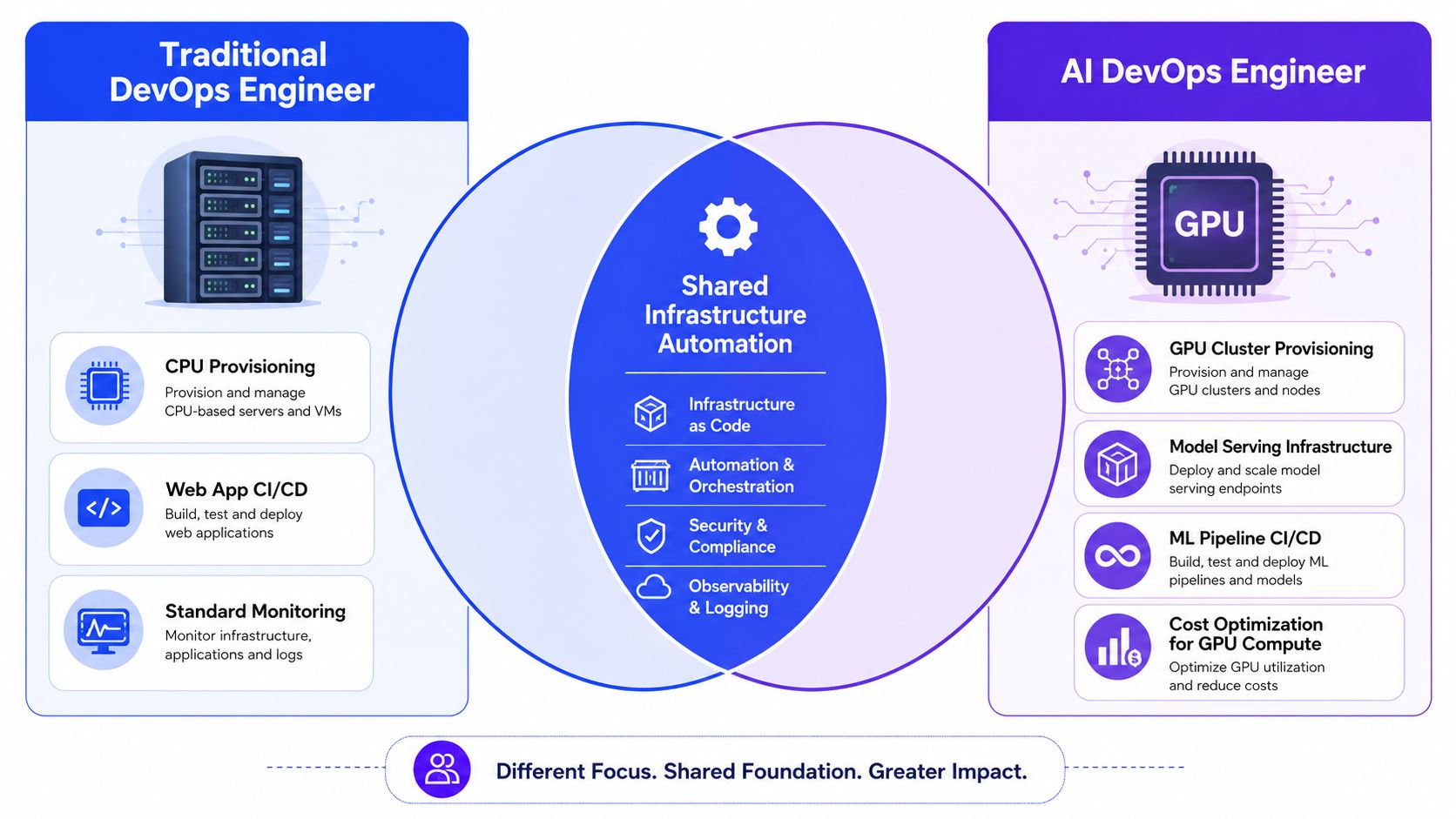
The distinction matters because AI workloads stress infrastructure differently from ordinary web applications. A standard DevOps engineer may focus on CPU-based services, microservice deployment, application CI/CD, and uptime monitoring. An AI DevOps engineer must also account for GPU scheduling, large model artifacts, high-throughput data access, inference latency, and the operational cost of specialized compute.
MLOps overlaps with this work but has a different center of gravity. MLOps usually emphasizes the model lifecycle, experiment tracking, dataset and feature pipelines, evaluation, registries, and retraining workflows. AI DevOps emphasizes the platform those workflows run on. In smaller teams, one person may cover both disciplines. In larger teams, separating ownership prevents every production problem from becoming “the ML team's issue.”
Draw the ownership boundary before you hire
Use this simple test:
- Traditional DevOps: owns general cloud infrastructure, application delivery, service networking, secrets, and conventional monitoring.
- MLOps: owns model lifecycle workflows, experiment tracking, data and feature operations, evaluation, and retraining.
- AI DevOps: owns GPU infrastructure, workload orchestration, model-serving platforms, AI-specific CI/CD, capacity planning, and operational guardrails.
The boundary should follow the failure mode. If the issue is a failed training run because the dataset is invalid, MLOps or data engineering should lead. If the issue is GPU nodes failing to scale or inference pods being scheduled onto unsuitable hardware, AI DevOps should lead.
MLOps has become a major market, with global estimates ranging from USD 2.19 billion in 2024 to USD 4.39 billion in 2025, and projections as high as USD 16.61 billion by 2030 and USD 89.91 billion by 2034, depending on the research firm and forecast horizon, as summarized by Research Intelo's MLOps market analysis. That expansion reflects a practical shift. Teams now need people who can industrialize model deployment, monitoring, and governance rather than treating production AI as an experiment.
If your team needs a clear baseline for a conventional DevOps title, you can find DevOps engineer templates with Talantrix and then add the AI-specific ownership areas above. For a deeper comparison of platform responsibilities, review DevOps for machine learning.
Core Responsibilities and Daily Work
The job is operational, not theoretical. An AI DevOps engineer spends the day improving the path from available compute to reliable inference or training.
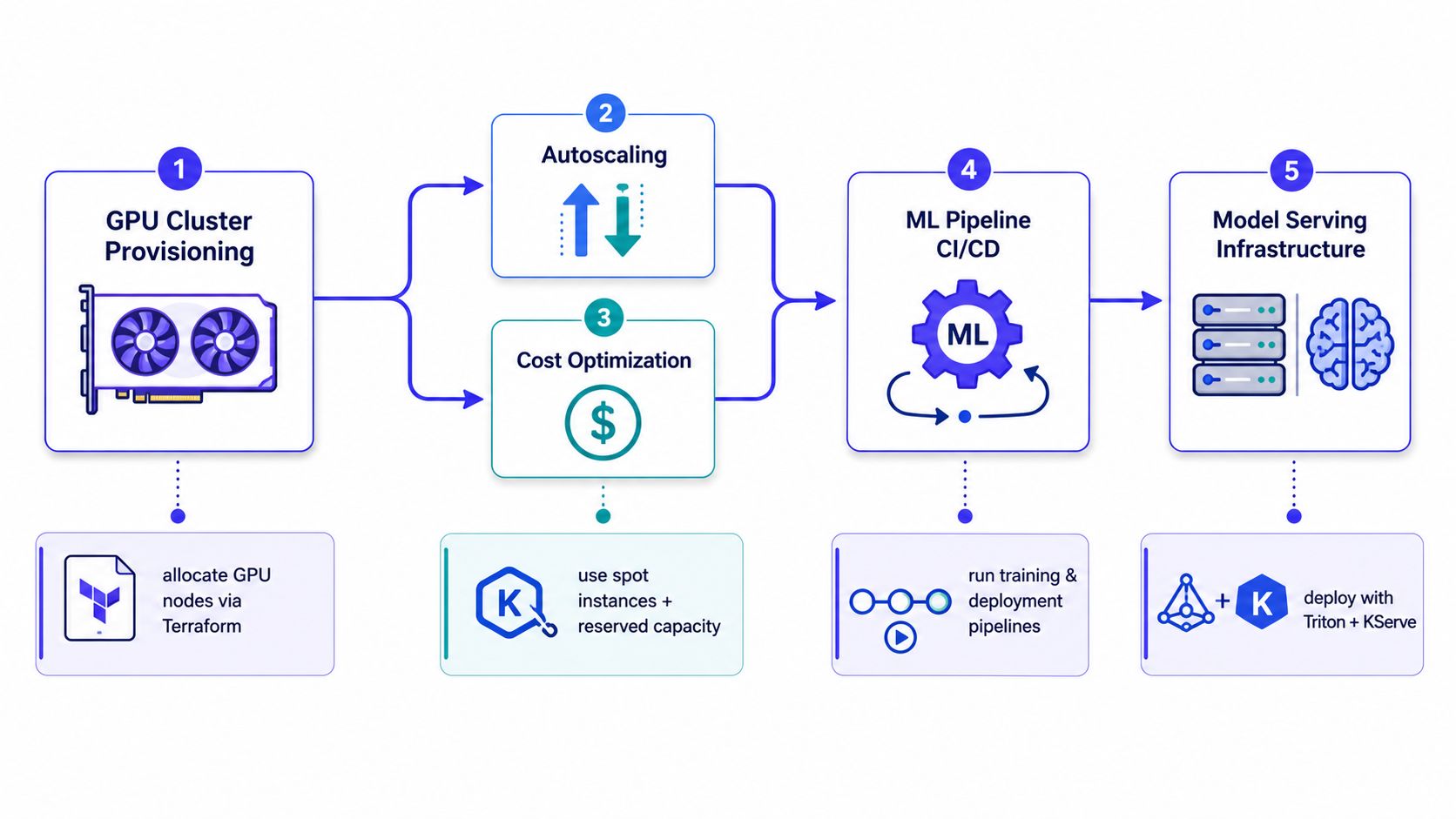
GPU infrastructure is usually the most visible responsibility. The engineer provisions GPU nodes through Terraform or Pulumi, configures Kubernetes scheduling, maintains GPU operators and drivers, and designs autoscaling policies for workloads with different resource profiles. They also plan for bursts, such as a large training run, without leaving expensive capacity idle after the workload ends.
Cost control belongs in the design, not in a finance review after the fact. The engineer can separate on-demand capacity from interruptible workloads, use queues for flexible training jobs, and establish resource policies that stop teams from requesting GPUs without a clear utilization plan. The correct choice depends on interruption tolerance, latency requirements, data locality, and compliance constraints.
Delivery and serving ownership
The delivery pipeline must treat models as production artifacts. That means building serving containers, storing large model weights in an appropriate registry or artifact system, validating images and dependencies, and promoting versions through controlled environments. A capable engineer can implement canary releases for inference services so a new model or runtime is exposed gradually while the team watches behavior.
Serving infrastructure adds another layer of operational detail. The engineer may deploy Triton or KServe, configure batching and concurrency, define resource requests, and connect the service to authentication, rate limits, and rollback automation. They should also make model versions visible to the incident responder. If an endpoint degrades, the team needs to know which image, model artifact, prompt configuration, and infrastructure change reached production.
Observability and security
Uptime alone is an inadequate signal for AI systems. The monitoring loop should collect, aggregate, compare, alert, and investigate. Production AI and large language model operations should track inputs, outputs, latency, token usage, refusal or error rates, and quality scores, then compare rolling windows with a stable baseline, as described in AWS guidance on production monitoring and drift.
A practical scorecard includes:
- Infrastructure health: GPU utilization, node health, queue depth, memory pressure, and serving saturation.
- Service behavior: latency percentiles, throughput, error rates, and availability.
- Model behavior: drift indicators, quality scores, refusal patterns, and output anomalies.
- Unit economics: cost per prediction or request, idle capacity, and workload-level resource consumption.
Security work includes restricting access to training data, isolating workloads, protecting model endpoints, rotating secrets, scanning containers, and logging administrative actions. The engineer should also define capacity limits and failure behavior before the first traffic spike arrives.
Technical and Domain Skills by Seniority Level
Hiring managers often confuse tool exposure with operating ability. Listing Kubernetes, Terraform, Prometheus, and a cloud provider tells you very little unless you test whether the candidate can use those tools to make a production system reproducible and recoverable.
The matrix below separates execution from ownership.
| Skill Area | Junior | Mid-Level | Senior |
|---|---|---|---|
| Linux, networking, and containers | Debugs processes, networking, images, and basic runtime failures | Troubleshoots production container and network issues independently | Sets platform standards, isolation patterns, and failure policies |
| Kubernetes and GPU operations | Understands pods, deployments, scheduling, and basic GPU concepts | Operates GPU clusters, GPU operators, node pools, and autoscaling | Designs multi-region or hybrid platform architecture and capacity strategy |
| Infrastructure as code | Modifies existing Terraform or Pulumi modules safely | Builds reusable modules and manages environment promotion | Defines platform composition, governance, and build-versus-buy direction |
| CI/CD | Maintains pipeline steps and artifact handling | Designs training and serving promotion workflows | Establishes organization-wide release controls, rollback, and policy gates |
| Model serving | Understands endpoints, containers, and basic runtime health | Operates Triton, TorchServe, or KServe deployments | Chooses serving architecture based on latency, throughput, cost, and risk |
| Observability | Adds dashboards and alerts from established patterns | Correlates GPU, service, and model signals during incidents | Defines service-level objectives, risk indicators, and executive reporting |
| AI domain knowledge | Understands inference, training, model artifacts, and basic drift | Works fluently with registries, distributed workloads, and evaluation gates | Shapes platform strategy across model types, teams, regions, and compliance needs |
| Leadership | Documents work and escalates clearly | Owns production improvements from design through operation | Mentors engineers, leads planning, and resolves cross-functional trade-offs |
The promotion inflection points
A junior engineer follows established runbooks and learns how AI workloads differ from ordinary services. They don't need to design a platform, but they must have strong Linux, networking, and container fundamentals.
A mid-level engineer can own a production cluster and deployment pipeline without constant supervision. They should explain why a workload needs a particular scheduling policy, how a rollback works, and which signal would distinguish an infrastructure failure from a model regression.
A senior engineer changes the operating model. They plan capacity, choose between managed and self-operated components, create standards for multiple teams, and make trade-offs visible to finance, security, product, and engineering leadership. If a candidate only names tools but can't explain those decisions, they aren't senior.
How to Interview and Evaluate Candidates
Most interviews for this role test the wrong person. They assess generic DevOps commands or ask ML theory questions that never reveal whether the candidate can operate an AI platform during an incident.
Start with a narrow job description. Your must-have list should include Kubernetes operations, infrastructure as code, cloud or on-premise GPU experience, CI/CD, observability, security, and incident response. Put model training theory, feature stores, and research frameworks in the collaboration or nice-to-have section unless the role explicitly owns them.
A usable opening might read:
Role mission: Build and operate the infrastructure that delivers reliable training and inference workloads.
Must own: GPU clusters, Kubernetes scheduling, model-serving deployment, infrastructure as code, release automation, observability, security, and capacity planning.
Works with: ML engineers on packaging and evaluation, data engineers on data access, and product teams on reliability and cost requirements.
Ask questions that expose judgment
Use scenario questions rather than trivia.
- Infrastructure design: “Design a GPU cluster for a mix of scheduled training and latency-sensitive inference. How would you separate capacity, scheduling, scaling, and failure domains?”
- Pipeline reliability: “A new model passes evaluation but fails after deployment because its runtime dependencies differ from the serving environment. Where would you add controls?”
- Version management: “How would you connect model version, container image, configuration, and rollback state?”
- Incident response: “Inference latency rises while node health remains normal. What signals do you inspect first?”
- Governance: “What baseline metrics would you define before release, and how would you document production differences?”
NIST guidance supports this baseline approach. The NIST AI RMF Playbook says teams should monitor and document how production metrics and performance indicators differ from pre-deployment measurements. The NIST AI RMF Measure guidance also recommends hypothesis testing or domain expertise for distribution differences, along with control limits, confidence intervals, integrity constraints, and machine learning methods for anomaly monitoring.
| Dimension | Score 1 (Weak) | Score 3 (Strong) | Score 4 (Exceptional) |
|---|---|---|---|
| Infrastructure depth | Names cloud services but can't reason about scheduling or failure | Designs reproducible GPU and Kubernetes environments | Balances reliability, capacity, security, and cost across boundaries |
| ML pipeline fluency | Treats models like ordinary application binaries | Understands packaging, registries, evaluation gates, and rollback | Connects model lifecycle controls to platform architecture |
| Observability mindset | Watches uptime only | Tracks infrastructure, serving, and model signals | Builds baseline-driven detection and clear incident workflows |
| Automation instinct | Prefers manual fixes | Automates repeatable provisioning and releases | Creates safe self-service with policy and human approval where needed |
| Communication clarity | Gives tool-centric answers | Explains trade-offs and ownership | Aligns technical decisions with risk, cost, and business outcomes |
Score independently before the panel discusses the candidate. For broader AI hiring calibration, use AI engineer hiring guidance alongside this rubric.
Red flags include a traditional DevOps candidate who has never handled model artifacts or GPU scheduling, and an ML engineer who can train models but can't explain access control, rollback, alert ownership, or production debugging. A polished tool list isn't evidence of operational maturity.
Compensation Benchmarks and Hiring Alternatives
The market data supports strong demand for the underlying discipline. In 2025, platforms accounted for 64.23% of the MLOps market, BFSI represented 22.11% of revenue, cloud deployment held 61.2% of the deployment segment, and North America held roughly 34.22% to 38.5% regional share across major reports, as summarized by Mordor Intelligence's MLOps market research. Those figures point to where this role creates value, cloud-native platforms, regulated workloads, and production systems, but they don't provide a defensible salary number. Compensation varies by geography, employment model, scope, and seniority, so don't copy a generic benchmark into your budget.
Use the operating problem to choose the hiring model.
| Hiring Model | Cost Range | Best For | Key Trade-off |
|---|---|---|---|
| Full-time AI DevOps engineer | Set through your market and level | Ongoing platform ownership and incidents | Higher fixed commitment, stronger continuity |
| Senior DevOps engineer with AI scope | Existing compensation structure | Smaller workload with limited model complexity | AI responsibilities may compete with core platform work |
| Fractional specialist | Contract-defined | Architecture, stabilization, and urgent gaps | Requires a clear handoff plan |
| Contract to hire | Contract-defined | Teams still validating long-term role scope | Conversion expectations must be explicit |
| Managed MLOps platform | Vendor-defined | Standardized workflows and fast initial setup | Less control and potential platform constraints |
Decide with three operational signals
Hire full-time when the team deploys models regularly, runs meaningful GPU infrastructure, supports multiple production endpoints, or needs someone accountable for on-call and platform standards. A senior DevOps engineer can absorb the work when AI workloads remain limited, serving is simple, and the team already has strong automation practices.
Choose fractional support when the immediate need is architecture, cluster setup, observability design, or a migration plan. Convert that arrangement into a permanent role when the same incidents recur, ML teams wait on infrastructure changes, releases depend on one specialist, or no one owns capacity and reliability decisions.
For broader context on compensation planning, compare the role with AI engineering salary guidance. Treat any benchmark as an input to a role design conversation, not as a substitute for one.
Onboarding Checklist for the First 90 Days
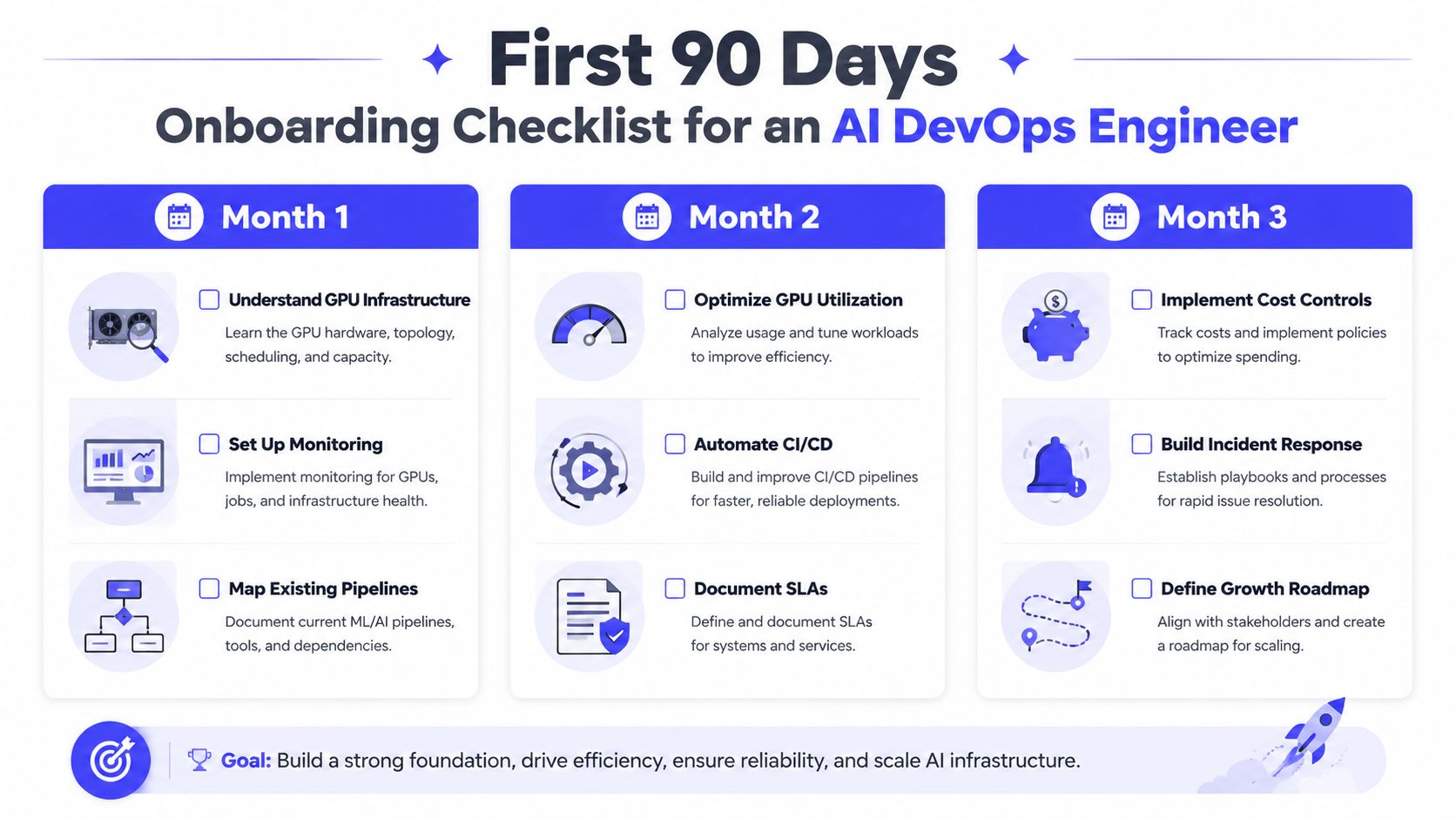
A new hire needs production context quickly. Withholding all access for too long forces them to optimize documentation or low-value tickets while the risks remain invisible. Give them controlled, audited access, pair them with an experienced engineer, and define outcomes before their first day.
Days 1–14
The first phase is discovery and access.
- Understand the platform: Review cloud accounts, Kubernetes clusters, GPU node pools, storage, networking, secrets, and deployment environments.
- Map the workflows: Trace one training pipeline and one inference path from source commit to production behavior.
- Shadow operations: Join on-call reviews, incident walkthroughs, release reviews, and meetings with ML, data, security, and finance stakeholders.
- Document risk: Produce a short inventory of brittle dependencies, manual steps, missing alerts, and unclear ownership.
The manager should evaluate whether the engineer can describe the system and identify the most consequential operational gaps. Don't reward a long document. Reward accurate priorities.
Days 15–45
The engineer should own one bounded improvement with a measurable operational outcome. Good projects include adding model-serving observability, automating a manual deployment step, improving artifact traceability, or tightening GPU scheduling policies.
Require a design note, implementation plan, reviewable changes, a rollback path, and a handoff document. The engineer should also demonstrate the change during a controlled release or incident simulation. NIST frames AI risk management as continuous, with responses monitored regularly under the framework's Manage function, as summarized in NIST AI risk management guidance.
Days 46–90
The final phase tests leadership across team boundaries.
- Lead one cross-functional initiative: Examples include moving a training workflow to a new orchestrator or defining inference reliability objectives.
- Establish operating controls: Assign alert ownership, escalation paths, review cadence, and documentation standards.
- Present a roadmap: Explain what to fix next, what to defer, and which trade-offs affect reliability, cost, security, or delivery speed.
- Create reusable artifacts: Leave behind runbooks, dashboards, pipeline templates, and an infrastructure backlog with owners.
Avoid assigning generic tickets that could go to any DevOps engineer. The new hire should work on the AI platform's highest-risk constraint, not merely the most familiar task.
Next Steps to Build Your AI Infrastructure Team
Before you post the role, make three decisions.
First, identify the actual gap. If your team needs GPU provisioning, serving reliability, infrastructure automation, and AI-specific operations, hire an AI DevOps engineer. If the problem is experiment tracking, data lineage, feature pipelines, evaluation, and retraining, hire an MLOps specialist. If both problems exist, define the split before interviews begin.
Second, choose the engagement model. A full-time hire fits recurring platform ownership. Fractional or contract-to-hire support fits an urgent architecture gap, an unstable platform, or a team still validating its long-term scope. Managed tooling can defer some platform work, but it won't remove the need for clear ownership, incident response, and governance.
Third, calibrate the panel. Audit the current infrastructure, write a role description around the failure modes you need to prevent, and score every interviewer against the same evaluation rubric.
The cost of a mis-hire appears in delayed deployments, fragile training pipelines, unclear incident ownership, and infrastructure decisions that no one revisits. Download the companion checklist, run a platform-gap review, and schedule a calibration session before you start screening candidates.
ThirstySprout helps companies source remote AI, MLOps, DevOps, cloud, and data engineering talent for full-time, contract, or fractional engagements. Visit ThirstySprout to discuss your AI infrastructure requirements and build a focused hiring plan around your stack, workload, and operating model.
Hire from the Top 1% Talent Network
Ready to accelerate your hiring or scale your company with our top-tier technical talent? Let's chat.