

AI code generation can increase output while making delivery slower. In an early-2025 study of experienced open-source developers, allowing AI tools made task completion 19% longer, even though developers later believed the tools had made them 20% faster. METR's study is a useful warning: perceived speed and measured throughput aren't the same thing.
The right question isn't whether an AI assistant can write code. It can. The question is whether your team can verify, secure, maintain, and operate the code quickly enough to convert generated output into shipped value.
This guide treats AI code generation as a throughput-versus-verification trade-off. You'll learn what the tools do, where productivity gains hold up, why security debt deserves executive attention, how to measure return on investment, and what to change in hiring and team design during the first 90 days.
What AI Code Generation Actually Does
AI code generation is best understood as high-speed candidate generation, not autonomous software engineering. The model predicts code from the context it receives, including your prompt, nearby files, editor state, repository patterns, and sometimes terminal or version-control output. It can produce something that compiles while still violating a business rule, mishandling an edge case, or creating a security problem.
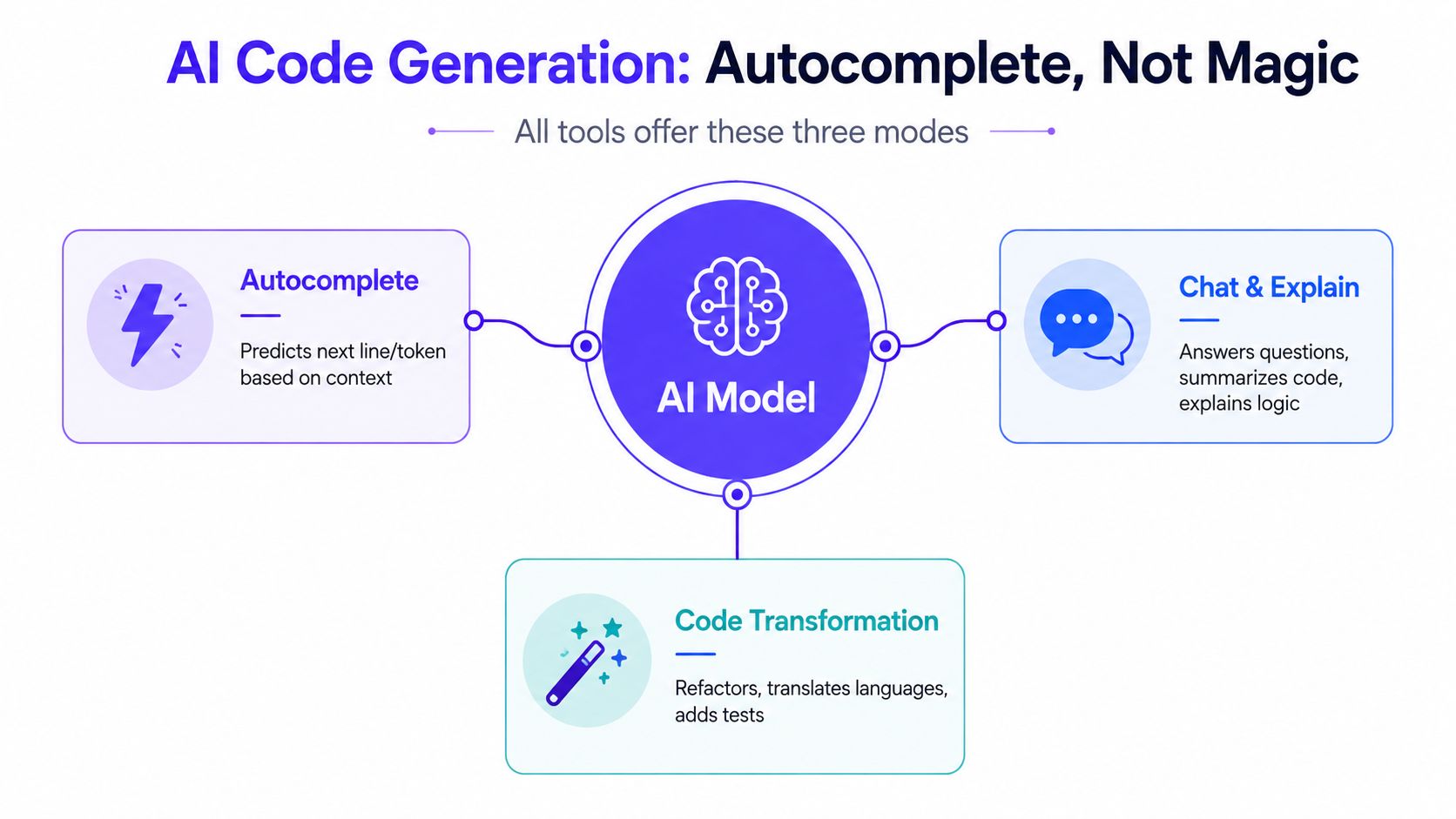
Most products expose three functional modes.
Autocomplete predicts the next token, line, or block. You might start a React hook and receive the state logic, dependency array, and return value. This mode is fast because the developer supplies much of the context through the active file.
Chat and explanation accepts a natural-language request. You could ask for a SQL migration based on a schema comment, request an explanation of a payment handler, or ask for unit-test cases around an existing function. The output is broader, but quality depends heavily on the model's understanding of local conventions and requirements.
Transformation changes existing code. An agent may refactor a payment handler across several files, translate a utility from one language to another, update imports, and add tests. The blast radius grows. A useful transformation requires repository context, clear constraints, and a review process that can inspect every changed file.
Compilation is not correctness
A successful build answers a narrow question: does the code satisfy the compiler or interpreter? It doesn't answer whether authorization works for every tenant, whether a retry can duplicate a charge, or whether a migration preserves data under rollback.
That distinction should shape your workflow:
- Define the contract before prompting.
- Ask the tool for a small, reviewable change.
- Generate tests beside the implementation.
- Run static analysis, dependency checks, and integration tests.
- Review intent, edge cases, and failure paths yourself.
For a broader introduction to AI-assisted product delivery, Refact's software development guide provides useful context. The operating mental model is simple: AI generates candidate code quickly. Humans own the contract, the edge cases, and the production blast radius.
The Core Models and Techniques Behind the Tools
AI code-generation products such as GitHub Copilot, Cursor, and Codeium use transformer-based large language models trained on code and natural-language data. A base model learns statistical relationships between tokens. Fine-tuning on instruction-response examples improves its response to developer requests, while reinforcement learning from human feedback, or RLHF, aligns outputs with expected behavior.
The model is only one part of the system. Tool quality depends heavily on context and verification.
A completion system can draw from the active file, open tabs, repository search, symbol definitions, dependency metadata, and version-control history. Retrieval-augmented generation, or RAG, selects relevant repository material and adds it to the model's working context. A smaller code-specialized model with strong retrieval can outperform a larger general-purpose model that cannot see local conventions or dependencies.
| Model family | Training focus | Best suited for |
|---|---|---|
| General-purpose language models | Broad natural language, reasoning, and programming patterns | Design discussion, documentation, explanations, and mixed technical tasks |
| Code-specialized models | Source code, programming languages, repositories, and developer workflows | Inline completion, boilerplate, test scaffolding, and code translation |
| Instruction-tuned models | Following explicit developer requests and structured output requirements | Chat-driven generation, review checklists, and constrained transformations |
| Agent-oriented systems | Tool use, multi-turn planning, repository operations, and test execution | Cross-file edits, debugging loops, and implementation tasks with verification |
Context quality beats model size
Code is relational. A function depends on types, interfaces, configuration, tests, database assumptions, and conventions that may sit far from the current cursor. Repository-level embeddings help tools locate those relationships. Fill-in-the-middle training helps models complete code when both preceding and following context matter.
Agent loops add execution, not correctness. The system can inspect files, propose a change, run tests, read failures, and revise the patch. That process can raise throughput, but it also creates verification work and security debt if permissions, time limits, sandboxing, and stop conditions are missing.
Teams should evaluate prompt design, retrieval, fine-tuning, and tool orchestration separately. The guide to AI customization methods compares those approaches. For the underlying model concepts, read this large language model overview. In week one, test each approach against representative repository tasks, then measure review effort, failed tests, and security findings alongside generated output.
How Teams Use AI Code Generation Day to Day
AI code generation should increase throughput without weakening verification. A five-person startup backend team should begin with a controlled workflow around small, frequent decisions, not an autonomous agent that can rewrite the repository.
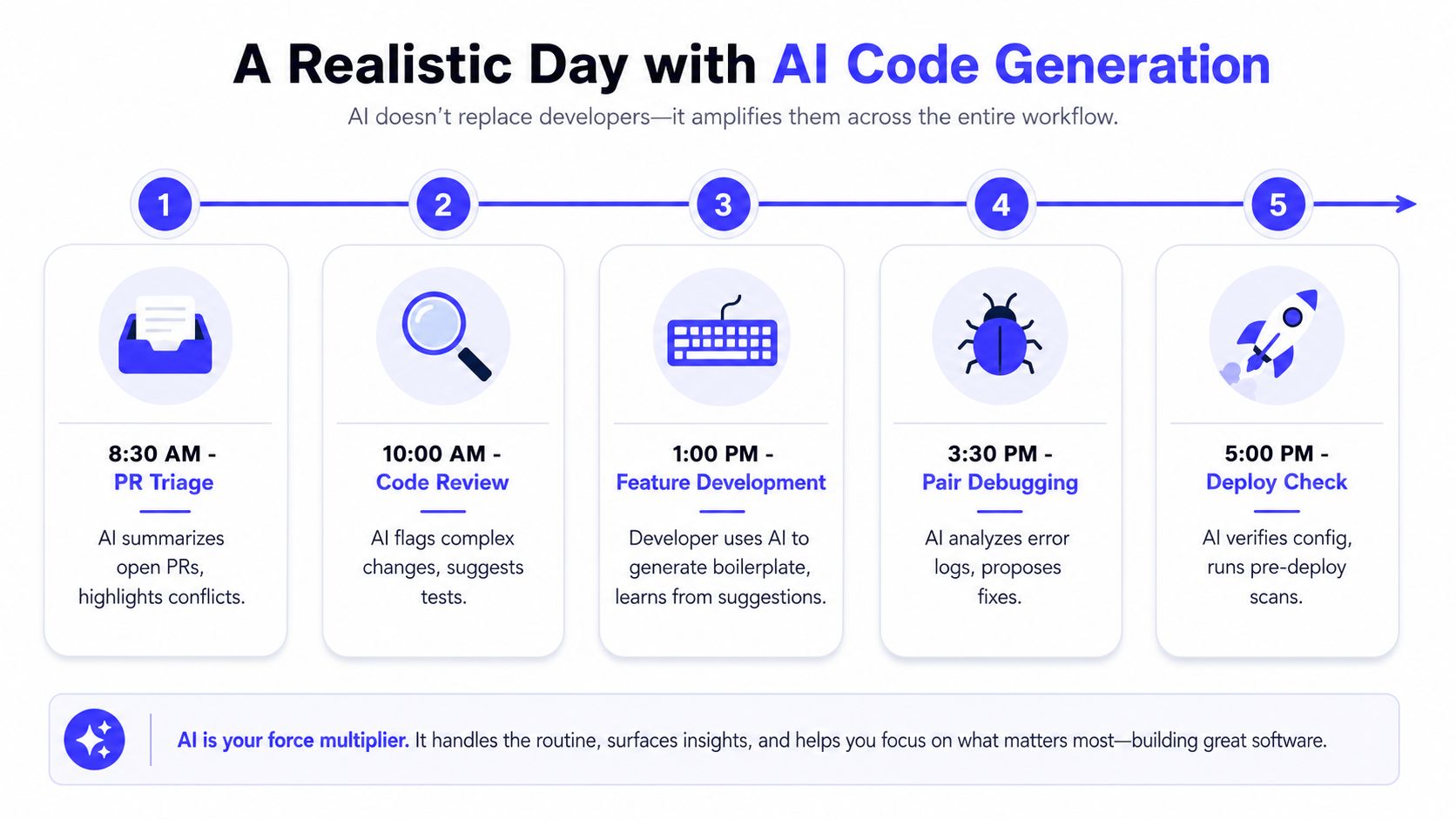
At 8:30 a.m., an engineer asks an assistant to summarize open pull requests, identify changed dependencies, and highlight conflicts. The summary reduces reading time, but the engineer still opens each diff and checks for missed behavior changes. That review step protects against plausible summaries hiding security debt or an incomplete change.
At 10:00 a.m., review focuses on system risk. The assistant suggests tests for a new billing path, while the reviewer checks idempotency, authorization, and error handling. Those checks depend on repository and product knowledge, not code completion.
At 1:00 p.m., the team uses inline completion for repetitive handlers, CRUD endpoints, serializers, and Terraform modules. Developers accept small suggestions and keep each change close to the feature contract. This is the right trade-off early on: gain speed where verification is cheap, and keep humans responsible for behavior and boundaries.
The afternoon is where verification matters
At 3:30 p.m., an engineer provides an error log and the relevant function. The tool proposes a fix, states its assumptions, and generates a regression test. The engineer reproduces the failure before accepting the patch.
At 5:00 p.m., deployment checks validate configuration, run tests, and execute security scans. The assistant can explain a failed check. It should not bypass a gate because generated code looks plausible.
A practical toolchain includes:
- Editor completion: Local patterns, repetitive code, and small functions.
- Chat side panels: Explanations, test design, and guided refactoring.
- Terminal assistants: Commands and diagnostics, with restricted execution.
- Pull request bots: Summaries and review prompts, never final approval.
Adoption also needs a shared operating policy. One engineer may write detailed prompts, another accept broad changes, and a third reject the tool, producing mixed style, unclear provenance, and a review queue that grows faster than implementation capacity. Set repository instructions, a shared prompt pattern, and explicit approval boundaries in week one. This prompt engineering guide provides a practical starting point.
The Productivity Claim and Where It Breaks Down
The strongest evidence supports a narrower claim than most marketing pages make. AI code generation can improve throughput in the right task and environment, but the result depends on developer experience, repository familiarity, task type, and verification overhead.
A randomized study across 4,867 developers found a 26.08% increase in completed tasks for developers using the tool, with the result measured through variable-based regression. The study supports a causal interpretation, but it doesn't mean every task or team receives the same gain.
Other evidence points in different directions. A 2024 study reported up to 50% time saved in documentation and autocompletion, 30–40% savings in repetitive coding, test generation, debugging, and pair programming, and a projected 33–36% reduction in coding-related task time. The study summary describes measured task categories, not a universal improvement in shipped product velocity.
| Study or source | Headline claim | What was measured | Where it breaks down |
|---|---|---|---|
| Randomized developer trial | 26.08% more completed tasks | Task completion across 4,867 developers | Results depend on repository familiarity and task mix |
| 2024 real-world project study | Up to 50% savings in selected activities | Documentation, autocomplete, repetitive coding, testing, debugging, and pairing | Selected activities aren't the same as end-to-end delivery |
| METR field study | Tasks took 19% longer | Experienced open-source developers working with AI available | A different population and workflow can reverse the result |
| Stack Overflow 2025 survey | Broad adoption of AI tools | Reported use and planned use | Adoption doesn't prove quality or net productivity |
Measure shipped outcomes, not suggestion volume
Acceptance rate and lines of code are weak management metrics. A developer can accept many suggestions and still create more review work, defects, or operational burden. PRs merged safely, change failure, escaped defects, and feature lead time are closer to business value.
The review burden is real. Stack Overflow's 2025 survey found that 45% of respondents considered debugging AI-generated code time-consuming, while 66% reported that outputs were often “almost right, but not quite.” The survey results explain why a faster first draft can produce a slower release.
Use AI tools to boost productivity with AI tools, but define productivity as verified delivery, not generated volume. Your verification budget has to grow with the amount of code you ask the team to produce.
Security, Safety, and the Hidden Cost of Generated Code
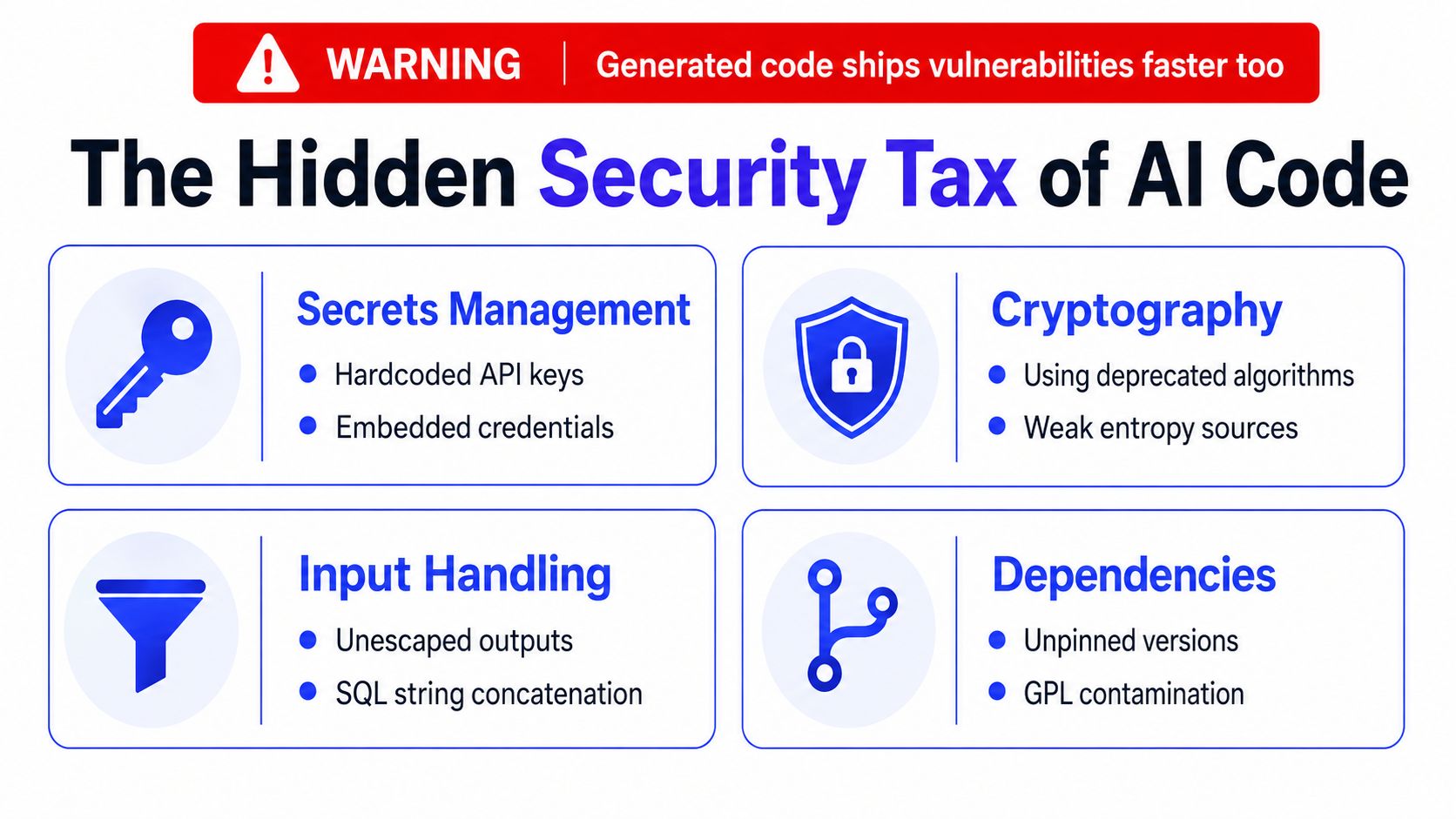
Generated code carries a security tax because it can reproduce unsafe patterns at production speed. The most important risk isn't that an assistant occasionally writes an obvious vulnerability. It's that a plausible implementation passes a hurried review and creates security debt.
Independent 2025 research found known security flaws in 45% of tested tasks across more than 100 models. Other research reported vulnerability rates from 12% to 62%, depending on methodology and language. Veracode's research coverage shows why teams should treat these findings as a risk signal rather than a universal defect rate.
Ship these guardrails in week one
- Block secrets early: Run secret scanning before commits and in continuous integration. Never paste production credentials into a prompt.
- Pin dependencies: Require approved versions and review new packages for provenance, maintenance, and licensing.
- Sandbox execution: Treat generated shell commands, SQL, migrations, and infrastructure changes as untrusted until reviewed.
- Review sensitive paths manually: Authentication, authorization, payments, cryptography, identity, and personal data need a human owner.
- Set a data policy: State what source code, logs, customer data, and proprietary prompts may enter each tool.
- Preserve provenance: Record whether an artifact was generated, transformed, or merely explained by an AI system.
Static application security testing, or SAST, and software composition analysis, or SCA, remain useful. They don't replace reasoning about intent, tenant isolation, business authorization, or whether a sequence of individually valid operations creates an unsafe state.
Watch compliance obligations as part of tool selection. SOC 2 and HIPAA controls can affect access, logging, retention, and data handling. The EU AI Act may also matter depending on the system and use case. These aren't reasons to ban AI code generation. They're reasons to make its boundaries explicit.
This AI security best-practices guide can help turn those controls into an engineering checklist.
Measuring ROI and Productivity Metrics That Matter
Don't approve an AI coding budget because developers accept more completions. Approve it when the team ships valuable changes with acceptable quality and lower operational friction.
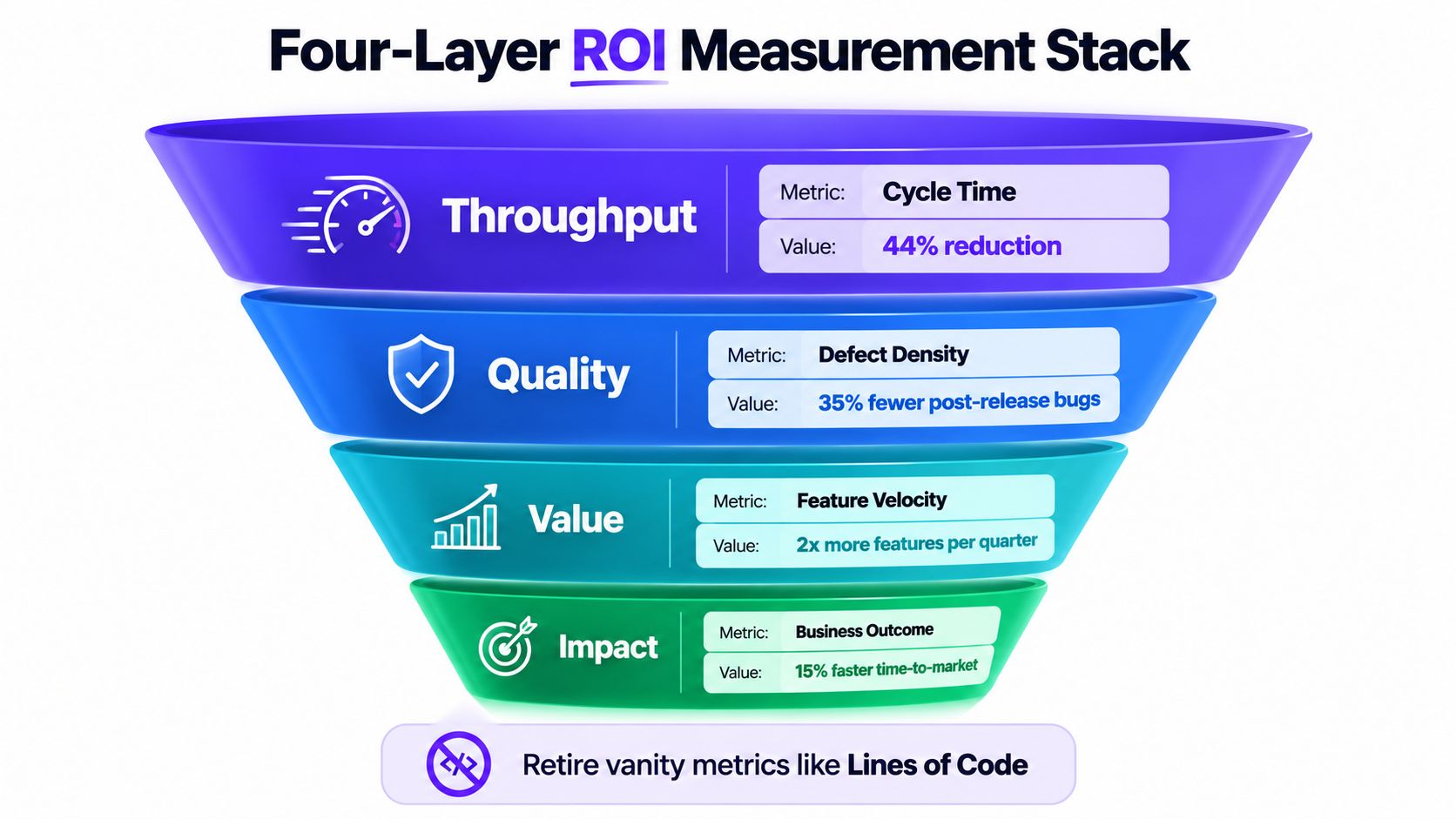
Use a four-layer measurement stack.
Throughput
Track cycle time, PRs merged per engineer, time from first commit to review, and time from approval to deployment. Compare similar repositories and task types. A simple baseline tells you whether the tool changes delivery or merely changes where effort appears.
Quality
Track escaped defects, change failure rate, rollback and revert activity, security findings, and post-release incidents. If throughput rises while these measures worsen, the tool isn't producing a healthy return.
Developer experience
Ask whether engineers spend less time on repetitive work and more time on design, debugging, and customer-facing improvements. Track interruption cost, review fatigue, and whether new hires can understand the codebase without accepting generated explanations blindly.
Business impact
Connect engineering measures to feature lead time, time to first meaningful PR for new hires, on-call burden, and customer commitments. The board cares about reliable delivery and business outcomes, not completion counts.
Run a clean rollout
Before enabling a tool for everyone, capture a control period of 4 weeks and compare matched cohorts by repository, language, and task category. The empirical study on AI-assisted productivity and security is a useful reminder that productivity gains can coexist with a 23.7% increase in introduced security vulnerabilities.
Avoid Goodhart's law. If you reward acceptance rate, developers will accept more suggestions. If you reward lines changed, the repository will contain more lines. Set a small scorecard instead:
| Area | Leading signal | Decision rule |
|---|---|---|
| Throughput | Shorter cycle time without larger PRs | Continue the pilot if quality remains stable |
| Quality | Stable or improving escaped-defect and failure measures | Add guardrails if defects rise |
| Experience | Less repetitive work and manageable review effort | Retrain or narrow workflows if review fatigue grows |
| Business | Faster feature delivery without more on-call burden | Expand only when customer value improves |
Hiring, Team Shapes, and What to Do Next
AI code generation changes what strong engineers do, but it doesn't remove the need for engineering judgment. Syntax recall matters less than the ability to define interfaces, interrogate assumptions, review unfamiliar code, and recognize when a polished answer is wrong.
Use interviews that test those skills. Ask the candidate to critique an AI-generated authentication patch with a hidden authorization flaw. Ask how they'd constrain an agent before granting repository access. Give them a small transformation task and evaluate the questions they ask before they write code.
Three team shapes that work
Small startup: Two senior engineers use AI for scaffolding, tests, documentation, and repetitive integrations. They don't replace missing architectural ownership. The risk is concentrated review capacity, so security-sensitive changes need explicit sign-off.
Scaleup product squads: Each squad has an AI champion who maintains prompt patterns, collects failure examples, and helps reviewers calibrate. A platform group manages approved tools, access, logging, and repository context.
Platform-led organization: A dedicated platform team owns shared instructions, guardrails, evaluation harnesses, model routing, and CI integration. Product engineers consume a paved path instead of inventing a separate workflow for every repository.
A 30-60-90 day adoption plan
- First 30 days: Pilot one workflow, such as test scaffolding or internal CRUD endpoints. Define prohibited data, require normal CI, and record baseline delivery and quality measures.
- By 60 days: Train reviewers on authorization gaps, dependency mistakes, error-path omissions, and unsafe generated commands. Compare matched teams and remove workflows that add review cost without improving delivery.
- By 90 days: Formalize the usage policy, publish approved patterns, establish ownership for evaluations, and decide whether to expand, narrow, or stop the program.
Don't respond to AI adoption by cutting junior developers blindly. Juniors still provide a mentorship pipeline, but they need structured tasks, close review, and education about verification. Senior engineers, security specialists, developer-experience engineers, and machine learning engineers become more valuable because someone must design the system around generation, testing, governance, and operations.
Hire for skepticism with speed. The best engineer won't accept the first plausible answer. They'll use the tool aggressively, then prove that the result deserves to ship.
ThirstySprout helps startups and enterprise teams hire vetted remote AI engineers, machine learning engineers, MLOps specialists, data engineers, and AI product talent for production coding workflows. Visit ThirstySprout to discuss a focused pilot, or review the team shape you need before expanding AI code generation across your organization.
Hire from the Top 1% Talent Network
Ready to accelerate your hiring or scale your company with our top-tier technical talent? Let's chat.