

TL;DR
- Agile is what to build, DevOps is how you ship it. Agile focuses on iterative work and customer feedback. DevOps automates the path from code to customer.
- Merge them for speed and quality. The goal is a unified workflow where small, valuable changes from Agile sprints reach users quickly and safely through a DevOps pipeline.
- Start with DORA metrics. Measure what matters: Deployment Frequency, Lead Time for Changes, Mean Time to Recovery (MTTR), and Change Failure Rate. These numbers reveal your true engineering velocity and stability.
- Embed DevOps skills in Agile teams. Avoid creating a separate DevOps team, as it becomes another silo. Instead, build cross-functional teams where developers own their code in production ("you build it, you run it").
- Next step: Start a pilot. Pick one service or team and build a basic CI/CD pipeline. A small, measurable win in 2–4 weeks is the best way to get buy-in.
Who this is for
- CTO / Head of Engineering: You need to increase deployment speed without sacrificing stability, especially for new AI/ML features.
- Founder / Product Lead: You're frustrated that new features get stuck in a long release queue, delaying customer feedback and time-to-value.
- Technical Lead: You're tasked with merging Agile and DevOps practices but need a practical framework and a way to measure success.
Your Quick Guide to the Agile and DevOps Partnership
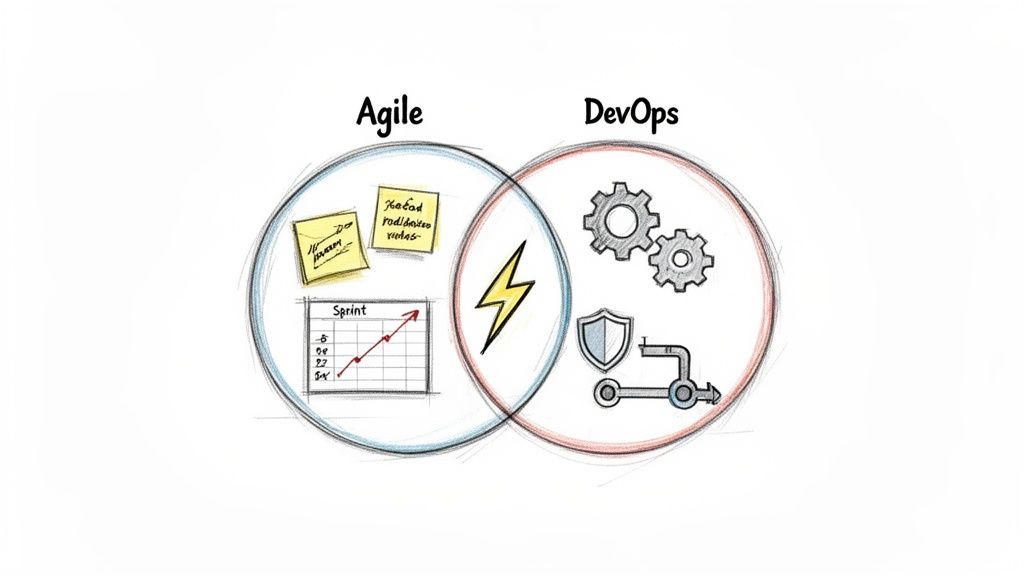
Alt text: Venn diagram illustrating the relationship between Agile and DevOps, highlighting key concepts.
For anyone leading an engineering or product team, grasping how agile development and DevOps complement each other is a game-changer. This is about breaking down the walls between "building the code" and "running the code" to create a single, unified workflow.
I've seen it play out countless times. An Agile team nails their two-week sprint, producing a fantastic new AI-driven feature. But without a solid DevOps culture, that code sits idle. It gets stuck waiting for manual handoffs and a high-stakes deployment that has everyone holding their breath.
With DevOps, the moment the sprint ends, that new feature is automatically integrated, tested, and rolled out. What took weeks now happens in hours. That's the difference.
Agile vs. DevOps: A Quick Comparison
To see their distinct roles more clearly, let's break them down. This table highlights what each methodology prioritizes.
| Aspect | Agile Development | DevOps |
|---|---|---|
| Core Focus | Managing complex work through iterative cycles and feedback. | Automating and integrating processes between development and operations. |
| Key Practices | Sprints, daily stand-ups, user stories, retrospectives. | CI/CD, Infrastructure as Code (IaC), automated testing, monitoring. |
| Primary Goal | Adapt to changing requirements and deliver customer value. | Deliver software faster, more reliably, and with higher quality. |
| Business Impact | Ensures you build the right thing. | Ensures you ship it quickly and safely. |
While Agile streamlines the creation of software in small pieces, DevOps builds the pipeline to deliver those pieces continuously.
Unifying Speed and Direction
Combining Agile and DevOps creates a powerful feedback loop across the entire product lifecycle. It ensures improvements from your Agile sprints reach users quickly. In turn, real-world data flows back into the next sprint planning session.
This integration directly impacts business outcomes:
- Faster Time-to-Value: Features go from idea to production in days or hours, not weeks.
- Improved Quality and Stability: Automated testing catches bugs early, reducing production incidents and recovery time.
- Increased Team Productivity: Engineers stop wasting time on manual handoffs and firefighting, freeing them to innovate.
The secret is a culture of shared ownership. When you adopt the "you build it, you run it" mantra, developers are responsible for their code in production. They naturally start writing more resilient and operable software.
While we're focusing on their synergy, our guide comparing Agile vs DevOps offers a more detailed breakdown of their differences.
A Unified Workflow: The Core Framework
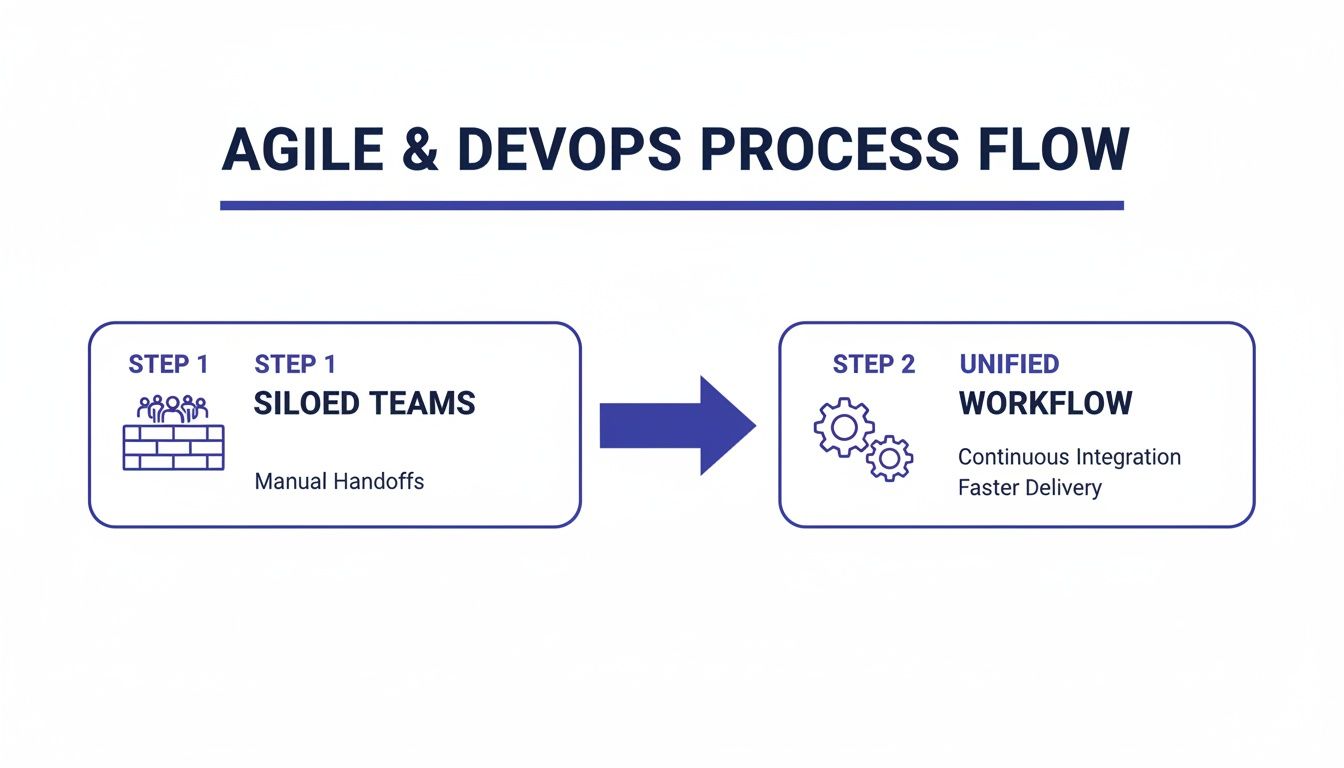
Alt text: Diagram illustrating Agile and DevOps process flow from siloed teams to unified workflow for faster delivery.
To achieve a true Agile-DevOps workflow, you need to implement four core practices that create a high-speed path to production.
- Build a Unified CI/CD Pipeline: The bedrock is a solid Continuous Integration/Continuous Delivery (CI/CD) pipeline. It's an automated assembly line that moves code from a developer’s laptop to users without manual intervention. For AI teams, this pipeline also manages model training, validation, and versioning.
- Adopt Trunk-Based Development: Have all engineers commit small, frequent changes directly to a single "main" branch. This makes integration a non-event that happens dozens of times a day, cutting down merge conflicts and keeping the codebase releasable.
- Implement a Layered Automated Testing Strategy: A fast pipeline is useless without a robust testing pyramid. This includes fast unit tests, integration tests for system components, and a few end-to-end (E2E) tests for critical user workflows. This is a key part of software development life cycle best practices.
- Create Fast Feedback Loops: Use observability tools (logging, metrics, tracing) to see how your application performs in real time. This hard data provides objective input for your next sprint, ensuring your team iterates based on real-world outcomes, not just assumptions.
Two Real-World Examples of Agile and DevOps in Action
Theory is great, but the real test is seeing how these ideas solve real business problems. Here’s how two different teams used Agile and DevOps to accelerate their work.
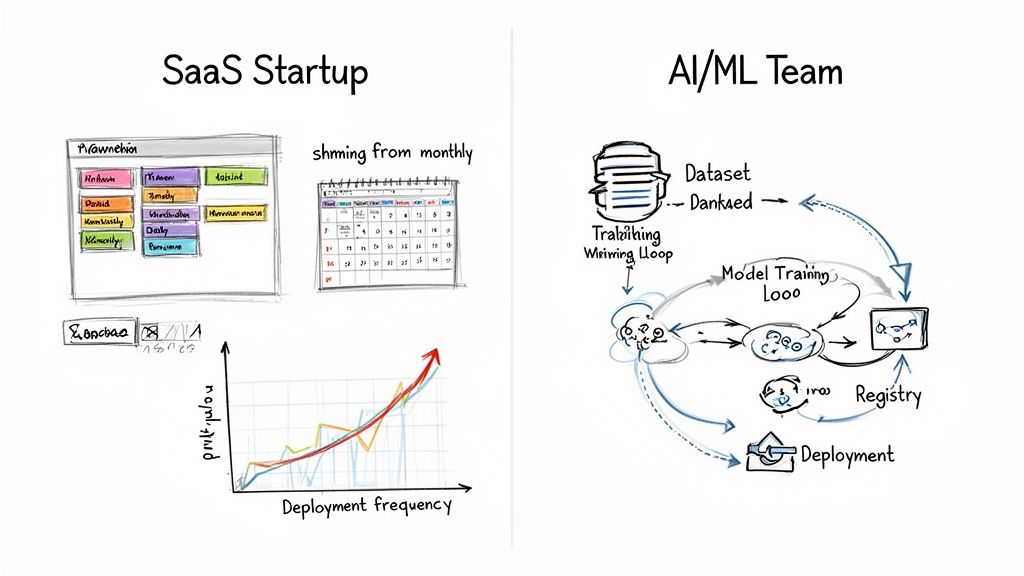
Alt text: A whiteboard sketch contrasting development practices for a SaaS startup with an AI/ML team workflow.
Example 1: SaaS Startup Overcoming Risky "Big Bang" Releases
Situation: A fintech startup was stuck in monthly cycles. Each release bundled a month's worth of changes, making it incredibly risky. A single bug could mean hours of frantic rollbacks, killing momentum and burning out the team.
Intervention:
- Agile Shift: They scrapped rigid monthly sprints for a fluid Kanban workflow. This encouraged smaller, more frequent commits focused on a continuous flow of finished work.
- DevOps Implementation: They built a CI/CD pipeline using GitLab. Every commit automatically triggered builds and tests. Passed changes were pushed to production behind a feature flag with a final manual approval.
Business Impact: Deployment frequency skyrocketed from monthly to multiple times per day. Production rollbacks dropped by over 80%. The team began shipping with confidence, not fear.
Example 2: MLOps Team Automating Model Deployment
Situation: An AI team building a recommendation engine struggled to get models from a Jupyter notebook to production. A model that performed well in research often failed in the real world due to data drift or scaling issues.
Intervention:
- Agile for Model Iteration: The team used two-week sprints to focus on specific model experiments, like testing a new feature or tuning hyperparameters.
- DevOps for Model Operations (MLOps): They built a pipeline with MLflow to automate the model lifecycle. The pipeline trained, validated, and logged performance metrics for every new model candidate. If the new model beat the production model on key metrics (like click-through rate), it was automatically registered and deployed.
This adoption is part of a larger trend. The state of Agile adoption shows a clear link between combining Agile planning with automated pipelines to shorten release cycles. This is why building effective cross-functional team building with these skills is a competitive advantage.
Deep Dive: Measuring Success and Avoiding Pitfalls
Merging Agile and DevOps is a cultural shift, not a one-time project. Success isn't "doing Agile"; it's shipping better software, faster. You need to prove that's happening with the right metrics and an awareness of common roadblocks.
The Gold Standard: DORA Metrics
The best engineering organizations track four DORA (DevOps Research and Assessment) metrics. They measure your team's speed and stability.
- Deployment Frequency: How often do you ship to production? Elite teams deploy on-demand.
- Lead Time for Changes: How long does it take a commit to get to production? Aim for hours, not weeks.
- Mean Time to Recovery (MTTR): How quickly can you fix a production failure? Top performers recover in under an hour.
- Change Failure Rate: What percentage of deployments cause a failure? The best teams keep this below 15%.
These four metrics create a natural tension that balances speed with stability. You can't just ship fast; you have to ship well.
Three Common Pitfalls (And How to Fix Them)
The 'Water-Scrum-Fall' Trap: The team uses Agile ceremonies (sprints, stand-ups) but still works in mini-waterfalls, throwing work "over the wall" to QA and then Ops.
- The Fix: Create a truly cross-functional team with end-to-end ownership. The same group writes, tests, deploys, and monitors the code. This forces collaboration and breaks the handoff mentality. For more on test strategy, see our guide on automating regression testing.
Toolchain Chaos: Every team chooses its own tools, creating a disconnected mess that makes it impossible to get a clear performance picture.
- The Fix: Establish a "paved road"—a standardized, integrated toolchain that is the easiest path for all teams. A dedicated platform engineering team can build and maintain this foundation.
Cultural Resistance: Developers say, "I'm not an Ops person." Operations teams distrust any deployment they didn't do by hand. No tool can fix a lack of buy-in.
- The Fix: Get executive sponsorship, but prove the value from the bottom up. Start with a pilot team and celebrate their wins publicly. Frame the shift as a way to eliminate tedious manual work and empower everyone.
- Assess Your Current State (30 mins): Use the scorecard above with your team to get a baseline. Find your single biggest bottleneck. This isn't about blame; it's about finding a clear, actionable starting point.
- Start Small With a Pilot Project (2–4 weeks): Pick a low-risk, high-visibility project, like building a simple CI pipeline for one microservice. A measurable win is the best internal marketing for driving broader adoption. As teams advance, they can explore topics like AI for DevOps.
- Hire for the Culture You Want: The surest way to infuse this thinking into your organization is to hire engineers who have lived it. Prioritize candidates who can point to specific, hands-on experience in automated, collaborative environments.
- Start a Pilot: Let's scope your project and match you with talent in days.
- See Sample Profiles: Review vetted MLOps and AI engineers from our network.
- Agile is the blueprint—deciding what to build and in what order.
- CI/CD is the automated factory—taking code and safely getting it to users.
- Agile approach: Run focused sprints to iterate on model experiments, not just software features.
- DevOps pipeline (MLOps): Automate data validation, model training, versioning, and deployment.
Checklist: Agile + DevOps Maturity Scorecard
Use this simple scorecard to get a quick reality check on your team's maturity. Score each capability honestly from 1 (Non-existent) to 5 (Fully Automated & Optimized). The goal isn't a perfect score; it's to find your next area for improvement.
| Capability | Description | Score (1-5) |
|---|---|---|
| CI/CD Automation | Code commits automatically trigger build, test, and deployment pipelines without manual intervention. | |
| Automated Testing | We have a strong safety net of unit, integration, and E2E tests that run on every commit. | |
| Deployment Frequency | We can confidently deploy to production on-demand, multiple times a day if needed. | |
| Feedback Loops | Data from production monitoring and user behavior directly influences our next sprint's priorities. | |
| Shared Ownership | Developers feel responsible for their code in production. The "you build it, you run it" mindset is real. | |
| Standardized Tooling | We use a consistent, well-integrated toolchain that everyone understands, minimizing friction. |
A low score isn't a failure. It’s a roadmap pointing to your biggest opportunity for improvement.
What to Do Next
Moving toward a genuine Agile and DevOps culture can feel overwhelming. Focus on these three manageable steps to build momentum.
At ThirstySprout, we screen every candidate for these cultural and technical abilities. Our network is full of senior AI and MLOps talent who can champion these practices from day one.
Ready to build a high-velocity AI team?
References and Further Reading
When you start weaving agile development and DevOps together, plenty of practical questions come up. Here are straightforward answers to the issues we see most often.
Should we create a separate DevOps team or embed them in Agile squads?
Embed DevOps skills directly into your Agile squads.
Creating a separate DevOps team is a trap. It quickly becomes a new silo and a bottleneck. The real goal is a "you build it, you run it" mindset. You do this by building "T-shaped" teams where engineers have deep expertise in one area (like ML) but also broader skills in testing, infrastructure, and deployment.
What is the difference between CI/CD and Agile?
Agile is your philosophy for managing work; CI/CD is the technical engine that brings it to life.
You can be Agile without CI/CD (e.g., manual deployments after a sprint), but you leave all the speed and safety on the table. They are designed to work together.
How do Agile and DevOps apply to MLOps and AI teams?
The principles absolutely apply, but the complexity is higher. With AI, your "product" is a combination of code, data, and models.
The feedback loop is critical. You must monitor how a model performs with live data. That performance data then becomes the most important input for the next Agile sprint, telling the team whether to retrain, tune, or rethink the model.
Ready to accelerate your AI team with talent that lives and breathes Agile and DevOps? ThirstySprout connects you with senior, pre-vetted AI and MLOps engineers who can build and scale your systems from day one. Start a Pilot with us today.
Hire from the Top 1% Talent Network
Ready to accelerate your hiring or scale your company with our top-tier technical talent? Let's chat.