

Fractional hiring is an ongoing, part-time engagement where a senior professional is embedded in your leadership team for roughly 10–20 hours per week, providing strategic ownership rather than one-off deliverables. It's the right fit when you need experienced AI or engineering judgment now, but the role doesn't yet justify a full-time executive commitment.
A common situation looks like this: your company has funding, an AI roadmap, and engineers shipping features, but no one owns the model strategy, evaluation process, or production architecture. A full-time Head of AI may be premature. A contractor can build a defined component, but may not stay long enough to shape decisions. An agency can deliver a package, but may not become accountable for the choices your team makes every week.
That gap is where fractional hiring works. You bring in a senior operator who joins recurring leadership meetings, reviews technical decisions, coaches the team, and owns a defined strategic mandate while working across multiple organizations.
Understanding Fractional Hiring for AI and Tech Teams
The practical definition
Fractional hiring means engaging a senior professional on an ongoing, predictable, part-time basis. The person is embedded in your organization, participates in decisions, and maintains continuity over months. The work usually focuses on leadership and judgment, not isolated deliverables.
For AI teams, that might mean a fractional Head of Machine Learning reviews the model roadmap, sets evaluation standards, chooses an operating approach for machine learning operations, and helps recruit permanent engineers. A fractional AI Product Manager might prioritize use cases, align product and engineering, and decide which experiments deserve production investment.
The distinction matters because fractional hiring isn't just hiring someone for fewer hours. A reduced schedule alone doesn't create strategic ownership. The company must give the person authority, access to information, and a mandate that can be advanced between meetings.
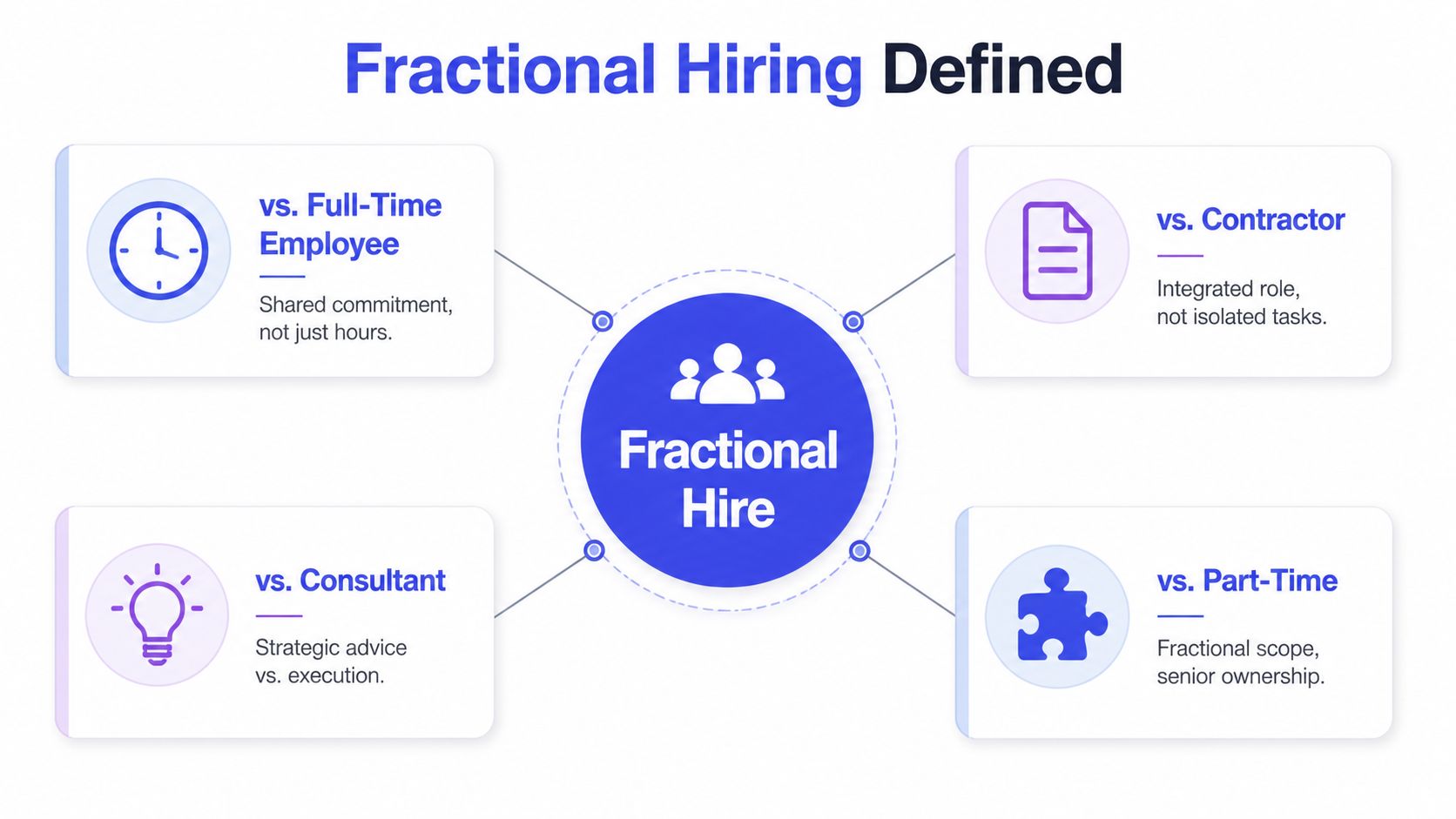
How it differs from adjacent models
A full-time employee owns a role as their primary commitment. They can manage daily execution, build internal relationships continuously, and absorb ambiguous work. Choose this model when the function has persistent demand and requires constant coordination.
A contractor usually works toward defined outputs, such as implementing a retrieval pipeline, migrating a data warehouse, or adding monitoring to an existing service. Contractors can be excellent for execution, but the engagement may not include long-term leadership responsibility.
A consultant typically diagnoses a problem and recommends a path. Their value often comes through analysis, workshops, or a strategic plan. A fractional leader goes further by staying involved as the organization acts on those recommendations.
A part-time employee may work a reduced schedule, but the term doesn't automatically imply executive scope or portfolio work. Fractional roles are most useful when the company needs senior judgment and recurring accountability. Industry guidance commonly places these engagements at 10–20 hours per week, often equivalent to one to three days weekly, as described by the U.S. Chamber of Commerce's guide to fractional hiring.
The model has moved beyond a niche startup workaround. One industry report placed the global fractional executive market at $5.7 billion in 2025, with annual growth of 14%, and reported that the pool of fractional professionals doubled from 60,000 in 2022 to 120,000 in 2024. LinkedIn profiles mentioning fractional roles also rose from 2,000 in 2022 to 110,000 in 2024, according to the same reporting from FractionUS.
Practical rule: If you need a person to own decisions over time, consider fractional hiring. If you only need a defined output, write a contractor scope instead.
Fractional Talent vs Full-Time Hires and Contractors
The best hiring model depends on the work's persistence, ambiguity, and need for internal authority. Don't choose fractional talent only because a full-time hire feels expensive. Choose it when the organization needs senior ownership, but the workload is uneven, transitional, or still forming.
A full-time hire makes sense when the leader must manage daily execution, build a permanent department, or coordinate constantly with several teams. An independent contractor fits a bounded technical task with a clear definition of done. An agency works when you need a broader delivery package and don't want to manage individual specialists directly.
Fractional talent sits between those options. The professional remains involved in strategic decisions, but the company purchases only the recurring capacity it can use. For a useful discussion of employment trade-offs, review this guide to full-time vs part-time employees.
Hiring model comparison
| Model | Best For | Time Commitment | Cost Range | Strategic Ownership |
|---|---|---|---|---|
| Full-time employee | Permanent leadership and daily team management | Primary working commitment | Full compensation package | High, with continuous availability |
| Fractional leader | Ongoing senior guidance and ownership with limited demand | Commonly 10–20 hours weekly | Retainer or daily rate, agreed by scope | High, if authority is explicit |
| Independent contractor | Defined implementation or specialist output | Project-based or scheduled hours | Project fee or hourly arrangement | Usually limited to assigned work |
| Agency | Packaged delivery across several disciplines | Governed by statement of work | Project or service fee | Shared, often managed through the agency |
| Part-time employee | Reduced schedule within an employment relationship | Fixed reduced schedule | Pro-rated employment package | Depends on role design |
The critical question is who owns the decision after the meeting ends. If the answer is nobody, you don't have a fractional role. You have advisory time without accountability.
For implementation-focused needs, compare the scope and management implications of a freelancer software engineer. A freelancer may be exactly right for a defined build. A fractional technical leader is better when the company needs architecture judgment, hiring input, and sustained coordination.
Use this decision rule:
- Choose full-time when the function will remain central and busy enough to require daily leadership.
- Choose fractional when the company needs senior ownership, but the mandate can be advanced through recurring weekly decisions.
- Choose a contractor when the desired outcome is specific, testable, and independent of broader organizational change.
- Choose an agency when delivery requires a coordinated team and you prefer to outsource execution management.
Don't ask which model is cheapest. Ask which model gives the work the right level of ownership without creating idle capacity or execution gaps.
Engagement Models and Pricing Structures
Fractional engagements work best when the schedule is predictable. A company should know when the leader is available, which meetings they attend, and what decisions they own. Ad hoc access creates the worst of both worlds, limited continuity for the company and unclear priorities for the professional.
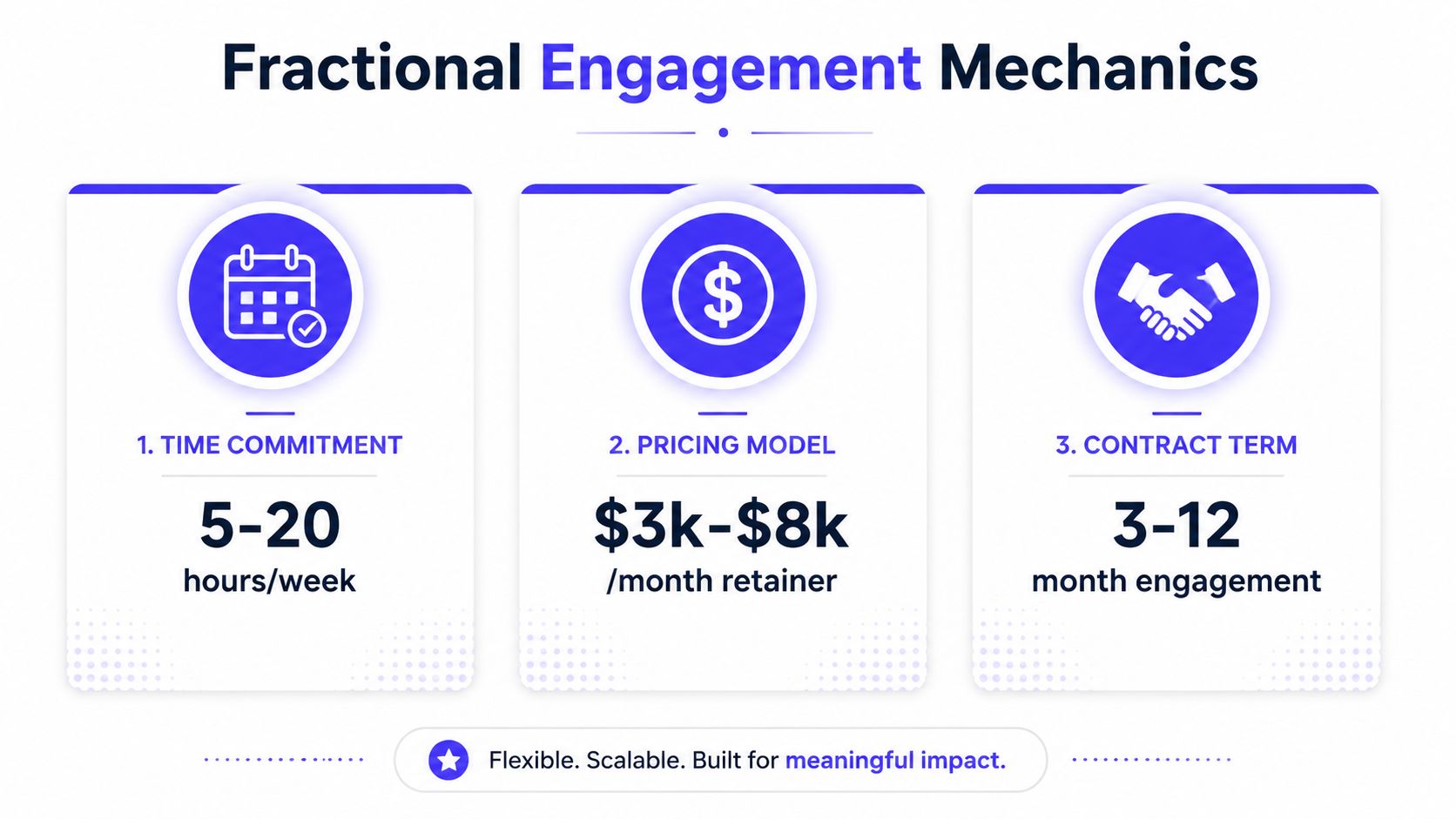
A common benchmark is 10–20 hours per week, or roughly one to three days weekly, with compensation structured through a fixed monthly retainer or daily rate. Another industry guide describes arrangements ranging from 5 hours per week upward, so the lower end can work when the mandate is narrow and the internal team can execute independently. These benchmarks appear in Practicus's explanation of fractional work and Quickly Hire's guide to fractional hiring.
Three structures that hold up
Monthly retainer: The company reserves a defined amount of capacity each month. This structure suits leadership roles because it supports recurring meetings, asynchronous review, and continuity. Write down the expected availability and what happens when requests exceed the reserved capacity.
Daily rate: The professional works on agreed days, often for workshops, architecture reviews, hiring loops, or leadership planning. This can be easier to administer when the calendar is predictable, but it can encourage companies to measure attendance instead of outcomes.
Blended engagement: A base retainer covers leadership access, while additional execution is separately scoped. This is useful when a fractional AI leader needs to guide a permanent team and occasionally produce artifacts such as an evaluation framework or hiring scorecard.
Pricing depends on seniority, scarcity, role authority, industry context, and the amount of execution included. Don't accept a rate without defining the operating model. A lower price can become expensive if the engagement produces recommendations that nobody implements. For market context, use a resource that helps buyers compare fractional AI officer rates, then validate the quote against scope rather than title alone.
The contract should cover:
- Reserved capacity: State the weekly or monthly commitment and availability windows.
- Decision rights: Specify which technical or product decisions the leader can make.
- Deliverables: List artifacts, reviews, hiring support, and operating ceremonies.
- Confidentiality and intellectual property: Clarify ownership of code, documents, prompts, models, and training data.
- Security access: Grant only the systems required for the mandate.
- Conflict disclosure: Require disclosure of overlapping clients or competitive work.
- Review points: Set a recurring assessment for scope, outcomes, and continuation.
If the company needs more execution capacity than leadership judgment, IT staff augmentation may be a better structure. Fractional hiring should not become a vague substitute for an entire missing engineering team.
Real-World Examples of Fractional AI Roles
A fractional role succeeds when the mandate is narrow enough to fit the schedule and important enough to justify senior authority. The following examples show how I'd scope two common AI leadership gaps.

Example one, fractional Head of Machine Learning
A company has machine learning engineers building models, but the team lacks a consistent approach to evaluation, deployment, and technical prioritization. The founder doesn't need another individual contributor writing training code. They need someone to establish direction and raise the quality of decisions.
A sensible scope could include:
- Reviewing the model and data pipeline architecture.
- Defining evaluation criteria for offline and production behavior.
- Establishing a review cadence for model changes.
- Coaching engineers on experimentation and reliability.
- Advising on hiring the permanent ML lead.
- Joining the engineering leadership meeting each week.
The role should explicitly exclude daily ticket management, ownership of every model experiment, and unlimited implementation work. Those exclusions protect the fractional leader from becoming an overloaded staff engineer and protect the company from paying for an unclear service.
A useful scorecard might evaluate whether the leader created a documented target architecture, introduced a repeatable evaluation process, clarified ownership across engineering and product, and produced a hiring recommendation. Those outcomes are more useful than counting meetings.
The main failure mode is insufficient internal execution. If nobody can implement the recommendations, the company needs an ML engineer or MLOps specialist alongside the fractional leader. A fractional Head of ML can make the right call, but can't personally operate every data pipeline and production service on a limited schedule.
Example two, fractional AI Product Manager
A product organization has several proposed AI features, including a support assistant, automated document extraction, and a recommendation workflow. Stakeholders disagree about value, risk, and launch order. A fractional AI Product Manager can impose decision discipline without taking over the whole product organization.
The engagement could cover:
- Interviewing customers and internal users to clarify the highest-value workflow.
- Ranking opportunities by user value, data readiness, operational risk, and feasibility.
- Writing a product brief for the selected use case.
- Defining human review, fallback, and escalation behavior.
- Aligning engineering, design, legal, and go-to-market stakeholders.
- Establishing launch criteria and a feedback loop.
The role shouldn't promise a successful AI feature without access to users, product data, and engineering capacity. It also shouldn't own commercial results that depend on sales, pricing, or support decisions outside the product manager's control.
For a broader leadership model, compare how a fractional Chief AI Officer engagement differs from a product-focused mandate. The title matters less than the decisions the person can make and the team that will execute them.
Hidden Risks and Market Realities
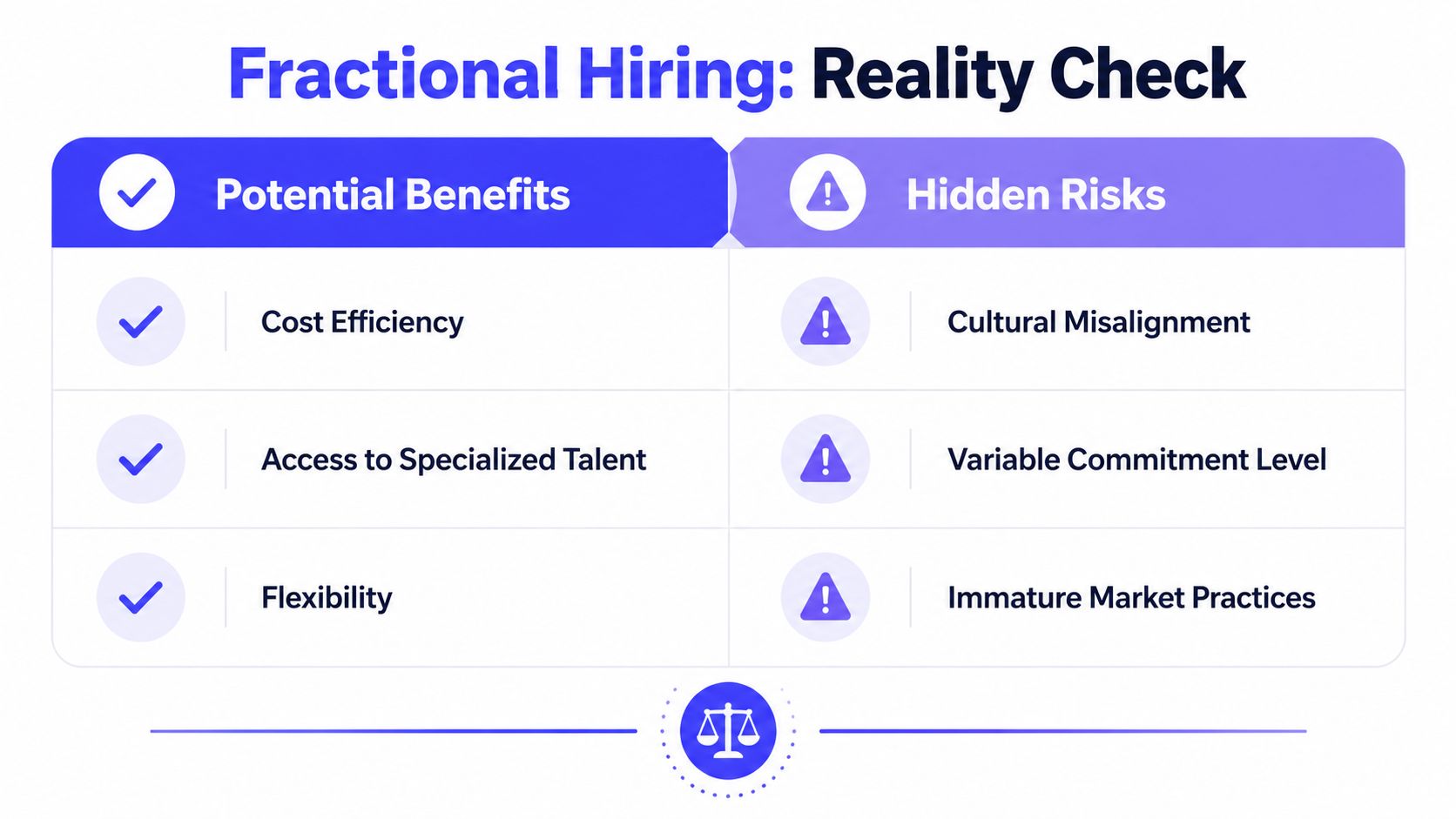
Fractional hiring isn't automatically lower risk. It changes the risk profile. You trade the continuity of a full-time leader for flexibility, and you trade the narrow output of a contractor for broader strategic involvement.
The first danger is scope creep. A fractional Head of AI starts with architecture and hiring, then gets pulled into incident response, vendor selection, roadmap disputes, and daily standups. The company still expects executive judgment, but the role now carries an impossible operational load.
The second danger is authority without access. Leaders can't own outcomes if they can't see the data, attend the relevant meetings, or influence the team responsible for implementation. Give a fractional professional a title without decision rights, and you'll create advisory theater.
What the market signals
The market still lacks consistent norms for pricing, retention, quality evaluation, and compliance. Worker-side reporting reflects that immaturity: one 2025 survey summary reported that 59.6% of fractional leaders struggle to find clients, while 50% cited low business awareness and 36.4% cited pricing difficulty. Those figures come from PRWeb's report on fractional hiring, and they should make buyers more disciplined, not more suspicious.
A professional can be highly capable and still lack the operating fit your company needs. Ask for references that address decision quality, communication, and follow-through. Test how the candidate handles disagreement, incomplete data, and a roadmap that changes after customer feedback.
Use these protections:
- Define a written mandate: State what the person owns and what remains with the founder, CTO, or product leader.
- Set a capacity ceiling: Create a process for approving work beyond the agreed commitment.
- Protect confidential systems: Use least-privilege access and document intellectual property ownership.
- Create a continuity plan: Record decisions, context, and operating procedures so the team isn't dependent on one person.
- Review the engagement: Assess outcomes and scope at a fixed cadence instead of allowing an indefinite retainer.
The embedded video offers another perspective on the operating model:
Fractional hiring fails when the company wants a full-time leader at a part-time price. It works when leaders design the role around a specific strategic bottleneck and give the internal team enough capacity to execute.
Decision Framework for Fractional Hiring
Use this framework before you speak with candidates. It forces the company to decide whether it needs ownership, output, or a service package.
Step one, classify the problem
Write the problem as a decision, not a job title. “We need an AI leader” is weak. “We need to select one production use case, define its evaluation approach, and prepare a permanent team to deliver it” is actionable.
Then classify the need:
- Strategic ownership: Consider fractional talent if the work requires recurring leadership but not daily management.
- Defined execution: Choose a contractor when the output has clear acceptance criteria.
- Permanent operating capacity: Hire full-time when the role will manage people, systems, and decisions every day.
- Bundled delivery: Consider an agency when you need multiple skills under one delivery agreement.
Step two, test the time horizon
Fractional hiring suits a transition, an emerging function, or a sustained but uneven leadership need. It isn't a substitute for a permanent hire when the company already knows it needs daily ownership.
Ask whether the company can state what should be true after the engagement. If the answer is unclear, don't sign a broad retainer. Start with a discovery scope that produces a defined operating plan.
Step three, write the scorecard
Use outcome categories rather than activity counts:
| Category | Evaluation question |
|---|---|
| Technical direction | Did the leader clarify the architecture and trade-offs? |
| Product alignment | Did product and engineering agree on the next decision? |
| Team leverage | Did the internal team gain repeatable practices? |
| Risk control | Did the engagement identify security, privacy, reliability, and compliance gaps? |
| Continuity | Can the team operate without undocumented personal context? |
Step four, structure a pilot
A pilot should have a fixed mandate, named stakeholders, scheduled decision forums, and a review date. It should also define what happens if the company converts the role to full-time, expands the scope, or ends the engagement.
Before signing, confirm:
- The executive sponsor and internal delivery owner.
- The systems and data the professional can access.
- The meetings that require participation.
- The artifacts the leader will produce.
- The decisions that require explicit approval.
- The process for handling work outside scope.
- The conditions for renewal, conversion, or exit.
Don't use a fractional engagement to postpone a decision the business has already made. If you know the team needs a permanent Head of ML, hire for that role and use fractional support only to bridge the gap.
Next Steps for Building Your AI Team
Start with the bottleneck, not the title. Identify the decision your current team can't make confidently, the work that remains blocked, and the internal person who will carry execution forward.
Then choose the model:
- Fractional leader: Use this for strategic ownership, architecture direction, prioritization, or interim leadership.
- Full-time hire: Use this for permanent team building, daily management, and continuous operational responsibility.
- Contractor: Use this for a defined technical output with clear acceptance criteria.
- Agency: Use this when you need coordinated delivery across multiple specialties.
Within the next working session, write a one-page mandate with the role's authority, schedule, outcomes, exclusions, access requirements, and review criteria. Share it with candidates and ask them to explain what they would do first, what they wouldn't own, and where the internal team must contribute.
Then run a structured pilot. Review decisions made, artifacts delivered, team capability, and unresolved risks. If the engagement exposes a permanent leadership need, convert that learning into a full-time search rather than extending an indefinite temporary arrangement.
ThirstySprout helps companies source vetted remote AI engineers, MLOps specialists, data professionals, AI product leaders, and fractional technical leadership. Visit ThirstySprout to discuss a scoped pilot, review sample profiles, and match the engagement model to the work your team needs done.
Hire from the Top 1% Talent Network
Ready to accelerate your hiring or scale your company with our top-tier technical talent? Let's chat.