

TL;DR: Your Action Plan
- When to Hire: Use a freelancer for specific, time-bound goals: to accelerate a critical feature, de-risk new technology (like a GenAI pilot), or backfill a team member on leave. Avoid hiring them for core, long-term product ownership.
- Where to Source: Prioritize niche talent networks that pre-vet for senior AI/ML skills. This cuts your time-to-hire from months to 2–4 weeks and de-risks the engagement.
- How to Vet: Ditch brain teasers. Dive deep into a real past project, focusing on technical trade-offs and business impact. Use a mini-case study relevant to your project (e.g., "how would you build this RAG prototype?").
- How to Onboard: Use a "First 5 Days" checklist. Your goal is to get them shipping a small but meaningful piece of code by day five. A project one-pager is non-negotiable for immediate context.
- How to Manage: Implement a lightweight governance rhythm: a 15-minute weekly async report, a 30-minute sync call, and a shared risk log. This builds trust without micromanagement.
Who This Guide Is For
This guide is for CTOs, Engineering Managers, and Founders who need to hire specialized software engineering talent to meet a business deadline, but can't afford a 3–6 month traditional hiring process. You need to act within weeks, not quarters.
It's for leaders who understand that hiring a freelancer is a strategic decision for speed and expertise, not just a way to find "cheap temporary help." You'll learn how to source, vet, and manage elite freelance engineers to deliver business value, fast.
Quick Framework: Freelancer vs. Full-Time Hire
Use this decision matrix to determine if a freelance software engineer or a full-time hire is the right fit for your current need.
| Scenario | Best Fit: Freelancer | Best Fit: Full-Time Hire | Business Impact |
|---|---|---|---|
| Project Type | Specific, time-bound project with clear deliverables (e.g., build an MVP, integrate an API). | Long-term, core product development with evolving requirements. | Freelancers accelerate time-to-value on focused initiatives. |
| Urgency | High. Need a productive contributor within 2–4 weeks. | Moderate. Can afford a 2–3 month hiring and onboarding cycle. | Freelancers capture market opportunities that would be missed otherwise. |
| Expertise Needed | Niche, specialized skill not on the team (e.g., MLOps, RAG, agentic systems). | Core competencies needed indefinitely (e.g., full-stack, DevOps). | Freelancers de-risk new tech adoption by providing proven expertise. |
| Budget | Operating Expense (OpEx). You have a project budget but not permanent headcount. | Capital Expense (CapEx). You have approval for a permanent, long-term salary. | Freelancers offer a flexible cost model tied directly to project outcomes. |
| Team Impact | Augmenting the team to hit a deadline or unblock a specific problem. | Building institutional knowledge and investing in long-term team culture. | Freelancers increase team velocity without disrupting long-term roadmap. |
The choice hinges on whether you're solving a temporary, specific problem or building a permanent capability.
Practical Example 1: Vetting an ML Engineer for a RAG Project
Let's say you need a freelancer to build a Retrieval-Augmented Generation (RAG) prototype for your company’s messy knowledge base. Your vetting shouldn't be about textbook definitions; it should be about navigating real-world muck.
Here’s a sequence of practical interview questions to reveal their hands-on experience:
- What it tells you: Do they think about data quality first? Do they ask clarifying questions before jumping to a solution?
- What it tells you: Can they connect technical choices to business outcomes? Do they understand the trade-offs of different retrieval methods?
- What it tells you: Do they have a plan for measuring success? Are they focused on delivering a useful, reliable system?
These questions force a candidate to move beyond theory and demonstrate their ability to solve real-world problems. Their answers will tell you more than any coding test.
Practical Example 2: The First 5 Days Onboarding Checklist
A chaotic start almost always leads to a failed engagement. Use this compressed, context-rich onboarding framework to get a senior freelancer shipping meaningful code in days, not weeks.
Day 1: Access and Immersion.
- Grant access to all systems: Git, project board (Jira, Linear), cloud environments, and Slack.
- Provide a scriptable local setup. If it takes more than 2 hours to get their dev environment running, your onboarding process has a bug.
- Share the Project One-Pager (see template below).
Day 2: Codebase and Context.
- Schedule a 1-hour pairing session with a senior engineer to tour the codebase. Focus on architecture, not line-by-line details.
- Walk them through the CI/CD pipeline. They need to know how code gets to production.
Day 3: People and Priorities.
- Set up 15-minute chats with the product manager and designer. Give them the "human map" of who to ask for what.
Days 4-5: Ship Something Real.
- Assign a small but meaningful first ticket (e.g., a non-trivial bug fix). This forces them to navigate your entire development cycle and validates the onboarding process.
This framework builds momentum and shows you trust their expertise. For more tips on integrating external talent, see our guide on how to manage a remote team effectively.
Deep Dive: Sourcing, Contracts, and Management
Finding and managing elite freelance talent requires a deliberate strategy. Here are the trade-offs and pitfalls to avoid.
Sourcing Channels: Where to Find Elite Freelancers
Where you look for talent directly impacts the quality you'll find. Think about sourcing channels in tiers.
- Tier 1: Niche Talent Networks (High Signal): This is our recommended approach for critical hires. Platforms that focus exclusively on vetted, senior talent in specific fields like AI and ML do the heavy lifting. The advantage is speed and quality control; every candidate has already cleared a high technical bar.
- Tier 2: Curated Marketplaces (Medium Signal): Platforms like Toptal or Braintrust offer a wider talent pool with some vetting. They are a solid middle ground but require more work to find a specialist.
- Tier 3: Direct Outreach & Referrals (Variable Signal): Your own network can be a goldmine, but it's time-intensive and puts the entire burden of vetting on you.
- Tier 4: General Freelance Platforms (Low Signal): Sites like Upwork or Fiverr are suitable for small, simple tasks but are not a reliable source for strategic, complex engineering projects.
The market for specialized engineers is tough. With 87.5% of tech leaders finding it difficult to hire, using a high-signal channel is a strategic advantage.
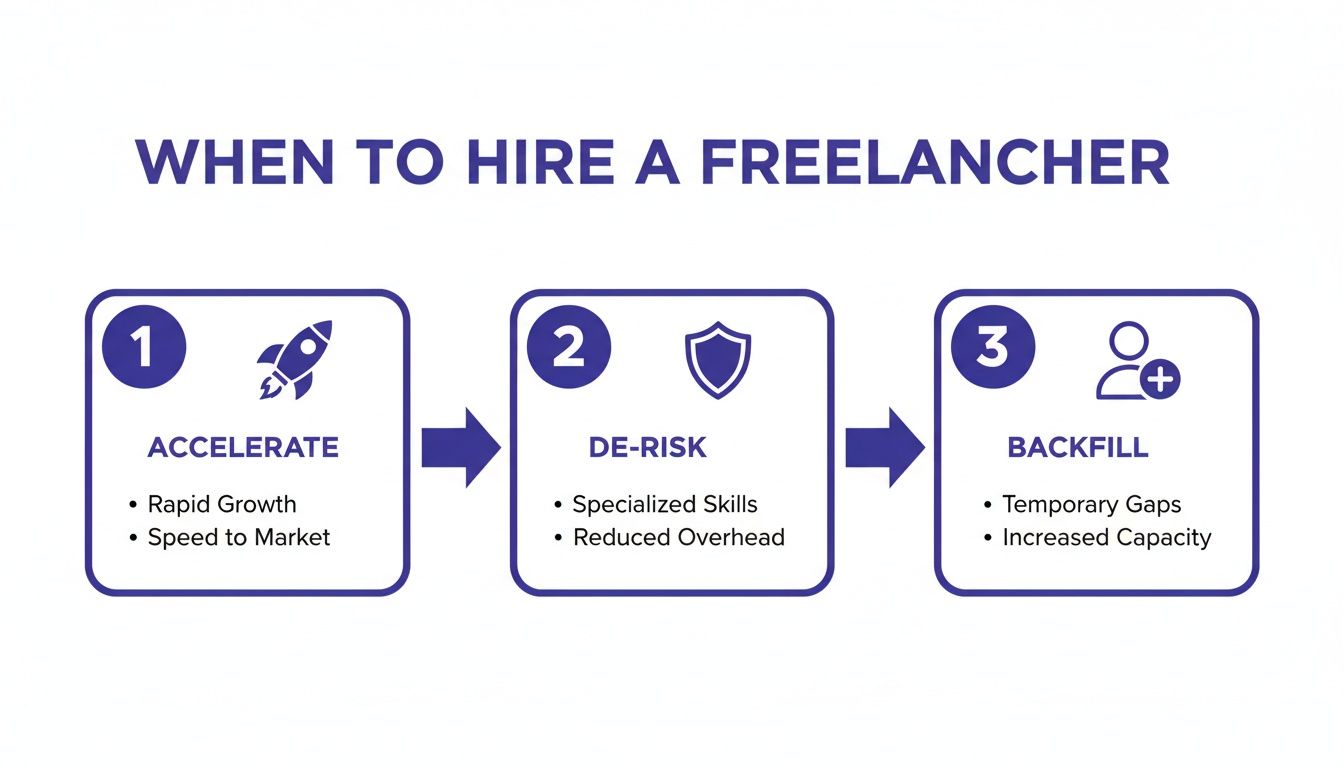
Alt text: Infographic showing three key reasons to hire a freelancer: accelerate, de-risk, and backfill, which aligns with strategic business goals.
Engagement Models: How to Structure a Fair Contract
Choosing the right payment model reduces risk and aligns incentives.
| Model | Best For | Pros | Cons & Risks |
|---|---|---|---|
| Fixed-Price | Small, tightly-scoped projects with zero ambiguity (e.g., a marketing landing page). | Cost certainty. You know the total price upfront. | Inflexible. Kills agility. Bad for R&D or any project where requirements may evolve. |
| Time & Materials (T&M) | Complex, agile development where requirements evolve (e.g., most AI/ML work). | Maximum flexibility. Fosters a collaborative partnership. | Budget uncertainty. Requires trust and good management (e.g., weekly hour caps) to control costs. |
| Retainer | Ongoing access to expertise for advisory or maintenance. | Guaranteed availability. Secures an expert's time. | Potential for underutilization. You pay for the time whether you use it all or not. |
For most innovative software projects, Time & Materials (T&M) is the best model. It acknowledges that you'll learn and adapt as you build, empowering the engineer to be a true partner. Also, be aware of local regulations like Understanding IR35 for IT Contractors if hiring in the UK.
Project Governance: How to Stay on Track
Avoid the two extremes of micromanagement and benign neglect. The right approach is a lightweight rhythm that fosters trust and provides visibility.
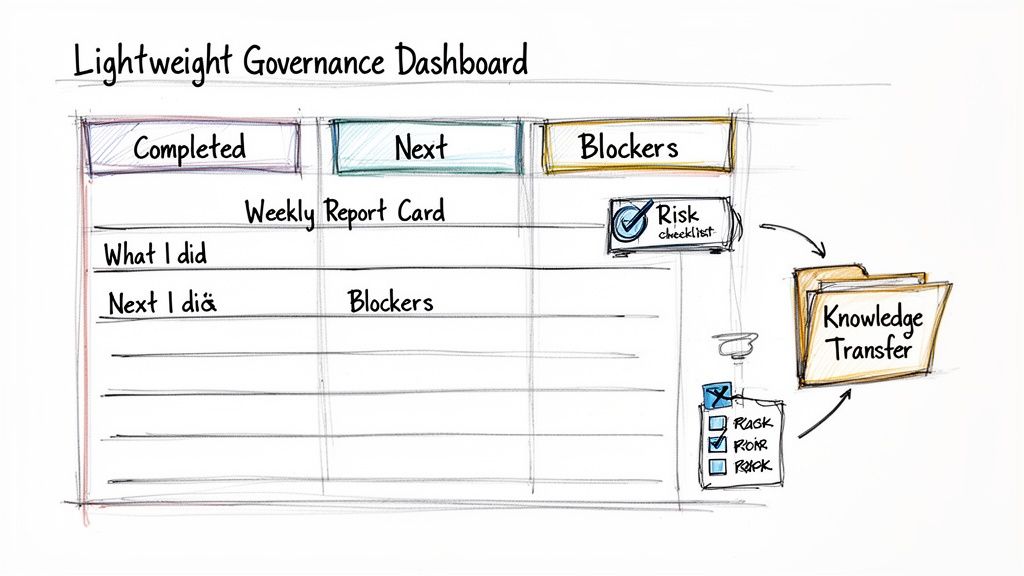
Alt text: A hand-drawn sketch of a Lightweight Governance Dashboard with sections for tasks, risks, and knowledge transfer, illustrating a simple project management tool.
Our go-to model has three parts:
- Weekly Async Report: A 15-minute update from the freelancer covering accomplishments, next goals, and blockers.
- Weekly 30-Min Sync: A focused call to tackle blockers and align on strategy, not a status update.
- Shared Risk Log: A simple document (Google Sheet, Notion) where anyone can flag potential issues.
This system respects their expertise and keeps the project focused on business value. A great freelance engineer doesn't want to be managed; they want to be enabled.
Checklist: Project One-Pager Template
Before a new freelancer starts, give them this "Project One-Pager." It's a single source of truth that condenses everything they need to know to be effective from day one.
Project: RAG Prototype for Customer Support
| Category | Details |
|---|---|
| Business Goal | Reduce support ticket resolution time by 20% by giving agents an internal Q&A tool that pulls answers from our knowledge base. |
| Success Metric | The prototype must successfully answer >70% of test queries with factual accuracy during UAT with 5 pilot users. |
| Technical Stack | Python (FastAPI), LangChain, Pinecone, OpenAI GPT-4, React (Next.js). |
| Key Contacts | Jane Doe (Product Lead), Kevin Smith (Tech Lead), Sarah Chen (Design). |
| Code Repository | Link to the Git repo. |
| Project Board | Link to the Jira/Linear board. |
| First Milestone | Ingest and embed the first 1,000 documents into Pinecone by EOD Friday. |
This simple document immediately connects their work to company goals and gives them a clear objective. It’s the best tool for getting someone pointed in the right direction from hour one. This is just one tactic; broader IT staff augmentation strategies can provide more context. Other useful skills include knowing how to effectively list self-employment on a resume, which signals professionalism.
What To Do Next: Your 3-Step Action Plan
- Define Your Scope: Use the Project One-Pager template to clarify your business goal, success metrics, and first milestone. This forces clarity and makes you a more attractive client.
- Choose a Sourcing Channel: Based on your urgency and need for specialized skills, decide between a niche network, a curated marketplace, or direct outreach. For critical AI roles, we recommend a vetted network.
- Schedule a Scoping Call: The fastest way to validate your project and find the right talent is to talk to an expert.
References
This playbook is based on our experience vetting and placing hundreds of remote AI and software engineers. For further reading, we recommend these resources:
- ThirstySprout: How to Hire Remote Developers
- ThirstySprout: How to Manage a Remote Team Effectively
- Atlassian: Jira Software
- OpenAI: Official Website
Ready to hire a pre-vetted, elite freelance software engineer for your AI project? At ThirstySprout, we match you with production-ready experts in days. Start a Pilot.
Hire from the Top 1% Talent Network
Ready to accelerate your hiring or scale your company with our top-tier technical talent? Let's chat.