

TL;DR
- Focus on Outcomes: Instead of "create wireframes," write "design user flows that increase checkout conversion by 15%." Connect every design task to a clear business metric.
- Be Specific About Seniority: Clearly define the scope, autonomy, and skills for junior, senior, or lead roles. A mismatch here is the #1 hiring mistake.
- Provide a 90-Day Plan: Show candidates exactly how they’ll onboard and what success looks like in their first 3 months. This signals you’re serious about their growth.
- Use a Take-Home Test That Respects Time: Assign a small, hypothetical 2–3 hour challenge that tests problem-solving, not just visual polish.
- Include a Salary Band: Be transparent with a competitive, data-backed salary range. This builds trust and filters for the right candidates from the start.
Who This Guide Is For
This guide is for CTOs, product leads, and founders who need to hire a UI/UX designer to improve key business metrics like conversion, retention, or user engagement. You need to write a job description that attracts strategic thinkers, not just pixel-pushers, and you need to do it within the next few weeks.
Why Your UI/UX Designer Job Description Matters

alt text: Hand-drawn UI/UX designer job description concept with categories for seniority, specialization, and career levels.
A generic job description attracts generic candidates. Mashing together junior, senior, and lead responsibilities into one vague post wastes time, money, and delays your product goals.
Your job description is a candidate's first impression. A great one acts as a powerful filter—it pulls in designers genuinely excited by your specific challenges and pushes away those who are not a fit.
Connect the Role to Business Impact
A designer's job is to solve user problems to hit business targets. Your job description must make this connection explicit. Instead of saying "create wireframes," frame it as "design and validate user flows that increase checkout conversion by 10%."
This approach attracts strategic thinkers, clarifies success metrics, and signals that design is core to your business strategy.
Calibrate for the Right Seniority
The difference between a junior, senior, and lead designer is massive. A junior designer executes tasks within an existing system; a lead designer owns the entire user experience strategy and mentors the team.
Misaligning the job title with the responsibilities is a common and costly mistake.
Practical Example 1: Seniority Comparison Matrix
Use this matrix to pinpoint exactly who you need to hire. It breaks down the key differences between junior, senior, and lead UI/UX designers, ensuring your job description aligns with the role's true scope.
Getting seniority right saves everyone a headache. The principles in our guide for hiring software developers apply here as well. For more general advice, some resources explain how to create job descriptions that get results.
Define What They’ll Actually Do
Generic bullet points like "creates wireframes" are ineffective. The best UI/UX job descriptions describe ownership, collaboration, and business impact. Help candidates envision their day-to-day work—collaborating with product managers, pairing with engineers, and presenting to leadership.
From Tasks to Tangible Outcomes
Frame every responsibility around a measurable outcome. This simple shift attracts designers motivated by impact, not just closing tickets in Jira.
- Try: "Lead end-to-end user research to uncover key customer pain points, directly shaping our product roadmap."
- Try: "Develop high-fidelity, interactive prototypes in Figma that clearly communicate user flows and bring design solutions to life for usability testing."
- Try: "Partner with product and engineering in an agile environment to translate complex business requirements into intuitive user interfaces."
Practical Example 2: The First 90-Day Scorecard
Including a 90-day plan shows you have a clear vision for the role. It’s a massive green flag for great candidates, proving you are invested in their success from day one.
Pinpoint the Right Skills and Qualifications
This section is your most important filter. Be specific, realistic, and ensure the requirements match the seniority level. Every skill you list should connect directly to a business goal.

alt text: A diagram titled 'Designer Goals' illustrating Business Goal branching into User Research and Prototypes.
As the diagram shows, a designer’s daily work must trace back to strategic company objectives.
Hard Skills
Be direct about the tools and methodologies your team uses daily.
- Design & Prototyping Tools: Specify your stack (e.g., Figma, Sketch). Clarify you expect high-fidelity, interactive prototypes.
- User Research Methods: Mention specific methods you use, like user interviews, usability testing, and A/B testing, to signal a data-driven culture.
- Information Architecture: Call out the need for skills in creating intuitive sitemaps, user flows, and clear wireframes.
Soft Skills
Soft skills often separate good designers from great ones. There's overlap with developer roles, but the application is unique. For context, see the core skills required for a software engineer.
- Communication & Collaboration: Emphasize the ability to articulate design choices to non-designers.
- Empathy: A great designer must deeply understand user motivations, frustrations, and goals.
- Problem-Solving: You need someone who can turn messy business requirements into elegant, functional design solutions.
The New Frontier: AI Competencies
As AI integrates into products, designers must craft intuitive experiences for features that learn and adapt. For inspiration, check out these key AI UI UX tools.
Designers need to understand the nuances of creating interfaces for systems that learn. This means designing for conversational UIs, showing model confidence visually, and providing graceful error recovery when the AI fails. The UX job market saw a 71% decrease in openings from 2022 to 2023, making adaptability and forward-looking skills like AI/ML UX critical.
UI/UX Designer Skill Matrix
Use this matrix to tailor the qualifications in your job description.
Nail the Numbers: Set Competitive Salary Bands
Getting compensation right is critical. A data-backed package shows you value design's strategic impact. Top-tier design talent remains in demand because their work directly ties to user retention and revenue.
Get a Read on the Market
The average U.S. UX designer salary is around $124,415 as of January 2025, but this varies. A Junior UX/UI Designer averages about $56,698, while remote junior roles often command a higher average of $83,725. This suggests companies pay a premium for remote designers who require less supervision. This guide on landing a junior UX role offers more insights.
What Drives a Designer's Salary?
A designer’s market rate is shaped by specific factors.
- Location: A San Francisco-based designer has different salary expectations than one in a lower-cost area. For remote roles, be transparent about your compensation philosophy (e.g., national average vs. location-based tiers).
- Company Context: A well-funded Series B company can offer more than a bootstrapped startup. Be realistic about where you fit in the market.
- Niche Skills (AI/ML): Designers who understand how to create intuitive experiences for AI-driven products command a significant premium.
Use platforms like Levels.fyi or Payscale to benchmark against similar companies to arrive at a fair and competitive offer.
Screen Candidates with Effective Interview Questions
Your interview process must dig into how a designer thinks—how they solve problems, collaborate, and navigate ambiguity. Use situational and behavioral questions that force candidates to explain the why behind their design choices.
Move Beyond the Portfolio Walkthrough
A polished portfolio is just the price of entry. Your goal is to understand the messy middle—the trade-offs, dead ends, and crucial insights.
Portfolio Deep-Dive Questions:
- "What was the single biggest assumption you started with on this project? How did user research confirm or shatter it?"
- "Walk me through a piece of user feedback that forced a major pivot in this design. How did you present a new direction?"
- "Tell me about a time an engineer hit you with a major technical constraint. How did you adapt the design without harming the user experience?"
A great answer reveals a repeatable, systematic way of thinking that turns chaos into clarity.
Assess Collaboration and Problem-Solving
A designer’s ability to work with product, engineering, and stakeholders is as critical as their Figma skills. For more ideas, our guide on AI engineer interview questions has frameworks you can adapt.
Situational and Behavioral Prompts:
- Collaboration: "Tell me about a time you fundamentally disagreed with a product manager. How did you find a path forward?"
- Adaptability: "Imagine we have to cut this design's scope by 50% to hit a deadline. How do you decide what to cut?"
- Business Acumen: "Describe a project where business goals and user needs conflicted. How did you find a solution that served both?"
A Take-Home Assignment That Respects Their Time
A well-scoped take-home assignment is a powerful signal. It must be respectful of a candidate’s time. Do not ask for free work on your product.
Example Take-Home Brief:
- Challenge: "Our app, 'QuickPantry,' sees high drop-off during onboarding. Analyze potential user problems and design a single screen or a short user flow (3-4 steps) to improve this experience."
- Deliverables: A short write-up (1-2 paragraphs) of your thinking and a low-to-mid-fidelity wireframe in Figma.
- Time Constraint: "Please spend no more than 2-3 hours. We care more about your problem-framing than a pixel-perfect UI."
- Evaluation Criteria: We will assess how you define the user problem, the rationale behind your solution, and your ability to communicate design decisions concisely.
Job Description Template and Checklist
Here is a practical, copy-and-paste template and a final checklist to ensure your job description attracts top talent by telling a story and setting clear expectations.
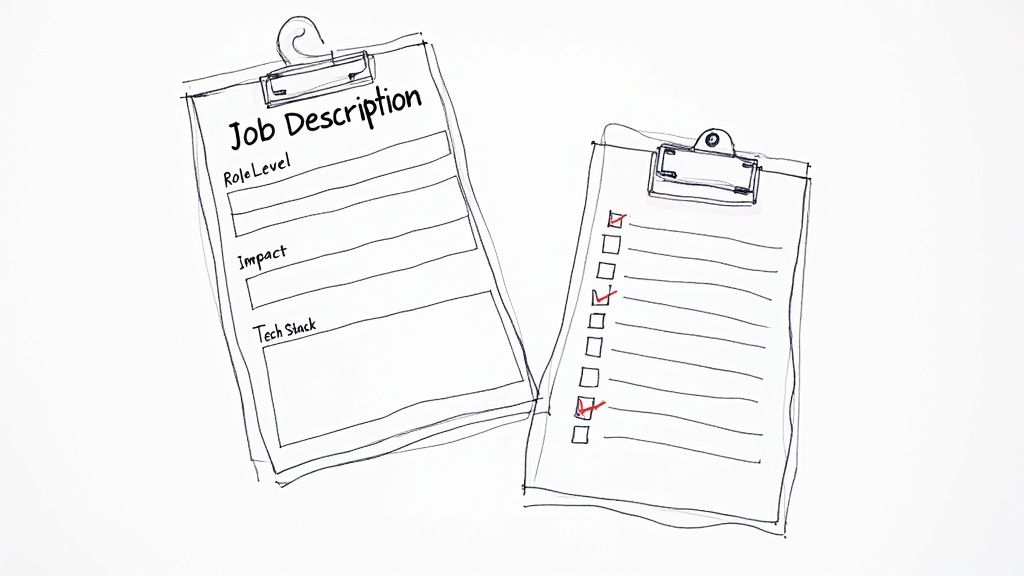
alt text: Two hand-drawn clipboards: one for a job description with blank sections, the other a checklist with three red checkmarks.
The Complete UI/UX Designer Job Description Template
[Job Title: e.g., Senior UI/UX Designer (AI Products)]
[Location: e.g., Remote (US Time Zones)]
[Compensation: e.g., $140,000–$170,000 + Equity]
About Us[State your one-line mission. What big, audacious problem are you solving? Keep it punchy and inspiring.]
The Opportunity[Your hook. In 2-3 sentences, explain why this role exists *now*. Is it for a new AI feature launch? To drive a 20% improvement in user retention? Connect the job directly to a core company goal.]
What You’ll Do (Responsibilities)[Use 4–6 outcome-focused bullet points. Instead of "Create wireframes," try "Own the end-to-end design of our new conversational AI assistant, from initial research and user flows to high-fidelity, testable prototypes in Figma."]
What You’ll Bring (Qualifications)[List 5–7 specific skills. Clarify "must-haves" vs. "nice-to-haves." Mention essential tools (Figma), key methodologies (usability testing), and what to show in their portfolio (e.g., "A portfolio with at least 2 projects demonstrating measurable business impact").]
Our Tech & Design Stack[List the key tools they'll use daily: Figma, Miro, Jira, etc.]
What We Offer[Highlight 3-4 standout perks beyond salary, like a professional development budget, remote work stipend, or unique team traditions.]
Pre-Publish Checklist
Before you post, run through this final check.
- Seniority is obvious: Is the level (junior, senior, lead) clear at a glance?
- Connects to business goals: Does it show how their work impacts the company?
- Scope is realistic: Are the skills requested reasonable for the salary and seniority?
- Portfolio mentioned: Is it explicitly stated that a strong portfolio is required?
- Reflects your culture: Does it sound like a real person wrote it?
What to Do Next
- Use the Template: Copy the job description template above and tailor it to your specific role and company.
- Benchmark Your Salary: Use Levels.fyi to validate that your compensation is competitive for your stage and location.
- Define Your Interview Process: Map out your interview stages, including who will be involved and what take-home assignment you'll use.
Ready to hire the specialized AI design talent you need? ThirstySprout connects you with pre-vetted, senior UI/UX designers experienced in shipping AI-driven features.
References
- ThirstySprout. (2024). Hiring Software Developers.
- Lathire. (n.d.). How to Create Job Descriptions That Get Results.
- ThirstySprout. (2024). Core Skills Required for a Software Engineer.
- Rapidnativ. (2024). Key AI UI UX Tools.
- Her UX Path. (2024). How to Land a Junior UX Designer Job in 2025.
- ThirstySprout. (2024). AI Engineer Interview Questions.
Hire from the Top 1% Talent Network
Ready to accelerate your hiring or scale your company with our top-tier technical talent? Let's chat.