

You've probably seen this already. The product is good, paid acquisition is getting expensive, and the organic channel feels oddly underbuilt for something so central to buyer research. Engineering owns the site, product owns the messaging, marketing owns launches, and nobody fully owns search.
That's usually when SEO turns into a vague request instead of a scoped role.
A strong SEO hire doesn't “do keywords.” They make sure your site can be crawled, your product pages match buyer intent, your content program targets real demand, and your reporting ties search work to signups, demos, or pipeline. If you're also reworking hiring workflows, tools like real-time interview answers with ParakeetAI can help teams move faster without reducing interview rigor.
Why Your Next Hire Might Be an SEO Specialist
If you're a founder, CTO, or product leader, this role matters when acquisition is too dependent on paid channels or founder-led outbound. SEO becomes valuable when you already have a site, product surface area, docs, landing pages, or category education opportunities that nobody is managing systematically.
A first SEO hire is usually justified by operational gaps, not by theory. Pages launch without internal links. Engineers ship JavaScript-heavy experiences without checking discoverability. Content gets written around opinions instead of demand. Reporting shows traffic, but not business value.
Practical rule: Hire SEO when search has become a company asset that nobody is maintaining end to end.
A quick way to think about seo job responsibilities:
- Own discoverability: Make sure search engines can crawl, render, and index what you ship.
- Translate demand into pages: Turn product features, use cases, and buyer questions into landing pages, docs, and content.
- Build authority: Improve off-page signals through link-worthy assets, digital PR support, and smart partnerships.
- Prove impact: Track the path from impressions and clicks to qualified conversions and revenue influence.
This guide is for operators, not career switchers. If you need to scope, hire, and manage your first SEO role inside an engineering-heavy startup or scaleup, the job is less about “marketing tasks” and more about system ownership.
The SEO Career Ladder From Junior to Principal
Organizations often hire for the wrong level because they describe the outcomes they desire, then budget for execution they can supervise. That usually fails. If no one internally can direct SEO work, a low-seniority hire won't create the roadmap for you.
In the current market, mid-level SEO roles make up 59% of listings, while senior roles account for 27% and junior roles 14%, according to Previsible's 2025 State of SEO Jobs Report. That distribution matches what most startups need. Someone who can both execute and own a system.

Junior SEO
A junior SEO is an executor. This person is useful when strategy already exists and the bottleneck is throughput.
Typical responsibilities include:
- On-page implementation: Update title tags, headings, internal links, image alt text, and basic content formatting.
- CMS support: Publish or revise pages in Webflow, WordPress, Contentful, or similar tools.
- Basic monitoring: Check Google Search Console and Google Analytics 4 for obvious issues or changes.
- Audit follow-through: Work through ticket lists from a senior SEO, growth lead, or agency.
What works well with a junior hire is a stable site, a clear publishing workflow, and strong management. What doesn't work is expecting this person to define your information architecture, forecast business impact, or influence engineering priorities.
Mid-level SEO
This is the first useful in-house hire for many startups. A mid-level SEO can own a program, not just a task list.
They should be able to:
- Run keyword and topic research: Prioritize clusters tied to your product, use cases, and sales motion.
- Manage technical health: Identify crawl, indexing, internal linking, and rendering issues and turn them into actionable engineering tickets.
- Own reporting: Build a dashboard that connects search visibility to business outcomes.
- Coordinate across teams: Work with product marketing, content, design, and engineering without needing daily hand-holding.
A mid-level SEO is usually the right choice if you have product-market fit, a functioning website, and enough content or landing page surface area to improve.
Hire this level when you need someone to own search as a repeatable operating system, not as a side project.
Senior or Principal SEO
This person builds the roadmap and changes how the company thinks about organic growth. They're not just finding keywords. They're deciding where SEO should and should not matter.
A strong senior hire typically handles:
- Growth planning: Prioritizing SEO by product line, market, funnel stage, and expected commercial impact.
- Technical strategy: Leading migrations, template changes, large-scale taxonomy work, or complex JavaScript rendering fixes.
- Forecasting and executive communication: Explaining what matters, what can wait, and how search work supports revenue goals.
- Team design: Deciding when to add content support, technical specialists, agencies, or contractor help.
Which level should you hire
Use this simple diagnostic:
| Your situation | Best fit |
|---|---|
| Strategy exists, pages need updates, someone can manage details daily | Junior |
| You need one person to own technical health, content opportunities, and reporting | Mid-level |
| SEO must shape roadmap, engineering priorities, and revenue planning | Senior or Principal |
The mistake to avoid is hiring junior because the task list looks easy. The visible tasks are easy. The judgment behind them usually isn't.
The Four Pillars of Modern SEO Work
Modern seo job responsibilities usually sit across four pillars. The titles sound familiar, but what matters is how each one affects product visibility, content efficiency, and measurable growth.

Technical SEO
This pillar answers a simple question. Can search engines access, understand, and index the pages you want to rank?
That includes crawlability, indexation, canonical setup, sitemaps, internal linking, page templates, redirects, and performance signals. On engineering-heavy teams, this is often where the most impactful work sits because product changes can subtly suppress discoverability.
One important example: SEOJobs notes that JavaScript rendering failures can block 40% of content on single-page applications from Googlebot crawling. If your app or marketing site relies heavily on client-side rendering, an SEO specialist needs to catch that before your launch turns into invisible inventory.
A good technical SEO doesn't just report issues. They translate them into engineering language:
- Issue: Blog pagination isn't crawlable
- Risk: Search engines find fewer articles
- Action: Adjust template links and crawl paths
- Business impact: Existing content investment becomes more discoverable
Content SEO
Buyer intent is mapped to actual assets through this process. Product pages, integration pages, comparison pages, glossary entries, docs, and blog content all play different roles.
The job here isn't producing “more content.” It's deciding what deserves a page, what format fits the query, and how to avoid thin or duplicated effort. Good content SEO usually involves keyword clustering, competitor gap analysis, brief creation, refresh plans, and page-level optimization.
For startups, content SEO works best when it's close to product truth. Generic top-of-funnel publishing often creates activity without qualified demand. Content tied to use cases, jobs to be done, integrations, migration concerns, and evaluation questions tends to age better.
Off-page SEO
Off-page work is about authority and trust. Early-stage teams often overcorrect here. They either ignore it, or they chase low-quality link schemes that create noise without value.
Useful off-page work usually looks like this:
- Digital PR support: Turning launches, data stories, or strong expert commentary into coverage
- Linkable assets: Creating resources worth citing, such as original frameworks, tooling guides, or useful templates
- Partnership distribution: Getting co-marketed pages, integration listings, or ecosystem mentions live
- Reclamation work: Finding unlinked brand mentions and converting them into proper references
What doesn't work is treating backlinks like a procurement exercise. The best off-page SEO is usually the output of a credible brand and a useful page.
Later in the process, this video gives a clear operational walkthrough of how SEO work spans multiple disciplines:
Analytics and reporting
This is the pillar that separates useful SEO from endless activity. The role should own measurement, not just execution.
Typical responsibilities include:
- Performance monitoring: Use Google Analytics 4 and Google Search Console to track organic sessions, conversions, impressions, clicks, and page-level trends
- Dashboarding: Build simple Looker Studio views for executives and deeper working dashboards for practitioners
- Opportunity detection: Spot pages with rising impressions but weak click-through rate, or pages that rank but don't convert
- Decision support: Show whether a technical fix, content refresh, or new landing page category is worth doing next
If the SEO specialist can't explain business impact in a dashboard your leadership team understands, the function will stay underfunded.
From Tasks to Impact Real SEO Deliverables
The easiest way to understand seo job responsibilities is to look at what a strong hire hands over. Not a list of activities. Actual working artifacts.
Example one, a technical SEO audit scorecard
A senior or mid-level SEO should be able to review your site and produce a scorecard that a CTO can act on. It should not read like a generic export from Screaming Frog. It should connect issues to engineering effort and business risk.
A simplified version looks like this:
| Area | What the SEO reviews | Example finding | Business impact | Recommended owner |
|---|---|---|---|---|
| Indexability | Search Console coverage, robots directives, canonicals | Important pages excluded from index | High-value pages may not appear in search | SEO + Engineering |
| Rendering | JavaScript output, source vs rendered HTML | Key content not visible pre-render | Product or content sections may be missed by crawlers | Engineering |
| Internal linking | Template links, nav, contextual links | New pages orphaned from the main structure | Slower discovery and weaker page authority flow | SEO + Product Marketing |
| Performance | Core page experience and template issues | Heavy assets on core landing pages | Poor UX and weaker discoverability | Engineering + Design |
This kind of deliverable earns trust because it respects how product teams work. It tells engineering what matters now and what can wait.
Example two, a content keyword map for a feature launch
When a new feature ships, SEO should create a map that ties the launch to demand and page formats. That keeps content, docs, and landing pages aligned.
According to the verified data, Ahrefs' 2025 State of SEO report is cited as showing that SEO specialists can save up to 40% of their time on tasks like generating topic clusters by using AI prompts. Used well, AI speeds up clustering and first-draft ideation. It does not replace judgment about intent, product positioning, or editorial quality.
Here's a practical template.
Example Content-Keyword Map for a New Feature Launch
| Target Keyword Cluster | Primary Keyword | Monthly Search Volume | User Intent | Proposed Content Asset |
|---|---|---|---|---|
| Workflow automation for support teams | support workflow automation | Qualitative review needed | Commercial investigation | Product landing page |
| AI support routing | AI ticket routing | Qualitative review needed | Solution comparison | Feature explainer page |
| Help desk automation setup | help desk automation setup | Qualitative review needed | Implementation intent | Documentation guide |
| Customer support AI best practices | customer support AI best practices | Qualitative review needed | Educational | Blog post with product examples |
A useful SEO deliverable gives other teams a decision they can make, not just a spreadsheet they have to interpret.
Measuring SEO ROI Beyond Traffic Numbers
Traffic is a leading indicator. It isn't the goal.
Hiring breaks down when leadership cannot connect SEO work to commercial outcomes. In fact, a 2025 LinkedIn Talent Insights report found that 72% of Series A-D tech founders cite unclear impact metrics as a major barrier to hiring SEO roles. That's a management problem more than a channel problem.
What to track instead
A practical SEO dashboard should separate leading indicators from business outcomes.
Leading indicators
- Index coverage: Are the pages you care about eligible to rank?
- Query footprint: Are you appearing for the problem and solution terms that matter?
- Page-level engagement: Which organic landing pages keep users moving deeper into the site?
Business indicators
- Organic signups: New users whose first or meaningful touchpoint came from organic search
- Demo requests or sales conversations: Organic-assisted or organic-sourced conversions
- Pipeline contribution: Opportunities influenced by key landing pages, comparison pages, docs, or educational content
If your dashboard only reports sessions and rankings, you'll eventually question the role. If it reports search-driven business activity, you can manage it like any other growth function.
A simple dashboard structure
A complex attribution setup is rarely necessary for teams on day one. They need a clean funnel view in Looker Studio or a similar reporting layer.
A useful weekly view includes:
- Visibility layer: impressions, clicks, top landing pages, top query groups
- Behavior layer: engaged sessions, key navigation paths, assisted conversions
- Commercial layer: trial starts, demo requests, qualified leads, influenced opportunities
This is also where hiring quality matters. The wrong person will report motion. The right person will report contribution. If you want a sharper framework for evaluating role impact after the hire, this guide on quality of hire metrics is worth adapting for SEO as well.
Rankings matter only when they lead to pages that support product adoption, sales efficiency, or pipeline creation.
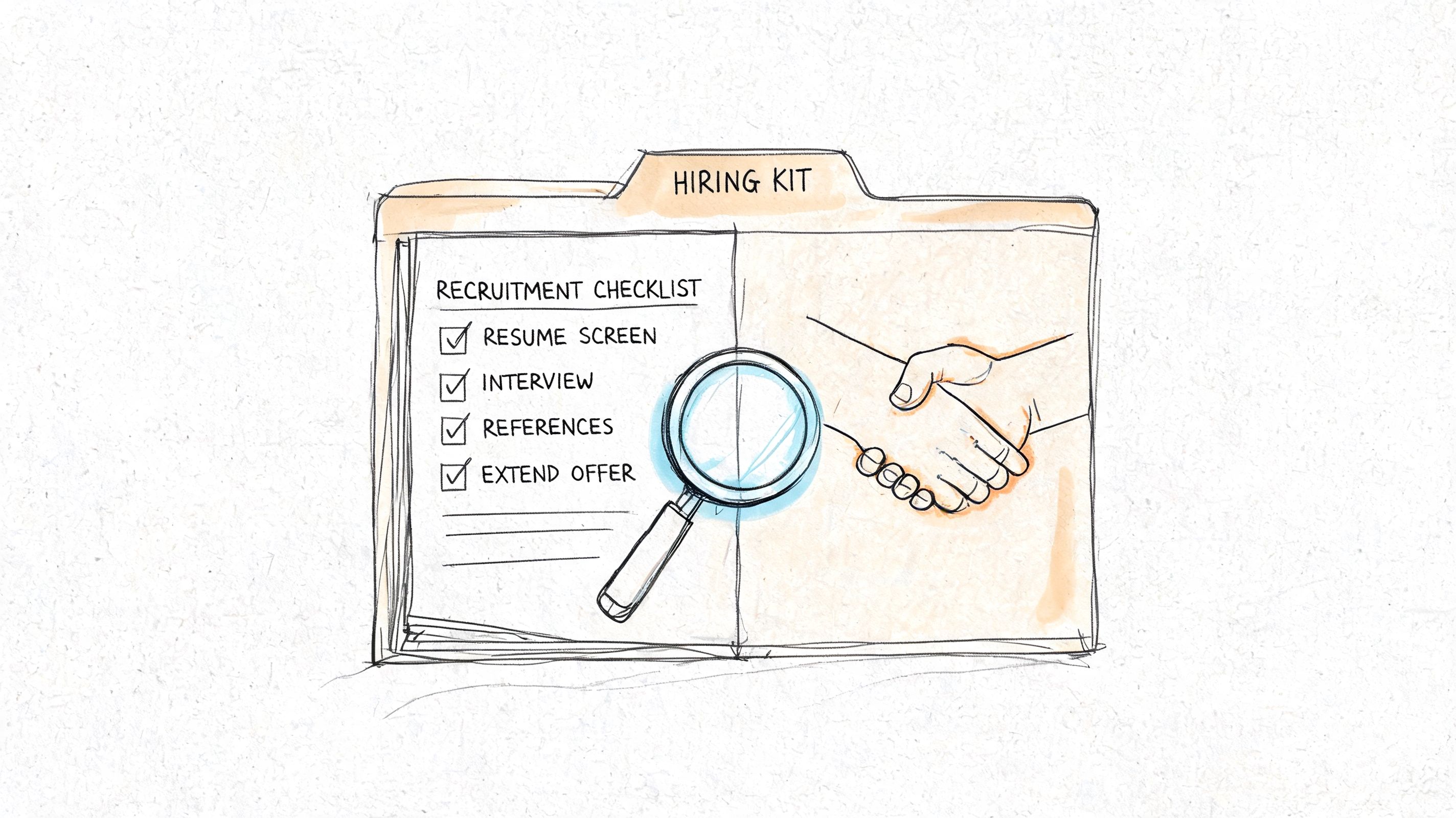
Your Startup SEO Hiring Kit
The market is broad. Verified job data shows that 4.47 million roles list SEO experience, with common tasks including monitoring organic sessions in GA4 and GSC, keyword analysis in Ahrefs or Semrush, and optimizing meta tags, H1s, and internal links. That means your hiring kit needs to screen for judgment, prioritization, and cross-functional communication, not just tool familiarity.
A copy-ready job description core
Use responsibilities like these, then scale up or down by seniority:
- Technical ownership: Audit crawlability, indexing, internal linking, page templates, and site changes that affect discoverability
- Content planning: Build keyword clusters, content briefs, landing page recommendations, and refresh plans tied to product priorities
- Performance reporting: Maintain GA4, GSC, and dashboard reporting for search visibility and conversion outcomes
- Cross-functional execution: Partner with engineering, product marketing, design, and content to ship improvements
For qualifications, ask for evidence of shipped work. Don't over-index on certificates. Ask what they changed, how they prioritized it, and how they measured the result.
If your team already hires technical specialists in adjacent domains, it helps to align role design with other modern job specs. This AI engineer job description example is useful as a model for writing outcome-based responsibilities instead of buzzword-heavy lists.
Interview questions that reveal real ability
Use questions that force candidates to show decision-making:
- Technical diagnosis: Tell me about a site change that hurt search performance. How did you isolate the cause?
- Prioritization: If you had one engineer for one sprint, what SEO issue would you fix first on our site and why?
- Content judgment: How do you decide whether a topic belongs on a landing page, in docs, or in a blog post?
- Executive communication: How would you explain SEO progress to a CTO who doesn't care about rankings?
- AI workflow: Where do AI tools help your process, and where do you refuse to trust them without review?
A take-home assignment that respects time
Keep it short. Ask for a one-page analysis, not unpaid strategy consulting.
Suggested brief
Review our public site and one competitor. In 30 minutes, identify:
- One technical risk
- Two content opportunities
- One metric you would put on the executive dashboard first
This format shows how they think, how they communicate, and whether they can translate SEO work into business language.
Onboarding Your SEO Hire for Maximum Impact
The first mistake after hiring is burying the SEO specialist inside marketing while keeping engineering and product at arm's length. If they can't access releases, analytics, and site owners, they won't produce much.
A practical 30-60-90 plan
Days 1 to 30
- Get access: GA4, Google Search Console, CMS, Ahrefs or Semrush, engineering backlog, and product roadmap
- Map stakeholders: Meet engineering, product marketing, content, and whoever owns web publishing
- Audit the current state: Identify technical blockers, page gaps, and reporting gaps
Days 31 to 60
- Ship quick wins: Fix high-priority indexing, linking, and template issues
- Build the first roadmap: Prioritize technical fixes, content opportunities, and page refreshes
- Stand up reporting: Create a lightweight dashboard for leadership and a working tracker for execution
Days 61 to 90
- Launch a focused initiative: This could be a feature page cluster, docs optimization pass, or technical cleanup sprint
- Set the operating rhythm: Define ticket flow with engineering and review cadence with leadership
- Clarify ownership: Make sure SEO is integrated into launches, not called in afterward
Remote teams need this operating rhythm written down. This guide on how to manage a remote team is a useful companion for making the cross-functional setup stick.
If you're hiring search talent into a product-led or engineering-heavy company, the best first step is to scope the role around business outcomes, not generic marketing tasks. ThirstySprout helps startups and scaleups build high-performance remote technical teams, including the AI, data, and product talent you need around growth-critical functions. If you're planning your next strategic hire, start a pilot or see sample profiles to move faster with less hiring risk.
Hire from the Top 1% Talent Network
Ready to accelerate your hiring or scale your company with our top-tier technical talent? Let's chat.