

The popular advice is to hire the strongest model builder you can find. That works only when your business problem ends at a notebook. In production, a senior machine learning engineer must keep data flowing, models reproducible, inference reliable, and operating costs visible while product and commercial requirements change around them.
The practical hiring question is therefore not, “Who knows the most algorithms?” It's, “Who can own the system after the demo?” This guide covers the responsibilities, evaluation process, compensation context, engagement options, and onboarding plan that help teams answer that question without confusing research ability with production judgment.
The Production Reality Behind the Senior ML Engineer Title
A senior machine learning engineer is not defined by the sophistication of a notebook. In most companies, the role is defined by what happens after deployment: data must remain valid, predictions must arrive on time, failures must be recoverable, and operating costs must stay visible. Hiring for MLOps judgment and system design usually produces better business outcomes than hiring for modeling credentials alone.
The hard work begins after model selection. Someone must enforce schemas, validate incoming data, preserve feature lineage, reproduce training runs, deploy artifacts safely, and detect changes in production behavior. Strong offline metrics do not protect a system from a broken data feed, late features, or an inference path that cannot handle real traffic.
Seniority means ownership after launch
Publications, competition rankings, and polished architecture discussions can indicate ability. They do not answer the operational questions that determine whether a model creates value:
- Can the engineer explain the data contract?
- Can they design rollback and retraining paths?
- Can they distinguish model degradation from upstream data failure?
- Can they make a defensible trade-off between accuracy, latency, and cost?
- Can another engineer operate the system from the documentation?
Production-focused role descriptions commonly assign senior engineers responsibility for end-to-end pipelines, Docker and Kubernetes deployments, model CI/CD, registries, drift monitoring, latency monitoring, and cloud infrastructure across AWS, Google Cloud, or Azure, as reflected in this senior machine learning engineer role description.
A senior engineer owns a connected production chain:
Data sources → validation → features → training → registry → deployment → monitoring → retraining
A weak link can produce stale predictions, failed workflows, poor customer outcomes, or an unexplained cloud bill. The strongest candidate identifies that weak link before proposing a more advanced architecture.
Practical rule: Treat model quality as one dimension of production quality. Reliability, observability, recoverability, and operating economics belong in the same hiring decision.
Cross-functional judgment matters just as much. A product manager may request real-time personalization, finance may impose a strict infrastructure budget, and platform engineering may restrict the available deployment environments. The senior engineer turns those constraints into an architecture the team can operate and support.
Production maturity usually predicts long-term impact better than pure modeling credentials in business applications. Research depth matters when a company is solving a novel algorithmic problem. For product teams, the harder task is making a useful model dependable under changing data, traffic, priorities, and costs. That is the production reality behind the title.
Core Responsibilities and Technical Skills That Matter
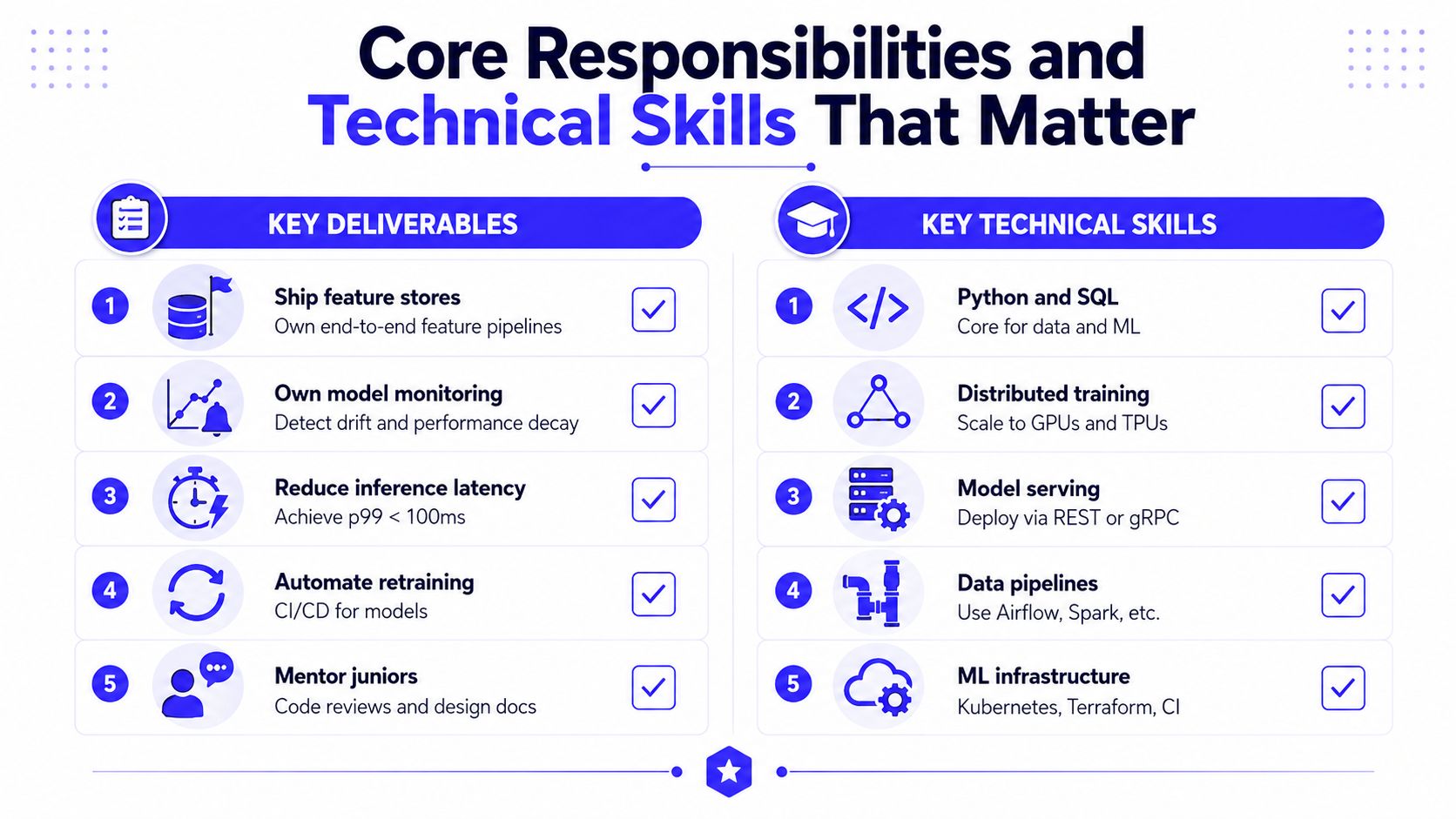
A feature release can fail even when its offline score improves. The senior machine learning engineer is the person who traces that failure from an invalid input or stale feature to a serving decision, then fixes the system without creating a larger operational burden. Their weekly output should resemble a production roadmap: reviewing an inference change, investigating an alert, writing a design document, improving a pipeline, and mentoring another engineer.
The role covers data preparation, model development, serving, and operational feedback. A useful guide to the machine learning engineer role reflects that breadth. A senior hire needs implementation skill, but also the judgment to decide whether more modeling work will improve the product or merely add complexity.
What the engineer should own
Data and feature systems are a primary ownership area. The engineer should define data contracts, add validation, trace feature lineage, and design retraining workflows that run consistently. A feature store may help a larger organization coordinate reuse and governance. For a small product, a versioned feature pipeline can be easier to operate and debug.
Model serving separates a senior owner from a contributor who focuses mainly on training. Candidates should understand batch and online inference, serialization, versioning, health checks, autoscaling, and rollback. They should also recognize when a simpler serving path reduces failure modes and support work.
Observability must cover more than uptime. Production signals should expose drift, skew, degraded latency, broken data feeds, and model performance once labels become available. Senior practitioners maintain runbooks for deployment, rollback, and incident response, as described in the MLOps role guide. Ask for examples of incidents they diagnosed, not only dashboards they built.
Latency-sensitive systems require concrete benchmarking. Ask candidates how they would measure p95 and p99 latency, throughput, GPU memory use, tokens per second per GPU, and cost per token. Senior LLM and inference roles may compare vLLM, SGLang, TensorRT-LLM, and Triton, then tune quantization, batching, caching, and scheduler behavior. The decision is acceptable quality at a unit cost and latency the product can support, as shown in this LLM inference optimization role specification.
The skills signal
Look for strong Python and SQL, cloud fundamentals, distributed processing, containers, CI/CD, model serving, and infrastructure-as-code. A specific framework matters less than the ability to learn the stack and explain its operational consequences.
Novel architecture design and academic publishing are useful signals, not default requirements. They become requirements when the role includes research. Candidates can use this resource on writing an engineer resume to present production ownership clearly.
A strong senior engineer connects business outcomes to technical measures. They explain why an offline metric matters, where it stops predicting value, and which production feedback loop will validate the model.
Senior ML Engineer vs Adjacent AI Roles
Titles overlap, but ownership boundaries shouldn't. A data scientist may design a rigorous experiment without owning the serving platform. An MLOps engineer may build excellent deployment infrastructure without selecting or training models. A research scientist may produce an important algorithm that still requires an engineering team to operate it.
Use the comparison below to define the problem before opening a requisition.
| Role | Primary Output | Production Ownership | When to Hire |
|---|---|---|---|
| Senior ML Engineer | Production model systems and iterative improvements | Owns the path from data through deployment and monitoring | Your product depends on reliable model behavior and the team needs one technical owner |
| MLOps Engineer | Infrastructure, automation, and platform capabilities | Owns deployment foundations, environments, registries, and operational tooling | Your modeling team can build models but deployment, reliability, or platform work is the bottleneck |
| Data Scientist | Analysis, experimentation, forecasts, and decision support | Often owns experiment quality, not necessarily production serving | The primary need is statistical analysis, causal reasoning, or business experimentation |
| Research Scientist | New methods, architectures, or scientific findings | Production ownership varies and may sit outside the role | Your advantage depends on novel algorithmic work or research output |
| AI Product Manager | Product direction, requirements, prioritization, and adoption | Coordinates outcomes rather than operating model infrastructure | The technical team needs sharper problem definition and product accountability |
Diagnose the bottleneck first
Hire a senior machine learning engineer when a model already has product relevance and the team needs someone to make the full system dependable. This is especially important when data pipelines, feature engineering, deployment, monitoring, and continuous optimization sit with one role, as shown in this applied AI engineering role.
Choose an MLOps engineer when the models are adequate but teams cannot ship them safely. Choose a data scientist when the business still needs to establish whether a relationship is real, useful, or statistically defensible. Choose a research scientist when the product's central risk is algorithmic novelty rather than production execution.
A research-heavy candidate can struggle in a role dominated by incidents, data contracts, and deployment decisions. A platform-heavy candidate can struggle when the job requires deep model selection. Match the interview to the actual failure mode.
One practical example makes the distinction clear. If predictions are accurate in a notebook but fail because training and serving features diverge, you need production ML ownership. If the team cannot determine whether a treatment changes customer behavior, you need experimental design. If the serving path is stable but GPU scheduling and deployment automation are unreliable, MLOps may be the better first hire.
Job Description Template and Interview Framework
Most job descriptions for this role are overloaded with libraries and credentials. That language attracts candidates who can list tools, but it doesn't always attract engineers who have operated systems under real constraints.
Start with the outcome:
Role purpose: Own the design, deployment, monitoring, and continuous improvement of machine learning systems that support a defined product or business workflow.
Then describe the operating context. Name the data sources, serving mode, cloud environment, collaboration partners, on-call expectations, and decisions the engineer will own. Avoid requiring a specific degree or publication record unless the work depends on research.
A useful description includes:
- First-quarter outcomes: Ship a production change, improve observability, and document the operating path.
- Technical scope: Python, SQL, data pipelines, model serving, containers, cloud systems, CI/CD, and monitoring.
- Decision rights: State which architecture and reliability decisions belong to the role.
- Collaboration: Explain how the engineer works with product, data, platform, and security teams.
- Growth path: Clarify whether the role can develop toward staff engineering, platform leadership, or applied research.
For legal and clarity checks, hiring teams can consult this guide to writing a compliant job posting. The posting should describe essential responsibilities accurately and separate required capabilities from learnable tools.
Evaluate evidence, not vocabulary
A senior interview should test system design, technical execution, and communication. LeetCode-style exercises may reveal general coding ability, but they won't tell you whether a candidate can recover a broken feature feed or choose a sensible serving architecture.
| Stage | Format | Key Evaluation Criteria | Sample Focus Area |
|---|---|---|---|
| Technical screen | Structured conversation | Production reasoning, data contracts, debugging approach | Design a pipeline with validation, lineage, and rollback |
| Take-home | Bounded system exercise | Reproducibility, observability, trade-offs, documentation | Handle drift, latency constraints, and a failed input feed |
| Deep dive | Candidate presentation | Ownership, decision quality, ability to defend alternatives | Explain a production incident and the corrective design |
| Cross-functional panel | Scenario discussion | Communication, prioritization, stakeholder judgment | Push back on an unrealistic accuracy or launch request |
A good take-home doesn't reward building the largest system. It gives candidates a constrained problem and asks them to state assumptions, failure modes, tests, and next steps. Score the reasoning directly.
Use a consistent rubric:
- Production ownership: Can the candidate explain what happens after deployment?
- System design: Do they make coherent choices about data, serving, and monitoring?
- Debugging: Do they isolate upstream, infrastructure, and model failures?
- Communication: Can product and engineering partners understand the trade-offs?
- Pragmatism: Do they avoid unnecessary platform complexity?
For additional question design, use the machine learning engineer interview questions resource and adapt the prompts to your own stack.
Salary Benchmarks and Compensation Planning
Compensation data for a senior machine learning engineer varies by source and methodology, so don't treat one number as a universal market price. PayScale reports a United States average salary of $165,075, with total pay ranging from $128,000 to $226,000, including bonus and profit-sharing components. Its dataset reports $157,458 for early-career senior engineers and $164,871 for mid-career senior engineers, suggesting relatively tight progression after engineers reach senior scope. See the PayScale senior machine learning engineer salary data.
Another 2026 labor-market analysis reports a $197,000 median ML engineering salary across 13,776 U.S. postings since January 2026 and approximately 490 new U.S. postings per week. A separate benchmark lists $260,000 to $430,000 base salary for senior ML engineers in the United States, with some total packages reaching $322,750 to $521,400 and aggressive counteroffers for top-tier talent reaching $900,000. These figures describe competitive segments, not a guaranteed salary for every senior hire, as outlined in this ML engineering jobs market analysis.
A different salary guide reports a senior range of $240,000 to $340,000 and equity of 0.08% to 0.30%, which is useful for planning a package beyond base pay. Review the senior machine learning engineer compensation guide alongside your location, company stage, scope, and hiring channel.
| Company Stage | Region | Base Salary Range | Equity Range | Total Comp Estimate |
|---|---|---|---|---|
| Early-stage | United States | Establish from the relevant benchmark and scope | Establish from company valuation and role impact | Model salary, equity, bonus, and liquidity assumptions separately |
| Growth-stage | United States | Benchmark against production ownership and competing offers | Tie equity to vesting terms and dilution context | Compare expected value with cash-heavy alternatives |
| Enterprise | United States | Use market data for the required specialization | Often more standardized than startup packages | Include bonus, profit sharing, and long-term incentives where applicable |
Don't invent precision that the market data can't support. ZipRecruiter reports $126,557 as average annual pay as of June 29, 2026, while the PayScale figure is higher, which shows why source methodology matters. The senior machine learning engineer salary guide can help you structure the comparison, but your final offer should reflect actual scope.
Build the package around the candidate's decision criteria. Clarify sign-on terms, vesting, refresh grants, retention triggers, bonus mechanics, remote expectations, and decision authority. Mission and autonomy can help an early-stage company compete, but they won't compensate for unclear ownership or an unrealistic operating burden.
When to Hire Full-Time vs Contract or Fractional Talent
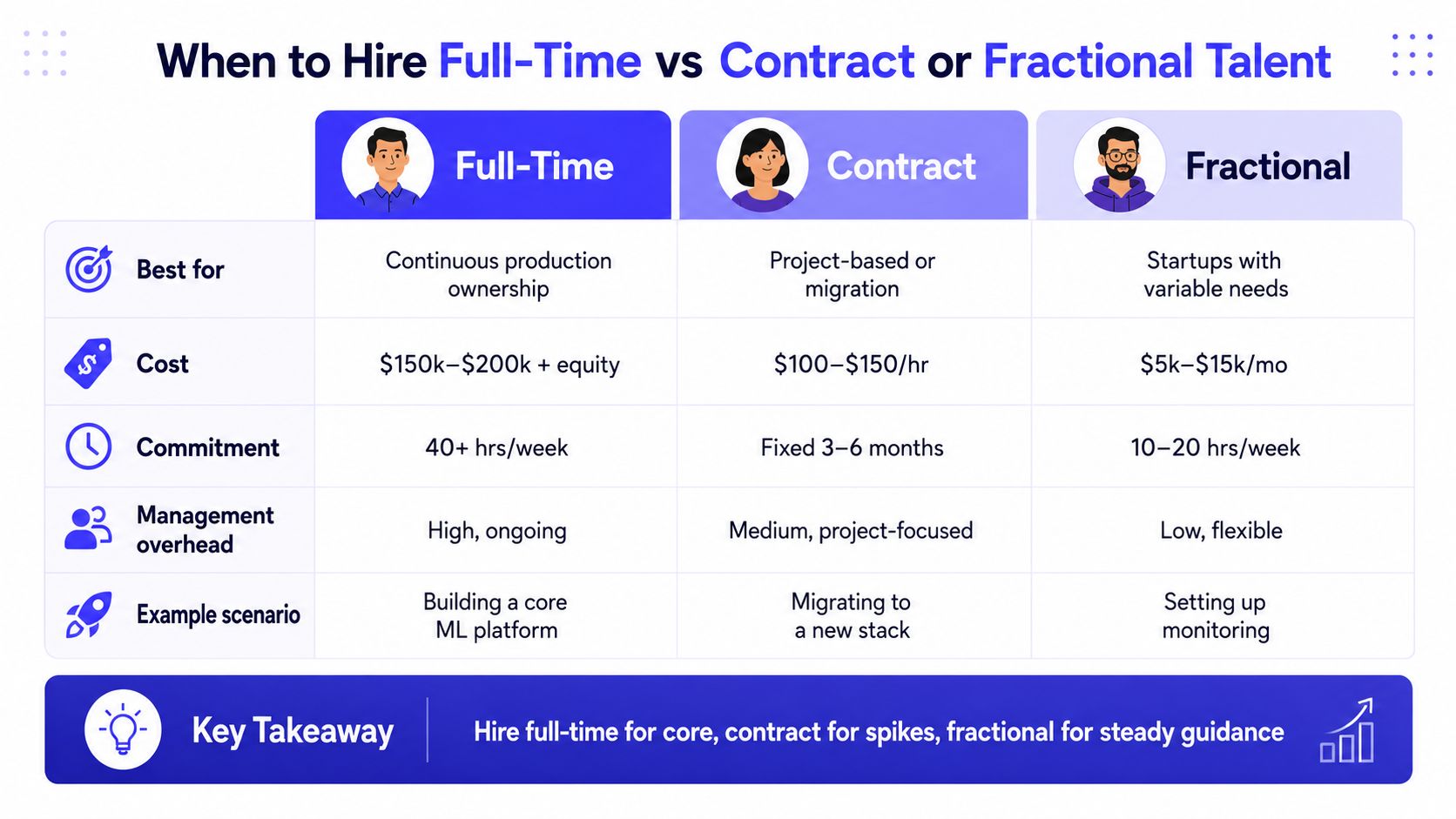
A full-time hire makes sense when machine learning is part of the product's ongoing operating model. The engineer will own deployment, monitoring, retraining, incident response, and iteration rather than completing a single migration.
Contract or fractional talent fits a narrower problem. A contract senior engineer can audit an existing stack, build an initial pipeline, migrate a serving system, or prepare a launch while your team decides what permanent ownership should look like. A fractional engineer can establish monitoring, review architecture, and mentor internal staff when the workload isn't yet consistent enough for a full-time role.
Choose the engagement by ownership pattern
Use this decision flow:
- Is ML core to the product and changing continuously? Hire full-time if the answer is yes.
- Is the work a defined build, migration, or infrastructure audit? Use a contract engagement with clear deliverables.
- Do you need recurring judgment but limited weekly capacity? Consider fractional support.
- Does the company lack internal technical capacity entirely? A consultancy or specialized talent network can help establish the first operating baseline.
- Will someone internal own the system after the engagement? If not, a short contract may only postpone the hiring problem.
The main trade-off isn't hourly cost versus salary. It's knowledge retention. A contractor can move quickly, but documentation, access controls, runbooks, and handover must be part of the deliverable. A fractional leader can improve decisions without creating a full management burden, but they may not be available during every incident.
If you use an external provider, clarify worker classification, confidentiality, intellectual property, security access, and employment practices liability. This explanation of EPLI and PEO risk explained is a useful reference when evaluating a professional employer organization or related arrangement.
A practical engagement brief should name the system, current failure, desired outcome, access required, handover owner, and acceptance criteria. Keep the first phase narrow enough to evaluate working style and technical judgment before expanding scope.
ThirstySprout offers access to senior AI engineers for full-time, contract, or fractional engagements, including machine learning and MLOps specialists. Treat that option like any other sourcing channel, and evaluate candidates against the production scorecard rather than the vendor label.
Onboarding Plan and Success Metrics for New Hires
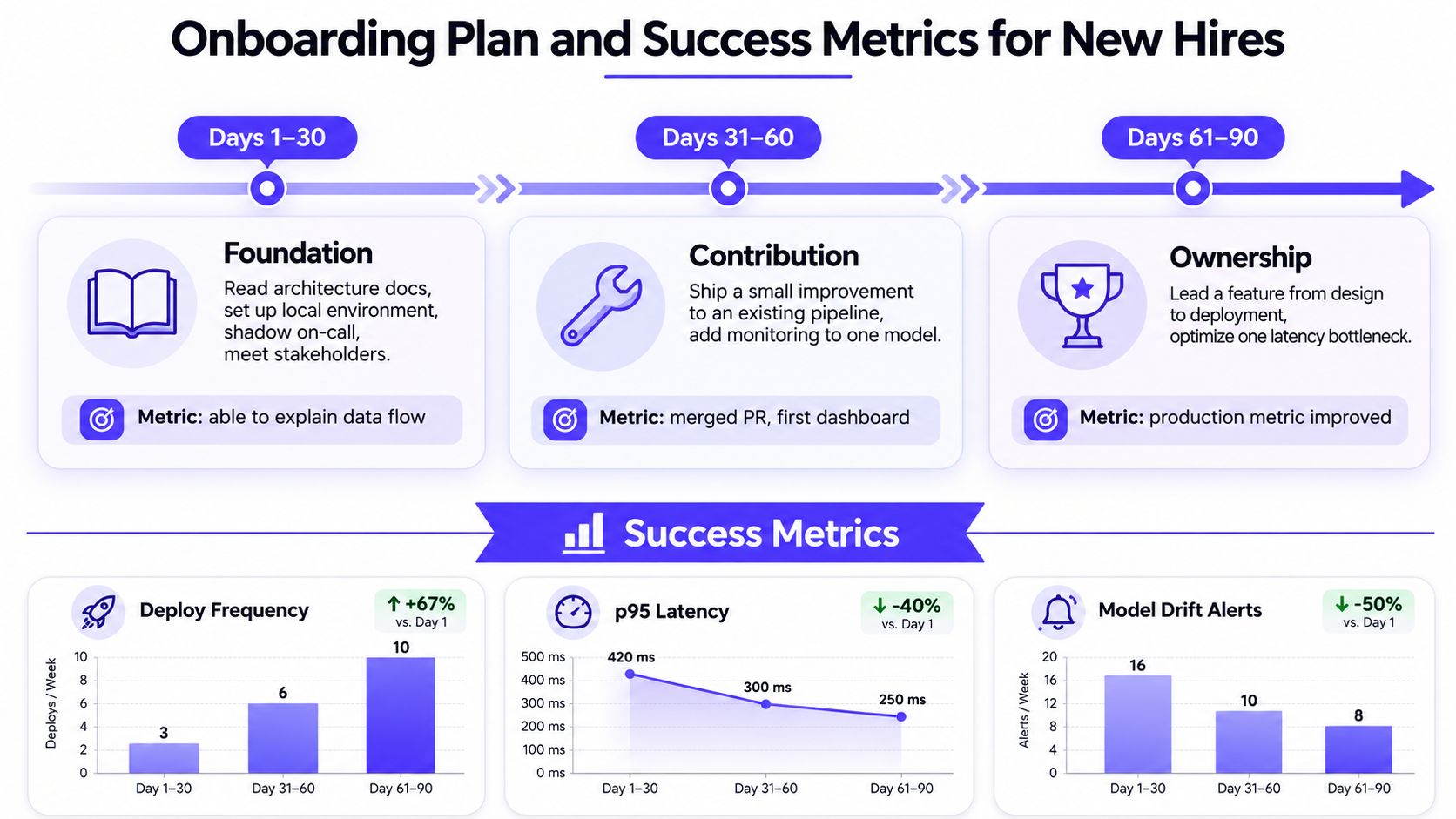
A senior hire shouldn't spend the first weeks reading documents without production access. Give them a safe path into the system, a named partner in platform engineering, and a small change they can ship early.
Days 1–30 and foundation
Provide repository access, cloud permissions, sample data, architecture documents, incident history, dashboards, and deployment runbooks. The engineer should shadow on-call or incident review, meet product and data stakeholders, and trace one prediction from source data to customer-facing output.
The first milestone is understanding, not a large feature. Ask the engineer to draw the data flow, identify the main failure modes, and submit a small end-to-end change to an existing model serving path. A merged pull request and a clear explanation of the system are stronger signals than a large speculative rewrite.
Days 31–60 and contribution
The engineer should own one feature or model iteration through training, validation, deployment, and monitoring. Require a design note that states the baseline, expected risk, rollback plan, and operational signals.
A useful dashboard should make model and system behavior visible. Depending on the product, track deployment frequency, p95 latency, error rates, data freshness, drift alerts, and eventual model performance. Don't force every metric into a single target. The right measure depends on the prediction's business role and feedback delay.
Days 61–90 and ownership
By day 90, the engineer should drive an architectural decision for at least one production system. That may mean simplifying a pipeline, improving a deployment workflow, adding a missing alert, or removing an unnecessary serving dependency.
Evaluate progress with evidence:
- System understanding: Can they explain the data and serving path without relying on the original author?
- Delivery: Have they shipped a safe production change?
- Operational readiness: Can they diagnose drift, skew, latency degradation, or broken feeds?
- Influence: Do product and engineering partners understand the trade-offs?
- Ownership: Are runbooks and design decisions clear enough for the team to maintain?
The common onboarding failure is assigning broad responsibility without decision rights. Give the new hire a bounded system, a business owner, and access to the signals needed to improve it. Then review the 30-60-90 plan with the manager, platform partner, and product stakeholder.
If you need a senior machine learning engineer who can own production systems rather than only build prototypes, ThirstySprout can help you scope the role and connect with full-time, contract, or fractional talent. Start with a focused production problem, book a 20-minute scope call, and use the scorecard above to run a pilot in 2–4 weeks.
Hire from the Top 1% Talent Network
Ready to accelerate your hiring or scale your company with our top-tier technical talent? Let's chat.