

You're probably seeing the same pattern every week. You search for remote React jobs, open 20 tabs, and half of them turn out to be hybrid, limited to one country, or implicitly optimized for senior candidates who can run on their own with very little supervision.
That doesn't mean the market is dead. It means the market is filtering harder.
Remote React hiring is still active. Live job-board snapshots showed 52% of React developer jobs were remote overall on Web3.career, with monthly remote shares ranging from 39% in Oct 2025 to 75% in Feb 2026 and 73% in May 2026. In the same period, Glassdoor listed 986 remote React developer jobs, and RemoteRocketship showed 154 remote React engineer roles, according to Web3.career's React job market snapshot. The opportunity is real. The noisy advice around it is the problem.
The strongest candidates don't win by spraying applications. They win by looking like a low-risk remote hire who can ship product, communicate clearly, and contribute beyond the component layer.
The 5-Step Playbook for Your Remote Job Search
Treat your search like a product sprint, not a lottery. A good process keeps you from wasting time on misaligned roles and helps you compound signal with every application.
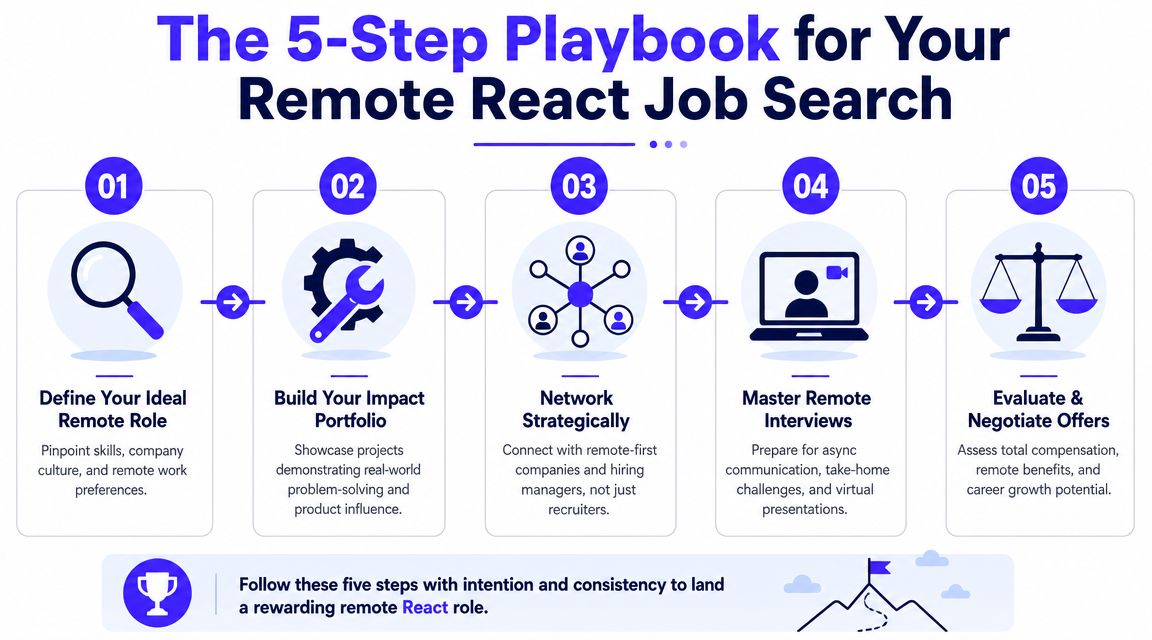
Define your target role
“Remote React developer” is too broad to be useful. Narrow it down by stack, product shape, and work style.
For example, these are very different searches:
- Next.js product engineer for SaaS teams shipping customer-facing flows
- React plus GraphQL front-end engineer for platform-heavy B2B tools
- React plus Node full-stack engineer for startup teams with small squads
- React plus AI prototyping engineer for teams building experimental product features
A tight target changes everything. Your résumé gets sharper. Your portfolio gets more coherent. Your outreach sounds informed instead of generic.
If you're also exploring adjacent roles, this guide to full-stack remote jobs is useful because many React openings implicitly favor candidates who can own some server-side and product integration work.
Build evidence, not just projects
Remote hiring managers need proof that you can work without hand-holding. A polished UI gallery won't do that.
Show work that answers practical questions:
- Can you make architecture choices?
- Can you handle API failures and edge cases?
- Can you write tests?
- Can you explain trade-offs in writing?
- Can you improve performance without breaking the product?
Practical rule: Every portfolio project should make a hiring manager think, “This person can probably own a feature with limited supervision.”
Source with intent
Don't just browse job boards. Build a short target list of remote-first companies, product-led startups, and teams whose stack matches yours. Then filter hard on geography, time-zone rules, and seniority expectations.
Engage like a peer
A strong application feels like a small work sample. Tailor your intro, reference one relevant product detail, and point to a project that maps to the role. You're not trying to sound enthusiastic. You're trying to reduce doubt.
Evaluate before you commit
The right remote job isn't the one with the best headline number. Contract setup, overlap expectations, written communication culture, and manager quality often matter more after month three than they do on offer day.
Craft a Portfolio That Proves Product Impact
Most React portfolios fail for one simple reason. They show code, but they don't show ownership.
A recruiter may still pass them along. A hiring manager usually won't.
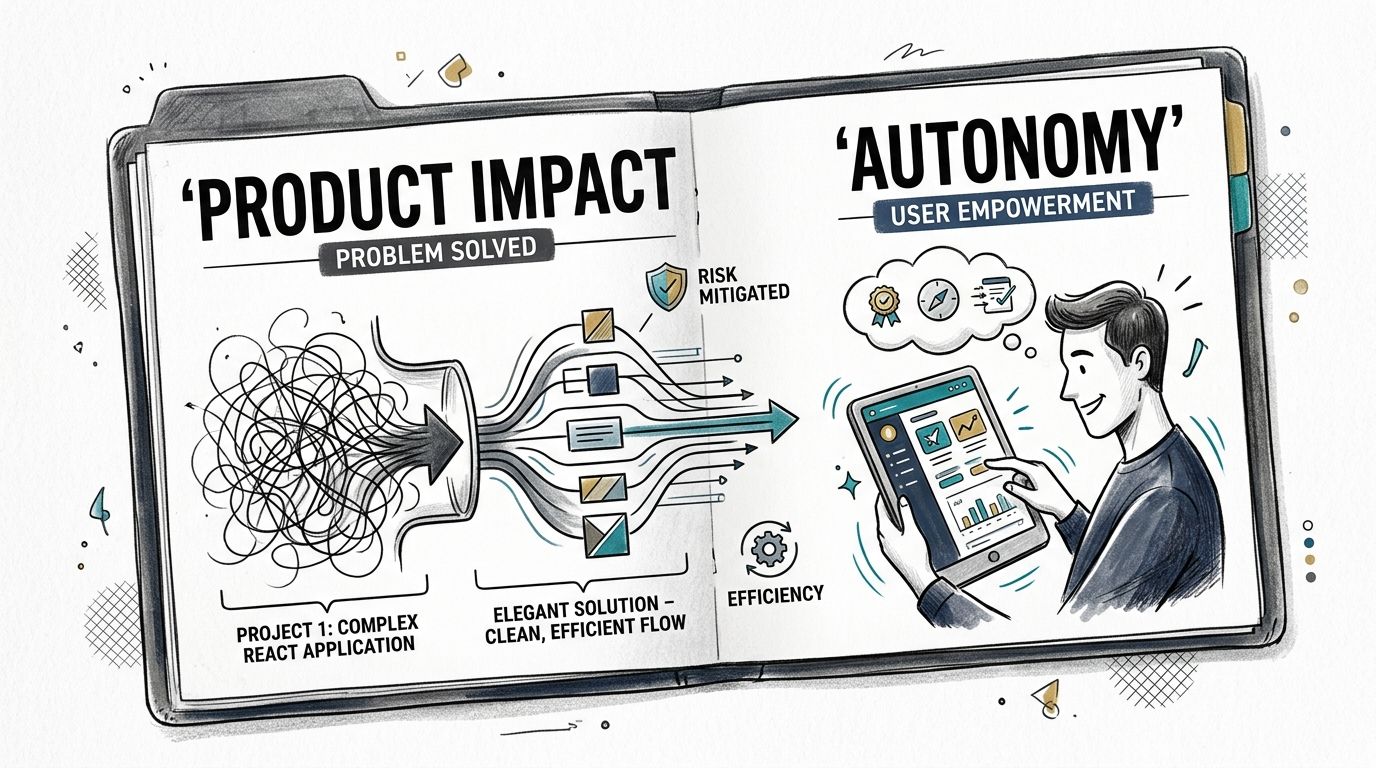
Recent listings make that gap more obvious. React roles are increasingly connected to broader product engineering, and Robert Half explicitly listed a “Software Engineer – React / GenAI Prototyping” role in its React openings, as shown on Robert Half's React job listings. That's a useful signal. Employers aren't only paying for component composition. They want people who can help shape features, wire systems together, and test ideas quickly.
Build one project that feels like a real product
A to-do app doesn't prove much. A focused product prototype does.
Here's a stronger portfolio project:
Mini-case example
Build a React app for support teams that lets users paste a customer conversation, generate a reply draft with an AI API, edit the response, and save prompt versions. Add authentication, usage states, error handling, loading fallbacks, and a basic analytics view.
That single project lets you demonstrate:
- Front-end architecture with React, TypeScript, and route structure
- Product judgment through UX decisions around latency, retry states, and editability
- Integration skill through API design and response handling
- Testing discipline with Jest and React Testing Library
- Remote-readiness through documentation that another engineer can pick up asynchronously
Remote React job guidance consistently emphasizes stack breadth beyond React itself, including Next.js, TypeScript, GraphQL, state management such as hooks, Zustand, or Redux, plus testing with Jest and React Testing Library, and it recommends presenting 1–2 end-to-end projects with documented setup, design trade-offs, and test coverage, as noted in Underdog's guide to React remote jobs.
Write the README like a handoff doc
At this point, most candidates leave signal on the table.
A strong README should include a short problem statement, setup steps, architecture notes, trade-offs, and known limitations. Don't hide the compromises. Explain them.
A useful structure looks like this:
| Section | What to include |
|---|---|
| Product goal | Who the user is and what problem the app solves |
| Tech choices | Why you picked Next.js, TypeScript, GraphQL, or REST |
| Trade-offs | What you optimized for first, and what you postponed |
| Testing | What is covered and what still needs integration or end-to-end tests |
| Operational notes | Environment variables, deployment assumptions, and failure cases |
Your portfolio is doing two jobs at once. It shows technical execution, and it shows how you communicate when nobody is sitting next to you.
If you want examples of how React work expands into mobile product thinking, RapidNative's guide to React Native is worth skimming. Not because you need to pivot to mobile, but because it highlights the same pattern employers care about in web roles too. Product constraints, platform trade-offs, and implementation choices matter more than pretty screenshots.
Show the decisions, not just the demo
A quick Loom walkthrough or short recorded demo helps, but don't stop there. Add a short “why these choices” section under each project.
A hiring manager should be able to answer these questions within two minutes:
- What business problem does this solve?
- What part did you own end to end?
- Where did performance or complexity show up?
- How did you verify quality?
- What would you improve next?
Here's a useful reference if you want a walkthrough on presenting technical work clearly:
Find and Engage High-Signal Remote Companies
A lot of wasted effort in remote React jobs comes from applying to roles you were never realistically eligible for.
The listing says remote. The fine print says one country only, partial overlap with one region, or a communication standard that expects very polished written English and independent planning.
Indeed's remote React listings show that pattern clearly. Some roles require an “idiomatic level” of English and strict communication discipline, while others are explicitly hybrid, according to Indeed's remote React job listings. That distinction matters because “remote” can mean three completely different working models.
Learn the three flavors of remote
Use this quick filter before you spend time customizing an application:
| Remote type | What it usually means | What to check first |
|---|---|---|
| Work from anywhere | Broad location flexibility | Payroll setup, legal eligibility, async expectations |
| Region-bound remote | Remote within a country or region | Residency requirement, tax setup, core collaboration hours |
| Hybrid or office-optional | Some flexibility, but office presence still matters | Commute expectation, relocation pressure, team norms |
The mistake mid-level candidates make is treating these as equivalent. They aren't.
A role that requires heavy overlap with U.S. hours might still be a great fit if you want close collaboration and strong mentorship. A work-from-anywhere role may sound better, but if the company is sloppy about documentation and decision-making, day-to-day work can be harder.
If a job post is vague about location, overlap, or communication norms, assume those details are part of the screening criteria.
Deconstruct the job description like an engineer
Read the posting in three passes.
First, mark the hard filters. These are experience level, geography, working hours, and must-have tools.
Second, mark the delivery signals. Look for phrases like own features, collaborate cross-functionally, improve performance, write tests, communicate estimates, or work independently.
Third, mark the future direction. If the role mentions experimentation, platform migration, product modernization, or AI-adjacent work, that tells you what the team is becoming, not just what it is today.
Candidates exploring adjacent markets should also watch how AI-facing teams hire product engineers. This overview of AI remote jobs is helpful for spotting companies where React work sits closer to product experimentation than pure front-end delivery.
Send outreach that proves relevance
Cold outreach works best when it feels like a precise match, not a plea.
Use a note like this:
Hi [Name], I'm a React engineer focused on shipping end-to-end product features with TypeScript, testing, and API integration. I noticed your team is hiring for a remote React role with emphasis on [performance / async collaboration / product experimentation]. I built a recent project that maps closely to that work, including [short relevant detail]. If helpful, I'd be glad to share a brief walkthrough and a few notes on the trade-offs I handled.
That works because it does three things well:
- Shows targeting instead of mass applying
- Reflects their priorities rather than your generic interest
- Offers proof without forcing a long back-and-forth
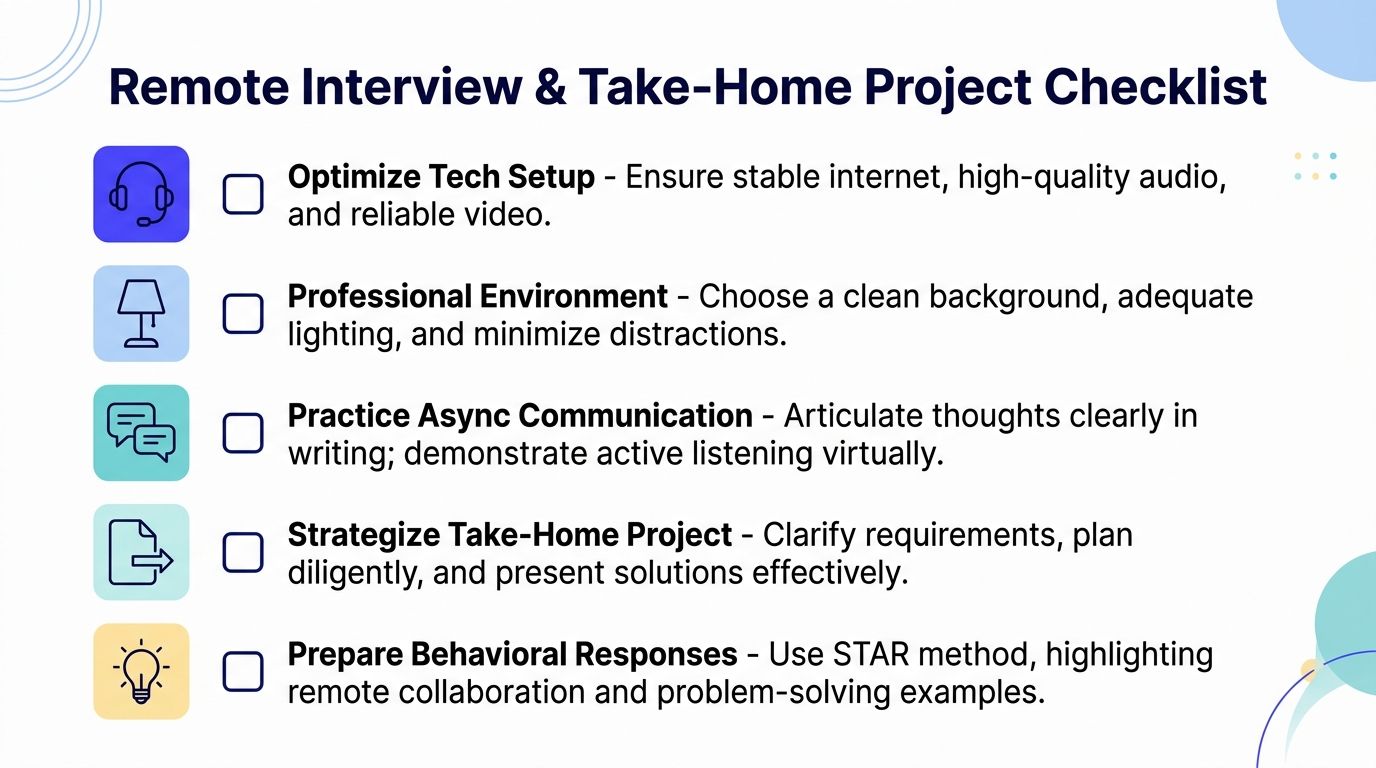
Prepare for the Remote Interview and Take-Home Project
Remote interviews aren't just technical screens over Zoom. They're trust tests.
Teams are trying to answer a harder question than “Can this person code?” They want to know whether you can unblock yourself, write clearly, make decisions with imperfect information, and collaborate without constant synchronous access.
One major market listing for remote React and Node roles requires at least 3+ years of experience and 4 hours a day overlapping with U.S. time zones, while also emphasizing automated testing and performance optimization, according to Turing's remote React and Node job listing. That tells you what many interview loops are measuring. Independent delivery, communication quality, and practical engineering maturity.
Handle the live interview like a design review
Don't narrate every thought. Structure it.
A clean pattern is:
- Restate the problem
- Name your assumptions
- Offer two possible approaches
- Choose one and explain why
- Call out trade-offs
- Mention testing and failure cases
That structure makes you sound easier to work with. It also mirrors how strong remote engineers write decision notes and technical comments.
Here are behavioral prompts worth practicing:
- Autonomy question
Tell me about a time you hit a blocker and moved the work forward without immediate help. - Async collaboration question
How do you communicate status when requirements are still moving? - Quality question
Describe a bug or performance issue you caught before release. - Trade-off question
When did you choose a simpler solution over a more scalable one, and why?
Interview shortcut: The clearest candidate often beats the flashiest candidate in remote hiring.
If you want to sharpen your answer style on core topics, this set of React interview questions and answers is a useful practice resource.
Turn the take-home into a proof package
Most candidates submit code and stop there. That misses the point.
Your take-home should include:
- A concise README with setup, assumptions, and trade-offs
- A short architecture note explaining state management, data fetching, and testing choices
- A brief product note on what you'd improve with more time
- A polished commit history that shows organized progress, not chaos
Here's a lightweight submission template:
| Artifact | What it signals |
|---|---|
| README | Clear async communication |
| Test file examples | Engineering discipline |
| Small design note | Product thinking |
| Recorded walkthrough | Stakeholder-friendly communication |
For candidates who also touch mobile stacks, best practices for React Native can help you think about maintainability, component boundaries, and production-readiness. The same habits transfer well to web take-homes.
What strong candidates do differently
They ask clarifying questions early. They don't overbuild. They explain what they chose not to build.
That last point matters a lot. In a remote team, judgment is visible through omission as much as implementation.
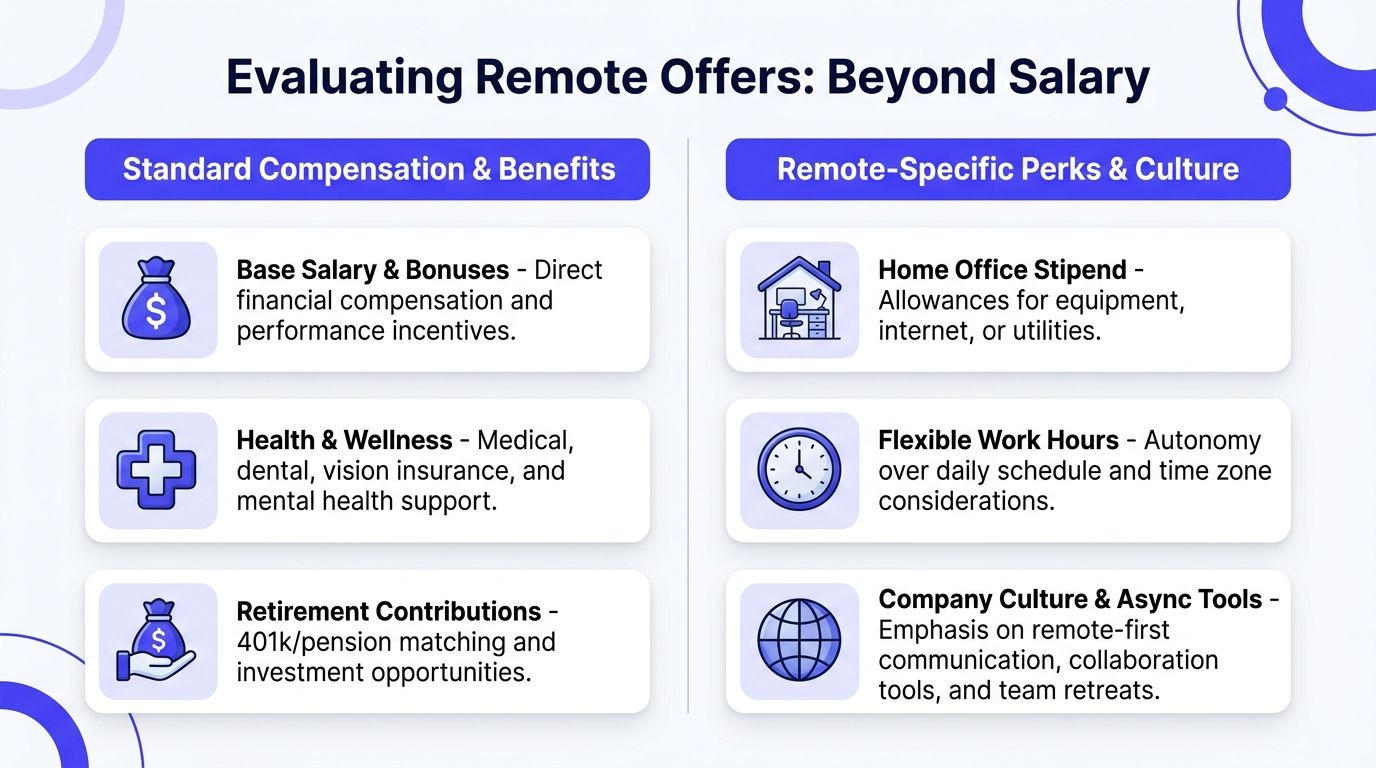
Evaluate Remote Offers Beyond the Salary
When you finally get an offer, don't reduce the decision to compensation alone. A remote role can look excellent on paper and still create daily friction if the work model is wrong for you.
The country where the employer operates also shapes the offer structure. In the 2025 Stack Overflow Developer Survey, the United States had the highest share of developers working remotely at 45%, while Germany reported 21% and the United Kingdom reported 31%, according to Stack Overflow's 2025 work survey. That affects common contract patterns, salary expectations, and how often companies hire internationally versus locally.
Use a simple offer scorecard
Score each offer across categories that affect your actual week, not just your headline pay.
| Category | Questions to ask |
|---|---|
| Contract setup | Are you an employee or contractor, and what does that change for stability and benefits? |
| Time-zone expectations | How many collaboration hours are fixed, and how often do meetings spill outside them? |
| Remote support | Is equipment covered, and who pays for the practical costs of working remotely? |
| Team operating style | Does the team document decisions, write specs, and respect async communication? |
| Growth path | Will you keep building the same UI tickets, or will you get broader product ownership? |
Two offers can look similar and still feel very different
Offer A might pay more, but require daily late-evening overlap, weak onboarding, and constant Slack availability.
Offer B might be more modest on paper, but come with clearer ownership, healthier team habits, and stronger long-term learning.
A remote offer is only as good as the working model behind it.
Questions worth asking before you sign
- How does the team make decisions when people are offline?
- What does a strong first 90 days look like in this role?
- How often are product and engineering priorities re-scoped?
- What writing is expected from engineers?
- Are remote employees evaluated differently from people near headquarters?
Those questions surface operational maturity fast. They also signal that you understand remote work as a system, not a perk.
Your Remote React Job Search Checklist
Use this as a working list, not inspiration.
Positioning checklist
- Choose a narrow target such as Next.js product engineer, React plus GraphQL engineer, or React plus AI prototyping engineer.
- Rewrite your résumé around shipped features, performance work, testing, and collaboration, not task lists.
- Create one clear headline that describes the value you bring in remote React jobs.
Portfolio checklist
- Build 1–2 end-to-end projects instead of several small demos.
- Document trade-offs in the README so hiring teams can assess your judgment.
- Include testing evidence with Jest or React Testing Library where relevant.
- Record a short walkthrough that explains problem, architecture, and next steps.
Sourcing checklist
- Filter for real remote fit by checking geography, overlap hours, and async expectations.
- Keep a target list of companies, contacts, and application status.
- Write personalized outreach tied to the company's actual product and stack.
Interview checklist
- Practice structured answers for autonomy, blockers, testing, and trade-offs.
- Prepare your environment with stable audio, lighting, and a clean setup.
- Submit take-homes with context including assumptions, limitations, and reasoning.
Offer checklist
- Compare contract models and understand the implications for benefits and stability.
- Ask about time-zone demands before accepting.
- Score the team's remote maturity based on documentation, onboarding, and manager clarity.
What to Do Next
Start with three moves.
First, turn the checklist above into a tracker you'll use. A simple spreadsheet or Notion board is enough if you review it every few days.
Second, rebuild one portfolio project so it signals end-to-end ownership, not just React fluency. If your routines need work while you do that, this guide to optimize your remote work habits is a practical companion because hiring teams notice consistency long before they trust autonomy.
Third, spend less time on generic boards and more time on high-signal opportunities. If you're evaluating remote product engineering roles across AI-adjacent teams, networks such as ThirstySprout can be one option to watch because they connect companies with vetted remote engineering talent across full-time, contract, and fractional work.
If you're hiring remote product engineers or building an AI team that needs senior front-end and full-stack talent, ThirstySprout helps companies connect with vetted remote engineers who can ship production work across modern stacks and time zones.
Hire from the Top 1% Talent Network
Ready to accelerate your hiring or scale your company with our top-tier technical talent? Let's chat.