

You need to fill a remote AI role now, not after a long sourcing cycle, three recruiter syncs, and a stack of resumes from people who have only played with demos. That’s the problem with most searches for ai remote jobs. Volume is easy. Signal is not.
The market is active, but it’s uneven. Remote and hybrid demand rose 19.8% in Q4 2025 compared with Q4 2024, and technology remained one of the biggest remote hiring categories, according to Toptal’s remote work demand research. At the same time, AI hiring is concentrated among a small share of firms, which means the best candidates often disappear before a broad job-board process even starts.
If you’re a CTO or founder, a key question isn’t “where can I post?” It’s “which channels give me production-ready people fastest, and which channels will waste a week?” This list is built for that decision.
I’ve grouped the options the way operators use them. Some are high-signal networks when you need someone who’s shipped LLM, MLOps, or data systems. Others are high-volume boards that work when you have internal screening capacity. A few are niche sources worth using to find specialists who won’t show up on broader platforms.
If you’re evaluating options from the candidate side too, this roundup of best AI job search tools is a useful companion. For hiring managers, the list below is about speed, vetting, and where noise tends to creep in.
1. ThirstySprout
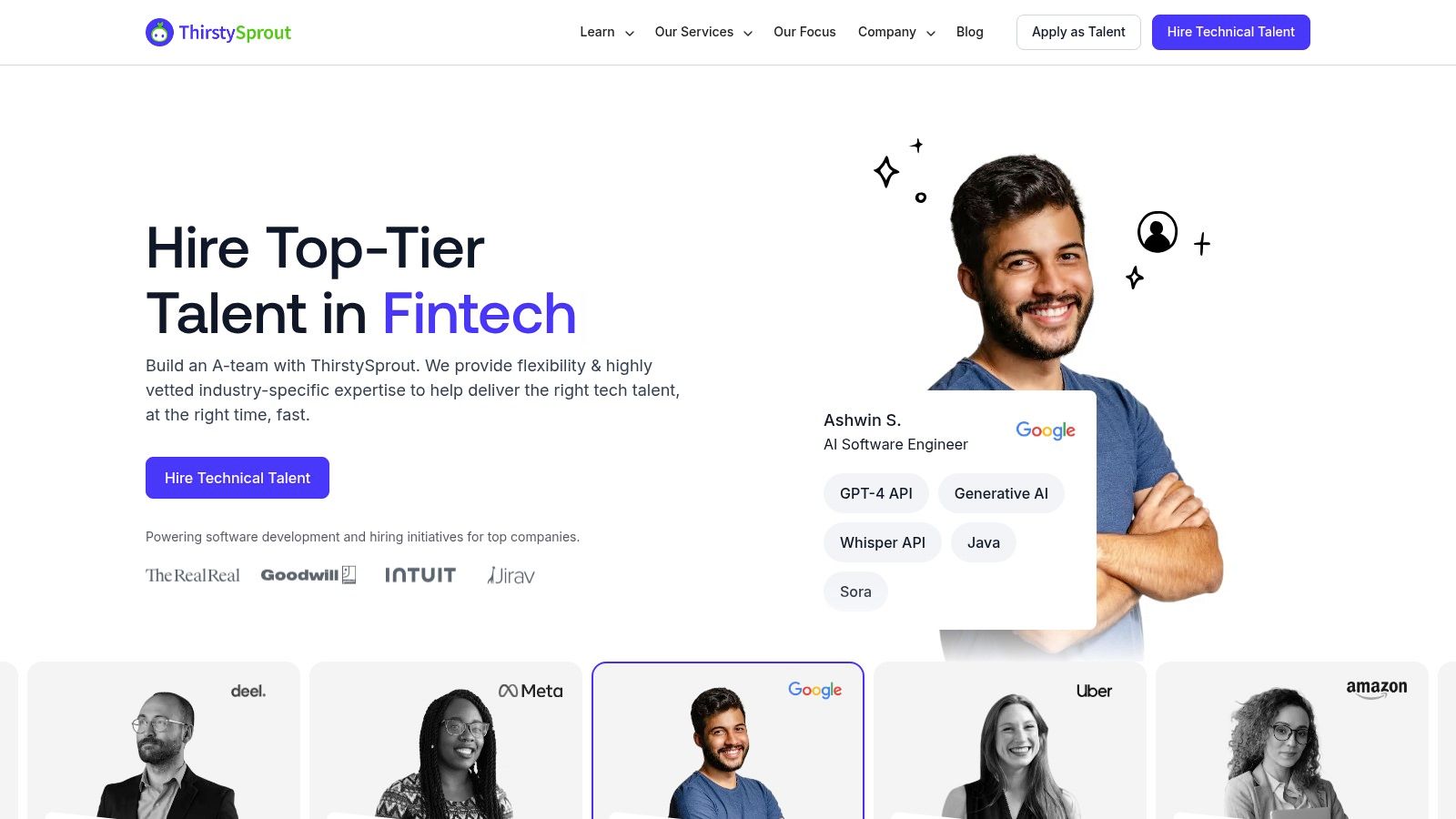
A common hiring scenario looks like this. The product is already in production, customer usage is growing, and the gap is no longer model experimentation. You need someone who can own retrieval quality, deployment safety, data pipelines, and the handoff between engineering and ML. In that case, ThirstySprout is a high-signal source worth checking first.
It is built around remote-first AI and engineering hiring, with a clear bias toward candidates who have shipped systems, not just discussed them. In ai remote jobs, that difference shows up fast during interviews. Strong candidates can explain failure modes, rollback plans, eval design, data contracts, and what breaks when multiple teams touch the same ML stack.
Where it fits best
This source makes the most sense in three situations:
- You need a senior builder fast: ML engineer, MLOps lead, data engineer, or backend engineer with real AI delivery experience.
- You have not locked the hiring model yet: Full-time, contract, fractional, or a small managed team can all work.
- You want a shortlist, not a flood: Useful when your team values screening quality more than top-of-funnel volume.
That makes it different from broad job boards in this list. Broad boards help when you can absorb noise. A curated source is stronger when each interview slot is expensive and the role touches production systems.
The trade-off is straightforward. You get speed and tighter screening, but you should expect a sales conversation and a custom process rather than self-serve posting. For a founder or CTO hiring under deadline, that is often the right trade.
Practical rule: Use a curated hiring partner when one weak senior hire can delay a release, create architecture churn, or force the rest of the team into cleanup mode.
The company shows recognizable client logos, including Mailchimp, Intuit, Rover.com, RealReal, and Deel. That is not a substitute for technical diligence. It is a useful signal that the audience is teams with real delivery pressure.
What works and what to watch
What works:
- Stronger production signal: Better fit for hiring around shipped systems than purely academic or prototype-heavy backgrounds.
- Faster path to interviews: Helpful when you need qualified conversations to start quickly.
- Flexible scope: Useful if you are deciding between one senior hire and a smaller pod around a milestone.
What to watch:
- Pricing is not public: You will need to scope the role and discuss terms directly.
- It is not built for cheapest-applicant sourcing: Teams optimizing for lowest cost and maximum volume will get more raw applicants elsewhere.
One hiring pattern works well here. Start with one senior remote AI engineer or MLOps lead tied to a specific production milestone. Let that person pressure-test architecture, tool choices, and workflow gaps before adding headcount. If your team still needs to tighten async execution before bringing in that level of ownership, this guide on managing a remote team effectively is a useful check before you hire.
2. We Work Remotely
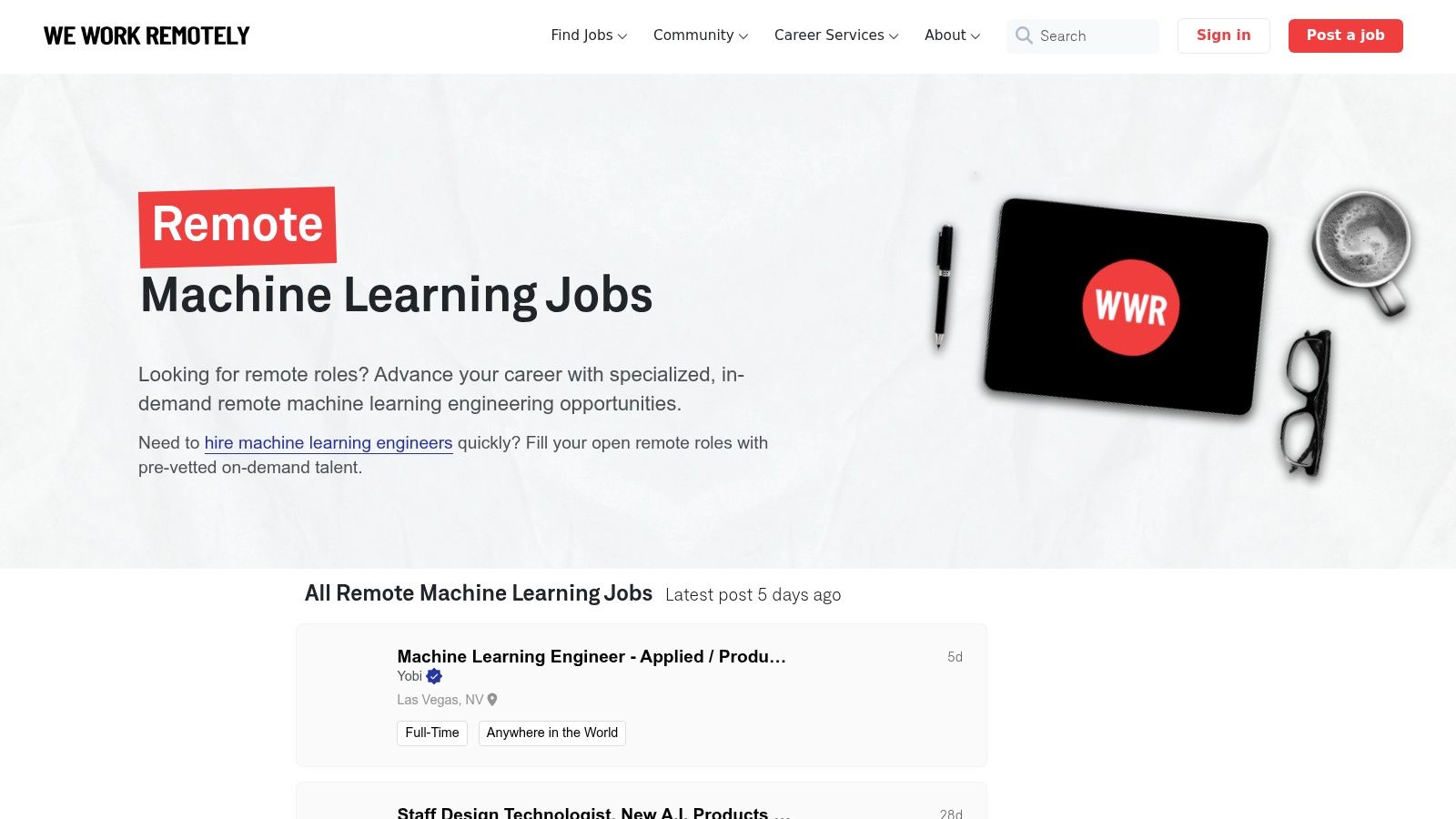
We Work Remotely is a high-volume remote board with enough category structure to make it useful for AI and machine learning searches. It’s not a deep vetting source. It is a strong top-of-funnel source if your team can screen well.
The listings span startup roles, established tech companies, and remote-friendly employers with clear geographic constraints. That makes it useful when you need reach and remote relevance at the same time.
Best use case
Use We Work Remotely when you have internal interview capacity and want to source broadly without immediately drowning in hybrid and onsite noise.
That’s especially helpful for teams already comfortable with asynchronous collaboration and distributed management. If your interview process is weak, volume will bury you. If your process is tight, this board can produce useful options quickly. Teams still building those habits should tighten their operating model first. This guide on managing a remote team is a good place to pressure-test whether your environment is ready for a senior remote hire.
A simple screening rule works well here:
- Ask for one shipped system: Not a side project.
- Ask for their exact role: Design, deployment, evaluation, or maintenance.
- Ask what broke: Strong candidates answer this clearly.
Good remote AI candidates explain trade-offs in plain English. Weak ones stay abstract.
The main downside is apply-flow inconsistency. Some listings route cleanly to the employer. Others bounce through partner networks or duplicate listings. Always verify the final destination and make sure the role is still open on the company’s own careers page.
3. aijobs.net

aijobs.net is one of the cleaner niche boards in this space because it stays close to AI, machine learning, data science, and adjacent technical roles. That narrower scope cuts out a lot of the junk you get from broad “tech jobs” pages.
For hiring managers, that focus is useful when the role is technical. You’ll still need to vet carefully, but the initial pool is more relevant.
When niche beats scale
This board is a good fit when the title itself is precise. Think ML engineer, data scientist, computer vision engineer, or MLOps engineer. If your spec is fuzzy, a niche board won’t fix that. It’ll just produce a smaller pile of mismatched resumes.
That’s why I’d pair it with a tighter role definition before posting. If your team is still collapsing machine learning engineer, data engineer, and research engineer into one bucket, stop and clean that up first. This breakdown of what a machine learning engineer does helps separate implementation-heavy hiring from broader AI hiring.
One practical interview question works especially well for candidates from niche AI boards:
“Tell me about the last model or pipeline you put into production. What owned the input schema, what monitored drift, and what happened when quality dropped?”
That question quickly surfaces whether the candidate has operated in real environments or only built experiments.
The trade-off is context. aijobs.net is lean by design. You won’t always get rich company write-ups or editorial guidance around the listing. That means less noise, but fewer trust signals. Treat it as a discovery source, not a substitute for diligence.
4. Remote OK
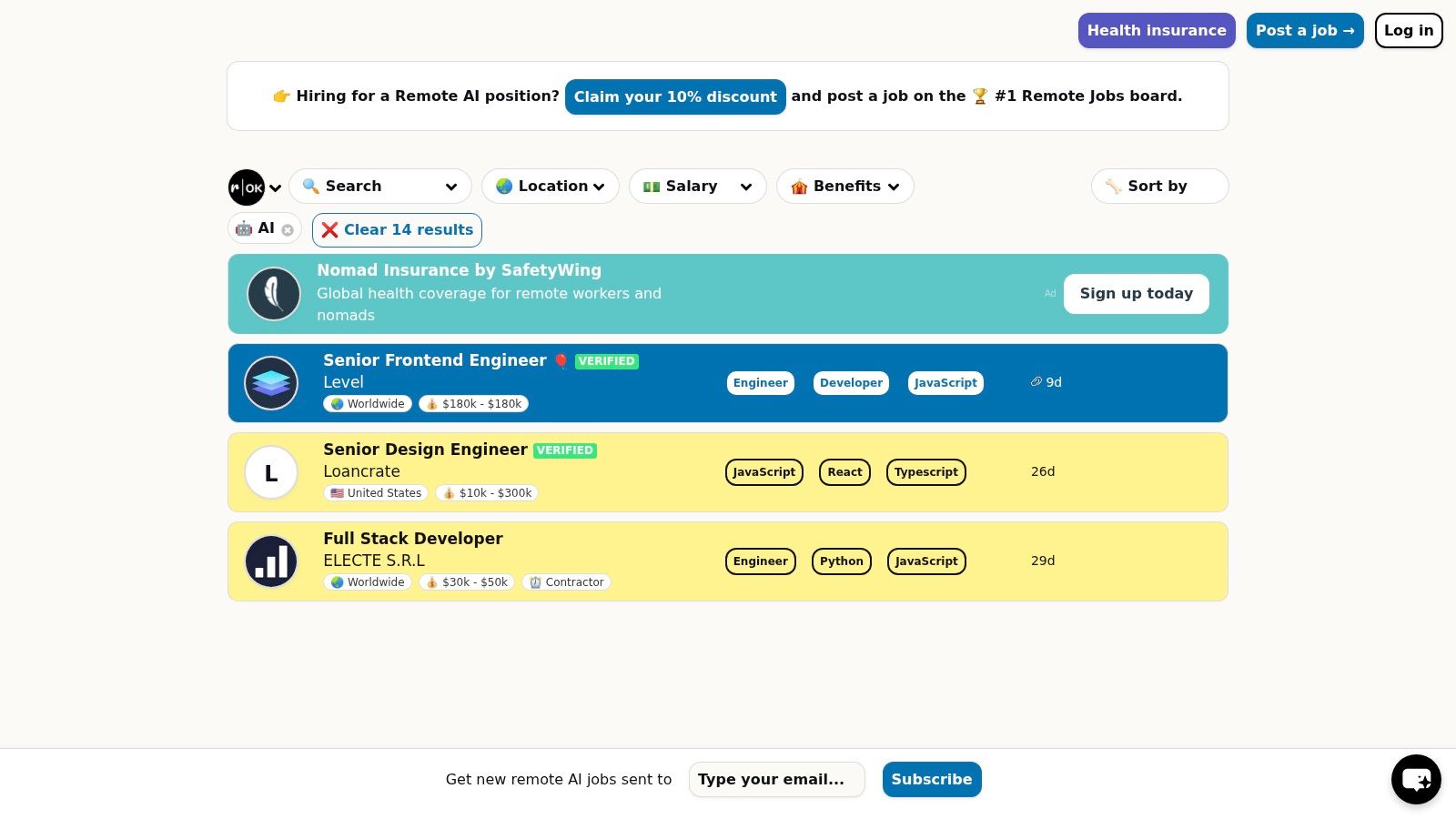
Remote OK is broad, busy, and useful if you know how to skim aggressively. Its AI category often includes visible salary tags, location cues, and enough metadata to help you reject bad-fit roles or applicants fast.
That visibility matters for busy hiring teams. A board that helps you discard poor fits in the first pass is often more valuable than one with prettier branding.
What I’d use it for
Remote OK works best for scanning market activity and finding companies or candidates who are active now. It’s useful when you want to compare how similar roles are framed across employers. That can sharpen your own job spec.
A quick calibration exercise:
- Read 10 similar listings: Note the recurring stack expectations.
- Remove vague requirements: If every listing says “AI experience,” define yours more tightly.
- Rewrite the scorecard: Separate must-have production skills from nice-to-have experimentation work.
The weakness is curation. Remote OK is a strong aggregator-style source, but not every post deserves equal trust. Duplicate listings happen. Some links route outward. Always verify on the employer site before you invest interview time.
If I were hiring for a senior LLM engineer, I’d use Remote OK for signal collection, not as my only channel. It’s good for awareness and decent for sourcing. It’s weaker as a stand-alone vetting solution.
5. NoDesk

NoDesk sits in a useful middle ground. It’s remote-focused, easier to skim than the biggest boards, and often feels closer to the kinds of companies that already know how to work asynchronously.
That’s good for ai remote jobs because hiring quality depends on the employer side too. A company can offer a remote AI role and still run a chaotic process. NoDesk’s curation reduces some of that friction.
Why founders like it
Founders and lean engineering leaders often don’t need the largest market. They need a shortlist they can review before the day ends. NoDesk is better for that than giant boards with endless pages.
I’d use it for roles where remote maturity matters as much as technical skill. A strong remote AI engineer who joins a company with poor documentation, vague ownership, and timezone chaos won’t look strong for long.
A simple job-post tweak works well here. Add one short section called “What success looks like in 30 days.” For example:
- Week 1: Review the current retrieval or model pipeline.
- Week 2: Ship one measurable improvement.
- Week 4: Present the next reliability or scale bottleneck.
Candidates who respond well to that structure are better at operating in distributed teams.
The main downside is inventory size. NoDesk is useful, but not massive. It’s best as a curated supplement, not your sole hiring engine. And if the platform pushes optional tools or upsells, I’d still direct applicants back to your own site or ATS for the final application.
6. Wellfound
Wellfound is still one of the best places to hire for startup-shaped AI roles. It gives you more company context than most job boards, and the remote filters are clear enough to avoid basic geography confusion.
That matters if you’re hiring into an early-stage team where the role is part builder, part owner, part translator between product and engineering.
Where it wins
Wellfound is strongest when you want candidates who understand startup ambiguity. The platform attracts people who are already self-selecting for growth-stage risk, changing scope, and smaller teams.
That’s especially useful for founders hiring their first or second AI specialist. If you’re in that situation, don’t post a vague “AI engineer” role and hope the right person interprets it correctly. Start with a tighter brief around product outcome, stack exposure, and operating expectations. If you’re still shaping the role itself, this guide on hiring remote AI developers is a practical starting point.
A mini scorecard I like for Wellfound candidates:
- Ownership: Have they led something from brief to release?
- Range: Can they move between experimentation and delivery?
- Communication: Can they explain trade-offs to non-research stakeholders?
Wellfound’s downside is setup friction. Candidates often need fuller profiles, and some jobs can feel lightly maintained. You still need to verify freshness. But for startup AI hiring, the platform is often worth the extra step because the context around company stage and compensation is better than average.
7. Himalayas

Himalayas is structured well for screening. The job and company metadata are easier to digest than on many remote boards, which makes it useful for busy hiring managers doing quick comparisons.
In practical terms, it’s one of the better places to scan for remote-first alignment before you spend time on a call.
What stands out
Himalayas does a good job presenting company details, role structure, and remote indicators in a way that’s easy to review. That’s valuable when your main bottleneck isn’t sourcing volume, but screening speed.
I’d use it in two situations:
- You want remote-only focus: Less hybrid clutter.
- You need a second-source check: Useful for comparing how companies position similar AI roles.
This platform is a reminder that AI hiring is spreading beyond a few obvious categories. Many professionals see AI skills as essential for competitiveness, believe AI speeds career progression, and say it broadens job opportunities. According to Market.us research on the AI in remote work market, that broader demand is why structured filtering matters. The pool is getting bigger, but not necessarily better.
The limitation is scale. Himalayas is useful, but it won’t match the inventory of larger boards. I’d keep it in the mix for quality screening, not rely on it alone for hard-to-fill senior roles.
8. Remotive
Remotive has been around long enough to earn trust as a remote-work brand, and that editorial layer still matters. It’s one of the better general remote boards for teams that want a mix of reach and reasonable curation.
For AI hiring, that means it works well when your role sits at the intersection of engineering, data, and product.
A practical use pattern
I like Remotive for roles that aren’t pure research and aren’t pure software either. Think applied ML engineer, AI product engineer, data-heavy backend engineer, or technical AI operations roles.
The value isn’t just the listing inventory. It’s that the platform has a stronger community feel and better safety posture than many generic aggregators. That reduces some friction around scammy listings and low-trust apply flows.
Hiring on broad remote platforms works best when your application asks for proof of shipped work, not a polished self-summary.
A simple application prompt for Remotive candidates:
“Share one feature or system you shipped that involved model behavior, data pipelines, or AI-assisted workflows. Include your role, the stack, and the hardest production issue.”
That one prompt filters out a lot of weak applications without adding a take-home too early.
The trade-off is that some Remotive features sit behind optional paid layers or adjacent offerings. That’s fine, but I’d still keep your actual hiring process anchored in your own ATS and technical screen.
9. Working Nomads
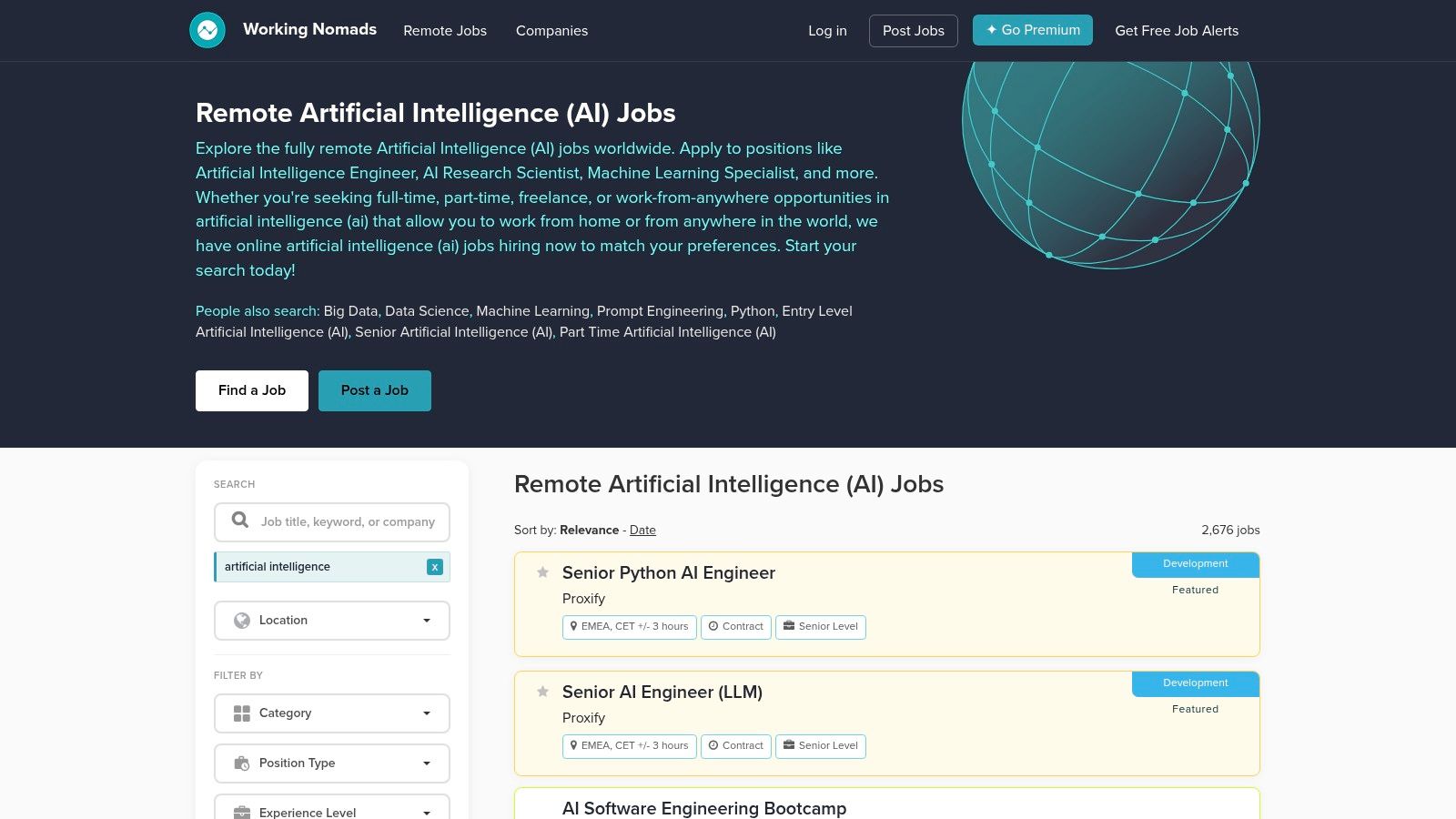
Working Nomads is an aggregator, and that’s both the benefit and the risk. It lets you scan broadly across many sources without doing the crawling yourself. It means duplicates and stale listings are part of the package.
That’s not a deal-breaker. It just changes how you use it.
Good for market scanning
I wouldn’t use Working Nomads as my primary source for a critical hire. I would use it to sweep the market fast, especially for less common titles or niche combinations.
For example, if you’re searching for someone who mixes data engineering with applied ML, or someone with both model-serving and backend API experience, an aggregator can uncover listings and employer patterns you won’t find from one board alone.
A good workflow here is simple:
- Use it to discover companies
- Open the employer’s own careers page
- Apply or post only through the official channel
That extra click is worth it. It reduces wasted time and lets you confirm the role is current.
The larger hiring context matters too. AI job postings have spread, but not evenly. Hiring Lab found AI job postings reached 6% of firms by late 2025, up from 2% in 2018, and that hiring was heavily concentrated among the largest firms in its analysis of Indeed data, as detailed in Hiring Lab’s review of concentrated AI adoption. For startups, that means broad discovery tools can help spot opportunities before larger employers absorb the market’s attention.
10. Outer Join

Outer Join is narrower than most of the list, and that’s exactly why it earns a spot. It’s aimed at machine learning, data science, data engineering, and related production data roles.
If your AI hiring problem is a data systems problem, this is often more useful than a generic AI board.
Strong fit for production ML stacks
Many founders say they need an AI engineer when what they really need is a strong data or MLOps operator. Outer Join is a better hunting ground for that category. The listings skew toward people who are closer to pipelines, infra, and data-heavy implementation.
That matters because AI hiring has a weird shape right now. There’s demand for senior capability, but there’s underemployment pressure among qualified specialists. TechRadar reported on Global Work AI survey findings that qualified specialists are actively seeking unskilled jobs, highlighting a mismatch in how the market prices and uses experienced talent, according to its coverage of AI underemployment. A niche board like Outer Join can help surface practitioners who are still looking for serious technical work, not generic “AI” branding.
One of the fastest ways to improve hiring signal is to replace “AI experience required” with a concrete systems question.
Try this in your outreach or first-round screen:
“Describe a production incident involving data freshness, model quality, or pipeline failure. What did you check first, and what change stuck?”
Candidates who’ve lived through real systems answer with specifics. Candidates who haven’t pivot to theory.
Outer Join won’t generate huge volume, but for data-centric AI roles, that’s often a feature, not a bug.
Top 10 AI Remote Job Sites Comparison
| Service | Core features | Quality (★) | Value (💰) | Target audience (👥) | Unique selling point (✨) |
|---|---|---|---|---|---|
| ThirstySprout 🏆 | AI sourcing + human vetting; 100k+ pre‑vetted; FT/contract/fractional; 48–72h matches | ★★★★★ (High match rate, high satisfaction) | 💰 Custom quotes; potential for significant hiring cost reduction | 👥 Startups (Seed–Scale) & enterprises needing production AI teams | ✨ Production-proven senior AI/ML teams; rapid placement; timezone-aligned |
| We Work Remotely | Large remote-only board; dedicated ML/AI category; frequent updates | ★★★★ | 💰 Free browsing; paid employer posts | 👥 Remote job seekers & employers (strong U.S./NA presence) | ✨ High-volume remote listings with time‑zone cues |
| aijobs.net | AI/ML-only scope; role/location filters; RSS/feed support | ★★★★ | 💰 Free to use; lightweight posting model | 👥 ML/DS engineers & hiring managers focused on AI roles | ✨ Deep specialization and community integrations |
| Remote OK | Remote board with AI category; many posts show salary/location | ★★★★ | 💰 Free browsing; visible salary tags on many posts | 👥 Remote seekers across startups and larger brands | ✨ Salary/location visibility + large, frequently updated inventory |
| NoDesk | Curated remote board; AI collections; email digests; salary bands | ★★★★ | 💰 Free browsing; some paid upsells for companies | 👥 Digital‑nomads and remote‑first companies | ✨ Curated digests and clear pay ranges for quick skim |
| Wellfound (AngelList) | Startup-centric profiles; remote toggles; salary/equity ranges | ★★★★ | 💰 Free for candidates; paid employer tiers | 👥 AI startup roles (Seed–Series D) & founders hiring remotely | ✨ Company context + salary/equity visibility for startup hires |
| Himalayas | Remote marketplace with AI page; company salary benchmarks; AI tools | ★★★ | 💰 Free browsing; optional “Plus” paid tools | 👥 U.S.-focused remote seekers & hiring teams | ✨ Candidate AI resume/cover-letter tools + salary benchmarks |
| Remotive | Editorially curated remote listings; newsletter; public API | ★★★★ | 💰 Free browsing; some paid community features | 👥 Remote tech/AI community & safety-conscious applicants | ✨ Editorial curation, scam guidance and API tooling |
| Working Nomads | Aggregator feeds with AI category; simple filters | ★★★ | 💰 Free; broad aggregated coverage | 👥 Broad remote job scanners looking for breadth | ✨ Quick scan of many sources; good complement to niche boards |
| Outer Join | Niche ML/DS/DE board; direct links to employer application pages | ★★★★ | 💰 Free browsing; smaller inventory | 👥 ML/data engineers & startups hiring production data roles | ✨ Highly targeted ML/data listings with clean apply flow |
Your Next Steps to Hire a Remote AI Team
The platform list is only half the decision. The rest is your hiring design.
A busy CTO doesn’t lose time because there are no candidates. You lose time because you use the wrong sourcing channel for the role, or because your process can’t separate credible operators from smart talkers quickly enough.
The current market rewards focus. Remote work is firmly mainstream, with 32.6 million Americans, or 22% of the workforce, working remotely in 2025, according to Neat’s roundup of remote work statistics. At the same time, AI skills are commanding stronger economics in the labor market. PwC’s 2025 Global AI Jobs Barometer, cited in Toptal’s research earlier, found AI-exposed industries had stronger revenue growth per employee and faster wage growth. That’s good news if you need senior AI talent. It means top candidates won’t wait around for a vague process.
Start with channel selection.
If you need speed and proven execution, prioritize a vetted network first. If you have recruiter bandwidth and a strong technical screen, add one or two high-volume boards. If the role is data-heavy or startup-specific, layer in a niche board like Outer Join or Wellfound instead of posting everywhere at once.
Then tighten the role itself. Don’t hire for “AI” in the abstract. Hire for one concrete delivery problem. Examples:
- an LLM feature that needs retrieval and evaluation
- an MLOps cleanup that needs deployment discipline
- a data platform role supporting model quality
- an AI product engineer who can ship the user-facing layer
A practical scorecard should cover only four things:
- Production history: Have they shipped and maintained a real system?
- System judgment: Can they explain trade-offs, failure modes, and rollback plans?
- Remote operating ability: Can they communicate clearly, write decisions down, and move asynchronously?
- Role fit: Are they right for your actual bottleneck, not just generally impressive?
Two mini-cases show how this works.
First, a founder hiring a first AI engineer should skip broad posting at the start. Use a high-signal network, interview three to five strong candidates, and test one paid pilot around a real integration or evaluation task.
Second, a larger engineering org adding several remote AI contributors can use a mixed funnel. Source from a curated network for the lead role, then use We Work Remotely or Remote OK for supporting hires once the lead helps define the bar.
If you’re approaching this from the candidate side too, this guide on how to find remote jobs is a useful complement.
If you want to move fast, keep the process short. Pick two or three sources. Use a real technical screen based on shipped work. Start with a scoped pilot when the role is ambiguous. If you need senior profiles quickly, ThirstySprout is built for exactly that workflow.
If you need vetted remote AI talent fast, ThirstySprout is the most practical place to start. You can use it to hire senior AI engineers, ML specialists, MLOps talent, and fractional or full-stack remote teams without building a noisy top-of-funnel from scratch. Start a pilot or review sample profiles to pressure-test fit before you commit.
Hire from the Top 1% Talent Network
Ready to accelerate your hiring or scale your company with our top-tier technical talent? Let's chat.