

TL;DR
- Choose Python for AI, ML, or Data-Heavy Products. Its ecosystem (TensorFlow, PyTorch) and massive talent pool are unbeatable for building intelligent features.
- Choose Ruby for Rapid Web App Development. Ruby on Rails excels at building SaaS, e-commerce, or content platforms quickly, especially when AI is not a core requirement.
- Python has superior performance for CPU-bound tasks (e.g., data processing) through its
multiprocessinglibrary, directly impacting time-to-value for AI workloads. - The hiring market is the deciding factor. The talent pool for Python is vast and growing, especially for specialized AI/ML roles. The Ruby talent pool is smaller and more focused on web development, making it difficult to hire for AI-related tasks.
- Action: Use our decision checklist to score your project's needs. If AI is on your 12-month roadmap, start scoping a small pilot project with Python to validate your architecture.
Who This Is For
This guide is for technical leaders who must make a strategic choice that dictates architecture, hiring budget, and product velocity.
You should read this if you are a:
- CTO, VP of Engineering, or Founder making a platform decision that will impact your ability to hire talent and ship features for the next 3–5 years.
- MLOps or Platform Lead concerned with the operational cost, deployment complexity, and scalability of supporting a data-intensive application.
- Hiring Manager or Product Lead who needs to understand how this choice will either create a hiring bottleneck or accelerate your product roadmap.
If your roadmap includes AI features within the next 12 months, this analysis focuses on the business impact of your choice: talent availability, time-to-market, and long-term technical debt.
Quick Answer: A Framework for Choosing Your Language
The Python vs. Ruby debate isn't about syntax; it's a strategic decision. To make a choice you won't regret, evaluate your project against these five business-critical criteria.
Step 1: Score Your Project Against These 5 Criteria
- Core Business Domain: Is your competitive advantage based on a data-driven algorithm (e.g., risk scoring, recommendations) or a user-facing web application (e.g., a project management tool)?
- Current Team Skillset: Do you have a team of senior Ruby experts who can ship fast, or are you building a new team that needs a language with a lower barrier to entry and a larger support community?
- Hiring Roadmap (Next 12 Months): Will you need to hire specialized roles like ML Engineers, Data Scientists, or MLOps Engineers? The talent pool for these roles is overwhelmingly in the Python ecosystem.
- Performance Profile: Will your primary workload be CPU-bound (e.g., training models, processing large datasets) or I/O-bound (e.g., handling thousands of concurrent web requests)?
- Long-Term Maintainability: Is your team small and experienced, thriving on convention and flexibility (Ruby)? Or is it a larger, mixed-experience team that benefits from explicit, readable code (Python)?
Step 2: Use the Hiring Flowchart to Finalize Your Decision
Your hiring plan is often the most critical factor. This flowchart visualizes the decision based on the roles you need to fill.
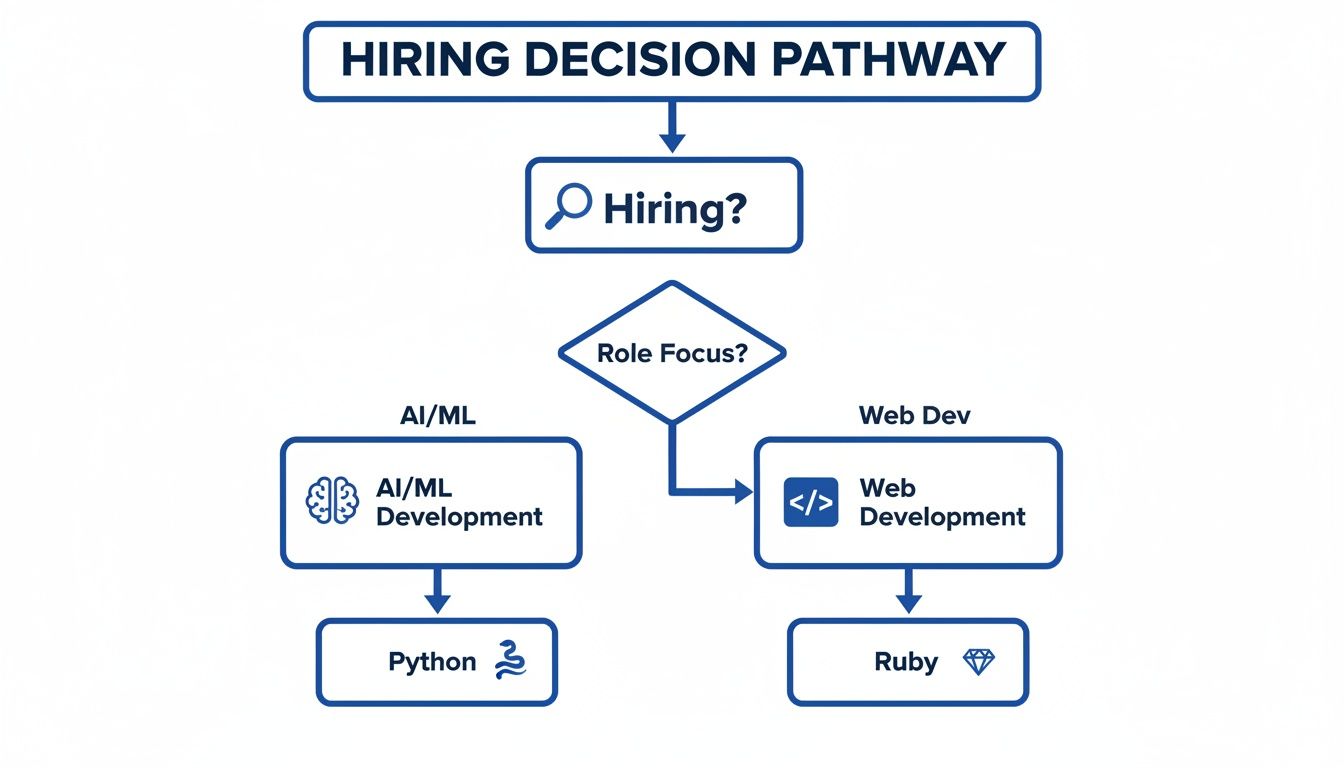
This flowchart shows that if your primary hiring need is for AI, ML, or Data Engineers, Python is the logical path. If you are focused on web development without immediate AI needs, Ruby remains a viable option.
Your choice has a direct impact on project timelines and costs. A Python-based AI project can often be staffed and launched faster due to the wide availability of talent and mature libraries.
Practical Examples: Two Real-World Scenarios
Abstract comparisons are useless. Let's analyze two common engineering tasks to see how the choice of Python vs. Ruby plays out in terms of cost, speed, and complexity.
Example 1: The CPU-Bound Image Processing Task
Imagine your application needs to resize 10,000 product images uploaded by users. This is a classic CPU-bound job; each resize is an independent computation that can be run in parallel.
Python Approach (multiprocessing): A developer uses the built-in
multiprocessinglibrary to distribute the 10,000 tasks across 8 CPU cores. The library sidesteps Python's Global Interpreter Lock (GIL) by creating separate processes. The total execution time is cut by nearly 8x.# A simplified example showing the multiprocessing conceptfrom multiprocessing import Pooldef resize_image(image_path):# ... image resizing logic here ...return "processed"if __name__ == '__main__':image_paths = ["img1.jpg", "img2.jpg", ...] # 10,000 imageswith Pool(processes=8) as pool:results = pool.map(resize_image, image_paths)Ruby Approach: Achieving true parallelism is harder. Ruby's Global VM Lock (GVL) prevents multiple threads from running Ruby code simultaneously. While you can fork processes manually, the tooling is not as integrated or straightforward as Python's
multiprocessingmodule. You get no performance gain from a multi-threaded approach for this CPU-bound task.
Business Impact: For the heavy computations common in AI and data science, Python's native support for multiprocessing directly translates to faster results and lower compute costs. A data processing job that takes an hour in a single-threaded environment can be completed in under 10 minutes.
Example 2: The I/O-Bound High-Traffic Web API
Now consider an API that handles 5,000 concurrent user requests. Most of the application's time is spent waiting for a database query to return or an external service to respond. This is an I/O-bound workload.
We'll compare two modern stacks: Python with FastAPI on Gunicorn and Ruby with Rails on Puma.
- Python (FastAPI + Gunicorn): FastAPI is built for asynchronous I/O from the ground up. When a request is waiting for the database, FastAPI automatically switches to handle other active requests. This async-native design is incredibly efficient for I/O-heavy workloads.
- Ruby (Rails + Puma): Puma is a multi-threaded web server that allows a single Rails process to handle many concurrent requests. It is highly effective for I/O-bound tasks. However, the Rails framework was not originally designed to be async-native, which can add slight overhead compared to FastAPI.
Business Impact: In benchmarks simulating high I/O, the FastAPI stack often shows lower latency and higher requests per second on the same hardware. This means you can serve more users with fewer servers, directly reducing your monthly infrastructure bill.
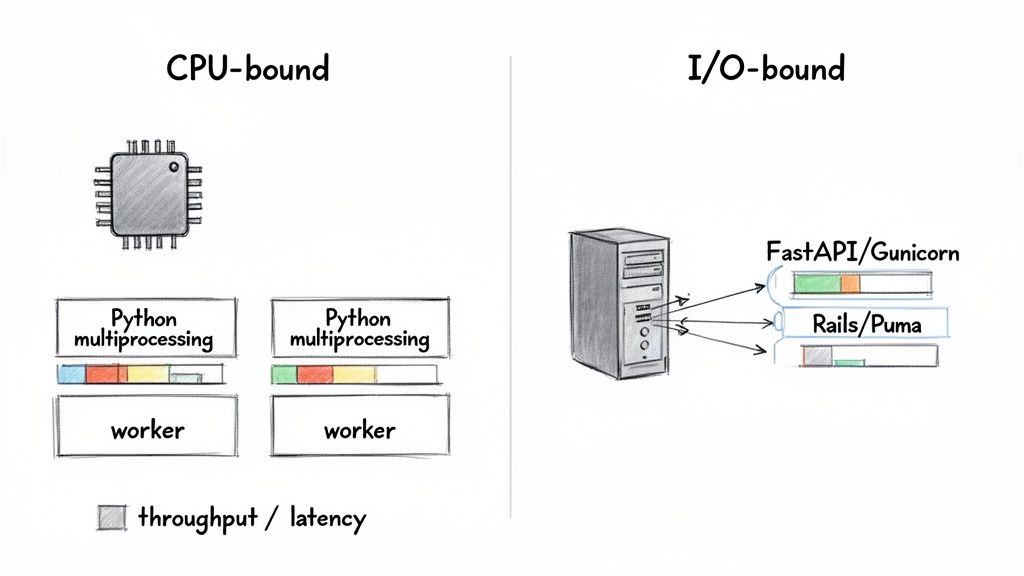
This diagram shows Python's advantage in CPU-bound tasks via multiprocessing and its efficiency in I/O-bound scenarios with modern async frameworks like FastAPI.
Deep Dive: Ecosystem, Talent, and Maintainability
Your choice of language is a long-term commitment to an ecosystem of tools, a specific talent pool, and a style of maintenance.
The Deciding Factor: The AI Ecosystem
A language is only as powerful as its libraries. The ecosystems for Python and Ruby are built for different worlds.
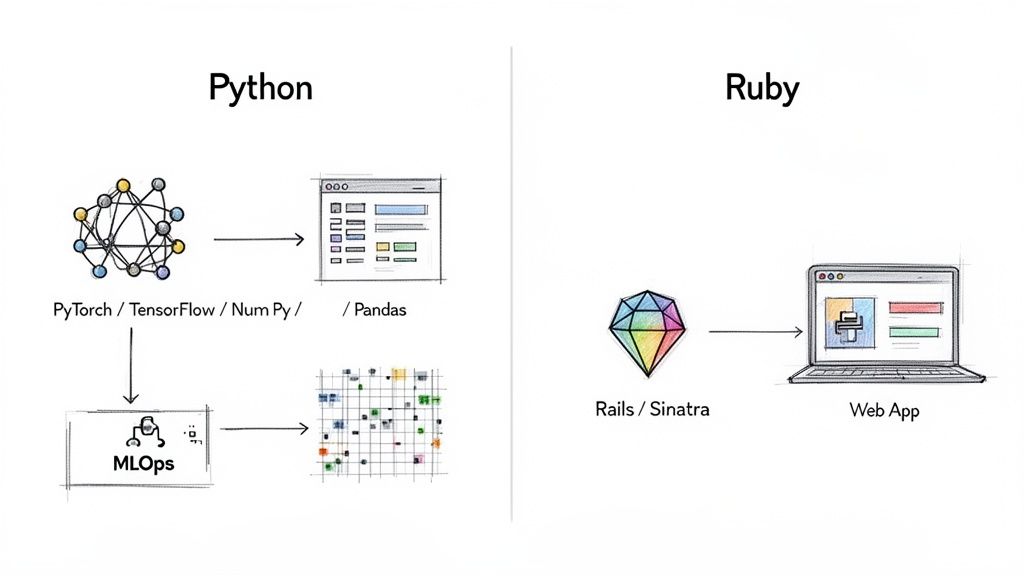
This diagram highlights the distinct ecosystems: Python is dominant in the AI/ML stack, while Ruby's strength lies in the web application stack with Rails.
Ruby's ecosystem, with gems like Devise and Sidekiq, is optimized for building web applications with speed and elegance. It excels at solving web development problems.
Python's ecosystem was built for data. Its libraries for Data Science, Machine Learning (ML), and Artificial Intelligence (AI) are the undisputed industry standard.
- Bedrock Libraries: Pandas and NumPy for data manipulation.
- Classic ML: Scikit-learn for accessible data mining and statistical modeling.
- Deep Learning: TensorFlow and PyTorch for building and training neural networks.
The result: Trying to build a recommendation engine in Ruby means fighting the ecosystem. You'll likely need to create a separate Python microservice just for the ML logic, instantly doubling your deployment complexity and operational overhead. A Python team can build and deploy the same feature in a unified stack in a fraction of the time (e.g., 2–4 weeks vs. 8–12+ weeks). This speed is a significant competitive advantage.
As you integrate AI, it's vital to consider responsible implementation. Our 2026 Responsible AI Guide provides a framework. For tooling, see our analysis of the best machine learning platforms.
Developer Experience and Maintainability
Ruby values "developer happiness" through flexibility and expressive, concise code. Python prioritizes readability and simplicity with its "one obvious way to do things" philosophy.
- Ruby's "Magic": An experienced Ruby developer can write beautiful, compact code. For example,
users.map(&:to_h)is elegant but can be confusing for new developers. This flexibility can lead to a codebase that is hard for newcomers to maintain. - Python's Clarity: Python code is explicit and self-documenting. The same operation might take more lines, but it's immediately understandable to anyone with basic Python knowledge. This consistency dramatically reduces onboarding time and long-term maintenance costs.
For a large or growing team, Python's readability is a strategic asset. For a small, senior team focused on rapid prototyping, Ruby's expressiveness can be a powerful tool.
Hiring Talent: The Market Has Already Chosen
When you choose a language, you choose your hiring pool. The talent market for Python is enormous and continues to grow, driven by its dominance in universities and high-growth fields like AI.
- Python Talent Pool: Vast and specialized. You can hire for general backend, data science, or MLOps roles relatively quickly (4–8 weeks for a team). The skills are standardized and the community is massive (over 8 million developers).
- Ruby Talent Pool: Smaller, more niche, and centered on web development. Finding a senior Ruby developer with production ML experience is extremely difficult and time-consuming (12–20+ weeks to build a team). This creates significant hiring risk if your product roadmap shifts toward AI.
This trend is clear in market data. Python's popularity has soared, while Ruby's has found a stable, smaller niche. You can dive deeper into these language popularity trends on Stackify. Choosing Python de-risks your hiring roadmap. To learn more about finding talent, a Python development firm can provide key insights, and our guide on a modern guide to sourcing in recruitment covers essential strategies.
For a different perspective on language decisions in other contexts, see our comparison of Go vs Java for enterprise applications.
Checklist: Your Python vs. Ruby Decision Scorecard
Use this checklist with your team to make an objective, data-driven decision. Score each criterion from 1 (low importance) to 5 (critical) for your project, then see which language aligns best with your priorities.
➡️ Download this checklist as a PDF to use with your team.
What to Do Next
You have the data and the framework. Now, turn this analysis into action.
- Run a Scoping Session. Use the decision checklist to lead a 60-minute meeting with your engineering and product leads. Document your choice and the business reasons behind it to ensure alignment.
- Define Your Pilot Project. If Python is your choice for an AI feature, scope a small, 2-week pilot. A good pilot goal is to build a proof-of-concept API for a core model, testing the data pipeline and deployment process.
- Engage an Expert. Don't spend months trying to hire the perfect team. A pilot with pre-vetted experts can validate your technical approach in weeks and give you the confidence to scale.
At ThirstySprout, we help companies like yours build and deploy AI features with our network of top-tier remote AI engineers. We can launch your pilot project in under two weeks.
Ready to build with confidence?
Hire from the Top 1% Talent Network
Ready to accelerate your hiring or scale your company with our top-tier technical talent? Let's chat.