

TL;DR
- Choose the right methodology: Use Scrum for complex products with clear goals, Kanban for continuous workflows like MLOps or support, and a Lean/Hybrid approach for high-uncertainty R&D.
- Define clear roles: The Product Manager owns the "what" and "why," the Engineering Manager owns the "how" and "who," and the Technical Program Manager orchestrates large, cross-functional projects.
- Track metrics that matter: Focus on the four DORA metrics—Lead Time, Cycle Time, Deployment Frequency, and Change Fail Percentage—to get a balanced view of speed and stability.
- Establish a practical workflow: Break down work from a high-level roadmap into Epics and then into actionable User Stories with clear acceptance criteria. Use Story Points for predictable sprints and T-Shirt Sizing for high-level planning.
- Avoid common pitfalls: Implement a change control process to prevent scope creep, use team-driven estimation to set realistic deadlines, and create a simple communication plan to keep everyone aligned.
Who This Guide Is For
This guide is for technical and product leaders who need to ship high-quality software faster without getting bogged down in theory. It’s built for operators who need to make changes in weeks, not months.
This playbook is for you if you are a:
- CTO or VP of Engineering scaling remote teams and trying to increase delivery velocity.
- Founder or AI Product Lead under pressure to innovate quickly without sacrificing quality.
- Engineering Manager or Technical Program Manager managing daily execution and project risks.
We'll provide frameworks, real-world examples, and actionable steps to improve your team's output and connect engineering effort directly to business impact.
The Quick Framework: How to Choose Your Project Management System
Building a high-performing software team requires a system that delivers predictable results. This involves three key decisions:
- Select an Agile Methodology: Start by choosing a framework that fits your team's size, project complexity, and workflow. Use the decision tree below as your starting point.
- Define a Clear Delivery Workflow: Translate your product roadmap into Epics and then into granular User Stories. Use a consistent estimation method (Story Points or T-Shirt Sizes) to plan work.
- Implement a Core Toolchain and Metrics: Use tools like Jira and GitHub to not only manage work but also to automatically track the four key DORA metrics. This creates a data-driven feedback loop for continuous improvement.
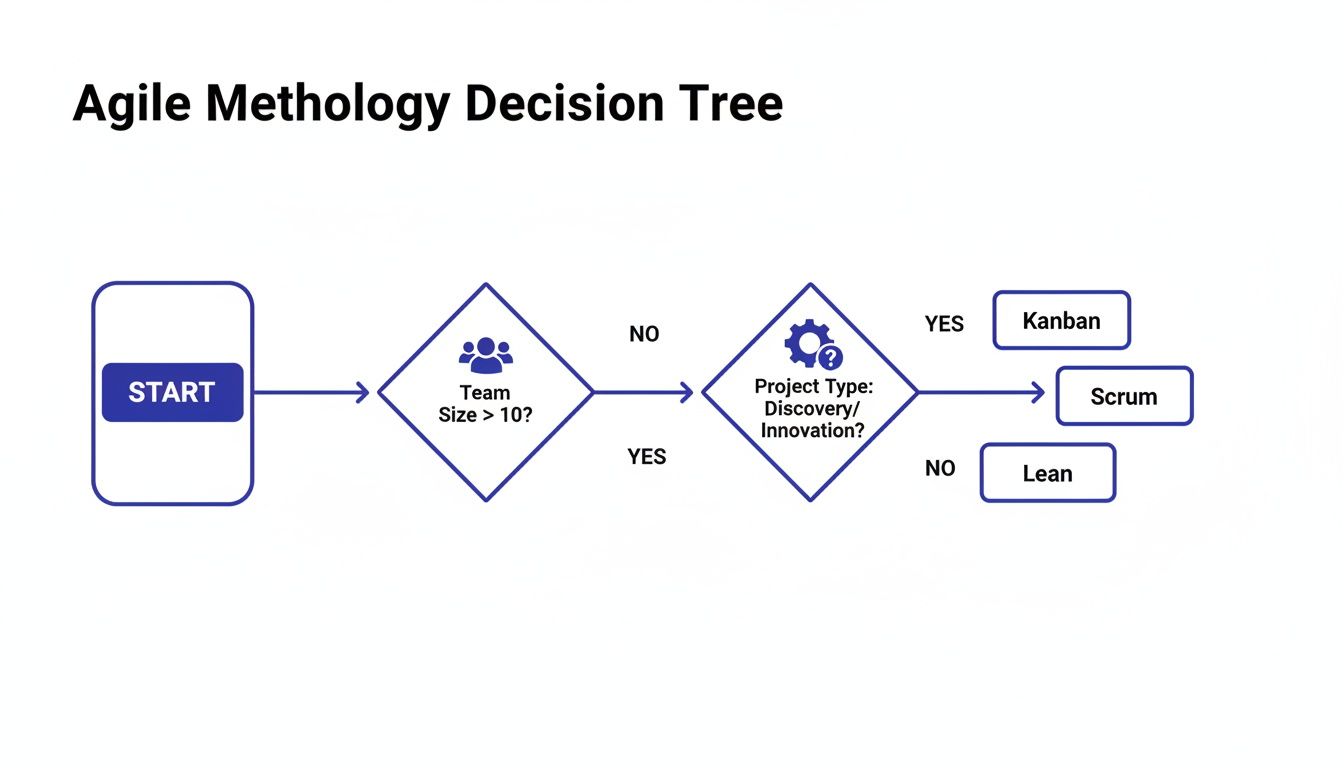
alt text: Flowchart illustrating an Agile methodology decision tree for selecting frameworks based on team size and project type.
Practical Examples of Methodologies in Action
The theory only matters if it works in practice. Here are two real-world scenarios showing how to apply the right Agile methodology.
Example 1: Scrum for a New SaaS Feature Launch
A startup is building an AI-powered analytics dashboard. The goal is clear, but the specifics will evolve with user feedback. This makes it a perfect fit for Scrum.
- Setup: The team decides on two-week sprints.
- Sprint 1 Goal: Deliver a basic, functional data connection and one chart.
- Sprint Backlog: The Product Owner prioritizes two user stories: "As a user, I need to connect my data source" and "As a user, I want to see a basic chart."
- Process: The team holds daily stand-ups to sync progress. At the end of the sprint, they demo the working feature to stakeholders.
- Outcome & Business Impact: Stakeholders immediately note that the data connection process is confusing. This feedback is captured before any more code is written. The team adapts by prioritizing a story to simplify the workflow in the next sprint, directly improving the user experience and reducing the risk of building an unusable feature.
Example 2: Kanban for an MLOps Team Workflow
An MLOps team manages deploying new models, monitoring performance, and fixing production bugs. Their work is unpredictable; a critical model-drift alert can override all other priorities. Kanban's flow-based system is ideal.
- Setup: They use a Kanban board with columns: "Backlog," "Experimentation," "Ready for Deployment," and "Monitoring."
- Key Rule: They set a Work-in-Progress (WIP) limit of 2 on the "Experimentation" column. This prevents engineers from juggling too many model variations at once, ensuring each gets proper attention.
- Process: When a high-priority bug ticket arrives, it goes to the top of the backlog and flows through the system without disrupting a sprint commitment that doesn't exist.
- Outcome & Business Impact: The WIP limit reduces context switching, which shortens the cycle time for model experiments. The team can respond to urgent production issues faster, improving system stability and minimizing downtime that could impact revenue.
A Deeper Dive: Trade-offs, Pitfalls, and Best Practices
Choosing a methodology is the first step. Nailing the execution requires understanding the details, from roles and responsibilities to the tools and metrics that drive performance.
Choosing Your Software Development Methodology
Modern project management for software engineering is rooted in the Agile philosophy: accept that you'll discover what you need to build by building it. Instead of a rigid, long-term plan, work is broken into small cycles that deliver value and create tight feedback loops.
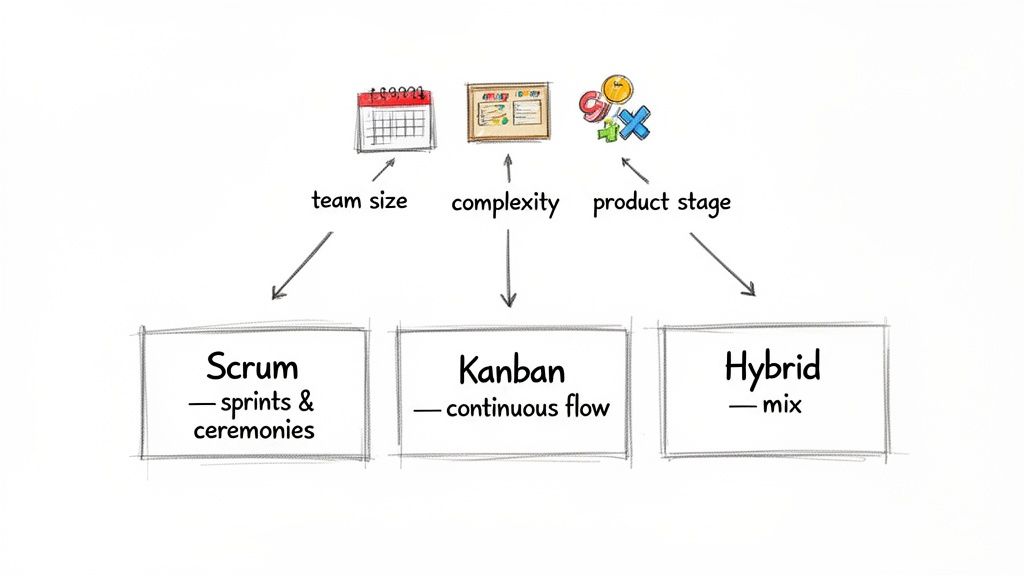
alt text: Diagram illustrating factors like team size, complexity, and product stage influencing Scrum, Kanban, or Hybrid methodologies.
Scrum: The Structured Sprint
Scrum organizes work into fixed-length iterations called sprints (typically 1-4 weeks), each aimed at delivering a potentially shippable increment of the product. It provides a predictable cadence that is excellent for complex projects with evolving goals. It keeps stakeholders aligned and the team focused.
Kanban: Visualizing Continuous Flow
Where Scrum is about rhythm, Kanban is about flow. It's ideal for teams with a continuous stream of tasks like support, operations, or MLOps. By limiting Work in Progress (WIP), Kanban forces teams to finish tasks before starting new ones, which optimizes for a short cycle time—the time it takes for a task to move from start to finish.
Lean: Reducing Waste in Development
Lean is a philosophy focused on maximizing customer value by eliminating waste. In software, "waste" includes inefficient handoffs, partially done work, or building features nobody uses. Practices like Continuous Integration/Continuous Delivery (CI/CD) are pure Lean thinking, as they automate manual processes to get value to customers faster.
From Big Ideas to Shippable Code: Nailing the Delivery Workflow
Your methodology is the philosophy; the delivery workflow is the day-to-day process of turning vision into working software. A solid workflow connects high-level business goals to the specific tasks engineers are working on.
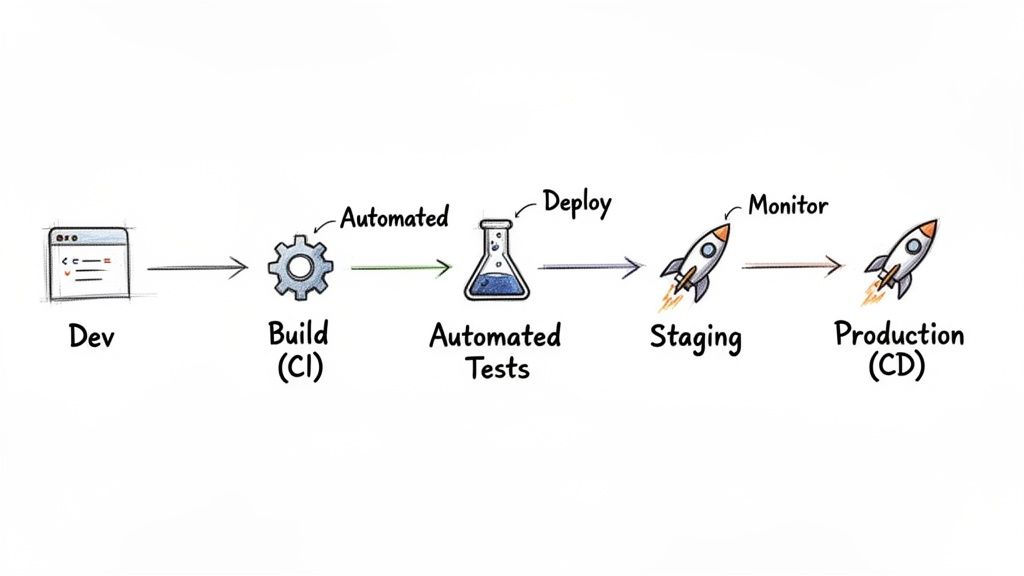
alt text: A diagram illustrating the Continuous Integration and Continuous Delivery (CI/CD) pipeline for software development.
It starts by breaking down the work into a clear hierarchy:
- Product Roadmap: The high-level strategic direction for the next few quarters.
- Epics: Major initiatives from the roadmap, like "Launch AI-Powered Search."
- User Stories: The smallest unit of work that delivers value to a user, framed from their perspective (e.g., "As a user, I want to upload a profile picture..."). Each story requires clear acceptance criteria defining what "done" means.
This structure ensures every task is traceable to a strategic goal, giving engineers the context they need to make smart decisions.
Defining Key Roles for Project Success
Clear roles prevent communication breakdowns and missed deadlines. For most software teams, a leadership triad ensures all bases are covered.
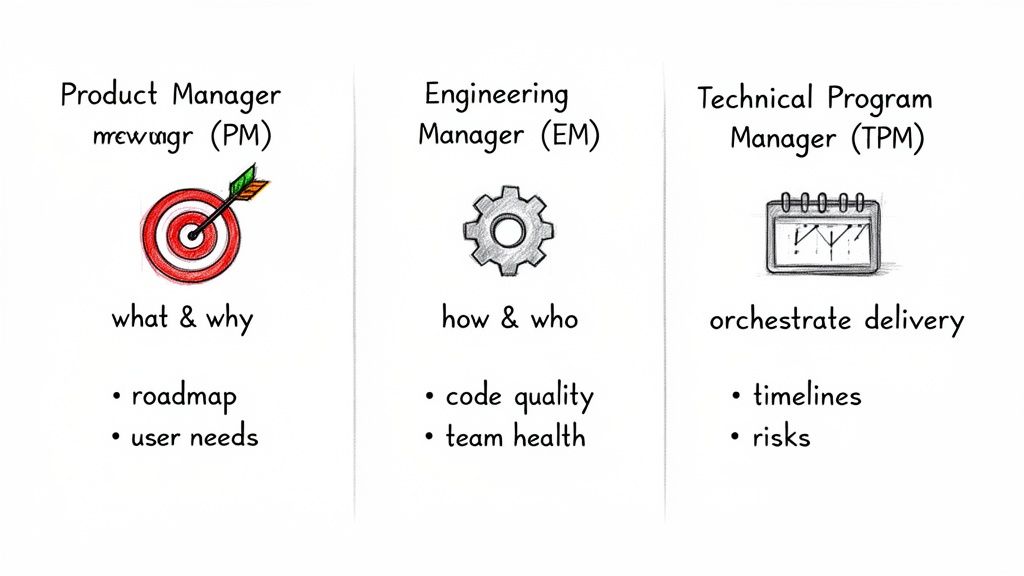
alt text: An image comparing Product Manager, Engineering Manager, and Technical Program Manager roles and responsibilities in software project delivery.
- Product Manager (PM): Owns the 'what' and 'why'. They are the voice of the customer, defining the product roadmap and prioritizing the backlog to solve real user problems.
- Engineering Manager (EM): Owns the 'how' and 'who'. They focus on building a high-performing team, guiding technical architecture, ensuring code quality, and removing roadblocks.
- Technical Program Manager (TPM): Owns the 'when' and 'how' for large, cross-functional projects. They manage dependencies, mitigate risks, and ensure all teams are aligned to deliver on schedule. You can see how this role fits into the broader ecosystem of roles in agile software development.
The PM defines value, the EM builds it with excellence, and the TPM ensures the entire delivery machine runs smoothly.
Using Metrics and Tools That Drive Performance
Don't drown in vanity metrics. Effective project management for software engineering focuses on a few key indicators that provide a balanced view of speed and stability.
Start with the four DORA metrics:
- Lead Time: The total time from an idea's conception to its delivery to a customer. This measures the efficiency of your entire value stream.
- Cycle Time: The time from when an engineer begins coding a task to when it's deployed. This helps diagnose bottlenecks within the development process.
- Deployment Frequency: How often you ship code to production. Elite teams deploy multiple times a day, reducing risk and accelerating feedback.
- Change Fail Percentage: The percentage of deployments that cause a production failure. This is your core stability metric.
These metrics measure outcomes, not just output. Improving them requires improving your underlying engineering practices, starting with the people you hire and the quality of hire metrics you track. You can automate the collection of this data using the tools you already have, like Jira and GitHub.
Navigating Common Project Pitfalls
Great project management is about anticipating and mitigating risks. Here are the most common pitfalls and how to solve them.
- Symptom: Hearing "Could you just add..." without adjusting the deadline.
- Solution: Institute a formal change control process. Every new request is documented, estimated, and requires a trade-off decision (e.g., if this goes in, what comes out?).
- Symptom: The team is constantly working overtime; code reviews are skipped.
- Solution: Empower the team to estimate their own work using techniques like Story Points. Track velocity over time to create data-driven forecasts. This is critical for preventing burnout, a major risk for remote teams; learn more about strategies to avoid burnout in remote work.
- Symptom: Engineers are surprised by decisions; the same questions are asked repeatedly in Slack.
- Solution: Create a simple communication plan. Define where different types of information live: Slack for quick questions, Jira tickets for task details, and a wiki like Confluence or Notion for documenting final decisions.
Checklist: 10 Steps to a Better Project Management System
Use this checklist to audit your current process or build a new one from scratch.
- 1. Define Your Primary Goal: Are you optimizing for speed, predictability, or quality? Be explicit.
- 2. Choose a Methodology: Select Scrum, Kanban, or a Hybrid model based on your team and project type.
- 3. Clarify Leadership Roles: Ensure you have clear owners for the Product (PM), Team (EM), and Program (TPM, if needed).
- 4. Standardize Your Work Breakdown: Mandate a Roadmap -> Epics -> User Stories hierarchy.
- 5. Enforce Acceptance Criteria: No story enters a sprint without clear, testable acceptance criteria.
- 6. Implement an Estimation Practice: Choose Story Points or T-Shirt Sizing and use it consistently.
- 7. Set Up Your Toolchain: Configure your project management tool (Jira or Linear) to mirror your workflow.
- 8. Automate Key Metrics: Set up dashboards to track the four DORA metrics automatically.
- 9. Establish a Change Control Process: Create a lightweight process for evaluating any new requests that impact scope.
- [- ] 10. Schedule Regular Retrospectives: Hold blameless retrospectives to discuss what’s working, what isn’t, and identify one concrete process improvement for the next cycle.
What To Do Next
- Audit Your Current System: Use the checklist above to identify the biggest gaps in your current project management process this week.
- Pick One Metric to Improve: Don't try to fix everything at once. Choose one DORA metric (like Cycle Time) and focus all process improvements on moving that number for the next 30 days.
- Talk to an Expert: If you're struggling to scale your remote team's output, a 20-minute call can help diagnose core issues and define a path forward.
Ready to build a high-performing remote AI or software team? At ThirstySprout, we connect you with pre-vetted, senior engineering talent that ships quality code fast. Start a pilot in under two weeks.
References
For further reading and data sources used in this guide:
- Scrum Guide: The Official Guide to Scrum
- Kanban Resources: What is Kanban? by Kanbanize
- Project Management Statistics: The Business Dive Report and Ravetree PMP Statistics for 2025
- Software Development Management
- Roles in Agile Software Development
- Quality of Hire Metrics
Hire from the Top 1% Talent Network
Ready to accelerate your hiring or scale your company with our top-tier technical talent? Let's chat.