

You've probably had this conversation already. The budget covers one or two events this year, your delivery leaders all want something different, and every conference page promises “innovation,” “networking,” and “future-ready skills.” That isn't useful when you're deciding where to send a PMO lead, a product operations manager, or an engineering manager who now owns delivery for AI work.
Choosing among project management conferences is a strategic decision because the event you pick changes who your team meets, what practices they bring back, and which tools make it onto your roadmap. That matters more now because the profession is large, globally distributed, and still changing fast. PMI reports more than 1.5 million PMP certificate holders worldwide, which helps explain why the biggest events now feel less like niche meetups and more like cross-functional business forums.
For CTOs, founders, and hiring leads, the right bet depends on the problem in front of you. If you need broad market signal, go big. If you need hands-on agile help, go narrow. If you need hiring conversations and tooling comparisons, prioritize events where vendors, practitioners, and delivery leaders are all in the same room.
I'd use a simple filter:
- Hiring priority: Choose conferences with dense senior attendance and active partner ecosystems.
- Process change: Choose practitioner-heavy events with workshops, not keynote-heavy events.
- Tool strategy: Choose events where the software ecosystem is visible and buyers ask hard implementation questions.
Here are the seven events I'd shortlist for 2026.
1. PMI Global Summit 2026
Your VP of engineering wants better portfolio visibility. Your product lead wants faster release cycles. Your hiring plan depends on meeting delivery leaders who have scaled cross-functional teams. That is the kind of situation where PMI Global Summit earns a look.
If I had to pick one large project management event for a leadership team, this is usually the conservative bet. It is PMI's flagship gathering, and the value is not just the session catalog. It is the mix of people in the room: PMO heads, transformation leaders, delivery managers, consultants, training providers, and software vendors. For CTOs and founders building AI or ML teams, that matters because modern delivery problems rarely sit inside engineering alone. They cut across governance, budgeting, compliance, vendor selection, and hiring.
PMI's flagship summit is also one of the few places where enterprise process people and product delivery people consistently cross paths. That creates useful tension. You hear how large organizations handle governance and reporting, but you also get practical exposure to how teams are adapting those controls for faster product cycles.
Where it pays off
The best reason to send someone is range with a purpose. If your company is trying to connect product planning, engineering execution, and leadership reporting, this event gives you enough coverage to compare operating models, tooling choices, and org design ideas in one trip.
It is especially useful for teams running hybrid delivery. That can mean AI feature work moves in short iterations while procurement, security review, and portfolio reporting still follow a slower enterprise cadence. PMI Global Summit tends to have both audiences present, which makes the conversations more grounded than what you get at pure agile events.
I would not send an IC project manager alone and hope for a strategic return. This event works better when you send a leader with a clear brief.
A practical plan:
- Choose tracks by business outcome: One for execution, one for governance, one for leadership or talent.
- Use the expo floor deliberately: Focus on workflow, reporting, and resource planning vendors that can support modern product teams, including teams deciding between Agile, Scrum, and Kanban approaches.
- Set hiring goals before arrival: If you are building AI or data-heavy delivery teams, treat partner events and hallway conversations as recruiting and market research time, not background networking.
- Book meetings early: The best peer conversations are usually scheduled before the first keynote.
For software leaders trying to connect conference learning to engineering reality, this guide on project management for software engineering is a useful companion.
If someone on your team also needs credential support, pair the trip with a structured PMP certification prep guide.
2. PMI Agile 2026
Some conferences try to cover every delivery model and end up shallow. PMI Agile works better when your real issue is product execution. If your teams are debating Scrum versus Kanban, struggling with planning discipline, or trying to make hybrid delivery less chaotic, this is a better use of budget than a giant generalist event.
Alt text: Audience listening to a project management conference speaker at PMI Agile 2026 style event.
The reason I like agile-specific conferences for tech leaders is simple. Broad PM events often discuss agile at the concept level. Agile-focused events usually get into team-level failure modes. Backlog design, estimation friction, discovery handoffs, role confusion, and scaling problems.
Best fit for product and engineering teams
PMI positions this event as the place to learn agile thoroughly, rather than getting the full PMI experience through the flagship summit. That makes it more practical for product delivery teams that need hands-on patterns, not broad profession-wide context.
A good use case is a company with two delivery tensions at once:
- engineering wants flow efficiency,
- product wants more predictable planning,
- leadership still wants visible portfolio reporting.
That's where PMI Agile tends to be useful. You can expose managers to agile leadership thinking without dragging them into purely theoretical agile debates.
A mini-case from real operating life: a SaaS team I advised had engineering managers running sprint ceremonies, product managers handling roadmap communication, and nobody owning cross-team dependency hygiene. The conference choice wasn't about “learning agile.” It was about finding methods to separate team rituals from actual delivery governance. An agile-specific event was the better bet.
Go here when your bottleneck is execution behavior, not PMO structure.
If you're still sorting out role confusion internally, this breakdown of agile vs scrum vs kanban will help before you book tickets.
The trade-off is focus. You won't get the same breadth on traditional portfolio management, and if your company still runs a lot of predictive work, the content may feel narrower than you want.
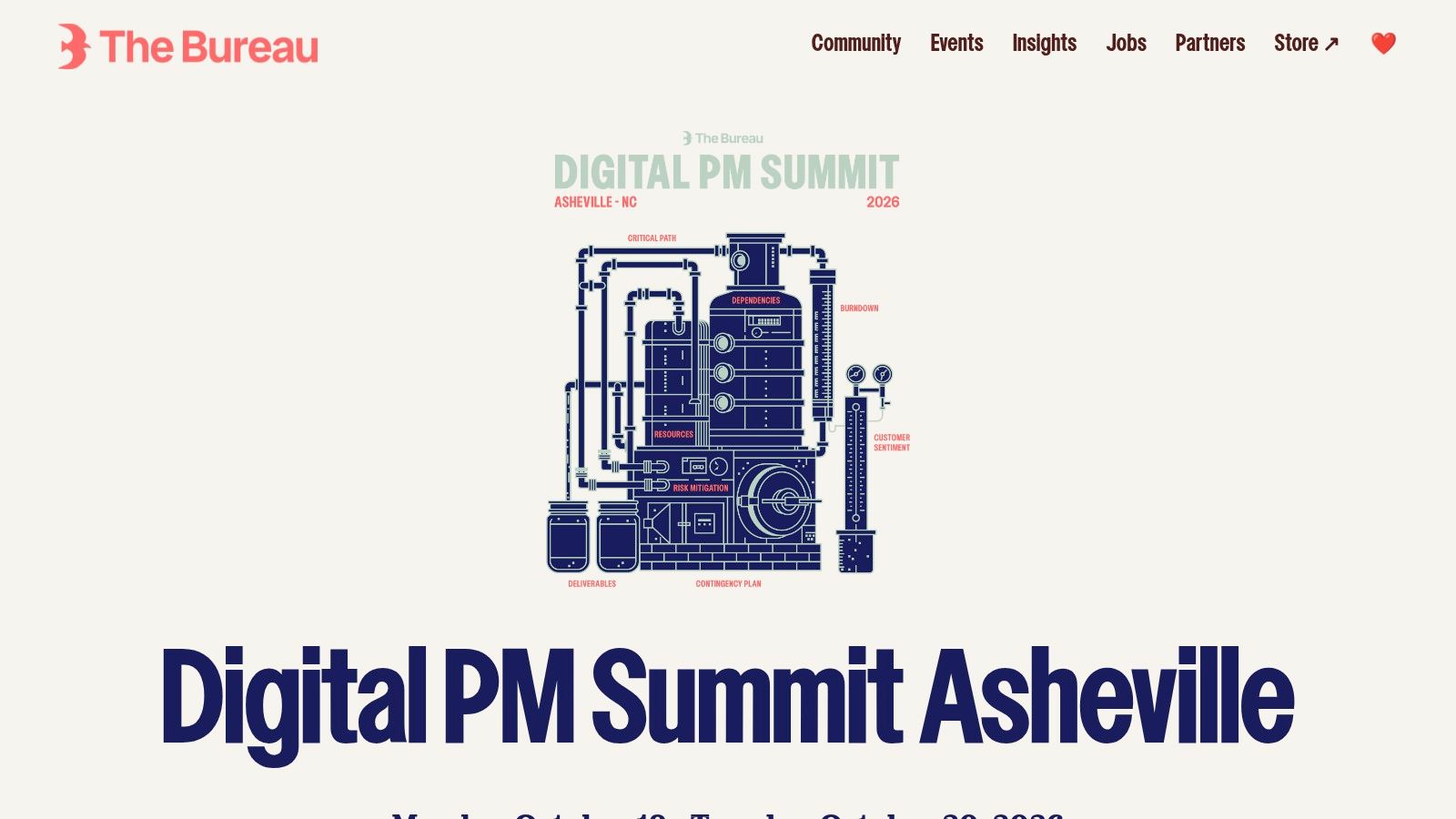
3. Digital PM Summit 2026
A CTO usually notices the need for this kind of event after a quarter goes sideways. The roadmap looked reasonable, the team was capable, and delivery still slipped because client requests kept reshaping scope, product decisions arrived late, and nobody translated strategy into workable trade-offs for the people doing the build.
Digital PM Summit is a good fit for that operating environment. It serves leaders who care about delivery judgment inside digital teams, especially where product, design, engineering, and stakeholders all pull on the same work from different directions.
Alt text: Promotional visual for Digital PM Summit 2026.
For CTOs and founders building AI or ML products, that matters more than it sounds. Shipping these teams well is rarely a tooling problem alone. The harder part is aligning research uncertainty, product expectations, data dependencies, and delivery communication without burning out the people in the middle. A smaller conference with experienced digital operators can be more useful than a larger event full of generic project content.
What makes it useful
The main value here is context-rich discussion. Smaller events usually produce better conversations about estimation under ambiguity, stakeholder control, team capacity, and where AI support actually helps versus where it adds noise. That is useful if your PMs already know the mechanics of planning and need stronger judgment calls.
I would send people who sit close to delivery friction. Agency leaders, digital program managers, product operations leads, and PMs supporting AI-heavy product work tend to get the best return. They can bring back practical patterns for handling fuzzy requirements, cross-functional handoffs, and client or executive communication under pressure.
A simple filter helps:
- Choose it if: your team runs digital delivery with constant cross-functional coordination and a lot of changing inputs.
- Skip it if: you need enterprise governance, audit, compliance, or formal portfolio management content.
- Best attendee profile: senior PMs or delivery leads who can compare notes with peers and turn ideas into operating changes once they get back.
The trade-off is scale. You will not get the breadth of a large PMI-style conference, and you should not expect a major recruiting floor. But if your goal is to sharpen how PMs handle modern product delivery, including AI-assisted planning and communication work, this event can produce better practical return per attendee.
My take: send operators, not spectators. This is one of the better project management conferences for tech leaders who want PM talent that can keep AI and digital product work moving when the plan stops matching reality.
4. PMO unCON North America 2026
A quarter starts with five active initiatives. By the board update, there are nine, two of them AI-related, and nobody agrees which ones should get scarce engineering time. That is the kind of mess PMO unCON North America is built for.
This event is a better fit for leaders responsible for portfolio clarity than for PMs looking to improve day-to-day delivery mechanics. The unconference format changes the value proposition. You are not sitting through polished talks from people far removed from the problem. You are in working sessions with operators who have dealt with intake chaos, weak prioritization, executive reporting gaps, and governance models that slow teams down instead of helping them.
For CTOs and founders building AI/ML teams, that distinction matters. Hiring strong engineers is only part of the job. Once AI experiments, platform work, and core product commitments all compete for budget and attention, the failure point is usually operating discipline. Teams need a clearer way to decide what gets staffed, what gets paused, and what evidence earns continued investment.
I would send a PMO lead, transformation head, portfolio manager, or senior operator who owns cross-functional prioritization. This is especially useful if your company is past the stage where team-level heroics can hide weak governance. Early-stage startups can get away with ambiguity for a while. Multi-team organizations cannot, especially once AI initiatives start pulling from the same hiring pool and infrastructure budget as the core roadmap.
The trade-off is straightforward. The unconference model produces candid discussion and practical pattern-sharing, but it gives you less structure than a large conference with fixed tracks and polished decks. Some attendees will get more value from that open format. Others will leave wishing for tighter session design and clearer teaching.
My take: send someone who can bring back operating decisions, not just notes. If your challenge is portfolio visibility, investment discipline, or PMO design for AI-heavy product work, this is one of the few project management conferences on this list with direct ROI for tech leadership.
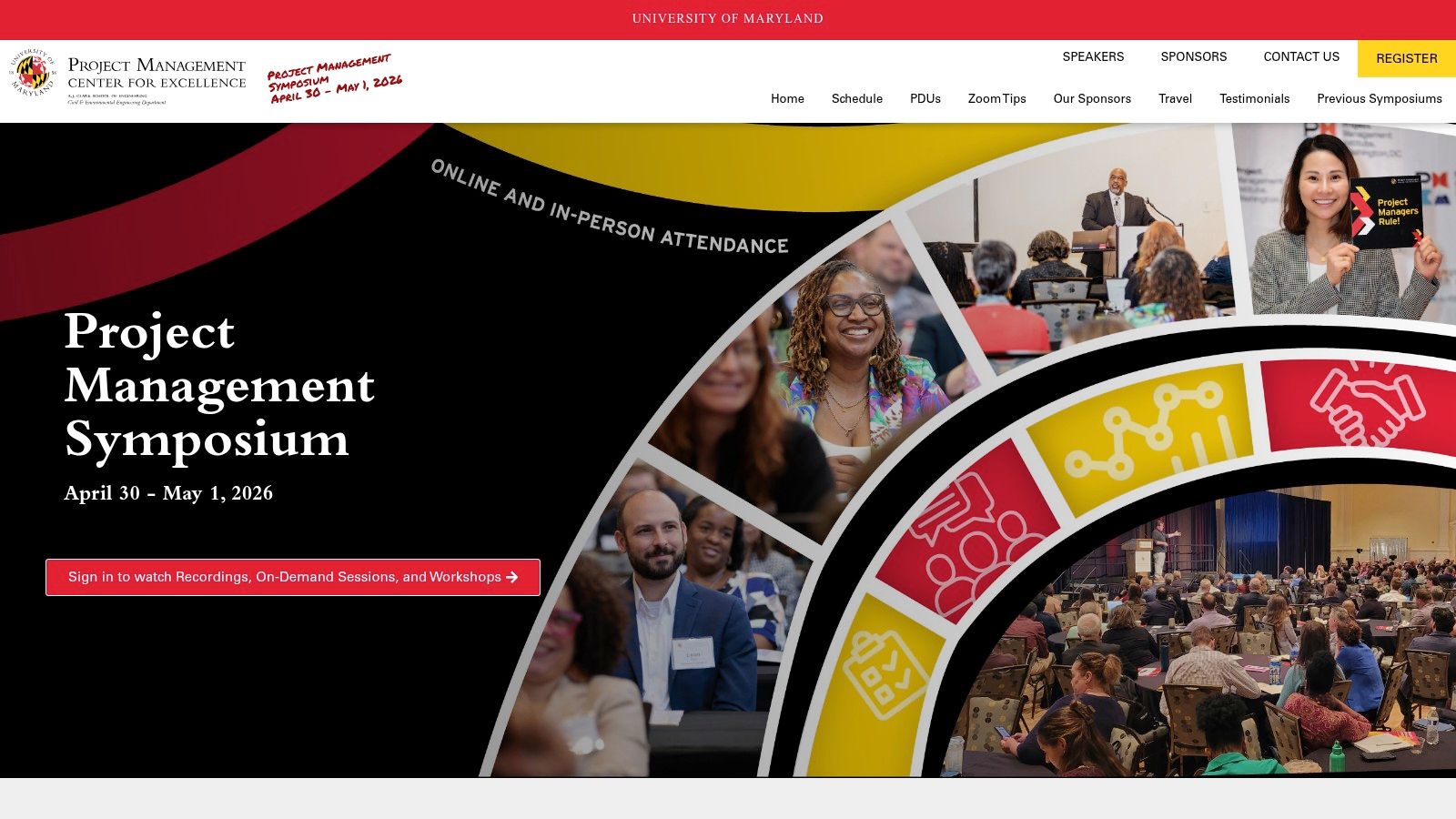
5. University of Maryland Project Management Symposium 2026
If you want a more cost-conscious, content-forward option, the University of Maryland Project Management Symposium deserves serious attention. It sits in a useful middle ground between academic rigor and practitioner relevance, and the hybrid format makes it easier to send more than one person without forcing the whole team onto planes.
Alt text: Banner image representing the University of Maryland Project Management Symposium 2026.
This is a good fit when your goal is learning density, not conference spectacle. Teams that need PDUs, AI-related PM discussion, and access to recordings often get better practical value from this format than from bigger commercial events.
Why tech leaders should care
The hybrid option matters more than most buyers admit. One person can attend in person for networking, while others join remotely and focus on selected sessions. That lowers coordination overhead and makes post-event debriefs easier because more of the team shares a common learning base.
PMI also notes that PMXPO is a free virtual event that brings together thousands of project professionals worldwide, while many in-person 2026 conferences cost hundreds of dollars plus travel, including the Dubai International Project Management Forum priced from $329 to $899. That's a useful reminder. Sometimes the right comparison isn't between two in-person events. It's between a premium trip and a lower-friction learning stack.
A mini-case where this kind of event works well: a company wants to improve AI program governance but doesn't want to send five managers to an expensive flagship conference. One leader attends on site, the rest review recordings, and the team runs an internal workshop the following week. That's often a better operating decision than treating conference travel as a perk.
The downside is that some sessions may feel more formal than what startup operators prefer. If your team wants an expo-heavy environment with partner booths and hands-on product demos, this won't scratch that itch.
6. Atlassian Team ’26
If your organization runs delivery through Jira and Confluence, Atlassian Team ’26 can produce faster operational payoff than a generic PM conference. It's not neutral, and that's the point. You go because you want tool-specific guidance, roadmap visibility, and partner conversations tied directly to how your teams already work.
Alt text: Conference attendees networking at an Atlassian-style teamwork event.
I'd especially consider this for engineering-led organizations where project management lives inside software delivery systems rather than in standalone PMO tooling. In those companies, the practical question isn't “what is modern project management?” It's “how do we configure work management so teams can execute without drowning in process?”
When vendor-centric is actually a strength
Vendor events are easy to dismiss, but that's a mistake when your process is already anchored to the platform. The useful conversations happen around workflow design, reporting discipline, service management links, portfolio rollups, and AI-assisted work management.
The market backdrop supports that focus. Recent estimates place the project management software market at $6.59B in 2022, projected to reach $20.47B by 2030 at a 15.7% CAGR, with another forecast estimating $7.24B by 2025 and $12.02B by 2030. That kind of growth is why tool ecosystems now shape conference agendas as much as methodology debates do.
Here's how I'd use this event with an engineering leadership team:
- Bring an admin or systems owner: They'll hear implementation details others miss.
- Review reporting pain first: Go in knowing where Jira workflows, dashboards, or portfolio views are failing.
- Translate learning into role clarity: This piece on roles in agile software development helps teams avoid tool-driven role confusion after the event.
The best outcome from a vendor conference isn't inspiration. It's a shorter path from feature discovery to operational rollout.
If you don't use Atlassian heavily, skip it. There are better project management conferences for broader learning.
7. ProjectSummit*BusinessAnalystWorld Orlando 2026
ProjectSummit*BusinessAnalystWorld Orlando works well when your delivery problems sit at the boundary between project management and business analysis. That's more common than many CTOs admit. Teams don't fail only because execution is weak. They also fail because requirements are muddy, handoffs are vague, and nobody owns the translation between business need and delivery plan.
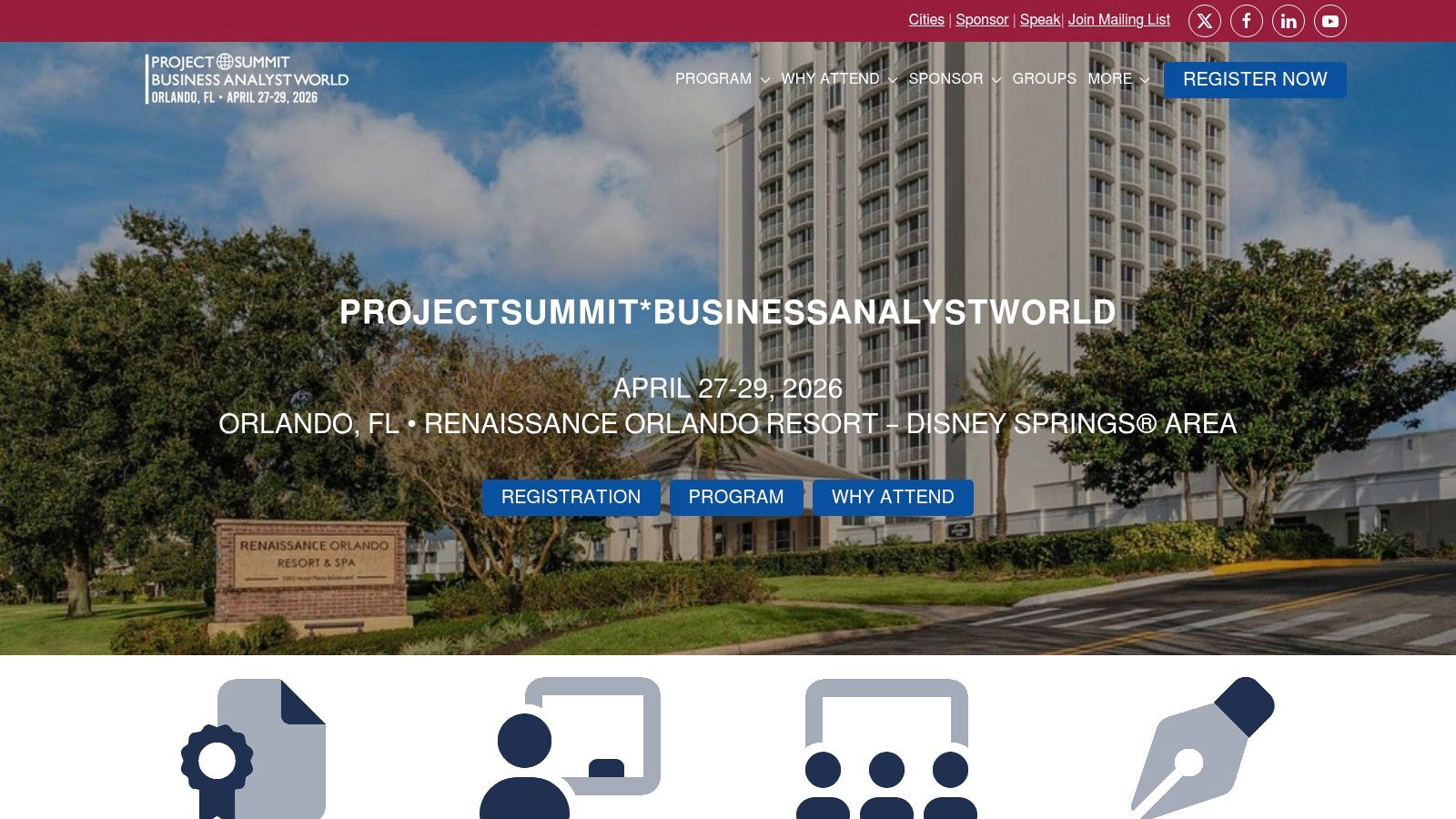
Alt text: Conference banner visual for ProjectSummit BusinessAnalystWorld Orlando 2026.
This event's strength is balance. You get leadership and agile content, but also sessions that usually help people build better project inputs. Requirements quality, process thinking, stakeholder alignment, and practical workshop outputs.
A strong pick for product-delivery overlap
I like this event for software companies where product managers, delivery managers, and analysts all shape scope but no single function owns requirement hygiene end to end. In those settings, the BA-PM crossover matters.
A practical decision rubric:
- Pick this event if: Your delivery misses often trace back to poor discovery or unclear requirements.
- Avoid it if: You mainly need enterprise-scale portfolio governance or large vendor comparisons.
- Send mixed roles: One PM and one BA or product ops lead is often the best pairing.
There's another reason this matters now. Dedicated software adoption is still lower than many leaders assume. Only 23% of organizations use dedicated project management software, yet 77% of high-performing projects do. That tells me the issue often isn't whether a team has a PM title. It's whether the operating system around planning, requirements, and reporting is disciplined enough to support good delivery.
For hands-on teams that want templates and methods they can bring back immediately, this is one of the better-value regional options.
Top 7 Project Management Conferences Comparison
A CTO usually has one conference budget problem, not seven. The real question is which event helps the team ship faster, hire better, or make a smarter tooling call in the next two quarters. Viewed that way, these conferences serve very different jobs.
| Event | 🔄 Implementation complexity | ⚡ Resource requirements | 📊 Expected outcomes | 💡 Ideal use cases | ⭐ Key advantages |
|---|---|---|---|---|---|
| PMI Global Summit 2026 | High. Large multi-track event that rewards pre-booked meetings and a clear agenda | High. Premium pass, travel, and several days away from the team | Enterprise delivery ideas, senior-level networking, PMO and portfolio perspective, vendor evaluation | CTOs, PMO heads, transformation leaders, teams comparing platforms or operating models | Covers delivery, governance, and leadership. Strong senior-peer density. Large vendor expo |
| PMI Agile 2026 | Medium. Focused program, but the best workshops fill quickly | Medium. Registration, travel, and workshop fees | Practical agile methods, scaling patterns, team-level improvements, AI-adjacent delivery discussions | Product, engineering, and delivery leaders trying to improve execution cadence | Focused agile content. Good practitioner case studies. Useful for teams balancing delivery discipline with product speed |
| Digital PM Summit 2026 | Low to Medium. Smaller event with easier session selection and faster networking | Moderate. Lower cost than the biggest conferences, plus optional workshops | Tactics teams can apply quickly, stronger peer connections, better digital delivery habits | Digital product teams, agencies, software leaders managing client or cross-functional work | Practical sessions with less theory. Easier access to speakers and peers |
| PMO unCON North America 2026 | Medium. Unconference format works best if attendees are ready to contribute | Moderate. Travel and registration, plus time to participate actively | Peer-led problem solving, PMO redesign ideas, governance models that reflect current delivery needs | PMO and portfolio leaders reworking governance for product, platform, or AI programs | Specialized PMO focus. High-quality discussion with less conference theater |
| University of Maryland Project Management Symposium 2026 | Low to Medium. Structured tracks and flexible attendance options | Low to Moderate. Strong value, especially with hybrid access | Practical and academic perspectives, PDUs, recorded sessions for later review | Teams that want useful content without a large budget commitment | Strong price-to-content ratio. Hybrid attendance and recordings help teams share learning internally |
| Atlassian Team ’26 | Medium. Best results come from planning around roadmap, admin, and partner sessions | Variable. More worthwhile for organizations already invested in Jira and Confluence | Product roadmap clarity, workflow improvements, hands-on demos, implementation partner conversations | Engineering and operations leaders standardizing delivery workflows or evaluating Atlassian at scale | Clear tool guidance. Practical demos. Broad partner ecosystem for implementation and integration |
| ProjectSummit*BusinessAnalystWorld Orlando 2026 | Medium. Regional multi-track event with workshops that need some planning | Moderate. Regional travel and workshop fees | Hands-on methods, templates, and skills that improve discovery and delivery inputs | PMs, BAs, product ops, and mixed delivery teams | Strong BA and PM crossover. Practical workshops with usable takeaways |
For AI and ML leaders, the split is pretty simple. PMI Global Summit and PMO unCON are better for operating model and governance questions. Atlassian Team is better for workflow and tooling decisions. Digital PM Summit and ProjectSummit*BusinessAnalystWorld are better when the immediate problem is execution quality inside product and delivery teams.
If hiring is part of the ROI equation, pick events where the hallway conversations are as valuable as the stage content. In practice, that usually means PMI Global Summit for senior network density, Atlassian Team for implementation talent and partners, and smaller events like Digital PM Summit when you want honest operator conversations instead of broad conference messaging.
Your Next Steps From Insight to Action
A CTO sends two leaders to a conference, spends the travel budget, gets a folder full of notes back, and six weeks later nothing in the delivery system has changed. I see that pattern a lot. The teams that get real return treat conferences as inputs to hiring, process, and tooling decisions, not as standalone wins.
Run the debrief within 48 hours. Keep it disciplined. Which ideas apply to your current operating model? Which ones solve a bottleneck you already have? Which ones sounded smart on stage but would add overhead in your environment? That filter matters even more for AI and ML teams, where a fashionable framework can distract from the harder work of shipping models, improving data quality, or defining ownership across product, engineering, and operations.
Then make one decision. Not five.
Pick a single pilot tied to a business problem and assign an owner. If the conference surfaced a better way to run intake for AI requests, test it with one team. If someone found a reporting pattern in Jira that could improve visibility across engineering and product, try it in one program before you standardize it. If a vendor looked promising, define the use case, required integrations, security constraints, and success criteria before you book a broader demo cycle. Process quality usually starts with cleaner inputs, and these registration form sample templates on Orbit AI are a useful reminder of that.
The hiring signal is often more valuable than the session deck. A good conference makes capability gaps obvious. You may leave with a clearer AI roadmap, a stronger governance model, or better delivery practices, then realize your current team does not have enough senior PMs, delivery leads, MLOps engineers, or AI product operators to execute them. That is a useful outcome if you act on it quickly.
My rule is simple. Match the event to the bottleneck, write down the two or three decisions it should inform, and judge the trip against those decisions after the team gets back. If the event sharpened your hiring plan, improved one delivery habit, or helped you avoid a bad tooling purchase, it did its job.
If your team comes back from a conference with a sharper AI roadmap but not enough hands to execute it, ThirstySprout can help you hire vetted AI engineers, MLOps talent, and AI product specialists who can turn delivery ideas into shipped systems. Start a pilot or see sample profiles to move from conference notes to production work.
Hire from the Top 1% Talent Network
Ready to accelerate your hiring or scale your company with our top-tier technical talent? Let's chat.