

TL;DR
- Agile is the guiding philosophy of iterative development and customer feedback. It's the "why."
- Scrum and Kanban are two frameworks for implementing Agile. They are the "how."
- Choose Scrum for complex projects with a clear goal (e.g., building a new AI feature). Its fixed sprints (1–4 weeks) provide predictability and focus.
- Choose Kanban for managing a continuous stream of work with shifting priorities (e.g., MLOps or bug-fix queues). Its continuous flow model provides maximum flexibility.
- Most AI teams use a hybrid model (Scrumban), blending Scrum's planning ceremonies with Kanban's workflow flexibility to manage both R&D and operations.
Who This Is For
- CTO / Head of Engineering: Deciding on an operating model for a new AI/ML team or optimizing an existing one.
- Founder / Product Lead: Trying to scope a project and understand how the team will deliver an AI feature or product on a timeline.
- AI/ML Team Lead: Tasked with implementing a process that handles both experimental research and stable production delivery.
This guide is for technical leaders who need to choose a framework and implement it within weeks, not months.
Quick Answer: A Decision Framework for Your Team
Picking the right framework directly impacts your team’s velocity, predictability, and ability to adapt. While Agile provides the core principles—customer collaboration, iterative progress, and responding to change—Scrum and Kanban offer the operational playbooks.
Your choice should be rooted in your team’s specific context. Use this decision tree:
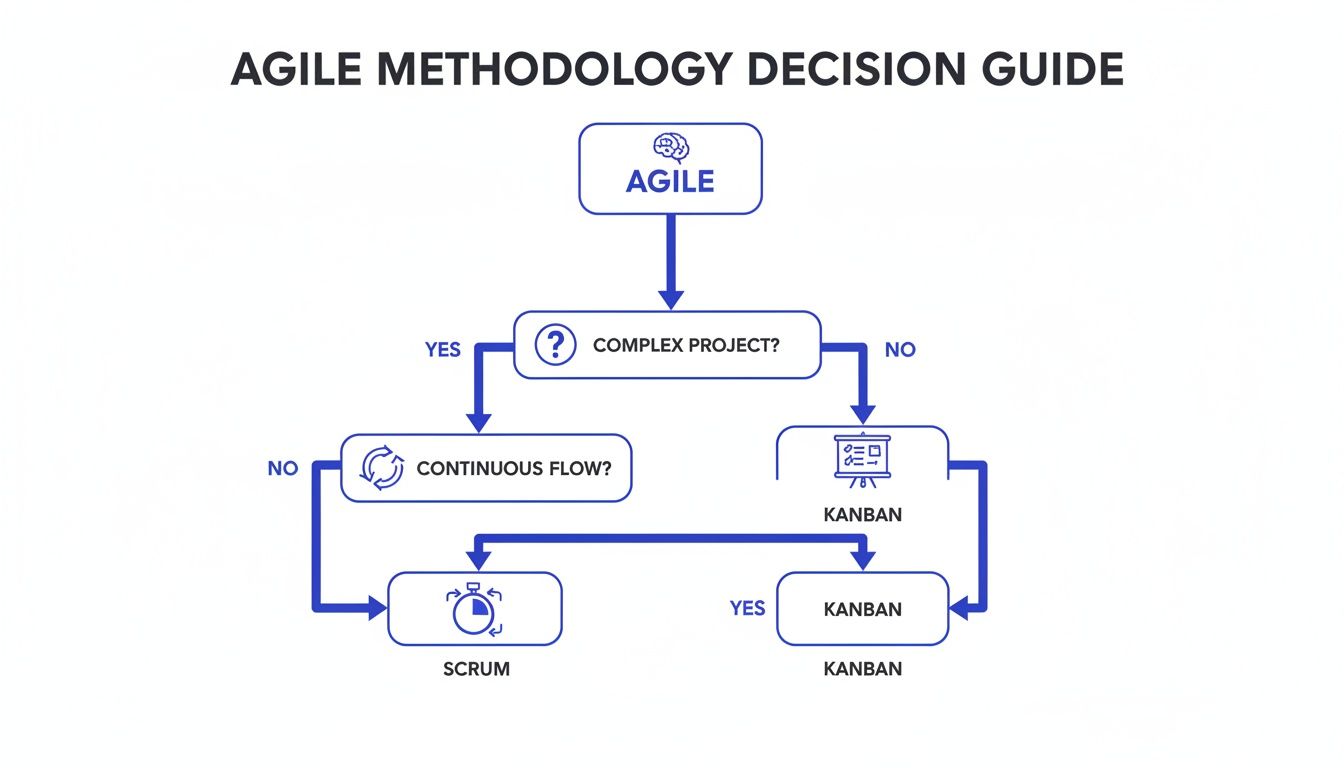
This flowchart helps map your project type to the most effective framework, guiding you toward Scrum's structure for complex projects and Kanban's flexibility for continuous workflows.
For a quick comparison, this table breaks down Agile against its two most popular implementations.
Scrum provides rhythm and predictability. Kanban offers flexibility to adapt to a high-volume, ever-changing stream of tasks. Your job is to decide which is more valuable for a given team or project.
Practical Examples: Scrum vs. Kanban in AI Teams
Theory is one thing; application is another. Let's examine two real-world scenarios that highlight where each framework shines.
Example 1: Scrum for Building an AI MVP
- Scenario: A Series B startup is building a new AI-powered logistics optimization engine. The goal is to launch a Minimum Viable Product (MVP) in one quarter to land a critical design partner. The work is complex, involving data integration, algorithm development, and a user interface.
- Rhythm and Focus: Breaking the goal into 2-week sprints creates a steady cadence, turning a massive project into achievable milestones. This allows the CTO to confidently report progress.
- Role Clarity: The Product Owner guards the MVP's scope, ruthlessly prioritizing features. The Scrum Master, a servant-leader who coaches the team, shields the AI engineers from distractions so they can perform deep R&D.
- Business Impact: The regular sprint reviews act as crucial checkpoints, ensuring the technical build never strays far from business objectives. This de-risks the project and prevents building a product that misses the mark.
Example 2: Kanban for an MLOps Team
- Scenario: An MLOps team at a scale-up manages a portfolio of 15 live machine learning (ML) models. Their work is a constant, unpredictable stream of tasks: urgent production bugs, model performance degradation alerts, and requests for new monitoring.
- Continuous Flow: A critical production bug doesn't wait for the next sprint planning meeting; it gets pulled in and addressed immediately. This makes the team highly responsive.
- WIP Limits: By setting a hard Work in Progress (WIP) limit—for instance, only three tasks "In Progress" at any time—the team is forced to finish tasks before starting new ones. This kills context-switching and dramatically shrinks cycle time.
- Business Impact: The goal isn't shipping a big batch of features; it's maintaining system stability. Kanban's metrics like cycle time (how long a task takes) and throughput (how many tasks are completed per week) directly measure the team's ability to fix problems fast.
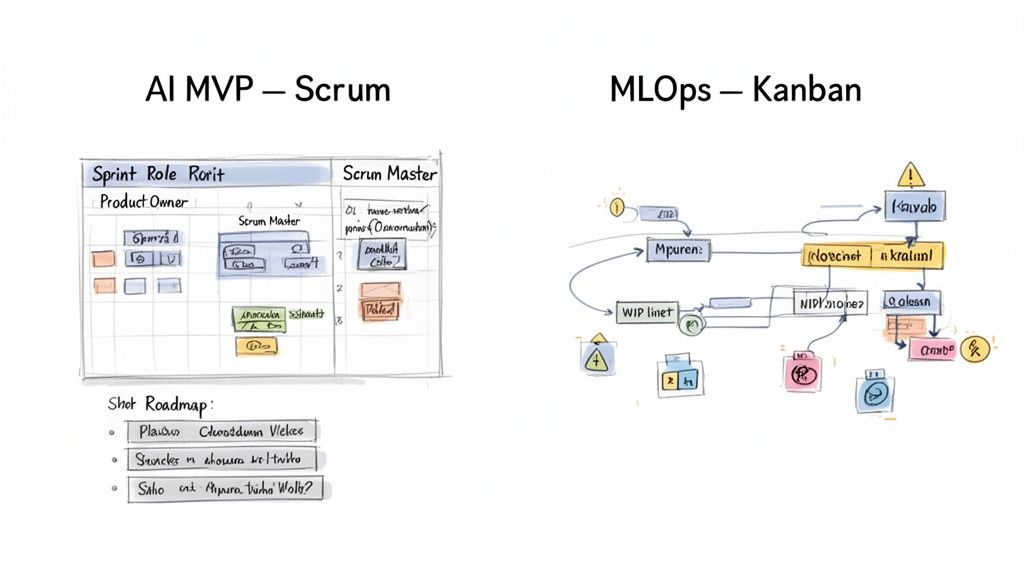
This diagram shows how Scrum focuses on a time-boxed roadmap for an AI MVP, while Kanban manages a continuous flow of tasks for MLOps.
Deep Dive: Trade-offs, Pitfalls, and Alternatives
Deciding between Scrum and Kanban isn’t about picking a "better" methodology. It's a strategic choice about which operating model fits your team's real-world context.
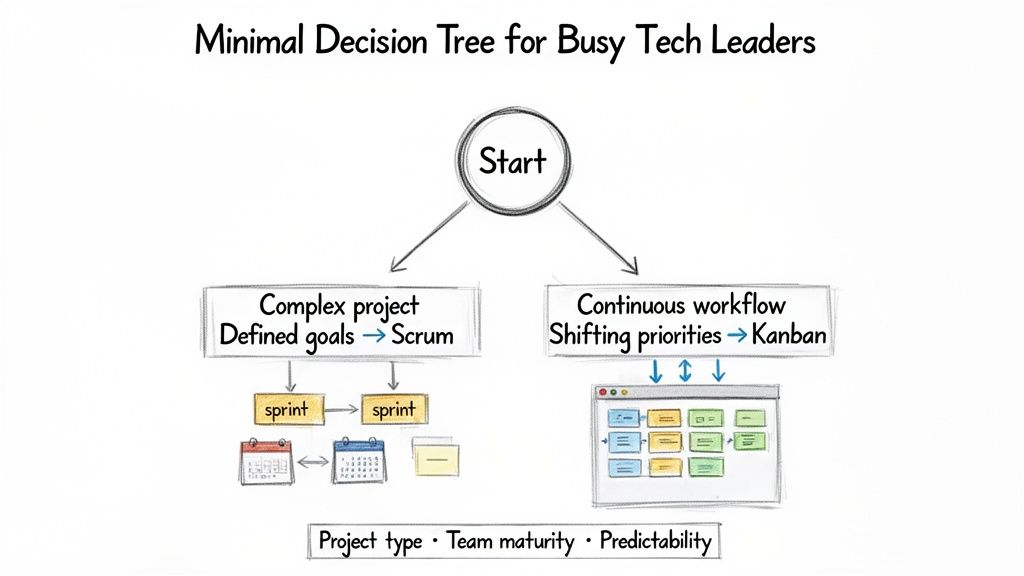
Leaders must weigh the structured predictability of Scrum against the adaptive flexibility of Kanban.
The Scrumban Hybrid: A Pragmatic Choice for AI Teams
Most experienced AI/ML leaders don't choose one or the other; they build a hybrid. This approach, often called Scrumban, pragmatically borrows the most effective elements from both methodologies.
This blended model accepts the dual nature of AI work: structured engineering and unpredictable research. You get the rhythm and planning from Scrum, paired with the flexibility and visual management of Kanban for day-to-day execution.
A practical Scrumban setup for an AI team often looks like this:
- Keep the Cadence, Not the Constraints: Stick with a regular 2-week cycle for planning, demos, and retrospectives. These rituals provide a predictable pulse for alignment.
- Swap Sprints for a Continuous Flow: Use a Kanban board with WIP limits instead of a rigid sprint backlog. This is key for handling research tasks that can't be accurately time-boxed.
- Visualize Different Workstreams: Use swimlanes on your board to create separate paths for New Feature Development, Model Experimentation, and Production Support. This clarifies where effort is going.
The goal isn't to make research predictable; that's impossible. It's to create predictable rituals around the work.
Common Implementation Pitfalls to Avoid
- "Zombie Scrum": Teams go through the motions of Scrum ceremonies (stand-ups, reviews) but without purpose. The agile spirit is dead. Fix: Make retrospectives actionable. Ask, "What’s one concrete experiment we can run next sprint to remove a blocker?" and hold the team accountable.
- The Kanban "Anything Goes" Board: A Kanban board without strict WIP limits becomes a messy parking lot for tasks. Context-switching runs rampant, and nothing gets finished. Fix: Treat WIP limits as law. A good starting point is to set the WIP limit for a column to the number of people working in that stage. When a column is full, the team's priority becomes unblocking it.
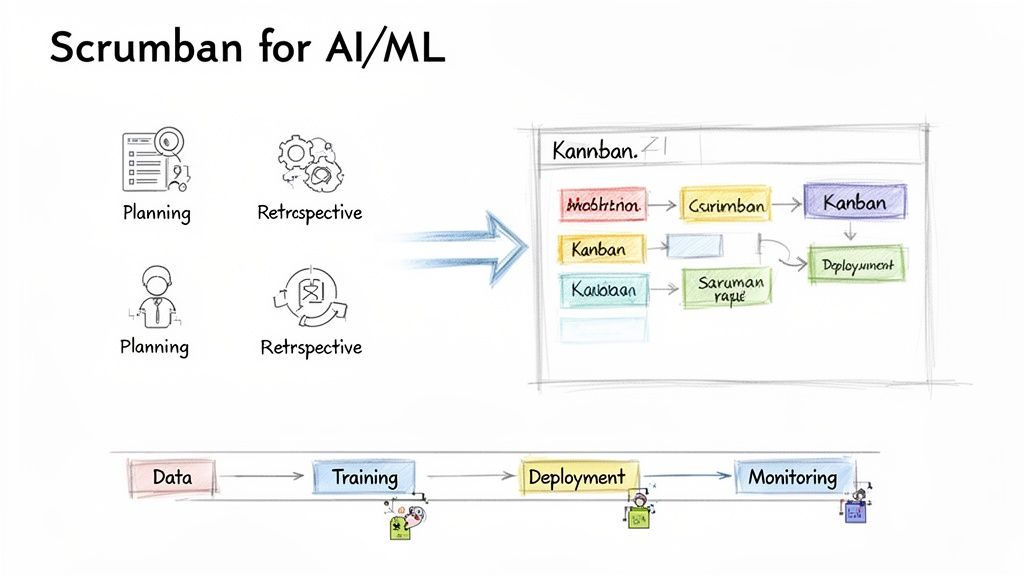
A Scrumban workflow combines Scrum's planning and review cycles with a Kanban board, creating a balanced system for AI/ML teams.
Actionable Checklist: How to Implement Your Chosen Framework
Shifting from theory to practice requires a careful process of discovery, testing, and tweaking. Use this checklist to roll out your chosen framework in an intentional, not chaotic, way.
The goal isn't to "do Agile" perfectly. The goal is to use an Agile framework to build a process that works for your team and your business.
What to Do Next
- Assess Your Current Workflow: Use the checklist above to analyze your team's primary type of work—is it project-based or a continuous flow?
- Propose a 30-Day Pilot: Choose one team and a target metric to test either Scrum, Kanban, or a Scrumban hybrid.
- Book a Scoping Call: If you need expert AI engineers who already know how to operate in these frameworks, let's talk. We can help you build a high-performing team in weeks.
Ready to build a high-performing AI team with the right agile process? ThirstySprout helps you hire vetted, senior AI and ML engineers who are experts in implementing frameworks like Scrum and Kanban for real-world results. Start a Pilot today.
References
- The Agile Manifesto
- The official Scrum Guide
- ThirstySprout's guide to roles in Agile software development
- Our comparison of Agile vs DevOps
- A primer on project management for software engineering
- Statistics on Agile adoption from Parabol.co
- A practical guide to machine learning for businesses
Hire from the Top 1% Talent Network
Ready to accelerate your hiring or scale your company with our top-tier technical talent? Let's chat.