

TL;DR
- It's a Toolkit, Not One Product: "Offshore development software" is a stack of tools for communication, project management, code collaboration, security, and AI/MLOps—not a single application you can buy.
- Match the Stack to Your Stage: A lean startup needs a simple, fast stack (Slack, Linear, GitHub). A scale-up needs a robust MLOps stack for governance and security (Jira, GitLab, Okta, MLflow).
- Security is Non-Negotiable: Implement a zero-trust environment from day one with Single Sign-On (SSO), Role-Based Access Control (RBAC), and automated code scanning. This is your primary defense against data breaches.
- Measure Outcomes, Not Activity: Track metrics like Cycle Time and Pull Request (PR) Throughput to gauge team performance objectively.
- Next Step: Run a Pilot. Define a 2–4 week project, audit your current software stack for gaps, and hire a pre-vetted engineer who can deliver value immediately.
Who This Is For
- CTO / Head of Engineering: You need to build a remote AI team and select the right software stack to ensure security, productivity, and scalability.
- Founder / Product Lead: You're hiring your first offshore engineers and need a cost-effective, practical toolkit to help them ship features fast.
- Talent Ops / Procurement: You're evaluating vendors and need a framework to assess the total cost and risk of an offshore software stack.
The 5-Pillar Framework for Your Offshore Stack
An effective offshore development software stack isn't just a random collection of tools; it's a digital headquarters built on five essential pillars. A weakness in any one pillar creates risk for the entire operation.
- Communication: Tools for real-time (synchronous) and delayed (asynchronous) conversation.
- Project & Code Management: A single source of truth for work and a secure way to collaborate on code.
- Security & Compliance: Guardrails to protect intellectual property and customer data.
- AI & MLOps: Specialized tooling for reproducible, production-grade machine learning.
- Integration & Scalability: A philosophy ensuring all tools work together and can grow with your team.
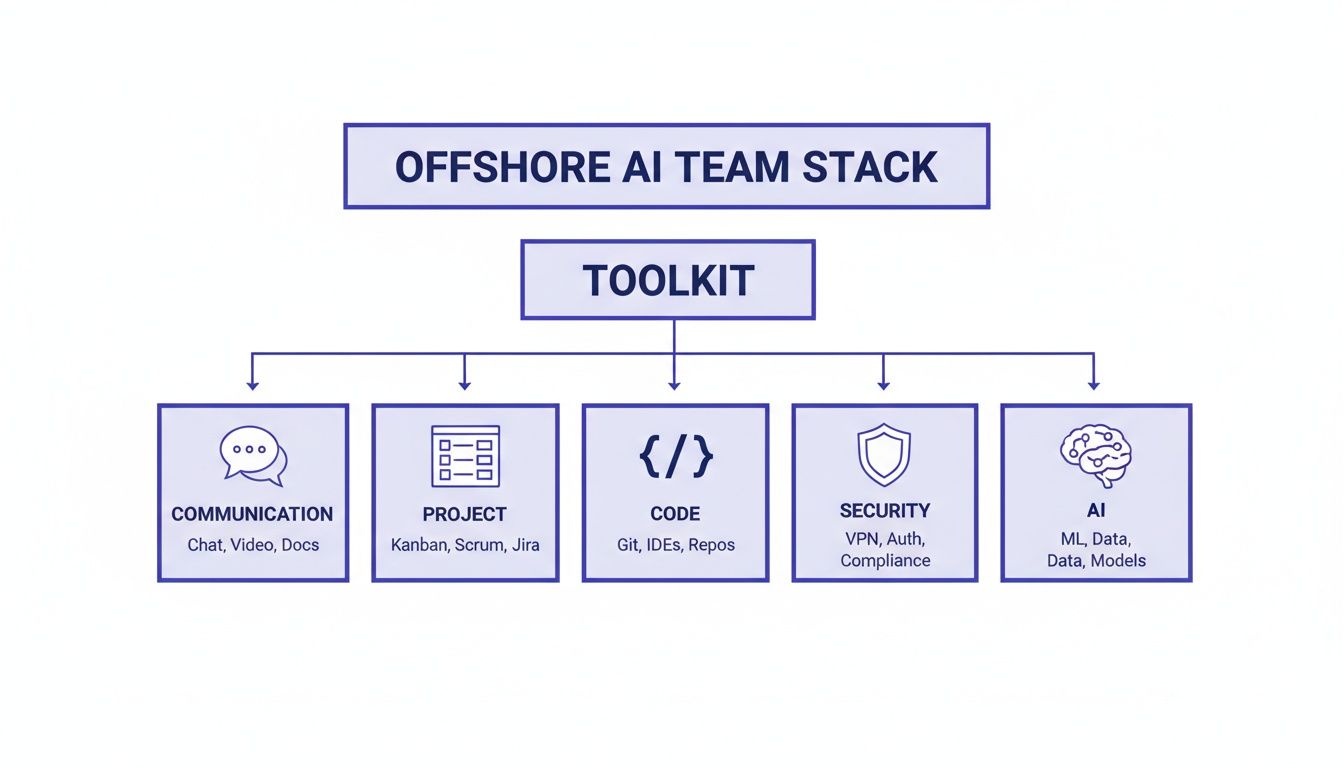
Alt text: Diagram showing the five pillars of an offshore AI team stack: Communication (Slack), Project Management (Jira), Code & CI/CD (GitHub), Security (Okta), and AI/MLOps (MLflow), creating a complete operational toolkit.
The right mix of tools from these five categories provides the scaffolding your remote team needs to build, ship, and maintain products as if they were all in the same room.
Practical Examples: Startup vs. Scale-Up Stacks
The "best" offshore development software stack is a myth. The right stack depends entirely on your company's stage, team size, and project complexity. A tool that's perfect for a scrappy startup is often a liability for a scale-up that needs tight governance.
Example 1: The Lean Startup Stack (2–5 Engineers)
You're a seed-stage startup with a small remote team. Your priority is speed and flexibility. Your stack should be lightweight, developer-friendly, and cost-effective.
- Communication: Slack for a central digital office.
- Project Management: Linear for its speed and keyboard-first design that engineers love.
- Source Control & CI/CD: GitHub (Team plan) for code collaboration and basic automation with GitHub Actions.
- Security: A secret manager like Doppler or 1Password's CLI to keep credentials out of your code.
This stack minimizes administrative overhead and maximizes developer velocity, enabling a small, high-trust team to ship features quickly.
Example 2: The MLOps Scale-Up Stack (10+ Engineers)
You're a Series B company with a dedicated MLOps team. Your priorities have shifted to repeatability, security, and compliance. Your stack needs to provide guardrails for building production-grade AI systems.
- Project Management: Jira for its powerful workflow customization and integrations needed for cross-team projects.
- Source Control & CI/CD: GitLab Premium to bundle source control, advanced CI/CD, and security scanning into one platform.
- AI & MLOps Tooling: MLflow and DVC for experiment tracking and data versioning, making deployments auditable and reproducible.
- Security: Okta for Single Sign-On (SSO) to centralize access control and Snyk for continuous vulnerability scanning.
This mature stack is designed for control and predictability, directly impacting business outcomes like reliability and regulatory compliance.
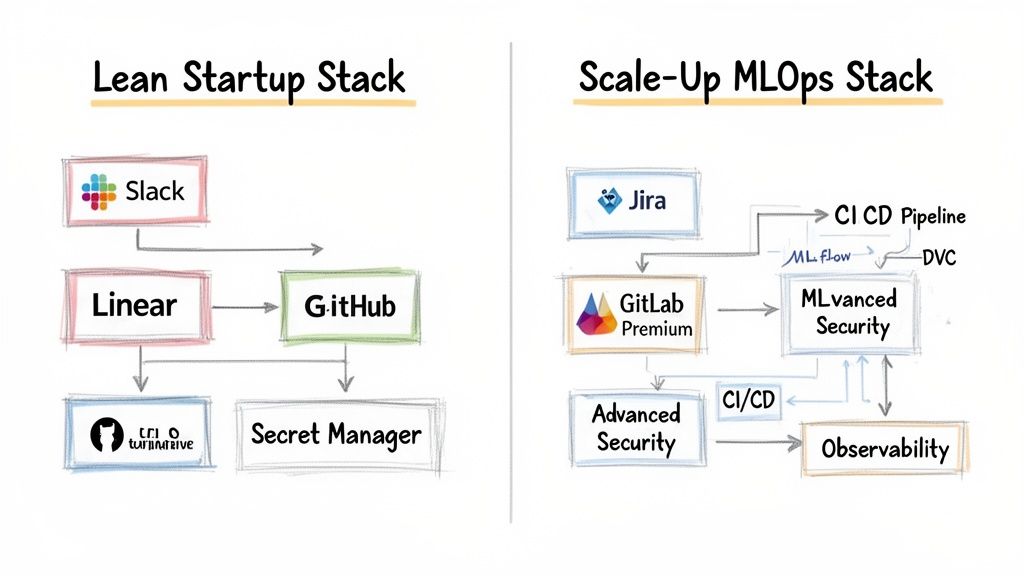
Alt text: Diagram comparing a "Lean Startup" software stack (Slack, Linear, GitHub) focused on velocity with a "Scale-Up MLOps" stack (Jira, GitLab, Okta, MLflow) focused on governance and security.
Deep Dive: Pitfalls, Trade-offs, and Best Practices
Choosing and implementing your offshore software stack requires more than just picking tools. It demands a clear strategy around processes, security, and people.
Onboarding Your Remote Engineers
A structured onboarding process is your best chance to integrate new engineers into your culture and workflow. The goal is to get them shipping code in their first week.
- Day 1: Access & Buddy Up. Grant access to Slack, Jira, and GitHub. Pair them with an existing team member to answer informal questions.
- Days 2-3: The First Ticket. Assign a small, well-defined bug fix. This low-stakes task lets them learn your entire development lifecycle, from pull request to deployment.
- Week 1: Process Deep Dive. Walk them through your CI/CD pipeline, code review norms, and sprint ceremonies.
This framework transforms onboarding from a logistical task into a strategic advantage.
Establishing Clear Communication Protocols
Remote work fails without explicit communication rules. Ambiguity across time zones kills productivity.
We recommend a simple guideline: the “4-Hour Slack Rule.” For any non-urgent, asynchronous question, team members can expect an answer within four of their working hours. This sets a predictable pace and prevents developers from getting blocked while protecting focus time.
These operational rhythms are critical. While offshore talent can offer 30-60% cost savings compared to US salaries, those savings disappear without efficient execution.
How to Measure Performance (Without Micromanaging)
You don't need to watch green dots on Slack. Your software stack provides objective data on what matters: outcomes.
- Cycle Time: How long does a task take from "In Progress" to "Done"? This metric from Jira or Linear is a direct measure of team velocity and highlights bottlenecks.
- Pull Request (PR) Throughput: How many PRs does an engineer merge per sprint? This reflects concrete output.
- Code Churn: What percentage of code in a PR is rewritten? High churn can indicate unclear requirements or a need for technical mentorship.
These metrics, pulled directly from your tools, allow you to manage performance based on results, not presence. For more on this, see our guide on how to manage a remote team effectively.
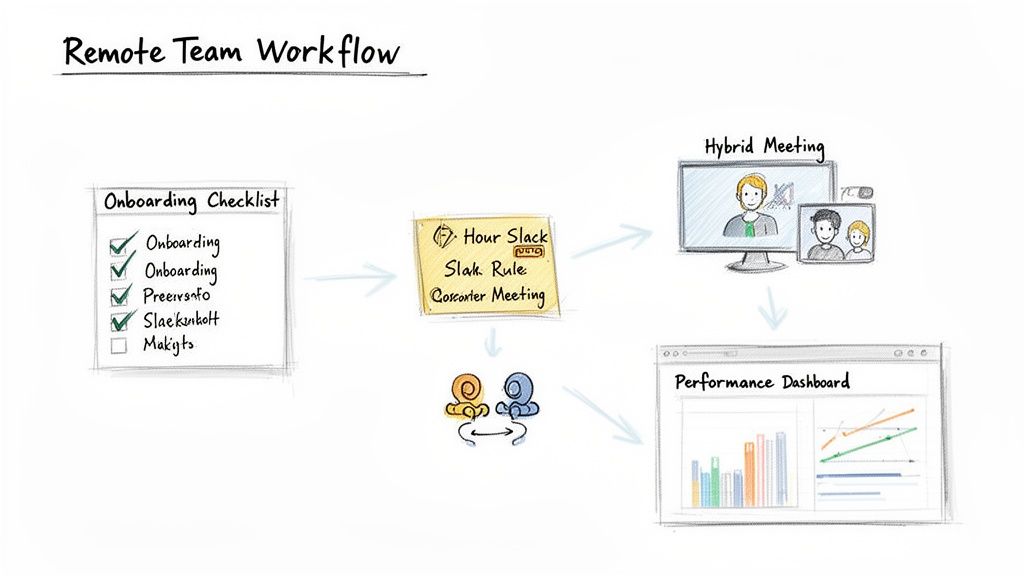
Alt text: Whiteboard diagram of a remote team workflow, showing steps for onboarding, communication protocols, hybrid meetings, and performance tracking with metrics from Jira and GitHub.
Security: The Unskippable Step
A distributed team demands a zero-trust security model. Your developer's physical location is irrelevant; your processes and tools are what matter.
- Identity and Access Management (IAM): Use tools like Okta or Azure AD to enforce Single Sign-On (SSO) and strict Role-Based Access Control (RBAC). When a contract ends, you revoke all access in one click.
- Automated Scanning: Integrate tools like Snyk or GitHub Advanced Security into your CI/CD pipeline to catch vulnerabilities before they reach production.
This proactive approach turns security from a worry into a managed process.
Checklist: How to Select Your Offshore Software Stack
Use this evaluation matrix to score potential tools based on what matters to your business. Assign a score from 1 (poor) to 5 (excellent) for each criterion, then multiply by the weight that fits your company stage.
This data-driven approach helps you move beyond marketing hype and choose the right tools for the job, avoiding the common pitfalls of tool sprawl or the costly build vs. buy software for your team trap.
What to Do Next
Building a high-performing offshore team is a sequence of deliberate steps, not a single leap.
- Audit Your Current Stack: Map your existing tools to the five pillars. Identify immediate gaps in areas like security or AI tooling before you spend a dollar.
- Scope a 2–4 Week Pilot Project: Define a small, contained project with a clear, measurable outcome. This is the perfect first task for a new hire and a low-risk way to test your new processes.
- Find the Right Talent Partner: The best software stack is useless without an expert who knows how to use it. Partner with a specialist to find a pre-vetted AI engineer who has already mastered your chosen tools and can start delivering value on day one.
Ready to build your team the right way?
References & Further Reading
Here are answers to the questions we hear most often from CTOs, founders, and engineering leaders.
How do I ensure data security with an offshore team?
Modern security is about process and tools, not physical location. Implement a "zero-trust" environment using Single Sign-On (SSO) with Okta, strict Role-Based Access Control (RBAC), and mandatory Multi-Factor Authentication (MFA). Automate vulnerability scanning with tools like Snyk in your CI/CD pipeline.
What is the real Total Cost of Ownership (TCO) for these tools?
TCO includes license fees plus the hidden costs of implementation, training, integration, and ongoing administration. A cheap tool that requires hours of engineering time to maintain is more expensive than a pricier, seamless one. Factor in lost productivity from poorly integrated systems.
How can I prevent tool sprawl and ensure adoption?
Prevent sprawl by standardizing on a core stack and requiring any new tool to be evaluated against it. Ensure adoption by prioritizing Developer Experience (DX). Tools that engineers genuinely enjoy using, like Linear, get adopted organically because they reduce friction and automate tedious work.
Related ThirstySprout Resources:
Hire from the Top 1% Talent Network
Ready to accelerate your hiring or scale your company with our top-tier technical talent? Let's chat.