

Your CTO asks for a product video. Your first instinct is probably wrong.
Most first videos in AI startups try to explain the whole platform. They open with a polished logo sting, spend too long on category framing, and end without giving a technical buyer a reason to care. The result looks expensive and feels forgettable.
A better marketing strategy video for a deep tech company does less. It picks one business goal, one sharp pain point, and one proof path. Then it shows the product clearly, with enough technical substance to earn trust.
That matters because video is already standard practice, not an experiment. As of 2025, 93% of businesses use video as a core marketing tool, up from 61% in 2016, and 91% of businesses in B2B and tech employed video marketing by late 2023 according to Siege Media's video marketing statistics roundup. For AI startups, the question isn't whether to use video. It's whether your first one will help sales or just sit on a page.
The 5-Part Framework for AI Product Videos
A useful first video follows a simple sequence:
- Goal
- Hook
- Script
- Production
- Distribution
Beginning at production is a common desire because it feels tangible. That's backwards. If you don't know who the video is for and what action it should drive, the rest becomes guesswork.
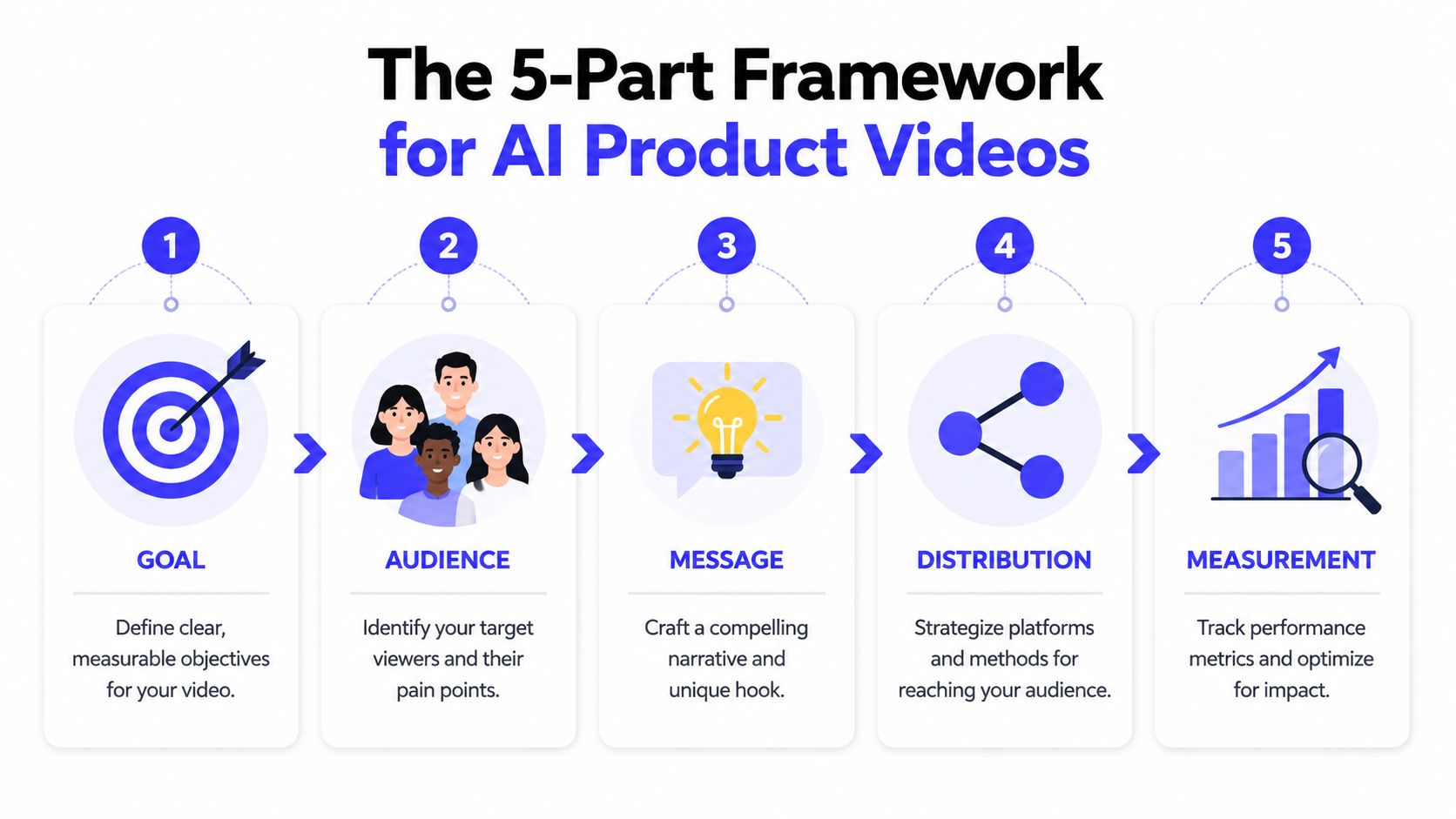
For a technical audience, each part has a specific job.
Goal
Choose one outcome. Not “awareness.” Not “engagement.” Pick something a founder, product marketer, or sales lead can inspect later. Good goals for a first video include improving demo quality, reducing confusion before a sales call, or helping prospects understand a difficult workflow faster.
If your product still changes weekly, align the video to the current buying motion, not the long-term brand story. Teams already doing high-fidelity wireframes for product communication usually adapt faster here because they know how to show flows, not just talk about features.
Hook
This is the opening argument. In AI, a hook works when it names a technical pain point crisply. It fails when it sounds like a category explainer for someone who has never touched production systems.
Script
Write for a skeptical engineer. Short sentences. Specific claims. A visible product flow. If a sentence could appear on any AI startup website, cut it.
Practical rule: Your script should answer three questions in the first part of the video. What problem is broken, who feels it, and what changed after using the product?
Production
Use the lightest setup that still looks credible. Screen capture, clean audio, one presenter who knows the system, and a few product moments that are easy to follow. If you need help moving from prompt to storyboard, this step-by-step AI video creation guide is a useful companion for lean teams.
Distribution
A single upload is not a strategy. Plan where the video lives before you record it. For most AI startups, that means a product page, outbound follow-up, LinkedIn clips, and sales enablement.
A strong marketing strategy video is less like an ad and more like a technical sales asset. That's why the framework works. It keeps the team focused on persuasion, not production theater.
Defining Your Goal and Finding Your Hook
The most common mistake is treating the first video like a company overview. Technical buyers rarely need that. They need a reason to believe your product solves a painful, specific problem they already recognize.
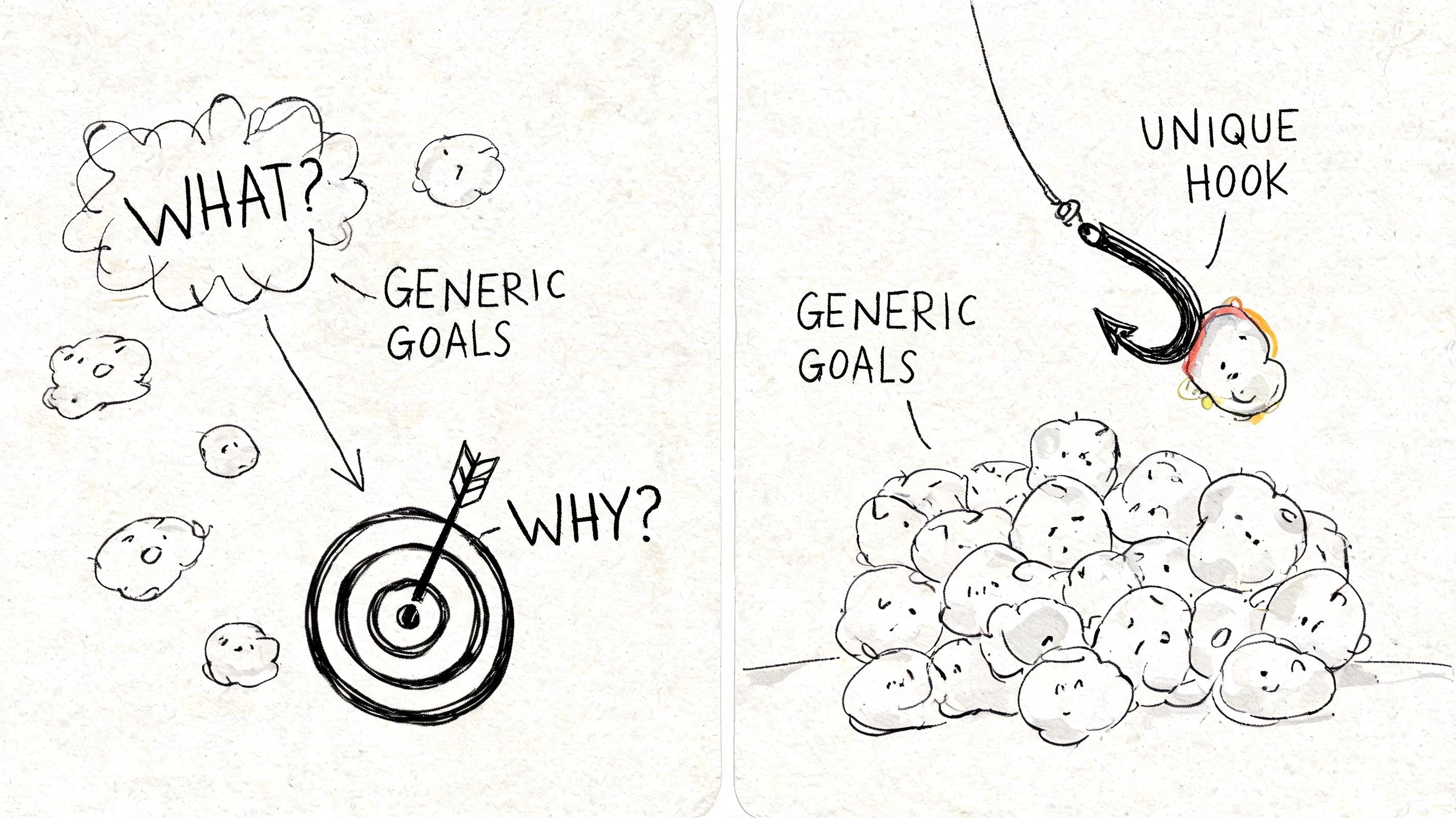
A generic goal produces generic content. “Explain our platform” sounds harmless, but it pushes the team toward broad messaging, too many features, and weak calls to action. A better goal sounds like this:
- For technical evaluators: Reduce confusion about how the model monitoring workflow fits into the existing stack.
- For product-led growth: Help free users understand the fastest path to first value.
- For sales: Give account executives a short asset they can send after discovery when prospects ask how the system works.
Weak goals versus usable goals
Here's the test I use. If your goal can't influence editing decisions, it isn't a real goal.
A usable goal tells you what to keep and what to cut. If the objective is to improve post-discovery follow-up, you probably don't need a founder intro. You do need a clean product walkthrough, a sharp use case, and a CTA that points to the next buying step.
A weak goal also makes measurement impossible. “Get more views” sounds measurable, but it doesn't tell you whether the right people watched or whether the video changed pipeline quality.
A technical buyer will forgive simple visuals faster than they'll forgive vague messaging.
Hooks that work for cynical technical audiences
The hook should sound like an informed point of view, not a marketing warm-up. That's especially important in AI, where buyers have already seen too many insightful explainers.
According to this niche-hook research reference, 74% of Series A-D CTOs ignore generic explainer videos, and a 2026 LinkedIn algorithm update prioritizes pain-point specificity. The practical takeaway is clear. Broad explainers blend in. Specific pain wins attention.
Good hook patterns for AI startups:
- Contrarian hook: “Why our first retrieval pipeline failed in production.”
- Pain-point hook: “Why your LLM support bot looks good in staging and breaks under real ticket volume.”
- Decision hook: “When not to fine-tune, and what to do instead.”
- Speed-to-value hook: “How to show model output quality to an enterprise buyer without a six-week proof of concept.”
Mini-case example
A small infrastructure tooling team I advised had a polished explainer that sounded competent and performed poorly in sales follow-up. We replaced it with a simpler video built around one line: “We stopped demoing the happy path and started showing the failure mode.”
The video opened with a broken workflow. Delayed jobs. Missing alerts. A dashboard nobody trusted. Then it showed the fix and the reasoning behind it. That change did two things. It gave the technical buyer immediate context, and it signaled honesty.
That kind of hook works because it respects the viewer's experience. Engineers don't want theater. They want evidence that you understand the ugly part of the problem.
Scripting a Compelling AI Product Story
Most AI product videos fail in the script, not in the edit.
The script either gets too abstract, or it drowns the viewer in implementation detail before they understand the business problem. You need a middle path. It should be technical enough to be credible and simple enough to follow in one sitting.

A practical script template
Use this structure for a first marketing strategy video aimed at technical buyers:
Problem
- What breaks today?
- Who feels the pain?
- Why is the current workaround bad?
Agitate
- What happens if the team keeps operating this way?
- Where do delays, errors, or trust issues show up?
Solution
- What does the product do differently?
- What changes in the user's workflow?
Proof
- What can the viewer see directly in the product?
- What evidence can you show without hype?
Next step
- What should the buyer do after watching?
- Problem: “If you're a [role], you've probably dealt with [specific failure or delay].”
- Agitate: “That usually means [visible consequence], which creates [business or engineering cost].”
- Solution: “Our product changes this by [simple mechanism], so your team can [practical outcome].”
- Proof: “Let's look at the workflow. First, [screen action]. Then, [screen action]. Notice [important detail].”
- CTA: “If this matches your environment, the next step is [demo, trial, pilot, or technical review].”
- Capture tool: Loom or another screen recorder for product walkthroughs
- Editing tool: Descript for trimming, captions, and cleanup
- Slides or diagrams: Figma for system visuals or simple flow screens
- Audio: A dedicated USB mic in a quiet room
- Lighting: Window light or a basic desk light placed in front of the speaker
- Thumbnail clarity: Show one clear outcome or product moment
- Mobile readability: Increase font size in recordings and overlays
- Caption quality: Assume many viewers watch muted at first
- CTA placement: Put the call to action in the video and around it on the page
- LinkedIn clip one: The problem statement and first pain point
- LinkedIn clip two: The product moment where the workflow changes
- Sales follow-up clip: A trimmed answer to a common objection
- Website embed: Full demo on a relevant product or solution page
- GIF snippets: Short loops for outbound emails or social posts
- Internal enablement asset: A version the sales team can send after calls
- Fewer repetitive questions from prospects before the second call
- Better-qualified inbound conversations because buyers self-select
- Stronger founder efficiency because one asset explains the workflow repeatedly
- Cleaner handoff to sales because the video establishes shared context
- Goal locked: The team agrees on the business action this video should influence
- Audience defined: You know the role watching and the problem they care about
- Hook chosen: The opening angle is specific enough to stand apart from a generic explainer
- Proof available: Every major claim can be shown in product, UI, workflow, or credible narration
- Opening is fast: The first lines name the pain clearly
- Story is concrete: The script follows problem, consequence, solution, and proof
- Demo is visible: Screen text is readable and the important moments are zoomed in
- Audio is clean: Viewers can tolerate simple visuals, but they won't tolerate muddy sound
- Primary home selected: Product page, use-case page, outbound sequence, or sales follow-up
- Repurposing plan ready: Short clips, snippets, and internal enablement versions are mapped
- CTA tagged: Each version points to one measurable next action
- Review cadence set: The team knows when it will inspect retention, clicks, and pipeline signals
This structure works because it mirrors how technical buyers evaluate new tools. They start with the problem shape, then inspect whether your approach is concrete.
Fill-in-the-blank script draft
You can draft a usable first version in plain English:
If your team wants extra help on narration rhythm and line length, this guide on how to write scripts for Framesurfer is a useful reference.
Example script snippet
Here's a simple B2B example for a technical hiring-related AI workflow:
“Hiring for MLOps often stalls because resumes don't tell you who has actually shipped production systems. Your team spends cycles screening, interviewing, and still lacks confidence. This workflow gives hiring managers a faster way to review vetted specialists by stack, delivery history, and role fit. Let's look at how a hiring lead filters for LLM infrastructure, reviews candidate depth, and moves straight into a scoped conversation.”
That works because it stays operational. No inflated category language. No detached brand slogans.
Here's a useful benchmark for pacing and demonstration style:
Two script checks before you record
Use this quick review with your product lead or CTO:
| Check | What to look for | Fix if missing |
|---|---|---|
| Specificity | Does the script name a real workflow, role, and pain point? | Replace category language with operational detail |
| Showability | Can every major claim be shown on screen or spoken by someone credible? | Cut claims that need hand-waving |
| Sequence | Does the viewer understand the problem before seeing features? | Reorder the opening |
| Plain language | Would a busy engineer follow this without replaying it? | Shorten sentences and remove jargon |
For teams explaining foundation models or agent workflows, it often helps to align terminology with a shared baseline. This primer on what a large language model is is a good example of the level of clarity you want.
Lean Production and Strategic Repurposing
High polish is overrated for a first technical video.
What matters more is whether the product is visible, the speaker sounds credible, and the viewer can understand the workflow without friction. A founder with a clear screen recording and clean audio will usually outperform a glossy brand piece that says very little.
Where lean production wins
Technical buyers often trust plain demonstrations more than overproduced messaging. A Loom walkthrough, edited in Descript, can feel more honest than a studio voiceover layered over stock footage. The trade-off is obvious. Lean production lowers visual drama. It raises perceived authenticity.
For a startup, that's usually the right trade.
A practical lean setup looks like this:
Field note: If the product UI is dense, zoom in aggressively. The viewer should never work to find the point of interest.
What to optimize before you reshoot
Lean doesn't mean careless. It means putting effort where it changes outcomes.
According to Sharp Films' guide to video marketing strategy, custom thumbnails can boost click-through rates by 30%, and 60% of B2B views are now on mobile. That means your title card, thumbnail, captions, and screen legibility matter more than cinematic transitions. The same source also recommends A/B testing thumbnails and calls to action rather than jumping straight into a full reshoot.
A few practical adjustments usually matter more than a new camera:
Example repurposing plan
One five-minute product demo can become a small content system if you plan for it:
If you want a practical walkthrough for slicing one source video into multiple assets, this ProdShort content creation strategy is a solid reference.
The teams that get value from video fastest don't produce more. They reuse better.
Measuring Success with Meaningful KPIs
A technical video shouldn't be judged like entertainment content.
Views matter only if the right people watch, stay engaged, and take the next step. For an AI startup with a high-value sales cycle, the useful question is simple: did this video reduce friction in the buying process?
That question matters because video is already tied to commercial outcomes. According to SellersCommerce video marketing statistics, 90% of marketers report positive ROI from video in 2025, watching product demo videos convinces up to 89% of users to purchase, landing pages with video can boost conversions by 86%, and companies using video generate 66% more qualified leads annually.
The KPIs that actually matter
For niche B2B, I'd track a short list and review it consistently:
| Metric | What It Measures | Good Benchmark (for Niche B2B) |
|---|---|---|
| Audience retention at key moments | Whether viewers stay through the problem statement, core demo, and CTA | Good enough that you can see prospects reaching the proof section consistently |
| CTA click-through rate | Whether the video drives action to demo, pilot, or contact | Good enough that sales and marketing can compare versions and identify a winner |
| View-to-demo rate | The share of viewers who move into a sales conversation | Strong when the video is used in a defined stage such as post-discovery follow-up |
| Video-influenced pipeline | Whether opportunities that engaged with the video progress more cleanly | Useful when paired with CRM notes and campaign tagging |
| Sales usage rate | Whether account executives and founders actually send the asset | Good when the team keeps reusing it because it answers a real objection |
Notice what's missing. Raw impressions. Vanity likes. Broad reach without role fit.
A simple tracking method
You don't need a complex attribution stack to start. You do need disciplined tagging.
Use one CTA per version of the video. Put it on a landing page, in outbound follow-up, or inside a sales email sequence with clear campaign labels. Then compare behavior by context. A homepage embed serves one purpose. A post-demo follow-up video serves another.
If your team is still building the basics of B2B demand capture, this guide to digital marketing for business to business is a good companion because it frames video as one asset inside a broader pipeline system.
Don't ask whether the video “performed.” Ask whether it made a sales conversation shorter, clearer, or easier to advance.
What success often looks like in practice
For a first AI product video, success often shows up in operational signals before it appears in a dashboard:
Those outcomes are easier to defend internally than view counts. They also tell you what to build next.
Your AI Video Strategy Checklist
If you're creating your first marketing strategy video, keep the scope tight. One audience. One pain point. One action. That's how early videos become useful assets instead of side projects that never help revenue.
Pre-production checklist
Before anyone records, confirm these decisions:
Script and recording checklist
Once the concept is set, pressure test the draft:
Distribution and measurement checklist
Publishing is where many teams lose momentum. Decide this before launch:
The best first video is rarely the broadest. It's the one your team keeps sending because it solves a real communication problem.
Two practical starter examples
Use these as templates if you're still deciding what to make first:
| Video idea | Best use | Why it works |
|---|---|---|
| Broken workflow to fixed workflow demo | Post-discovery sales follow-up | It shows the pain, then resolves it with visible product proof |
| Single use-case walkthrough | Landing page or outbound | It helps technical buyers decide if the product matches their environment |
If you want to operationalize this, turn the checklist into a simple Notion page with five fields: goal, audience, hook, proof, CTA. That alone will keep most early video projects on track.
If you're hiring around a new AI product and need the team that can demo, ship, and explain it well, ThirstySprout can help. You can Start a Pilot or See Sample Profiles to meet vetted AI and ML specialists who've worked on production systems and can support the product, content, and technical credibility your go-to-market motion needs.
Hire from the Top 1% Talent Network
Ready to accelerate your hiring or scale your company with our top-tier technical talent? Let's chat.