

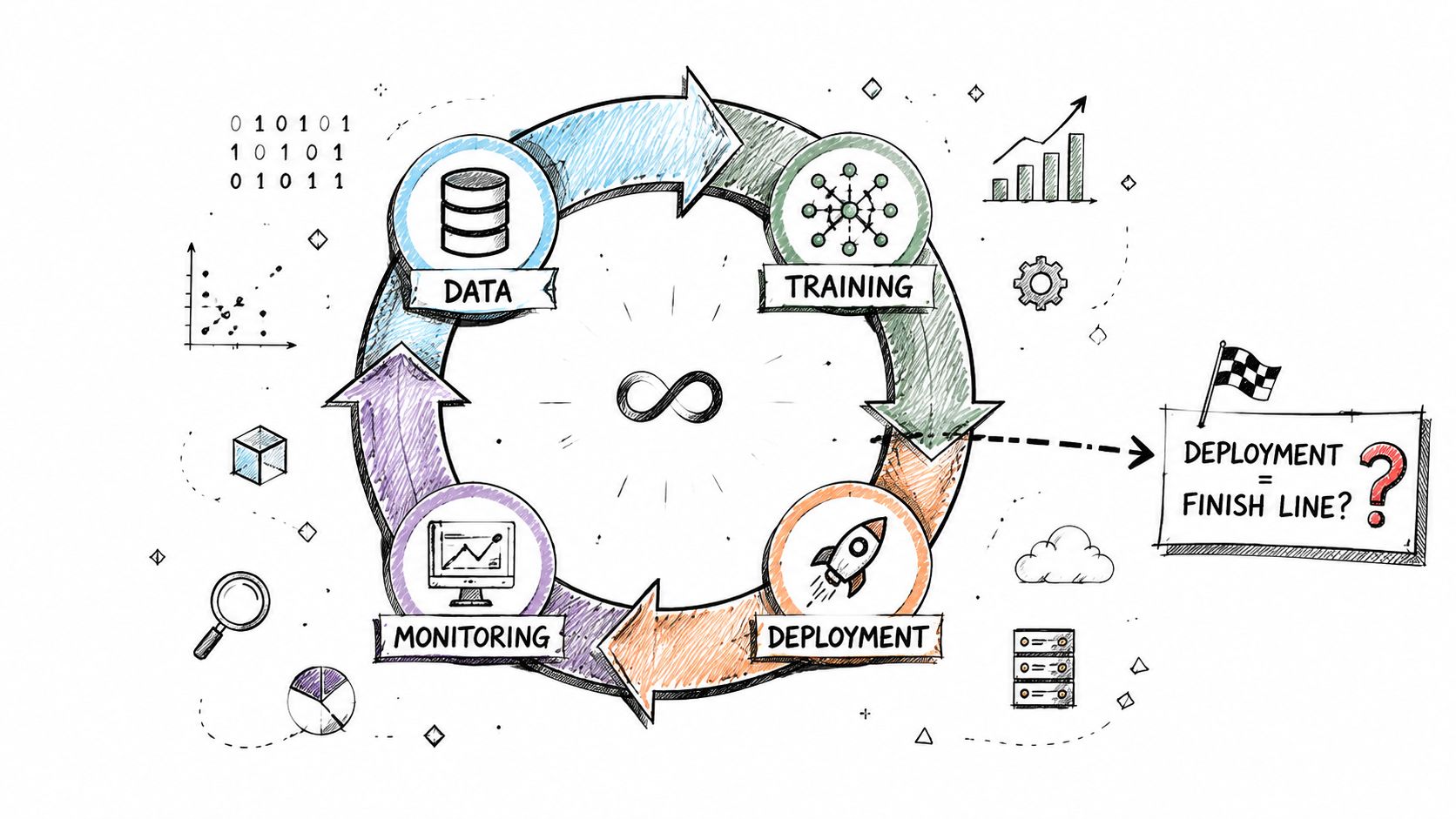
Most guides treat a machine learning pipeline as finished when a model reaches production. That advice is incomplete. Deployment is where the difficult work becomes visible: data changes, features diverge, labels arrive late, and business conditions move faster than the retraining plan.
A reliable pipeline is a continuous operational loop. It connects data ingestion, validation, feature computation, training, evaluation, deployment, monitoring, and controlled retraining. This guide focuses on the part that receives less attention, keeping that loop trustworthy after the first release.
TL;DR
- Treat deployment as a checkpoint, not the finish line. Continuous training, drift detection, validation, and rollback need explicit ownership.
- Add schema checks before training, inference, and batch scoring. Monitor data drift, prediction drift, training-serving skew, label leakage, model age, and numerical stability.
- Choose architecture based on team capability and maintenance burden. A lightweight managed workflow can be better than a platform your team can't operate.
- Benchmark retraining policies against time-based performance, Mean Time Ratio (MTR), and Time to Detect (TTD), rather than choosing a schedule by habit.
- If you need production capability quickly, Start a Pilot with experienced ML and MLOps talent, then turn the pilot into an owned operating model.
Why Most Machine Learning Pipelines Fail After Deployment
The popular build, train, deploy sequence sounds efficient because it ends at the moment a model becomes visible. In production, that's often the beginning of the risk. A model can pass offline evaluation and still produce unreliable decisions when its inputs, feature logic, user behavior, or operational context changes.
Google describes MLOps as seven integrated and iterative processes, including machine learning development, training operationalization, continuous training, and model deployment. Its guidance defines machine learning development as a reliable, reproducible training procedure covering data preparation, transformation, training, and evaluation, not a notebook that happens to produce a model (Google's MLOps lifecycle guidance). IBM places this evolution in a longer progression from early data-processing workflows before 2000, through machine learning's emergence in the 2000s, the rise of data science in the late 2000s and early 2010s, and the integration of ML libraries, AutoML, and DevOps practices in the 2010s (IBM's history of machine learning pipelines).
Offline success can hide online failure
One recurring failure is training-serving skew. The feature computation used during offline training differs from the computation used during production inference. Different code paths, point-in-time leakage, and schema mismatches can all create it. The model then sees training features that don't match what it receives online, so offline AUC can look materially better than actual production performance (System Overflow's explanation of training-serving skew).
The operational loop also includes delayed feedback. A recommendation model may receive labels after a user completes an action. A fraud model may encounter changing attack patterns before confirmed outcomes are available. If the pipeline waits for a perfect label set, teams may detect degradation only after the business has already absorbed the cost.
Practical rule: A model isn't production-ready because it can serve predictions. It's production-ready when the team can detect, explain, and safely respond to bad predictions.
That requires more than model-building talent. Engineers need repeatable deployment, data contracts, monitoring, versioned artifacts, and a clear incident path. A useful production readiness checklist should therefore include post-deployment ownership, not only infrastructure checks.
Core Components and Stages of a Production Pipeline
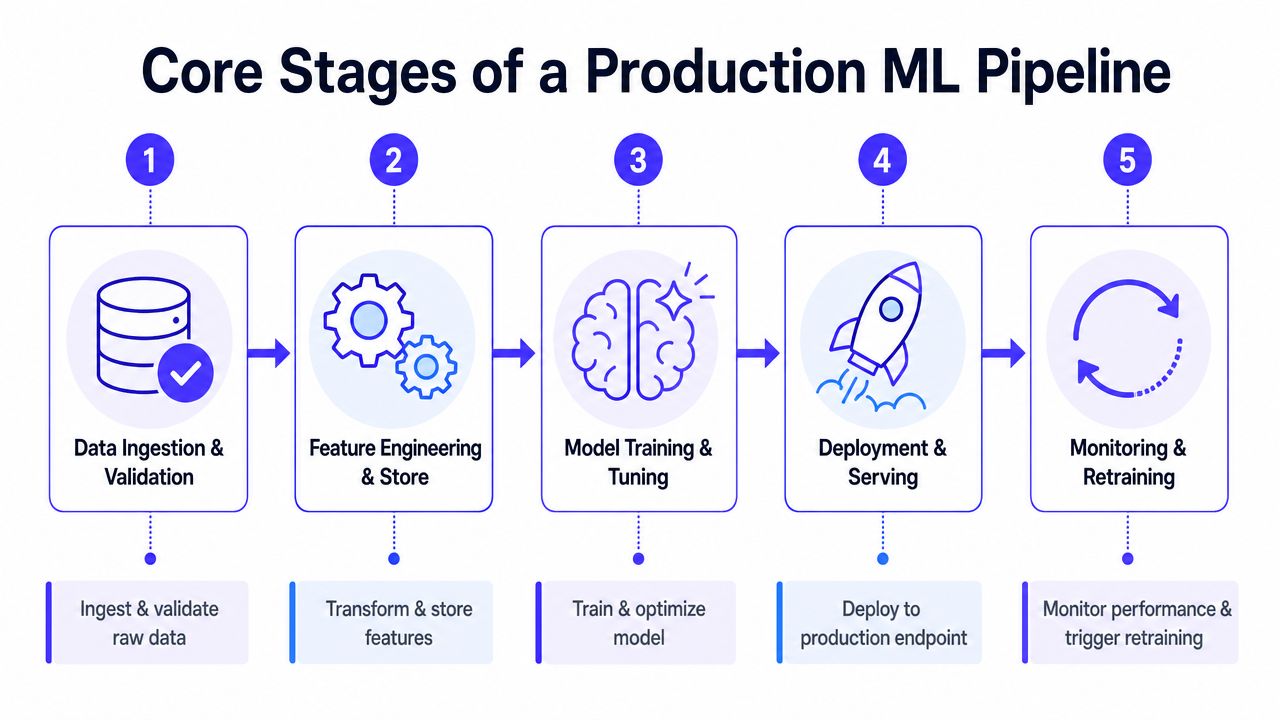
A production pipeline moves an input through controlled transformations and decision gates. Google's guidance connects data generation, training, validation, deployment, and monitoring as an iterative system (Google's production ML guidance). The exact tools can vary, but the responsibilities remain consistent.
Data ingestion and validation
The pipeline first collects batch, streaming, or event data and checks whether it matches the expected contract. Validation should cover missing values, unexpected blanks, value ranges, data types, and categorical values. Google recommends encoding expectations for feature ranges and categories in a schema, then testing incoming data against it before the pipeline proceeds (Google's monitoring guidance).
A failed validation should stop training or quarantine an inference request. Silent coercion is convenient during exploration, but it can turn a source-system change into a model-quality incident.
Feature engineering and storage
Feature code transforms raw fields into inputs the model can consume. For online use cases, teams often need a consistent path between historical training features and low-latency serving features. A feature store can help, but it introduces another system to govern, operate, and explain.
For a broader view of how upstream data design affects downstream ML reliability, review this guide to a pipeline for enterprise AI teams. The useful question isn't whether a feature store is fashionable. It's whether shared feature definitions reduce duplicated logic enough to justify their operating cost.
Training, evaluation, and deployment
Training should produce versioned code, data references, parameters, metrics, and model artifacts. Evaluation then applies quality gates that reflect the core decision, including slice-level behavior where relevant, not only one aggregate score.
Deployment can use a batch job, an online endpoint, or a staged release. The important control is reversibility. A model registry, promotion rule, and rollback path let an operator connect a production prediction to the exact artifact and feature logic that produced it.
Monitoring and retraining
Monitoring closes the loop. Track input quality, feature distributions, prediction distributions, latency, resource use, and business outcomes where labels become available. Retraining should be an explicit policy with approval and rollback behavior, not an accidental consequence of a scheduled job.
Teams comparing storage, transformation, and orchestration choices can use this overview of best data pipeline tools as a starting point, then test the shortlist against their own data contracts and serving requirements.
Architecture Patterns and Orchestration Options
Architecture should follow operational reality, not platform ambition. A small team with one stable batch use case may need little more than tested Python, a scheduler, a registry, and managed compute. A larger organization with many models, multiple environments, and frequent releases may need component boundaries, lineage, and centralized controls.
The weakest pattern is usually a notebook promoted directly into a job. It can prove a concept quickly, but it hides dependencies, makes reruns difficult, and encourages feature logic to split between training and serving. A modular pipeline is a stronger default once more than one person or workflow depends on the system.
| Approach | Best For | Trade-offs | Typical Stack |
|---|---|---|---|
| Notebook-to-job workflow | Early exploration and a narrow batch use case | Fast to start, difficult to test, version, observe, and operate as dependencies grow | Python, notebooks, a scheduler, object storage |
| Modular component pipeline | Teams with repeatable training and deployment needs | More interfaces and testing work, but clearer ownership and safer changes | Python packages, containers, model registry, Airflow or managed workflows |
| Managed MLOps platform | Teams that value speed and integrated cloud operations | Lower platform maintenance, with stronger vendor coupling and migration costs | Vertex AI or SageMaker, managed registries, cloud monitoring |
| Open-source orchestrated platform | Organizations needing control across varied infrastructure | Flexible, but the team owns upgrades, security, integrations, and reliability | Kubeflow, Airflow, Kubernetes, object storage |
| Lightweight custom service | A focused product with stable requirements and strong platform support | Efficient when narrow, risky when requirements expand beyond the original design | CI/CD, containers, scheduler, registry, observability tools |
Managed versus open source
Managed platforms reduce the amount of control-plane work your engineers must maintain. They can be a sensible choice when the team needs a production path quickly and already operates primarily in one cloud. The trade-off is vendor-specific configuration, service coupling, and the need to plan for portability where business risk justifies it.
Open-source tools provide more flexibility around deployment environments and component choices. They don't remove operational work. Kubeflow and Kubernetes can support complex workflows, but upgrades, permissions, cluster health, artifact storage, and debugging become part of your team's responsibility.
A practical selection test
Ask four questions before choosing a platform:
- Who operates it? Name the people responsible for failures, upgrades, and access control.
- What must be portable? Separate portable model artifacts from platform-specific orchestration and metadata.
- How often do releases happen? Frequent promotion requires automated gates and clear rollback behavior.
- What is the smallest safe design? Avoid adding a platform before the pipeline has repeatable interfaces and useful monitoring.
The right design is the one your team can operate during an incident, not the one with the longest feature list.
Where Teams Actually Struggle in Production ML
Production ML pain is concentrated in operations, not only algorithms. The DataTalks Club 2024–2025 ML and MLOps survey found that 60% of respondents cited deployment complexity as a major challenge, followed by 50% for lack of skills or expertise, 42% for monitoring and observability, 35% for data quality, 33% for scaling ML pipelines, and 30% for integration with existing systems (DataTalks Club survey results).
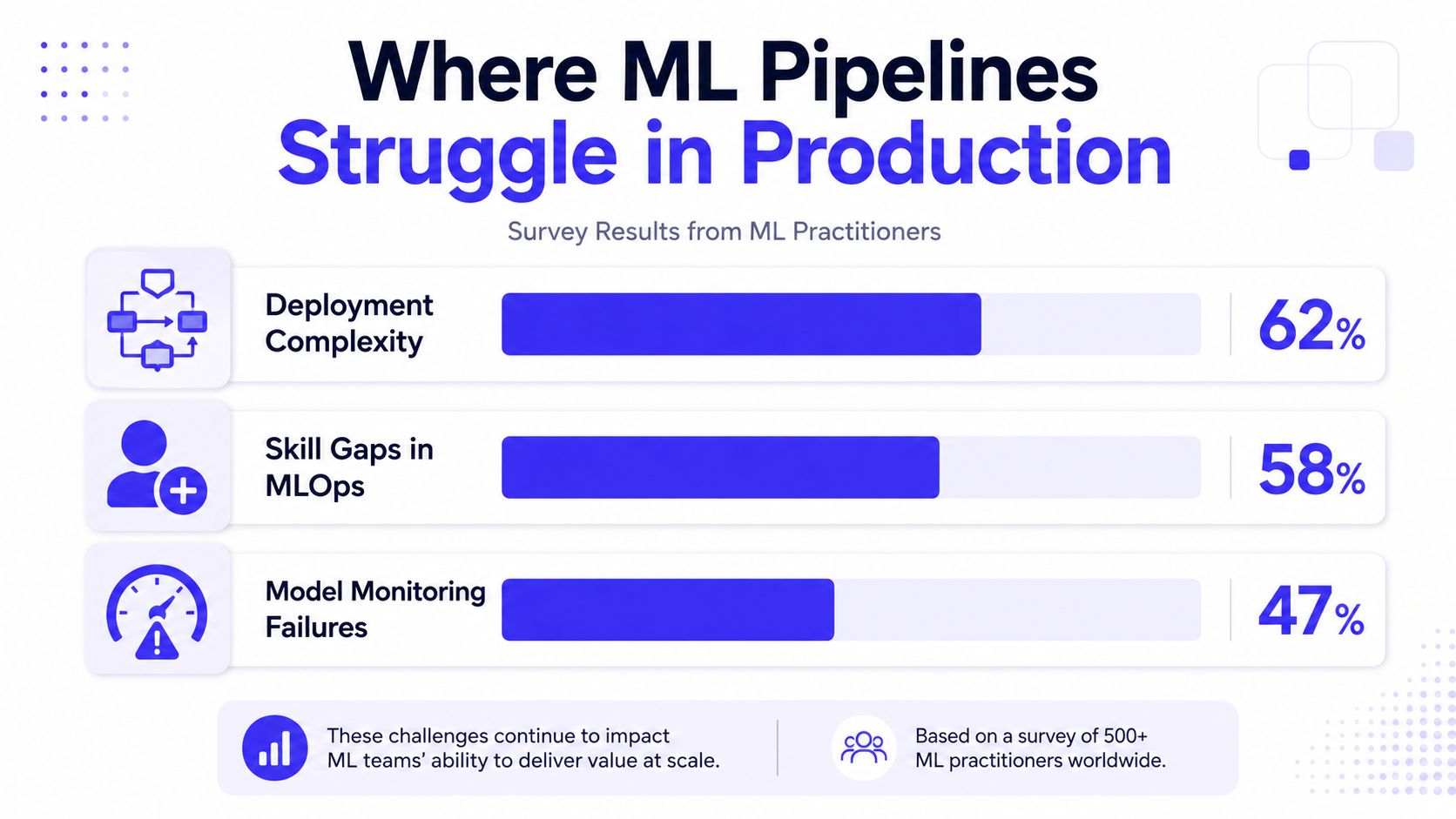
Those results point to a staffing and design problem. A model engineer may build a strong estimator, but deployment still requires packaging, service integration, permissions, resource planning, rollback, and operational response. Monitoring then adds another discipline, especially when labels arrive slowly or business outcomes are difficult to attribute.
Academic fieldwork published in 2024 describes the ML engineer workflow through four stages, data preparation, experimentation, evaluation and deployment, and monitoring and response (published fieldwork on ML engineering workflows). That framing matches what teams experience after launch. The pipeline keeps producing work even when the model itself hasn't changed.
The skew problem
Training-serving skew deserves special attention because it creates false confidence. An offline feature job might calculate a rolling value using data available at training time, while an online service uses a different timestamp rule or fallback value. Both paths may pass basic type checks, yet they represent different information.
The result can look like a mysterious model failure. In reality, the model is behaving consistently against inconsistent inputs. Shared feature definitions, point-in-time-correct datasets, and comparison tests between offline and online calculations address the root cause more effectively than another round of hyperparameter tuning.
A guide to AI observability platforms can help teams compare monitoring capabilities, but tool selection won't fix unclear ownership. Someone must define the signal, set the threshold, investigate the alert, and decide whether to roll back, retrain, or accept the change.
MLOps Best Practices for Reliable Pipelines
Reliability comes from controls placed at each handoff. A pipeline that validates only the final prediction is already too late. Put checks where bad data, incompatible code, and unsafe artifacts can still be stopped cheaply.
Build CI/CD around data and models
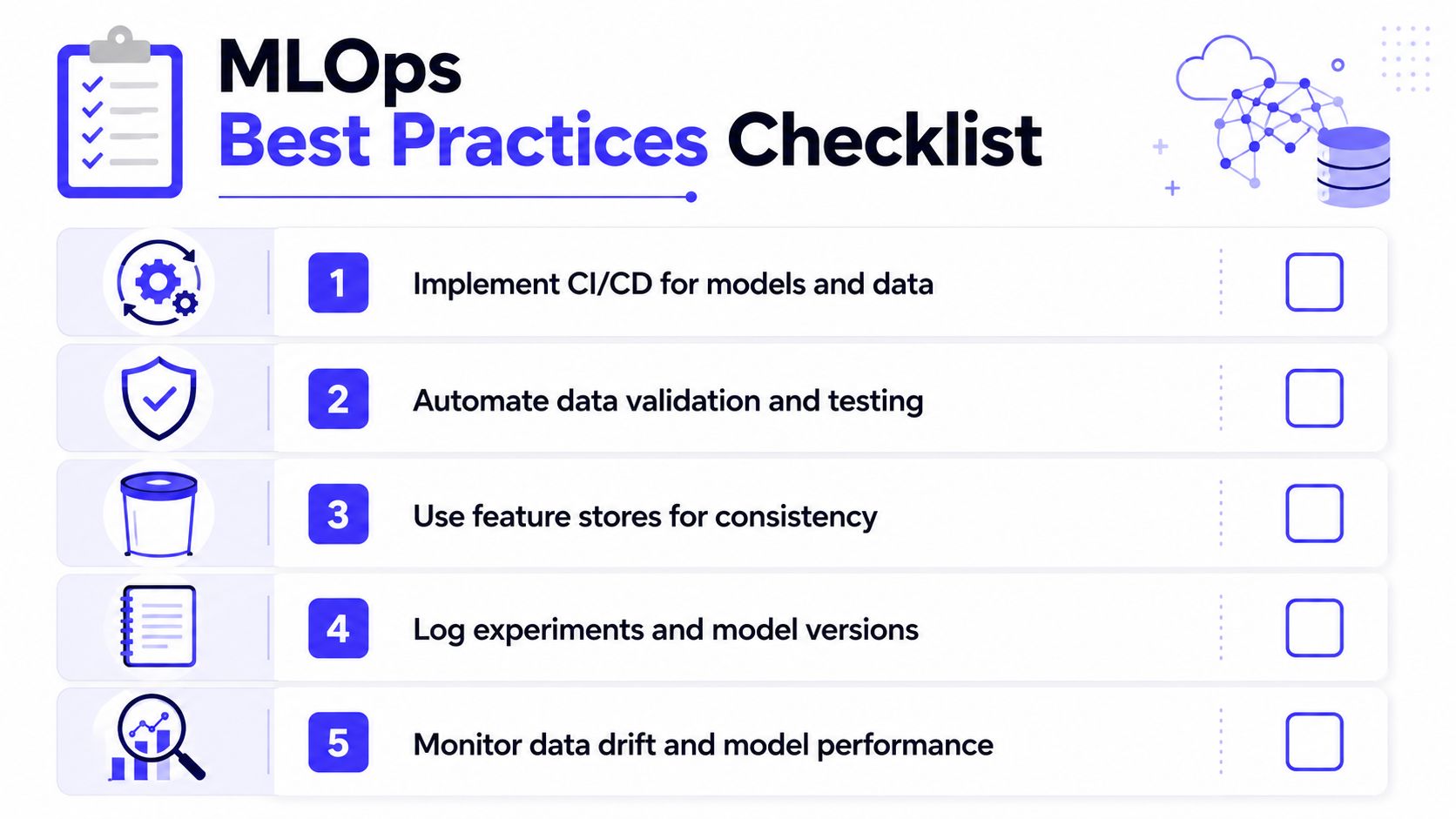
Continuous integration should test transformation code, feature contracts, training code, and serving behavior. Continuous delivery should promote an immutable artifact through environments only after evaluation gates pass. Store the code revision, data reference, feature definition, parameters, evaluation output, and model artifact together.
A release should answer three operational questions:
- What changed? Identify the code, data, schema, and dependency differences.
- Why is this acceptable? Record the evaluation result and any approved exceptions.
- How do we undo it? Keep the previous artifact available and test rollback before an incident.
For a practical discussion of toolchain decisions for MLOps, compare tools by the controls they enable, not by how many integrations they advertise.
Validate at multiple points
Google recommends monitoring training-serving skew, label leakage, model age, and numerical stability as pipeline-health checks (Google's production monitoring documentation). A practical validation layer should also check missing values, unexpected blanks, range violations, and new or missing categorical values before training, during inference, and during batch scoring (data validation practices for ML pipelines).
Version the tests alongside the pipeline. Run them in CI/CD, log the results for audits, and define failure thresholds before the first incident. This turns data quality from a discussion into an executable release condition.
Monitor signals beyond accuracy
Final accuracy is often delayed, incomplete, or unavailable. Datadog recommends proxy signals such as data drift and prediction drift, along with validation tests in processing pipelines to identify input problems before they cause downstream failures (Datadog's ML monitoring practices).
Retraining policy needs evidence. A drift-benchmarking framework compares no retraining, periodic retraining, model-drift-triggered retraining, and data-drift-triggered retraining using time-based performance and consumption measures such as F1, Mean Time Ratio, and Time to Detect (drift retraining benchmark framework). The correct policy depends on when drift appears and how reliably your detectors identify it.
Operational standard: Don't trigger retraining merely because a metric moved. Confirm that the signal is meaningful, the new data is trustworthy, and the resulting model can pass the same release gates as any other version.
Example Pipelines for Startups and Scale-Ups
A startup pipeline should optimize for learning speed without creating invisible production risk. Consider a Series A company with 2–3 ML engineers building a customer-risk model. The team can use managed object storage, a managed training service, a hosted model registry, and a simple workflow scheduler.
The flow might look like this:
source data → schema validation → feature job → managed training → evaluation gate → registry → staged endpoint → drift and prediction monitoring
The engineers keep transformation and training code in packages rather than notebooks. A pull request runs unit tests and schema tests. A scheduled job retrains when the agreed policy says it should, while a human reviews promotion when the model affects a sensitive decision.
This design avoids early platform sprawl. Its limits are clear, though. Cloud-specific components may make migration harder, and a small team can become the bottleneck for incidents, data contracts, and model review. The company should document ownership before adding another use case.
A scale-up pattern
A Series C company with a dedicated MLOps team may need modular components, custom orchestration, shared feature definitions, and central observability. Data engineering owns ingestion contracts. ML engineers own training components. Platform engineers own deployment primitives. Product or risk owners define acceptable behavior and escalation paths.
The pipeline can separate batch feature computation, online serving, evaluation, and monitoring into independently deployable components. A model registry records promotion history, while canary or staged releases limit exposure during changes. The benefit is stronger isolation and reuse. The cost is more interfaces, more operational dependencies, and a larger need for platform documentation.
| Decision | Lean startup pattern | Scale-up pattern |
|---|---|---|
| Compute | Managed training and serving | Shared platform with specialized workloads |
| Orchestration | Simple scheduler and CI/CD | Component-based orchestrator with lineage |
| Features | Versioned transformation package | Shared offline and online feature layer |
| Releases | Manual approval with automated gates | Staged promotion and automated rollback |
| Monitoring | Core data and prediction signals | Centralized observability, ownership, and response workflows |
Neither architecture is superior. The startup should resist building a platform it can't maintain. The scale-up should resist allowing every team to invent its own deployment and monitoring conventions.
Building the Team to Run Your Pipeline
A pipeline needs ownership across data engineering, model development, deployment, monitoring, and governance. Hiring only model builders leaves the most failure-prone work unassigned.
For an early product, one senior ML engineer may cover modeling and pipeline code while a platform or data engineer provides infrastructure support. A contract MLOps specialist can fill a short-term gap when the team needs deployment, observability, or CI/CD expertise before it knows whether that capability should become a permanent role.
At greater maturity, define clear responsibility for:
- Data contracts: ingestion quality, schemas, lineage, and source changes.
- Model lifecycle: training, evaluation, registry, promotion, and rollback.
- Serving operations: latency, capacity, security, and release safety.
- Production response: alerts, incident handling, drift investigation, and retraining decisions.
- Governance: fairness, compliance, privacy, and approval records.
Interview candidates with operational questions rather than only algorithm exercises. Ask how they would diagnose a model whose offline metric improved while online outcomes worsened. Ask what they would log for a rollback, how they would test training-serving consistency, and which retraining signals they would distrust.
A useful take-home assessment should include a small dataset, a schema change, a reproducible training command, an evaluation gate, and a monitoring plan. Review clarity, failure handling, and documentation, not just model quality. New hires should spend their first work on tracing one complete path from source data to production prediction, then improving one control at a time.
ThirstySprout helps startups and enterprises hire senior AI engineers, MLOps specialists, data engineers, and complete remote AI teams for production machine learning work. Visit ThirstySprout to scope a focused pilot, review suitable talent, and build the ownership your pipeline needs after deployment.
Hire from the Top 1% Talent Network
Ready to accelerate your hiring or scale your company with our top-tier technical talent? Let's chat.