

You're probably making this decision under pressure. A new AI feature needs to ship. Platform wants one server standard. Security wants fewer exceptions. Your engineers want packages that won't fight their toolchain.
That's why choosing a Linux distro for server use isn't just an operating system decision. It affects hiring, runbook complexity, incident response, upgrade pain, and how quickly an ML team can move from notebook experiments to production services.
Most distro roundups stop at package managers and release cadence. That's useful, but incomplete. The full cost shows up later, when your team has to maintain GPU drivers, patch worker nodes, pass audits, support container platforms, and onboard engineers who've seen one distro in the wild and another in your estate.
TLDR Your Server OS Choice
If you need the shortest possible answer, here it is.
- Choose Ubuntu Server LTS if your priority is fast delivery, broad hiring compatibility, and a low-friction path for cloud, Python, containers, and AI/ML tooling. It's the most practical default for startups and product teams that need one standard OS for web apps, APIs, batch jobs, and ML services.
- Choose Debian if your top concern is conservative stability and minimal change over time. It's a strong fit for infrastructure teams that prefer slower package churn and are comfortable solving more things from community documentation.
- Choose the RHEL family if compliance, vendor support, and certification matter more than package freshness. That means Red Hat Enterprise Linux for support-heavy environments, or Rocky Linux and AlmaLinux when you want similar operational patterns without a direct Red Hat subscription everywhere.
Here's a quick comparison to anchor the rest of the article.
| Distro | Best fit | Main advantage | Main trade-off |
|---|---|---|---|
| Ubuntu Server LTS | Cloud apps, AI/ML platforms, general-purpose fleets | Fast team onboarding, broad ecosystem, easy cloud fit | More frequent pressure to evaluate newer tooling choices |
| Debian | Stable web stacks, long-lived internal services | Predictable base, conservative changes | Smaller commercial support story, slower package freshness |
| RHEL / Rocky / AlmaLinux | Regulated environments, enterprise shared services | Strong enterprise conventions, policy alignment | More friction for teams that want newer packages quickly |
| Alpine Linux | Minimal containers, edge-style footprints | Very small footprint | Not a general default for most full server fleets |
| Immutable distros such as Fedora CoreOS | Reproducible platform layers, MLOps platforms | Reduces configuration drift | Requires stronger platform discipline |
This guide is for CTOs, heads of engineering, staff platform engineers, and MLOps leads who need a distro decision that will still look smart a year from now. If your team is standardizing around Kubernetes, GPU workloads, internal developer platforms, or mixed web and ML services, the second-order effects matter more than the distro logo.
A Decision Framework for Your Server OS
Linux isn't a niche choice. Linux powers 44.8% of all server operating systems globally and 59.2% of websites with identifiable operating systems. Over 96.3% of the top one million web servers run on Linux according to Linux server market share data compiled by CommandLinux. The pertinent question isn't whether Linux is the right family. It's which branch creates the fewest long-term problems for your team.
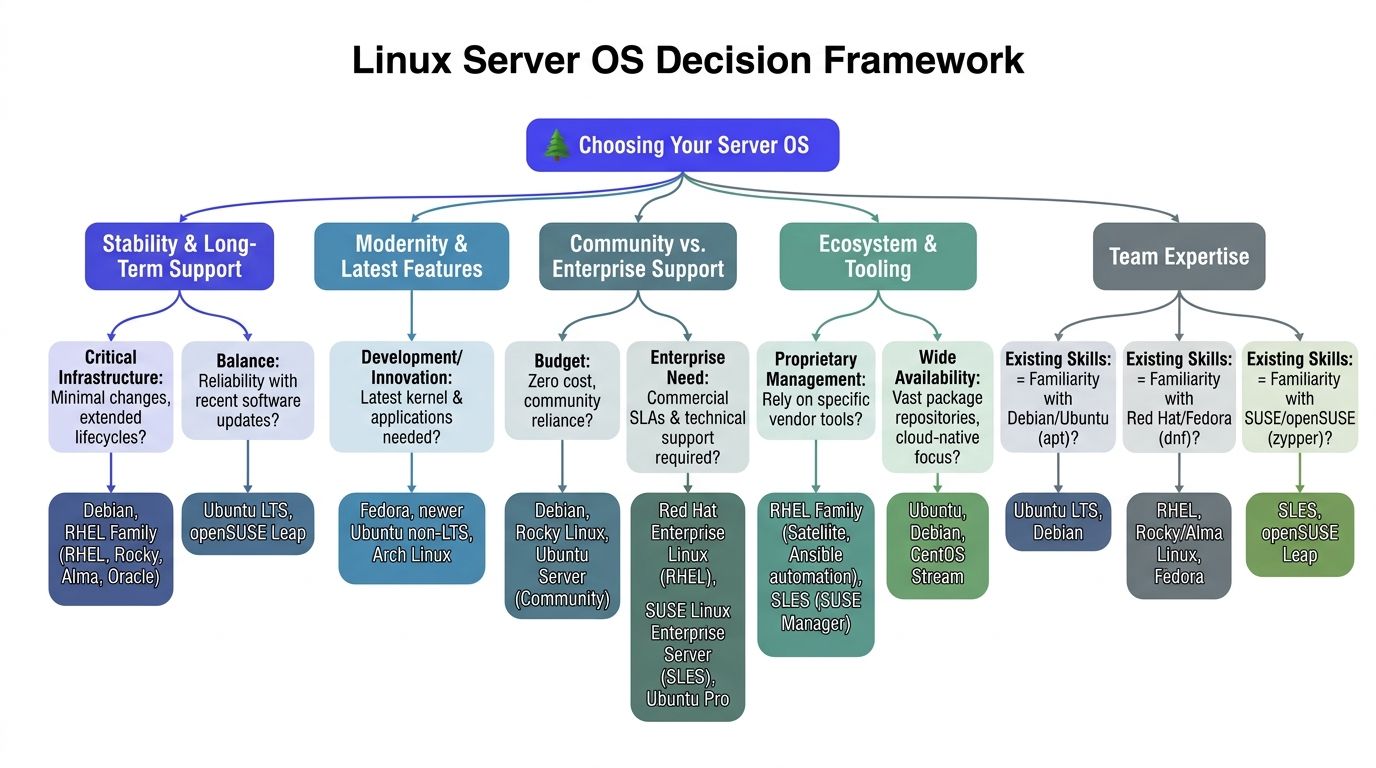
Start with the operating model
A good Linux distro for server standardization should match how your company works.
If product teams deploy daily and your platform team automates heavily, you need a distro that stays out of the way. If you run a tightly governed environment with long review cycles, a more conservative distro often wins because it creates fewer policy exceptions.
A simple rule helps:
Pick the distro that matches your change-management culture, not the distro your loudest engineer prefers.
Score five criteria before you test anything
Use these criteria in architecture review. Don't start with package manager debates.
Stability and long-term support
Ask how often you're willing to upgrade core services, rebuild images, and retest drivers. Slow-moving businesses usually value upgrade calm more than access to the newest package builds.Modernity and package freshness
AI and developer-platform teams often need newer Python packages, container tooling, GPU-adjacent dependencies, and cloud integrations. The cost of old packages isn't abstract. It shows up as custom repos, manual install steps, and one-off exceptions.Support model
Community support is often enough for startups. Enterprises with strict procurement, audit requirements, or critical vendor dependencies may need a support contract because escalation paths matter during incidents.Ecosystem and tooling fit
Your distro should fit the rest of your stack. Terraform, Ansible, Kubernetes, Docker, containerd, CI runners, and observability agents all have rough edges on some platforms. If your roadmap includes modern platform work, align the OS with your delivery model. Teams investing in cloud application development services usually benefit from reducing OS-specific exceptions early.Team expertise and hiring pool
This is the most overlooked criterion. If most candidates know Ubuntu well, but your production stack uses something far less familiar, you'll spend more on onboarding, internal docs, and review cycles.
Watch the second-order effects
The first-order question is “Will this run our app?” Almost every major distro can.
The second-order questions are harder and more useful:
- How many custom bootstrap steps will your engineers memorize?
- How easy is it to hire someone who can debug this at 2 a.m.?
- How much policy work will security ask for when you add a new service?
- Will your ML team build around the distro, or fight it?
The cheapest distro on day one can become the most expensive one to maintain if it pushes complexity into people, not licenses.
Comparing the Top Linux Server Distros
The market leader matters because it usually signals documentation depth, cloud familiarity, and labor market familiarity. According to W3Techs data from December 2025, Ubuntu powers 13.7% of all websites running Linux, and it holds the largest market share among Linux distributions deployed on web servers globally, surpassing Debian, Fedora, and Red Hat Enterprise Linux in both adoption and deployment volume. The same source also includes the firsthand observation, “When I worked at AWS a couple years ago, Ubuntu was BY FAR the most popular customer VM used,” in this Linux server distro guide from M5 Hosting.
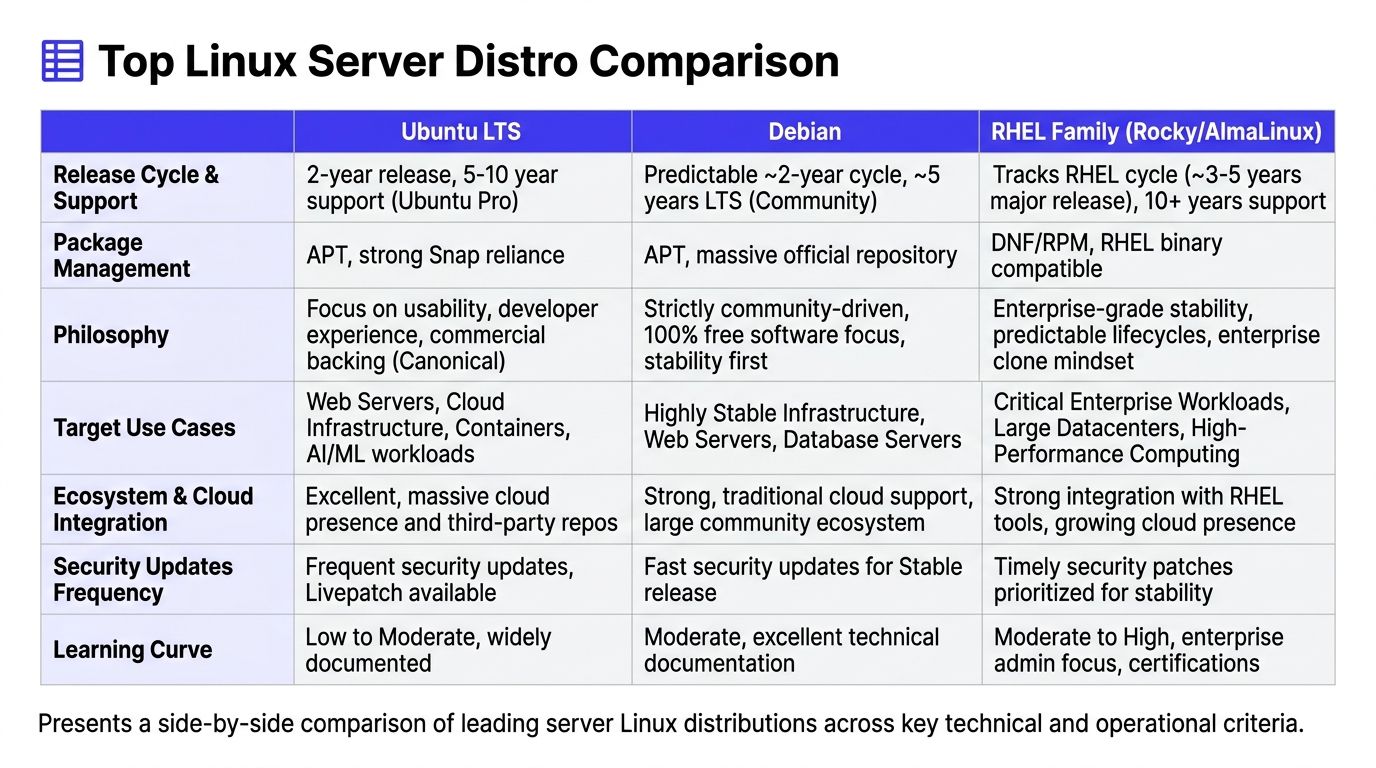
Side-by-side comparison
| Distro family | Where it fits best | What operators like | What usually annoys teams |
|---|---|---|---|
| Ubuntu Server LTS | Startups, SaaS platforms, AI/ML infrastructure, mixed fleets | Familiar tooling, broad docs, strong cloud ergonomics | Some enterprises prefer stricter enterprise support patterns |
| Debian | Long-lived stable services, conservative web infrastructure | Predictability, clean baseline, low drama | Package freshness can lag what app teams want |
| RHEL family | Shared enterprise platforms, regulated workloads, vendor-heavy estates | Policy alignment, operational consistency, enterprise acceptance | Can feel heavier for fast-moving product teams |
| Rocky Linux / AlmaLinux | Teams that want RHEL-like workflows without full RHEL everywhere | Similar admin patterns, solid replacement option | Support model differs from buying Red Hat directly |
Ubuntu Server LTS
Ubuntu wins when you want one answer for various teams. It's usually the easiest distro to standardize on when your estate includes web apps, internal APIs, queues, CI runners, data workers, and ML services.
Biggest differentiator: Ubuntu optimizes for team velocity without feeling experimental.
That matters in hiring. Engineers coming from startups, cloud-native environments, and modern DevOps teams often have immediate muscle memory with Ubuntu. That reduces onboarding friction and shortens the path from “new hire joined” to “new hire can safely own production changes.”
A practical mini-case:
- Scenario: A product team needs API servers, background workers, and a small GPU-backed inference tier.
- Why Ubuntu works: Common package assumptions, easy container host setup, and broad community examples.
- What to watch: If your security team expects highly opinionated enterprise controls out of the box, document your hardening baseline instead of assuming the distro alone handles it.
This is also a fair point to hear another viewpoint before standardizing:
Debian
Debian is what many senior operators choose when they want fewer surprises and can tolerate older packages. It's often the quietest option in production, which is a compliment.
Debian is excellent when your platform values calm over convenience.
Use Debian when the server's job is straightforward. Nginx, PostgreSQL clients, app runtimes, queues, cron-style workers, internal tools. It shines when your team prefers a stable substrate and doesn't mind adding newer components selectively when needed.
A second mini-case:
- Scenario: A company runs internal business systems and customer-facing web apps with a small platform team.
- Why Debian works: Fewer moving parts, a conservative release posture, and strong community trust.
- What to watch: ML teams may start asking for package exceptions faster than web teams do.
The RHEL family
RHEL, Rocky Linux, and AlmaLinux belong in a different conversation. They're less about “what's easiest for a startup” and more about “what survives procurement, audits, enterprise vendor demands, and institutional change control.”
Biggest differentiator: The RHEL family is built for organizations where platform decisions must satisfy more than engineers.
If your company sells into regulated buyers, integrates with certified vendor software, or maintains a central platform team serving many internal groups, this family often reduces friction with governance.
A useful interview question for senior hires in this environment is simple:
“How would you handle package availability gaps on a conservative enterprise distro without creating an unmaintainable shadow repo strategy?”
The best answers balance discipline with pragmatism. That's exactly the trade-off this distro family demands.
Mapping Distros to AI ML and Web Workloads
The wrong Linux distro for server use doesn't usually fail on day one. It fails six months later when teams pile on exceptions. That's why workload mapping matters more than brand loyalty.
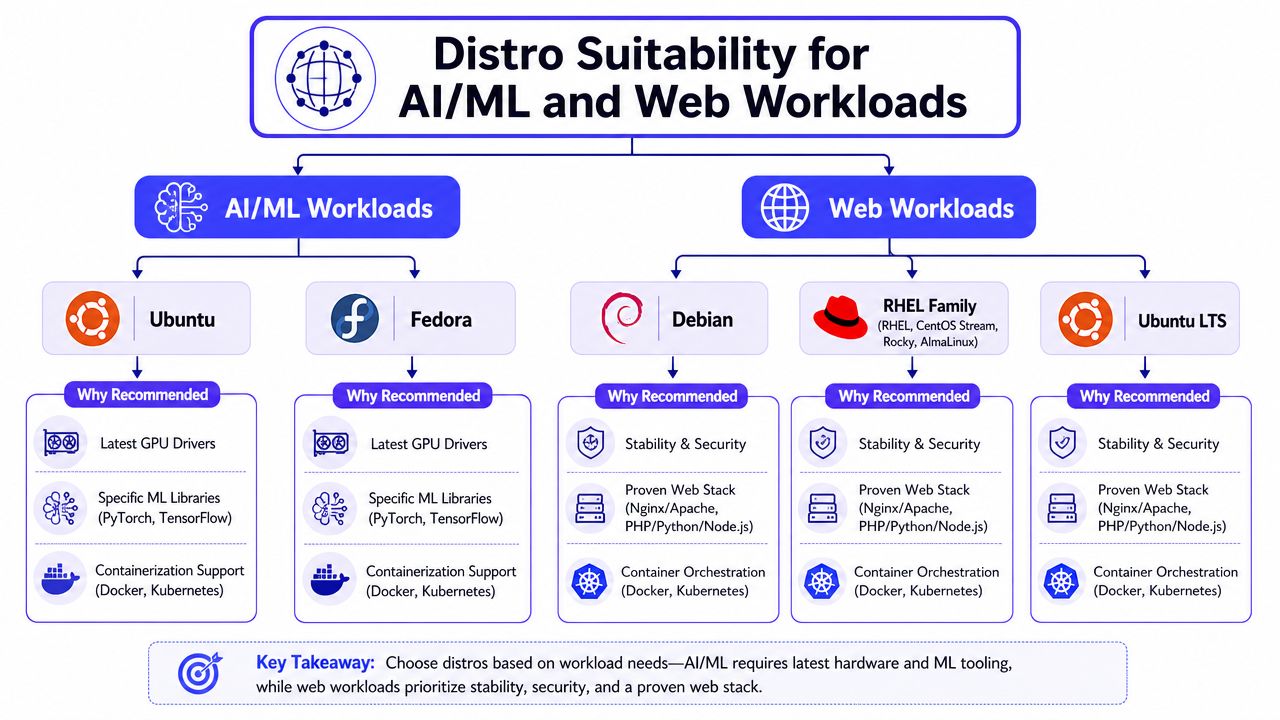
Team one builds an AI product
This team owns training jobs, feature pipelines, model packaging, and inference services. They usually care about Python tooling, container runtimes, GPU-adjacent support, and reproducibility.
For this team, Ubuntu Server LTS is often the default operationally sane choice. It keeps platform decisions simple enough that MLOps engineers can focus on packaging, scheduling, and observability instead of distro workarounds.
But there's a more advanced branch of the decision that many guides miss. Existing content fails to answer how to choose a Linux distro for immutable server architectures in AI/MLOps pipelines. Data from 2025 shows 32% of enterprises now adopt immutable servers for MLOps, yet only 8% of “Linux distro for server” articles discuss immutability, according to this analysis of server distro selection and immutable MLOps adoption.
That gap matters. When reproducibility is part of your reliability model, mutable pets become a liability.
Practical rule: If your ML platform keeps drifting between nodes, start evaluating immutable hosts such as Fedora CoreOS for the platform layer, even if your app teams still develop on Ubuntu.
This choice also connects directly to your container orchestration strategy. If you're deciding between simpler host patterns and cluster-first operations, this guide on Docker Compose vs Kubernetes is a useful companion.
Team two runs a high-traffic API
This team cares about uptime, patch discipline, repeatable deployments, and boring infrastructure. They don't need novelty. They need incidents to be rare and understandable.
Debian and the RHEL family both work well here. Debian is attractive when the stack is mostly standard web infrastructure. The RHEL family becomes more attractive when security and compliance reviews are a routine part of release management.
A lightweight architecture sketch for this team:
- Edge layer: Nginx or HAProxy
- App layer: Containerized API services
- Data layer: Managed database or separate database hosts
- Platform concern: Standard image build pipeline, CIS-style hardening baseline, config management, central logs
Team three deploys to edge or ultra-minimal environments
This team has a different constraint set. They care about image size, RAM footprint, and minimizing attack surface. Alpine Linux fits here because it's deliberately small. According to LinuxBlog's low-memory distro guide, Alpine Linux can idle at under 50 MB of RAM on a base install, with the Core edition requiring only 11 MB and operating on 64 MB of RAM.
That's valuable for edge-style deployments and slim container images. It doesn't make Alpine the best standard OS for an entire engineering org.
Use Alpine selectively:
- Great for minimal containers and constrained environments
- Less ideal for general-purpose server fleets where compatibility and operator familiarity matter more than footprint alone
Managing Security Compliance and Long Term Maintenance
Security pain rarely comes from the distro choice alone. It comes from a mismatch between distro philosophy and your organization's operating discipline.
When stability beats speed
If your company moves through architecture boards, audit requests, and vendor reviews, a conservative distro philosophy saves time. You don't want every new package request to become a governance event.
That's where the RHEL family remains strong. Red Hat Enterprise Linux is the default choice in conservative enterprises for server deployments due to its maturity, breadth of ISV certifications (over 10,000), and explicit compliance mapping for standards like FedRAMP and SOC 2, making it the only Linux with a dedicated certification program for server hardware, as summarized in this enterprise server distro review from ITU Online.
If your revenue depends on enterprise trust, that kind of alignment can matter more than package freshness.
Where teams underestimate maintenance cost
Long-term maintenance isn't just patching. It includes image pipelines, upgrade rehearsals, kernel compatibility checks, documentation, access controls, and handoffs between platform and application teams.
The hidden costs usually show up in four places:
Bootstrap sprawl
If every service team has its own setup script, the OS standard isn't really standard.Exception creep
One custom repo becomes five. One special kernel requirement becomes a permanent branch in your platform docs.Hiring friction
A rarer distro can be perfectly valid technically, but it narrows the pool of engineers who can operate it confidently on day one.Upgrade fear
Teams postpone upgrades when they don't trust the process. That eventually creates bigger, riskier maintenance windows.
A server distro is really a contract between platform engineering, security, and future hires.
The move-fast versus stay-stable split
Ubuntu and Debian often serve product-led organizations well because they keep common workflows accessible. The RHEL family often serves governance-heavy organizations well because it lowers friction with control functions.
Neither approach is universally superior. The wrong choice is forcing a move-fast team onto a support-heavy distro they'll constantly bypass, or forcing a highly regulated environment onto a distro model that creates endless exception handling.
A useful practice is to allow one primary distro and one exception path. For example, Ubuntu Server LTS for most workloads, plus an approved immutable or enterprise distro for specific platform layers.
Your Server Setup Checklist and Quick Starts
The decision shouldn't end with “we picked a distro.” It should end with a repeatable baseline.
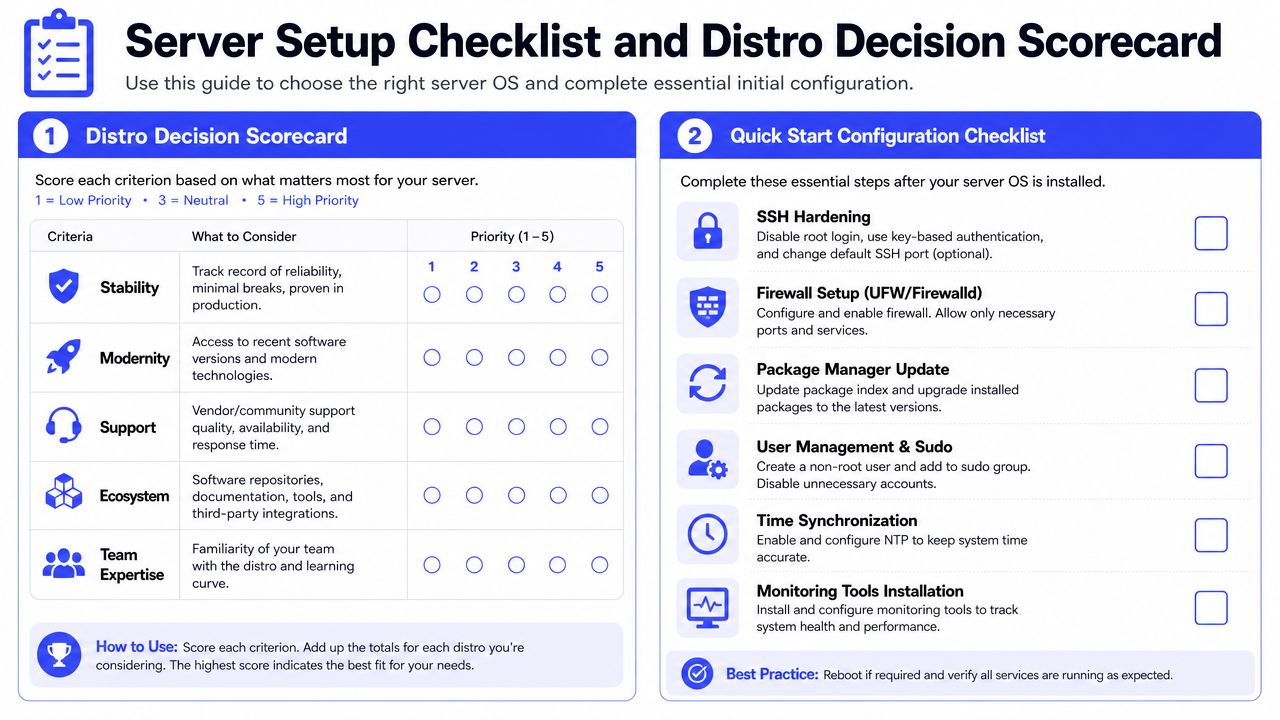
Distro decision scorecard
Use this in your architecture review doc.
Business fit
Does the distro match your release speed and support expectations?Team familiarity
Can most engineers debug, patch, and automate it without hand-holding?Tooling compatibility
Does it fit your container, CI/CD, observability, and security stack cleanly?Security posture
Can you harden it consistently with your current controls and runbooks?Lifecycle confidence
Do you trust your team to upgrade it calmly a year from now?
If you're building traffic-facing systems, pair this scorecard with your load balancing software evaluation so OS and edge architecture don't evolve in separate silos.
First five minutes on Ubuntu Server
sudo apt update && sudo apt upgrade -ysudo adduser deploysudo usermod -aG sudo deploysudo ufw allow OpenSSHsudo ufw enableWhy these first? They establish a patch baseline, remove the habit of logging in as root for routine work, and turn on a basic firewall policy.
First five minutes on Rocky Linux or AlmaLinux
sudo dnf update -ysudo adduser deploysudo usermod -aG wheel deploysudo systemctl enable --now firewalldsudo firewall-cmd --permanent --add-service=sshsudo firewall-cmd --reloadAfter that, standardize these checks in your build template:
- SSH hardening
- Time sync
- Audit and log forwarding
- Monitoring agent install
- Base packages for troubleshooting
- Golden image or IaC validation
What to Do Next with Your Server Environment
A good distro decision reduces uncertainty. It doesn't remove the need to validate it under your real workload.
Take three steps next.
First, run the scorecard with platform, security, and the team that will own the most operational burden. Don't let architecture choose in isolation from staffing reality.
Second, provision a pilot. Put one real service on the candidate distro. Include CI, logging, patching, secrets handling, and rollback. If you have ML workloads, test the actual training or inference path instead of a generic hello-world container.
Third, check whether your org has the people to run what it chose. The best technical decision still fails if no one owns image hygiene, hardening, and lifecycle management. If you're budgeting for innovation work alongside platform investment, practical finance resources such as Australian R&D tax guides can help founders and engineering leaders think more clearly about where infrastructure and product development spend intersect.
The right Linux distro for server use is the one your team can operate safely, hire for confidently, and maintain without building a private maze of exceptions.
If you need senior engineers to stand up or stabilize your AI infrastructure, ThirstySprout can help you Start a Pilot with vetted MLOps, platform, and AI engineers who've shipped production systems. You can also See Sample Profiles to assess the level of operator you'd want owning your server standardization.
Hire from the Top 1% Talent Network
Ready to accelerate your hiring or scale your company with our top-tier technical talent? Let's chat.