

TL;DR: What to ask an Engineering Manager
- For Technical Leadership: Ask, "Walk me through a significant AI/ML architecture decision you owned." Look for a clear explanation of business trade-offs (cost, latency, risk) beyond just technical specs.
- For Remote Team Building: Ask, "Describe your process for hiring a senior remote engineer." A strong answer details a structured process with scorecards, not just "gut feel," and emphasizes sourcing for autonomy and communication.
- For Project Execution: Ask, "How do you structure an ML roadmap to account for research uncertainty?" Look for methods like time-boxed research spikes or tiered roadmaps that balance R&D with predictable delivery.
- For People Management: Ask, "How do you identify and prevent burnout on a remote team?" A good answer provides specific, proactive rituals like enforcing focus time or using asynchronous stand-ups, not just reactive check-ins.
- Actionable Next Step: Use these questions to build a structured interview scorecard. A template is provided below.
Who This Guide Is For
This guide is for CTOs, VPs of Engineering, and founders who need to hire an Engineering Manager for a remote AI or ML team. You are likely in one of these situations:
- Scaling an AI feature: You need a leader who can manage the non-deterministic cycles of ML development, not just a standard SaaS feature factory.
- Building a remote-first team: You need a manager who excels at asynchronous communication, fostering culture across time zones, and hiring for autonomy.
- Facing high technical uncertainty: Your roadmap involves experimental projects, and you need a manager who can de-risk R&D while still delivering business value.
This framework helps you move beyond generic behavioral questions to identify leaders who build high-performing, distributed AI teams that ship with impact.
Framework: The 4-Part Engineering Manager Interview Loop
An unstructured interview, even with great questions, leads to inconsistent hires. Use this structured framework to reliably identify top-tier talent.
- Goal: Assess alignment and basic qualifications.
- Key Question: "Why are you looking to leave your current role, and what specifically about managing a remote AI team interests you?"
- Goal: Verify they can guide a team through complex technical trade-offs.
- Key Question: "Walk me through the most complex AI/ML system you've managed. What were the key architectural decisions and their long-term consequences?"
- Goal: Assess their skills in hiring, performance management, and project execution under uncertainty.
- Key Question: "Describe a time a key ML project was failing. How did you diagnose the root cause, manage stakeholder expectations, and get the team back on track?"
- Goal: Ensure they can operate effectively within your company's values and structure.
- Key Question: "Describe the engineering culture you are most proud of building. What specific rituals or processes did you implement to foster it?"
- Strong Answer (Connects to Business Impact): "We needed to reduce our model inference costs, which were scaling with user growth. We considered three options: a managed SageMaker endpoint, self-hosting on Kubernetes (k8s), or optimizing models with something like TensorRT. SageMaker was fast to implement but 40% more expensive at scale. Self-hosting was cheaper long-term but required two MLOps engineers to maintain. We chose to self-host on k8s because our cost projections showed we'd break even in six months, and it gave us more control over the hardware. The result was a 35% reduction in monthly cloud spend after the initial ramp-up, which directly improved our gross margin."
- Weak Answer (Stays purely technical): "We had to choose an inference solution. I picked Kubernetes because it's scalable and uses containers. We set up a cluster and deployed the models. It worked well."
- Strong Answer (Provides a proactive system): "I look for leading indicators in our async channels. Are engineers less engaged in Slack discussions? Are PR descriptions getting shorter? I also use our 1-on-1s to ask directly about workload and energy levels. Last quarter, I noticed two engineers consistently working late. I intervened by implementing 'Focus Fridays' with no meetings and helped them re-prioritize their tasks with the product manager to defer a non-critical feature. We tracked their hours for the next two weeks to ensure the workload was manageable."
- Weak Answer (Is reactive and generic): "I check in with my team in 1-on-1s to see how they're doing. If someone seems stressed, I tell them to take a break."
- Why it matters: A single choice, like a vector database, can impact cost and developer velocity for years. A manager who articulates the why behind their decisions is invaluable, especially for remote teams needing clear guidance.
- "Describe a time you had to make a major technical decision with incomplete data. How did you de-risk the choice?"
- "Tell me about a past architectural choice that turned out to be a mistake. What did you learn, and how did you pivot the team?"
- How to evaluate: Look for a narrative connecting a business need to a technical solution. Strong answers discuss costs, operational overhead, and performance metrics. A deeper dive into software architecture best practices can help you calibrate their responses.
- Why it matters: In a startup, one hire can alter team velocity and culture. Intentional hiring for communication and autonomy is non-negotiable for remote teams.
- "Describe how you built a high-performing engineering team from the ground up. What was your strategy for identifying the roles needed?"
- "Walk me through your process for hiring a senior engineer. How do you assess for technical depth and cultural fit in a remote setting?"
- How to evaluate: Look for a structured, proactive approach. Strong candidates discuss objective scorecards and creating an excellent candidate experience. Weak answers delegate the entire process to HR without strategic input.
- Why it matters: Great engineers leave managers, not companies. A manager’s skill in fostering connection and clear communication is a direct predictor of remote team health. This is key to retaining the talent you worked hard to hire.
- "Tell me about a time you had to manage an underperforming engineer. What steps did you take, and what was the outcome?"
- "Walk me through how you’ve balanced synchronous meetings with asynchronous work to protect your team’s focus time."
- How to evaluate: A strong candidate provides specific, structured examples. A great answer about underperformance details a clear performance improvement plan (PIP). A weak answer is vague, like "I had a chat with them." For more strategies, review best practices to manage a remote team.
- Why it matters: A model might not converge, or data issues can derail a project. A strong manager structures a roadmap that embraces this uncertainty while still delivering value.
- "Describe the most complex AI/ML roadmap you've managed. How did you structure it to account for research spikes and data dependencies?"
- "How do you balance investing in technical debt versus shipping new, experimental AI features? Give a specific example."
- How to evaluate: Look for concrete systems for managing uncertainty, like a "certainty-tiered" roadmap. Bonus points if they discuss adapting agile methodologies for ML, bridging the Agile vs. DevOps debate.
- Why it matters: In AI, a model can be accurate but too slow or expensive. A manager must balance model metrics (precision), infrastructure KPIs (deployment frequency), and business outcomes (ROI).
- "Tell me about a specific OKR you owned. How did you define the key results, track progress, and what was the outcome?"
- "Describe a time you had to balance conflicting metrics, such as inference cost versus model accuracy. How did you decide on the trade-off?"
- How to evaluate: Strong candidates provide concrete examples of metrics they've used and the actions they triggered. Familiarity with OKR management tools can also signal experience.
- Why it matters: Conflict is inevitable. A great manager sees it as an opportunity to clarify goals and align expectations, which is a direct indicator of leadership maturity.
- "Describe a significant conflict between your team and another functional group. How did you diagnose the root cause and guide them to a resolution?"
- "Tell me about a time two senior engineers on your team had a strong disagreement. What was your process for facilitating a resolution?"
- How to evaluate: Look for a structured, empathetic approach. They should talk about active listening, identifying shared goals, and defining objective decision criteria. A red flag is an answer that focuses on blaming others.
- Why it matters: Great engineers want to learn and advance. A manager who actively develops their people is a powerful retention tool, especially in the competitive AI talent market.
- "Tell me about a specific engineer you've mentored. Where were they when you started, and where are they now?"
- "Describe how you identify and accelerate the development of high-potential engineers."
- How to evaluate: Look for specific, people-centric stories. A strong candidate will detail tailored strategies they used to help someone grow, not generic processes like "annual reviews."
- Why it matters: In a scaling startup, culture is built intentionally or it happens by accident. This is magnified in remote-first organizations where culture can't be absorbed by osmosis.
- "Describe the engineering culture you are most proud of building. What specific actions did you take to foster it?"
- "Tell me about a time you had to part ways with a high-performing engineer who was a poor culture fit."
- How to evaluate: A strong answer moves beyond buzzwords and connects a value to a ritual, like implementing "blameless postmortems" to reinforce a culture of learning from failure.
- Why it matters: A manager with a growth mindset views failure as data, not a disaster. This is vital for creating psychological safety, which is a prerequisite for innovation.
- "Tell me about a significant project failure you led. What was your personal contribution to that failure, and what process did you change afterward?"
- "Describe a recent hiring decision that didn't work out. How did it change your approach to interviewing?"
- How to evaluate: Look for accountability and specificity. The candidate should articulate their role in the failure and the tangible actions they took to prevent a recurrence. Weak answers deflect blame.
- Why it matters: In AI, "we don't know" is often the most honest answer. A manager who can frame uncertainty as a manageable risk is essential for stakeholder confidence and team morale.
- "Explain a complex technical concept from a past project to me as if I were a non-technical CEO."
- "Describe a time you had to deliver bad news, such as a project delay. How did you structure the communication?"
- How to evaluate: Look for candidates who switch their framing based on the audience. Strong answers connect technical details to business outcomes.
- 1 (Weak): Lacks relevant experience; answers are generic.
- 2 (Average): Has some relevant experience but lacks depth or structure.
- 3 (Strong): Clear, structured answers with specific, relevant examples.
- 4 (Exceptional): Strong examples plus strategic insights that demonstrate deep expertise.
- Customize Your Scorecard: Select the top 4-5 competencies from this guide that are most critical for your open role and build your internal scorecard using the template above.
- Assign Roles to the Interview Panel: Assign each interviewer 1-2 competencies to focus on. This ensures broad coverage without asking the candidate the same questions four times.
- Conduct a Calibration Session: Before the first interview, meet with the hiring panel to review the scorecard and align on what a "strong" answer looks like for each competency.
- ThirstySprout: How to Manage a Remote Team
- ThirstySprout: Software Architecture Best Practices
- Ekipa: OKR Management Tools
Practical Examples: Good vs. Bad Answers
Evaluating answers requires a clear rubric. Here are two real-world examples of interview questions with what to look for.
Example 1: Evaluating Technical Trade-offs
Question: "Walk me through a significant AI/ML architecture decision you owned. What was the business problem, what options did you consider, what were the trade-offs, and what was the ultimate outcome?"
Example 2: Evaluating Remote Team Management
Question: "How do you identify early signs of burnout in a remote team, and what specific interventions have you used to address it?"
Deep Dive: The 10 Core Interview Question Categories
1. Technical Leadership & AI Architecture Decisions
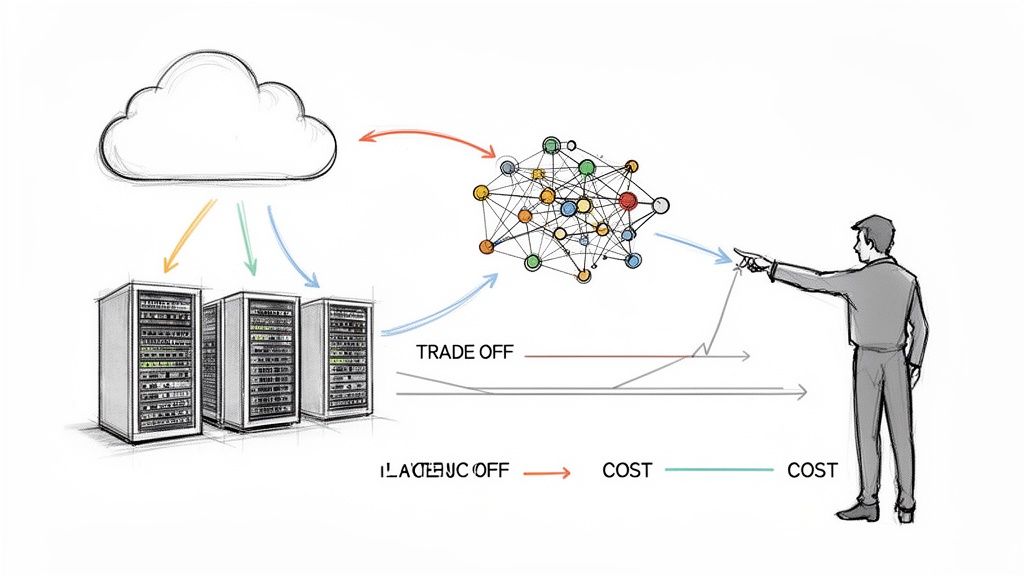
An effective engineering manager must provide sound technical direction. This category evaluates their ability to navigate complex architectural trade-offs, guide teams toward scalable and cost-effective solutions, and own the long-term consequences of their technical strategy.
2. Hiring & Team Composition Strategy
A manager's success is directly tied to the team they build. This category evaluates their ability to design, recruit for, and scale a high-performing remote team.
3. People Management & Remote Team Leadership
A manager's primary role is to nurture a high-performing team. In a remote-first world, this responsibility intensifies.
4. Project & Roadmap Management in ML/AI
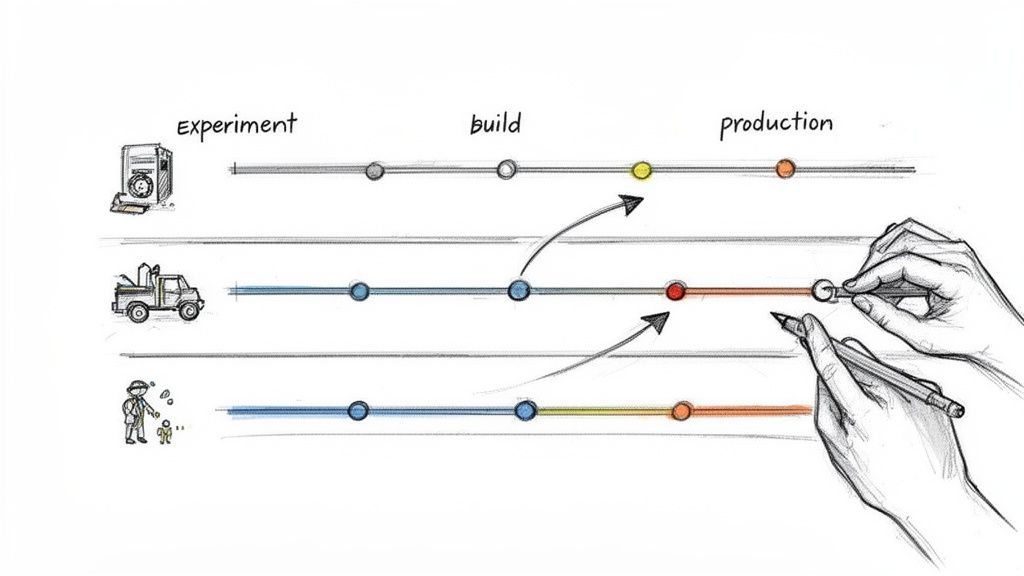
Managing an AI/ML roadmap requires a distinct skill set due to constant research and uncertainty. This category probes their ability to plan and execute when timelines are fluid.
5. Metrics, KPIs & OKR Frameworks
A manager must translate business goals into measurable technical outcomes. This category evaluates their skill in defining and acting on meaningful metrics.
6. Conflict Resolution & Cross-Functional Collaboration
A manager's effectiveness is often measured by their ability to harmonize efforts across teams like Data Science, Product, and MLOps.
7. Career Development & Succession Planning
A manager's success is measured by their team's growth. This probes their ability to cultivate talent and build a resilient team.
8. Company Culture & Values Alignment
A manager builds the engine that ships features: the team's culture. This assesses their ability to intentionally cultivate and scale a high-performing engineering culture.
9. Behavioral: Learning from Failure & Growth Mindset
In AI, the ability to learn from setbacks is a core competency. This probes a candidate's resilience, humility, and capacity for systematic improvement.
10. Behavioral: Communication & Storytelling Under Uncertainty
A manager must translate complex technical work into clear narratives for diverse audiences, from the C-suite to junior engineers.
Checklist: Engineering Manager Interview Scorecard Template
Don't just ask questions; use a scorecard to evaluate answers systematically. This minimizes bias and aligns your hiring team.
Candidate Name: [Candidate Name]
Role: Engineering Manager (AI Team)
Interviewer: [Your Name]
Rating Scale:
What to Do Next
Finding engineering leaders who can ace this kind of rigorous interview process is a challenge. ThirstySprout specializes in connecting you with the top 1% of remote AI and ML engineering managers who have already been vetted for their technical depth, leadership skills, and ability to deliver in high-growth environments.
Start a Pilot with a world-class manager from our network in under two weeks and see the impact on your team firsthand.
References
Hire from the Top 1% Talent Network
Ready to accelerate your hiring or scale your company with our top-tier technical talent? Let's chat.