

A Series A CEO hires two senior machine learning engineers, gives them a promising product brief, and expects a launch. Six months later, both engineers are still tuning models, the data pipeline is fragile, nobody owns rollback, and product leaders can't explain what “ready” means. The problem isn't always hiring quality. More often, the company hired talent before it designed the operating model that talent needed.
Learning how to build an AI team starts with capacity planning. You need the right combination of model development, data, deployment, product ownership, and risk controls before you open requisitions. The market makes that discipline essential. The World Economic Forum's 2025 analysis found that 94% of leaders reported shortages in AI-critical skills, while about one-third reported gaps of 40% to 60%. The same analysis says 44% still expected 20% to 40% gaps by 2028.
This guide gives you a production-first playbook: a four-role pod, structured hiring, a 0-30-90 onboarding plan, a governance charter based on the National Institute of Standards and Technology Artificial Intelligence Risk Management Framework, and a scaling path from one pod to an AI organization.
Why Most AI Teams Stall Before They Ship
The CEO in that opening scenario usually made a reasonable assumption: two experienced ML engineers should be enough to get an AI feature into users' hands. That assumption breaks when neither person owns the full path from data to serving. A research-oriented engineer can produce a promising model, but production also requires reliable data, deployment automation, monitoring, incident response, evaluation, and a product decision-maker who can define business value.
AI hiring is therefore a capacity-planning problem before it's a recruiting problem. The RAND research report on AI project failures says more than 80% of AI projects fail, with AI projects failing at about twice the rate of non-AI information technology projects. RAND identifies avoidable patterns including misaligned objectives, weak data foundations, and missing cross-functional ownership.
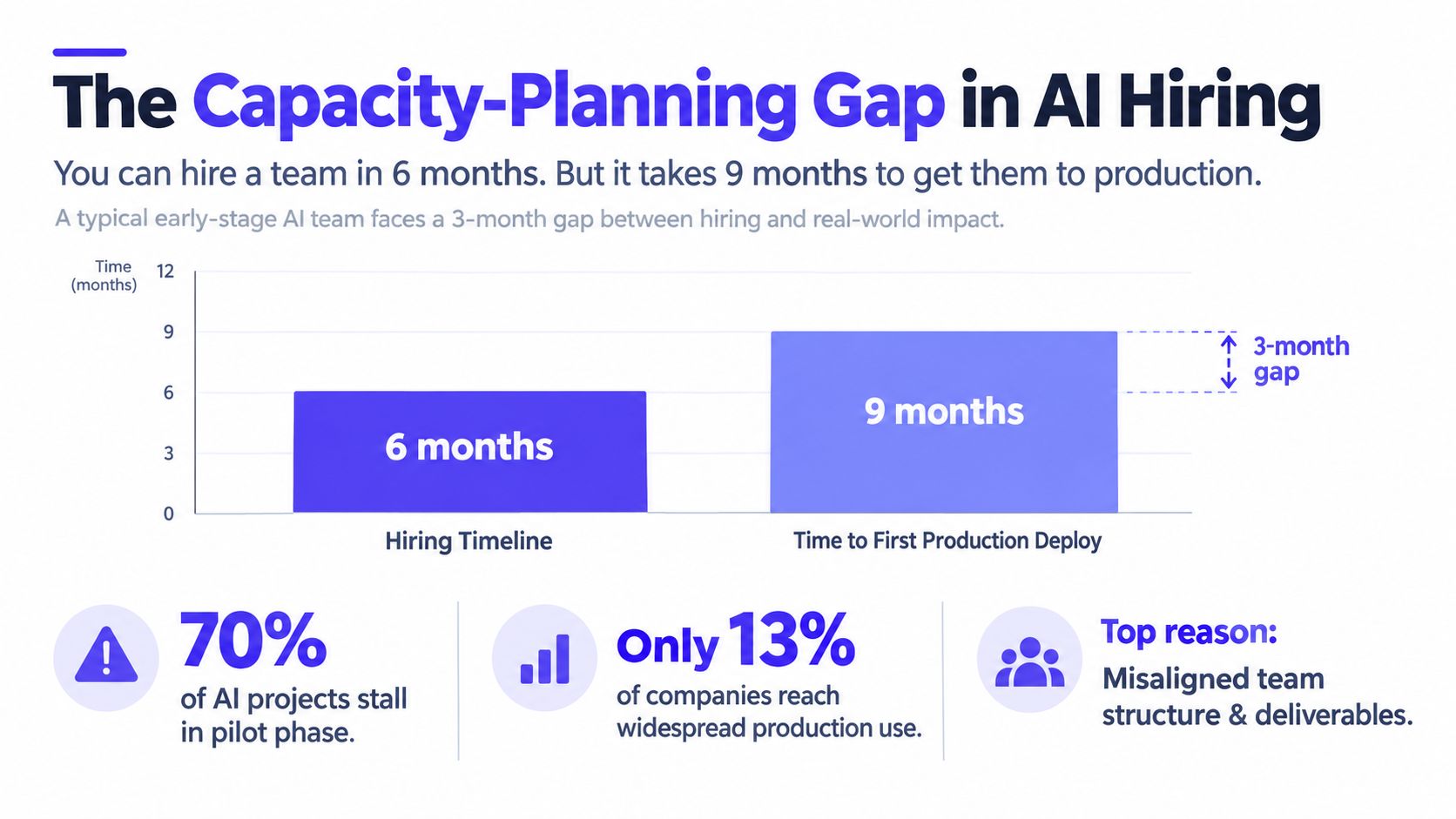
The stall patterns that repeat
Hiring only for research leaves the team without a reliable path to production. The model may be technically impressive, but nobody has primary accountability for infrastructure, release gates, or rollback.
Delaying data engineering creates a false sense of progress. Engineers train against hand-cleaned files, then discover that production data has missing fields, changing schemas, access restrictions, or no lineage.
Treating governance as phase two forces late rework. The team eventually has to answer who approved the use case, what data entered the system, how performance is measured, and who can stop the service.
Sharing one ML engineer across several squads fragments ownership. Every team gets advice, but no team gets a person accountable for an outcome.
Practical rule: Hire for the complete delivery loop, not for the most prestigious technical label.
The operating model in this guide is deliberately small. Start with a machine learning engineer, MLOps or platform engineer, data engineer, and applied AI product owner. Give them one production deliverable and a written governance charter. Tie hiring and onboarding to a 0-30-90 plan, rather than an open-ended research sandbox.
The Four Roles That Make an AI Pod Work
A production AI pod needs four primary accountabilities. You can combine responsibilities in a small company, but you shouldn't leave the accountabilities unassigned.
The ML Engineer owns model development, evaluation, feature logic, and the handoff between experimentation and serving. By day 30, this person should have reproduced a baseline, documented the evaluation set, and identified failure modes that matter to the product.
The MLOps or Platform Engineer owns training and inference environments, deployment, observability, access controls, and rollback. A useful day-30 deliverable is a small model deployed through the existing continuous integration pipeline with logs, a health check, and a tested rollback path.
The Data Engineer owns ingestion, transformations, data quality, lineage, and reproducibility. Their first proof of competence should be a documented data contract and a monitored pipeline that the ML Engineer can use without manual cleanup.
The Applied AI Product Owner owns the customer problem, workflow design, acceptance criteria, human escalation, and business outcome. Their day-30 deliverable should be a one-page product brief with a measurable definition of value and an explicit boundary for unsafe or low-confidence outputs.
Use this guide to ML Engineer responsibilities when turning the pod design into role specifications.
A scorecard that keeps hiring honest
| Role | Primary Accountability | Day-30 Deliverable | Scorecard Dimensions |
|---|---|---|---|
| ML Engineer | Model quality and evaluation | Reproducible baseline and failure analysis | Technical bar, systems judgment, collaboration, ownership |
| MLOps or Platform Engineer | Deployment, monitoring, rollback | Observable service in the existing release path | Technical bar, systems judgment, collaboration, ownership |
| Data Engineer | Data reliability and lineage | Tested data contract and monitored pipeline | Technical bar, systems judgment, collaboration, ownership |
| Applied AI Product Owner | Business value and safe workflow design | Product brief with acceptance criteria | Technical fluency, systems judgment, collaboration, ownership |
If budget is tight, hire the ML Engineer and MLOps Engineer first. A model that can't be deployed, monitored, or rolled back isn't a production capability. Add data and product ownership through existing staff only when those people can commit real time and accept explicit accountability.
An optional ML Researcher belongs in the pod when the product has a genuine modeling problem that existing methods can't address. Don't use research hiring to compensate for missing deployment or data foundations.
The headcount rule is simple: one role, one primary accountability, and one shared on-call rotation. That structure lets skills compound instead of fragmenting across loosely connected projects.
A Hiring Playbook You Can Run in Two Weeks
A CTO without a dedicated talent team can still run a disciplined hiring sprint. The trick is to write the job around the first production deliverable, then evaluate evidence of shipping rather than familiarity with fashionable tools.
Days 1 through 6
On days 1 through 3, write a one-page role specification. Include the product problem, current stack, first deliverable, decision rights, collaboration expectations, and the failure modes the hire must handle. Avoid a generic list of frameworks.
On days 4 through 6, source through three channels:
- Engineering referrals: Ask trusted engineers for people who have operated systems, not only trained models.
- Niche communities: Search communities where practitioners discuss deployment, evaluation, data quality, and incidents.
- Vetted staffing partners: Use a partner when you need access to pre-screened specialists without slowing the product team.
If a channel produces fewer than five qualified candidates, change the channel or tighten the definition of qualified. Don't lower the technical bar to protect a weak funnel.
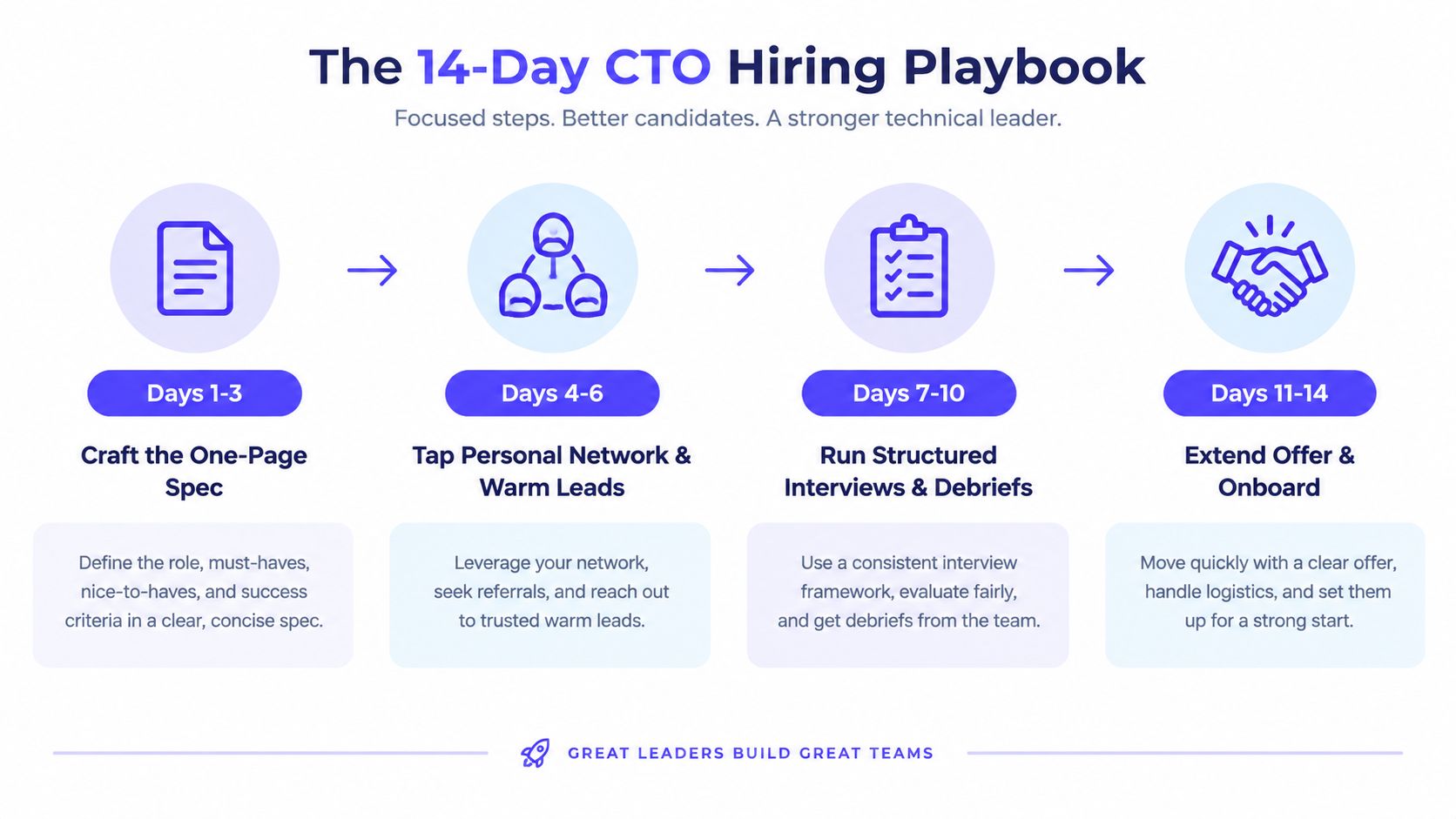
Days 7 through 14
Run a 45-minute screening call on days 7 through 9. Ask three questions:
- “Tell me about a model or AI service you shipped. What broke after launch?”
- “A deployed model's output quality drops while infrastructure health remains green. How do you debug it?”
- “Which part of production AI work do you want to own next?”
The second question tests systems judgment. The first tests honesty and operational experience. Strong candidates explain trade-offs, unknowns, and the actions they took after an incident.
On days 10 through 12, use a paid three-hour take-home brief. Give the candidate a small, representative dataset or a documented interface. Score data handling, evaluation design, tests, code clarity, assumptions, and operational notes. Don't score raw model accuracy in isolation.
On days 13 and 14, run a structured panel debrief against the scorecard. Then conduct references focused on reliability, collaboration, and response to failure. A lightweight recruitment applicant tracking system overview can help you keep evidence, interview notes, and decision ownership in one place.
Three signals predict shipping behavior:
- Monitoring curiosity: The candidate asks about monitoring and rollback during screening.
- Testing discipline: The take-home includes a meaningful test rather than only a notebook.
- Failure transparency: A reference volunteers an example of a project that broke and explains how the candidate responded.
Use a structured AI engineer hiring process when you need a repeatable version of this workflow across several roles.
Full-Time, Contract, or Fractional Talent
The right staffing model depends on how permanent the capability needs to be, how much context the work requires, and who will own the system after launch. A low-commitment engagement can be sensible for validation, but dangerous when nobody internal can operate what gets built.
| Dimension | Full-Time | Contractor | Fractional |
|---|---|---|---|
| Loaded cost | Ongoing employment commitment | Defined engagement cost | Part-time specialist commitment |
| Ramp time | Slower initial integration, stronger context over time | Faster for a defined brief | Fast for focused leadership |
| Intellectual property risk | Usually simpler internal ownership | Requires clear agreements and handoff | Requires explicit access and ownership boundaries |
| Roadmap changes | Absorbs changing priorities well | Can expand scope and cost | Works best when priorities stay focused |
| Best fit | Core AI product capability | Narrow experiment or bounded build | Governance, MLOps leadership, or specialist gaps |
Choose full-time when AI is a core product surface and the company can support the role through a sustained roadmap. The employee accumulates domain knowledge, participates in on-call, and makes architecture decisions with longer-term consequences.
Choose a contractor for a narrow experimental build with clear acceptance criteria, a fixed handoff, and an exit condition. A contractor who refuses to document decisions or transfer operational knowledge is a liability, even if the prototype looks good.
Choose fractional talent when you need senior judgment before you need a permanent role. This works well for an MLOps lead establishing deployment standards or a governance specialist creating review paths. It fails when the expert can't attend your incident bridge, review urgent changes, or make decisions during the hours your system operates.
For employment classification, intellectual property, and practical differences between permanent and contract arrangements, consult this permanent vs contract work guide.
A common hybrid pattern is to use a contractor to validate the use case, then convert the person or replace them with a full-time hire once the product earns a durable roadmap. The handoff should include source code, infrastructure definitions, evaluation assets, runbooks, model documentation, and unresolved risks.
Fractional hiring can fill a specific leadership gap without committing to a permanent structure. This guide to fractional hiring provides useful context when deciding whether the need is temporary expertise or a lasting accountability.
Onboarding and the First 90 Days
A new AI hire shouldn't spend the first quarter exploring without a production obligation. Give the person one visible deliverable, access to the people who own its dependencies, and a clear definition of what they must leave behind.
Days 0 through 30
Start with context. The hire should shadow a customer call, read the recent postmortems, inspect the existing CI pipeline, and deploy a small hello-world model through that path. They should also write a threat model covering data exposure, prompt or input abuse, access boundaries, and failure handling.
The manager's job is to remove ambiguity early. Name the service, the product owner, the technical reviewer, and the person who can approve a rollback.
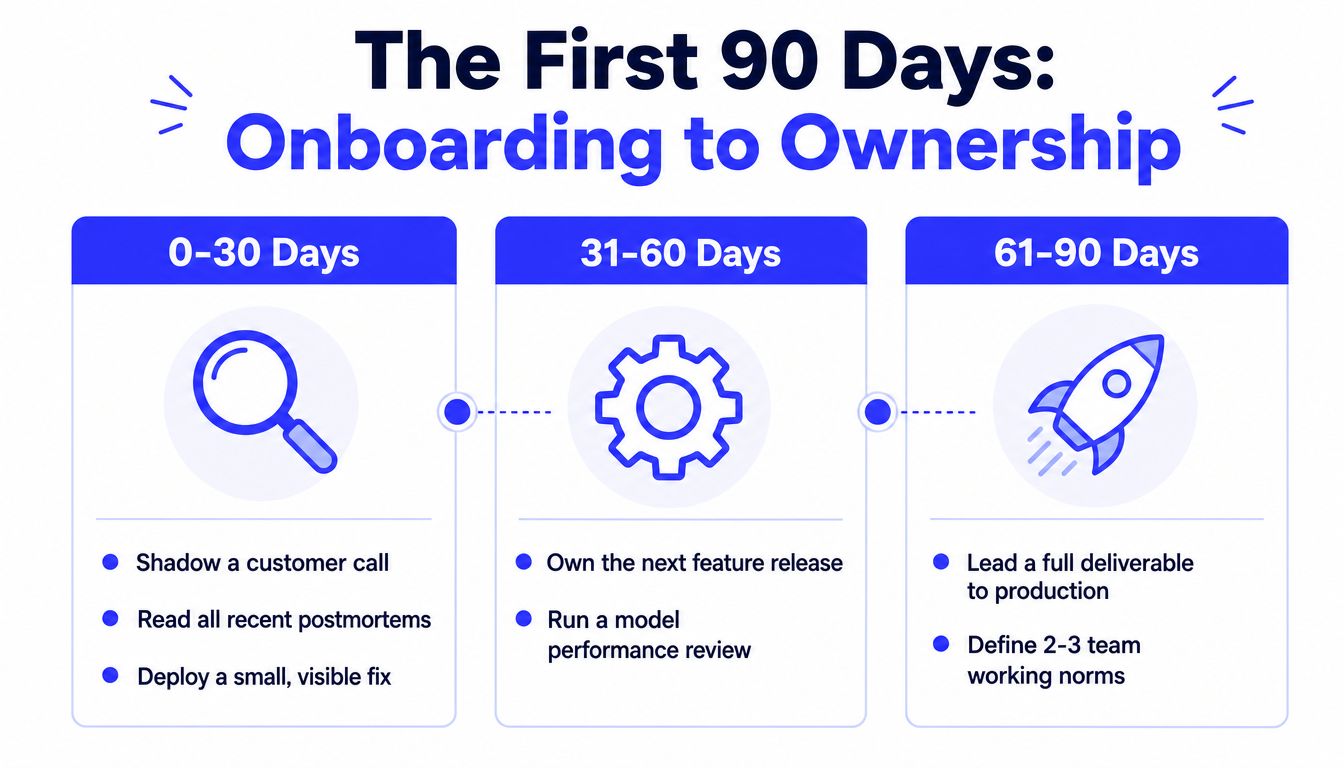
Days 31 through 60
The engineer should own one production service end to end. That includes deployment, monitoring, runbook maintenance, and rollback. Pair the new hire with an on-call engineer for two rotations so operational knowledge transfers in both directions.
Remote teams need visible working agreements. Use a daily 15-minute asynchronous standup in a shared document, a Friday demo, a monthly architecture review, and a public decisions log. The exact tools matter less than the habit of recording decisions where product, engineering, and operations can find them.
Days 61 through 90
By day 90, the hire should lead an incident retrospective, present a model card, review service metrics on one page, and propose the next quarter's roadmap. The deliverable should show what shipped, what failed, what remains risky, and what the team will stop doing.
A practical onboarding an employee guide can help managers formalize access, expectations, and early feedback without turning onboarding into an administrative exercise.
Use this manager checklist:
- Day 30: Baseline reproduced, data and threat assumptions documented, first deployment completed.
- Day 60: Service owned, monitoring active, rollback rehearsed, on-call pairing complete.
- Day 90: Incident retro led, model card reviewed, roadmap proposed, operating norms recorded.
Operating Model, Governance, and Metrics
Governance works when it tells people who decides, what evidence they need, and what happens when the system behaves badly. It becomes bureaucracy when nobody can connect a review form to a real risk or release decision.
The NIST AI Risk Management Framework Playbook organizes the work into Govern, Map, Measure, and Manage. Turn those functions into a one-page charter that the pod reviews every Monday.
- Govern: Name the accountable leader, define access controls, maintain the model registry, and publish acceptable-use rules.
- Map: Record each use case, stakeholder, data source, dependency, and plausible harm before launch.
- Measure: Set evaluation methods before deployment and monitor quality, performance, fairness, privacy, and security signals.
- Manage: Define incident response, rollback authority, escalation paths, and corrective actions.
The NIST AI RMF Core explicitly allows quantitative, qualitative, or mixed methods for measuring and monitoring AI risk. That means the team shouldn't treat evaluation as a one-time test. It belongs in the release process and the operating rhythm.
A weekly scorecard
| Metric | RMF Function | Target | Review Cadence |
|---|---|---|---|
| Model quality against the approved evaluation set | Measure | Threshold agreed before launch | Weekly |
| p95 inference latency | Measure | Under 300 ms | Weekly |
| Data drift using population stability index | Measure | Below 0.2 | Weekly |
| Human-review sample rate | Map and Measure | Defined by use-case risk | Weekly |
| Registry, access, and policy status | Govern | No unassigned owner or overdue review | Monday |
| Open incidents and remediation status | Manage | Every incident has an owner and due action | Monday |
The thresholds above are example operating targets, not universal standards. A support summarizer and a credit decisioning system shouldn't share the same risk tolerance. The product owner and accountable technical leader must set thresholds that reflect the use case.
Governance also clarifies speed. Reviewers know what evidence to expect, engineers know which approvals are pre-cleared, and incident responders know who can stop traffic. That operating contract reduces late-stage debate without pretending that every risk can be automated away.
Scaling From One Pod to a Real AI Organization
The “hire one genius researcher” approach sounds efficient because it minimizes headcount. It often creates a single point of failure instead. The RAND findings on misaligned objectives, weak data foundations, and missing cross-functional ownership support a different conclusion: production AI needs complementary responsibilities, not a heroic individual.
Move beyond one pod when the organization sees persistent demand that one team can't absorb. The signals are operational:
- Sustained backlog: Product requests remain blocked because the pod can't support discovery, delivery, and operations at the same time.
- Conflicting priorities: Business units request models with incompatible data, quality, or risk requirements.
- Shared infrastructure drift: Teams create separate training pipelines, evaluation harnesses, or inference gateways that solve the same problem differently.
- Repeated platform blockage: Engineers wait on shared infrastructure tickets instead of improving product behavior.
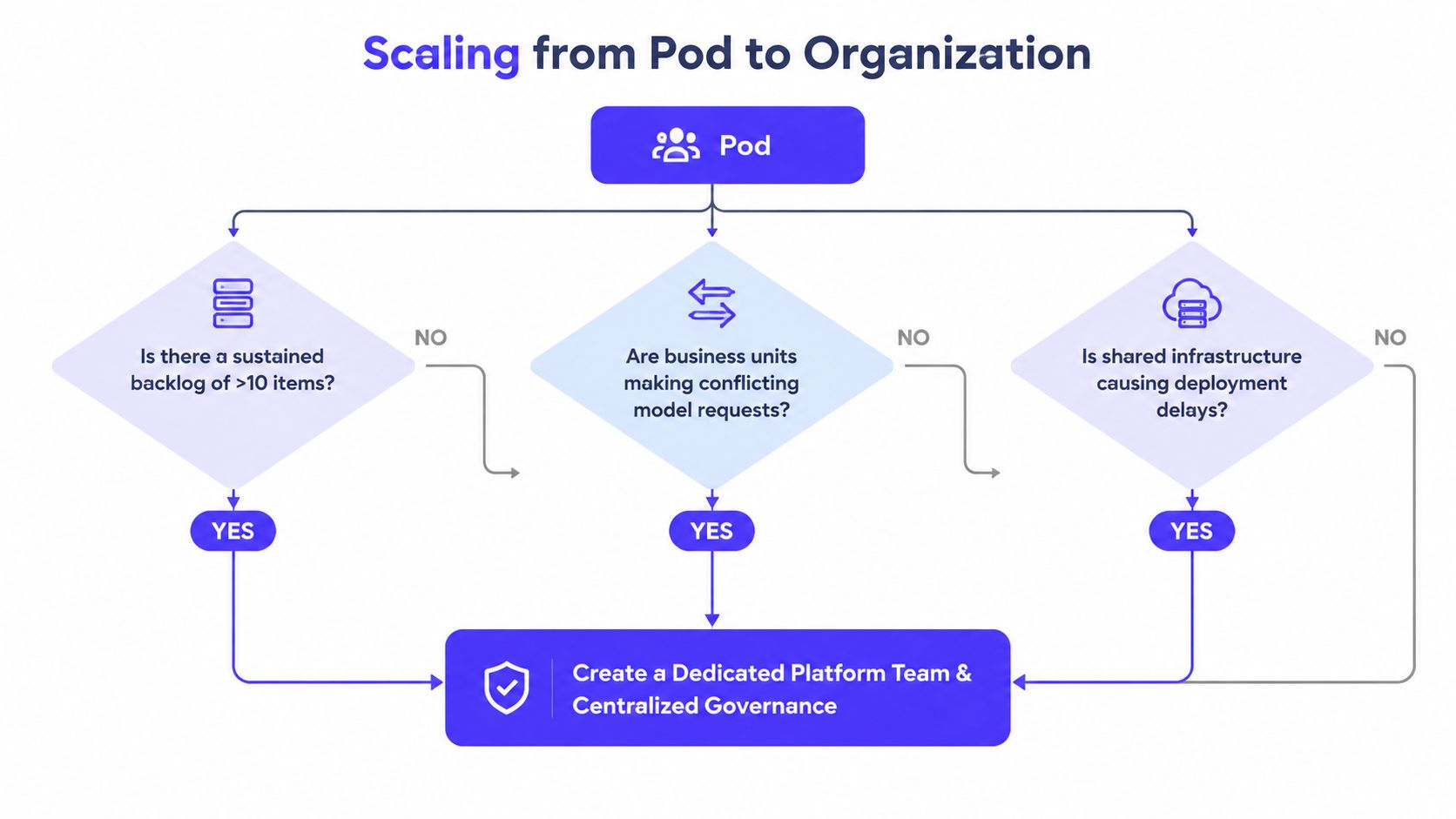
Three structural moves
First, split into product-aligned pods and create a thin platform team. The platform group should own shared feature stores, training pipelines, inference gateways, observability, and reusable evaluation infrastructure. It shouldn't become a ticket queue that hides product teams from operational ownership.
Second, appoint a senior individual contributor or staff-level ML platform engineer. This person owns reliability, cost decisions, platform architecture, and vendor selection. They need authority to reject duplicated infrastructure and to set standards that product pods can adopt without lengthy negotiation.
Third, establish a lightweight AI review board. It should approve model launches, review material changes, and monitor post-production incidents. Keep membership small and decision records public.
For a 12-month scaling review, check:
- Pod design: Each product pod has clear product and technical ownership.
- Platform boundary: Shared services have owners and documented service levels.
- Governance: Model launches have accountable approvers and an evidence trail.
- Capacity: The organization has planned headcount ranges per pod rather than hiring reactively.
- Shared services: Reserve 10% to 15% of AI capacity for platform and governance work.
- Monthly metrics: Review deployment reliability, evaluation coverage, incident response, infrastructure reuse, backlog health, and time from approved use case to production.
The structure is working when product pods move independently without rebuilding the foundations, and when platform investment reduces repeated work instead of adding another approval layer.
ThirstySprout helps companies scope the right remote AI team shape and connect with vetted AI/ML engineers, MLOps specialists, data engineers, and AI product talent for full-time, contract, or fractional engagements. Visit ThirstySprout to discuss your first production deliverable, identify role gaps, and start a focused pilot with the people needed to ship it.
Hire from the Top 1% Talent Network
Ready to accelerate your hiring or scale your company with our top-tier technical talent? Let's chat.