

You're not hiring a “React Native developer” in 2026. You're hiring someone to own a mobile codebase, and that usually means deciding what they'll carry, how much release responsibility they'll absorb, and whether they need to touch the native layer at all. If you skip that definition, you'll interview plenty of people who can ship screens, and miss the ones who can keep an app healthy across New Architecture, Hermes, app store releases, and CI/CD.
The right hire is rarely the one with the longest résumé. It's the one whose experience matches your app's architecture and operational burden. That's the difference between a useful mobile engineer and a polished interview performer.
Why Hiring React Native Developers Is a Different Problem in 2026
Hiring a React Native developer in 2026 is really a decision about operational ownership. You are not just filling a UI role. You are deciding who will carry the mobile codebase, who will touch New Architecture work, who will keep Hermes healthy, and who will own releases, CI/CD, and the store submission process when things break.
The market still treats this role too casually. React Native remains one of the most widely used cross-platform mobile frameworks, and it has been adopted by brands like Facebook, Instagram, Shopify, Discord, Uber Eats, and Walmart, which makes it a durable skill rather than a passing trend (RemoteCrew). That is useful, but it does not mean the candidate pool is interchangeable. Plenty of engineers can ship a screen. Far fewer can keep a mobile system stable across native dependencies, release pressure, and platform-specific failures.
The mistake most teams make
They post for “React Native” and expect a generic frontend engineer. That is how teams end up with people who can build clean interfaces but cannot explain release ownership, performance profiling, or the trade-offs around native modules. In mobile work, those are not side topics. They are the job.
Practical rule: hire for the architecture you run today, not the architecture you wish you had next quarter.
Start with the actual app shape. If you are running managed Expo with standard features, you want someone strong on product delivery and fast iteration. If your codebase depends on custom native modules, deep platform work, or a path toward the New Architecture, you need an engineer who can work across native boundaries, not just inside components. The best hire is often not the most senior person in the market. It is the person whose background matches the app's current burden and the operating model your team can support.
A useful mental model
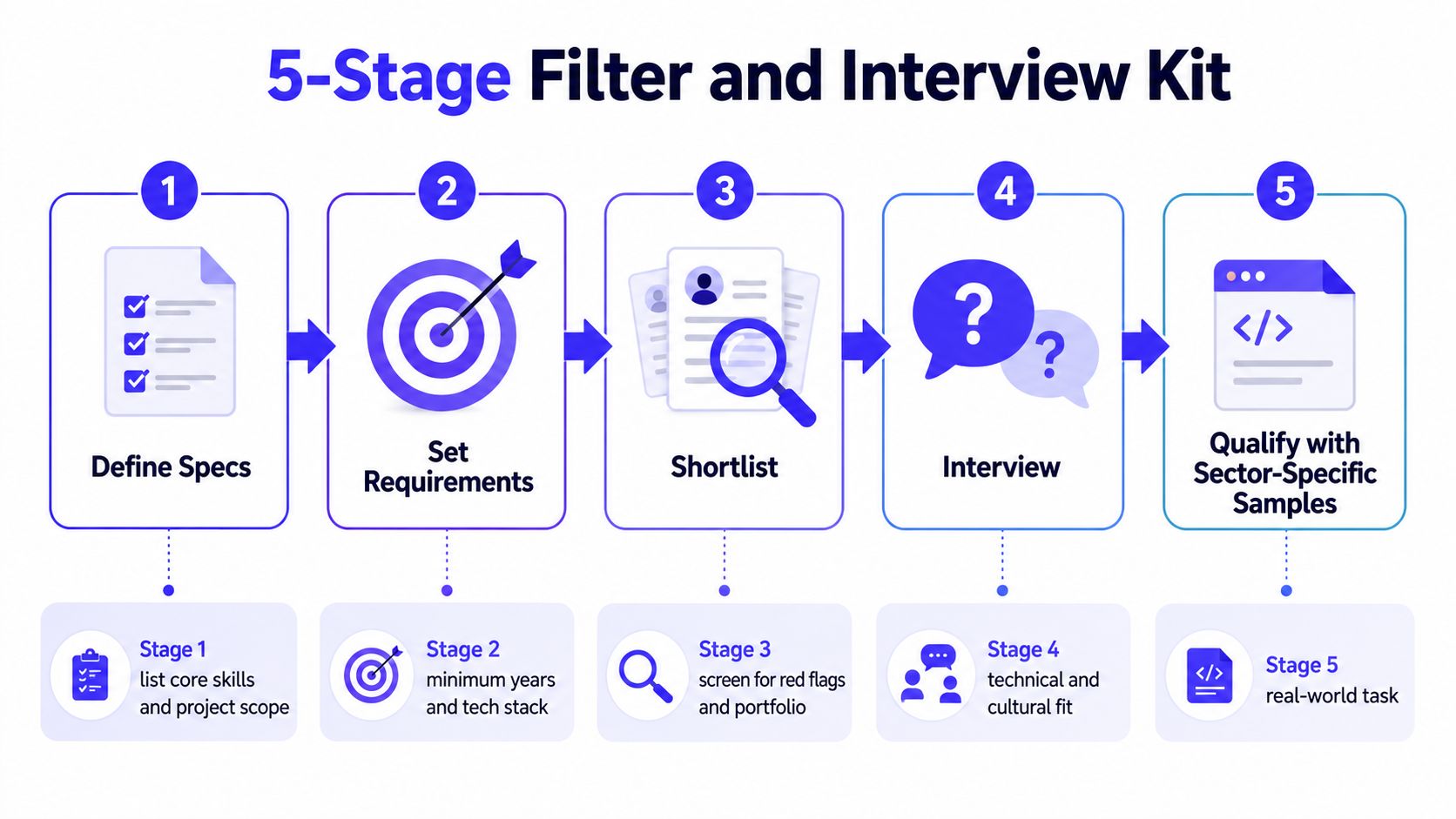
Separate the work into stages, not résumé years. Define the role, write the requirements, shortlist candidates, interview them, then validate them with sector-specific work samples and availability checks, a 5-stage filter that keeps you from mistaking noise for fit (Brocoders). That process works because mobile hiring fails on specificity, not effort.
A strong search starts with an explicit role brief. Get that right, and the rest gets much easier to judge.
Defining the Role and Levels You Actually Need
Before you hire, decide what kind of React Native engineer you need. If you skip this step, every candidate looks sort of relevant, and that's how bad hiring happens. You want a role definition that names the architecture, the release burden, and the level of ownership up front.
Start with the app shape, not the job title
Use this rule. If your app is staying inside managed Expo with standard features, optimize for a product-layer engineer who can move quickly. If you need custom native modules, deep platform work, or a migration path into the New Architecture, you need someone who can work across native boundaries, not just screens. That distinction is explicit in newer hiring guidance, which says the scarcity is not “React Native developers” in the abstract, but developers whose workflow and operational ownership match the app's state (Underdog).
Build the job description around must-haves
Here's the split I'd use.
- Junior: can build components, connect APIs, and work inside a guided workflow. Nice-to-haves are store familiarity and exposure to a native module, but they shouldn't be required.
- Mid: should be able to ship production features, handle platform-specific branches, and work with TypeScript comfortably. I'd expect stronger state management judgment here.
- Senior or lead: should own architecture decisions, debug native boundaries, and understand release systems well enough to prevent recurring failures.
If you're on a modern stack, the senior bar should explicitly mention TypeScript, Fabric, TurboModules, JSI, Hermes optimization, and native module development when those concerns are in scope (Fonzi). If the role doesn't require those skills, don't pretend it does. You'll just filter out good mid-level engineers who could have been productive.
| Level | Years shipping React Native | Must-have skills | Nice-to-have | Owns |
|---|---|---|---|---|
| Junior | 1 to 3 years | Components, API integration, basic navigation, TypeScript | App store exposure, simple testing | Screens and bug fixes |
| Mid | 3 to 5 years | Production features, state management, platform-specific code, real device testing | OTA updates, deeper performance work | Feature slices and mobile polish |
| Senior or lead | 5+ years | Architecture decisions, release flow, native modules, CI/CD ownership | Migration strategy, mentoring | App health, delivery, and technical direction |
Decide Expo versus Bare early
This decision should happen before recruiting starts. Expo-managed workflow and Bare React Native attract different people because the technical surface is different. If you need custom native integrations or expect native bridge work, write that clearly. If not, don't overcomplicate the brief.
The job description is a filter, not a marketing page. The more precise it is, the less junk you'll sort through later.
One more thing. Make the brief about business outcome, not only skills. “Own offline sync for field teams” is better than “5+ years React Native.” That single sentence helps candidates self-select and keeps your pipeline relevant.
Choosing the Right Engagement Model
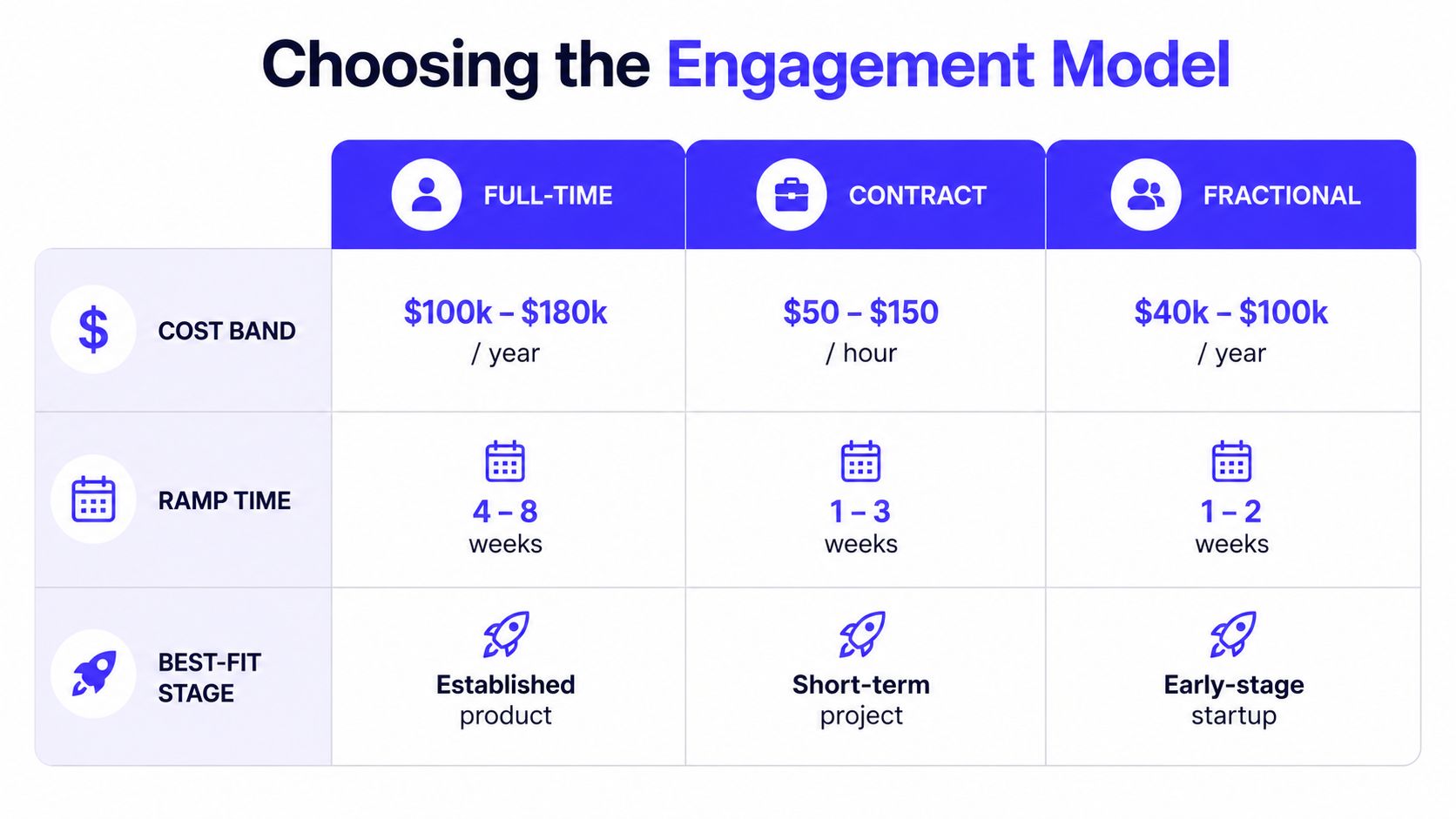
Hiring choice comes before budget math, but it starts with ownership. Full-time, contract, and fractional React Native developers do not carry the same load, and the wrong model creates gaps in who owns releases, CI/CD, Hermes, New Architecture work, and the day-to-day health of the app.
Match the model to the stage
Full-time works when the roadmap is durable and you need someone to own releases, QA coordination, incident follow-up, and ongoing app stability. Contract works when the scope is defined and speed matters more than long-term continuity. Fractional works when you need senior direction for architecture, migration, or release process design, but you do not need a full seat yet.
The biggest mistake is hiring for status instead of responsibility. If the role is really about owning release flow, CI/CD, or native integration decisions, say that plainly. If the work is narrower, do not pay for an oversized profile just because the title sounds safer.
When each model wins
- Full-time: best for a product with an active roadmap, recurring mobile work, and clear ownership of app quality.
- Contract: best for a defined build, a migration push, or a short burst of delivery work.
- Fractional: best for early-stage teams that need senior judgment, technical direction, or release discipline without committing to a full-time hire.
If your team hires remotely, use a market reference like remote React jobs to understand how candidate availability and seniority shift across regions before you lock the engagement model. That matters more than glossy job titles.
If you need help separating hiring scope from payment operations, the OneSafe ACH guide is a useful reference for the money movement side of vendor setup. Keep that operational layer separate from the decision about who owns the mobile stack.
A fair benchmark comes from the market itself. Independent hiring writeups and remote-vetting platforms show that contract React Native talent spans a wide rate band, and the higher end is where real seniority lives. Use that as a warning, not a target. Cheap contract work is fine for a bounded task. It is a weak choice for release ownership, app architecture, or long-term code quality.
Don't force a single answer
A seed-stage app with one urgent mobile objective usually needs a contract or fractional specialist. A later-stage team with steady release cadence and ongoing product work usually needs full-time ownership. Do not hire a full-time engineer because it feels tidy. Stability comes from clear ownership, not payroll category.
If the best candidate is slightly less senior but will own the right operational work, hire that person. That is the better trade-off.
Compensation Benchmarks You Can Budget Against
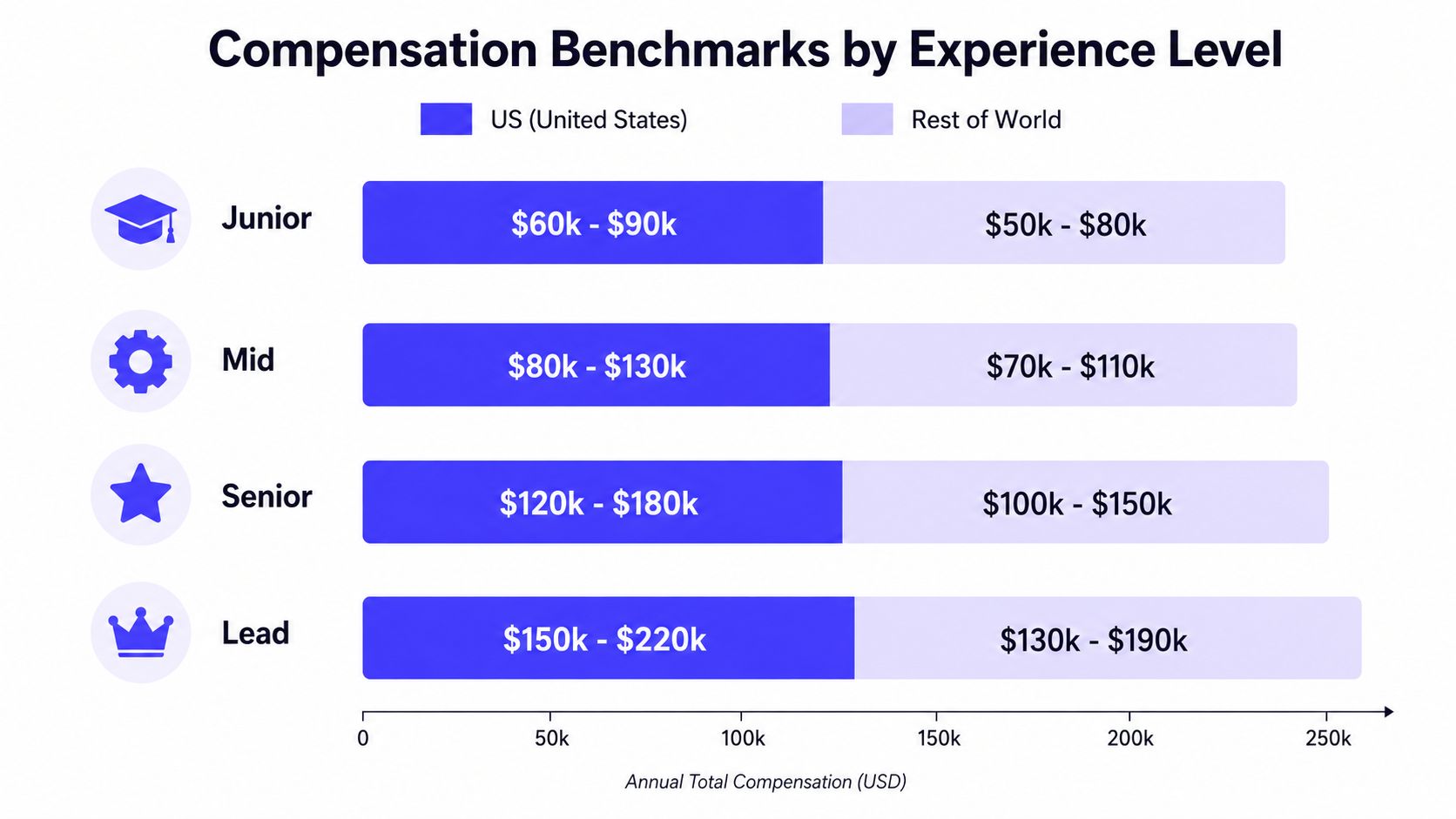
A serious hiring plan needs compensation boundaries. React Native sits in a real budget band because you are paying for mobile delivery, JavaScript or TypeScript fluency, and ownership of the app surface, not generic frontend work.
Anchor your budget to the role, not the headline
A practical salary range starts with the work you expect, not the title on the offer letter. For startups, market writeups show React Native compensation can swing widely based on seniority, equity mix, and whether the person is expected to own architecture or just ship tickets. Another salary guide puts U.S. mid-level React Native pay around $115,000, juniors around $75,000, seniors at $155,000+, and leads up to $190,000 (Underdog). Treat that spread as a signal. The more ownership you ask for, the more your budget needs to move.
Regional variation changes the hiring math
Regional pay differences are large enough to change your hiring model. One hiring guide places senior developers in North America at $120,000 to $150,000 annually, compared with $55,000 to $75,000 in Eastern Europe and $45,000 to $65,000 in Southeast Asia (DevsData). That gap is why remote hiring is often the practical answer when the role does not require someone on-site.
If you are mapping payroll against transfer workflows, the OneSafe ACH guide helps finance and recruiting talk through payment mechanics without mixing them into the hiring decision. Keep the money movement discussion separate from the question of who owns the mobile stack.
Budget for the hidden costs
Base salary is only part of the bill. Equity, benefits, notice periods, and the time your team spends screening candidates all add to the total spend. If you are hiring a senior engineer for a complex mobile role, I would rather see a tight range with a clear architecture brief than a low offer with vague expectations.
Set the level before you post the role. Decide whether you need a mid-heavy or senior-heavy hire, then write the compensation band to match the ownership required. If the app needs migration work, release leadership, or native integration, do not post a mid-level range and hope for senior outcomes.
The market is still tight for strong software talent, especially for engineers who can own delivery end to end. If you want a broader read on that demand pressure, the page on are software engineers in demand is a useful market check before you finalize the offer range.
The 5-Stage Filter and Interview Kit
The hiring process should look structured, not improvised. React Native talent is easy to overestimate in résumé review and easy to under-test in generic interviews, so you need a pipeline that exposes real mobile judgment. The hardest part is not finding candidates. It is defining the operational ownership they will carry, from New Architecture work to Hermes tuning, release management, and CI/CD.
Use a filter, then test the work
A clean 5-stage filter keeps you from hiring people who interview well and ship poorly. Define the spec, set the requirements, shortlist, interview, then qualify candidates with work samples and availability checks. That sequence is basic, but it forces discipline around the actual app instead of a generic mobile résumé.
Keep the loop short and deliberate. Use a recruiter screen, a technical interview, a live coding challenge, and a final conversation about fit and ownership. Long interview chains burn candidates and usually add noise, not signal.
Ask scenario questions, not definitions
Definition questions are easy to memorize. Scenario questions show whether someone has worked through mobile problems under pressure.
- Recruiter screen: ask what kinds of apps they have shipped, what workflow they used, and whether they have owned releases.
- Technical interview: ask them to explain performance profiling, native-bridge interaction, and how they think about state management in mobile.
- Live coding: have them build a simple screen that fetches data from a public API. Watch how they structure code, handle async behavior, and keep state readable.
- Take-home or review task: use a real-world problem around complex state management or offline synchronization.
- Final interview: check communication, ownership, and whether they can work with product and backend partners without confusion.
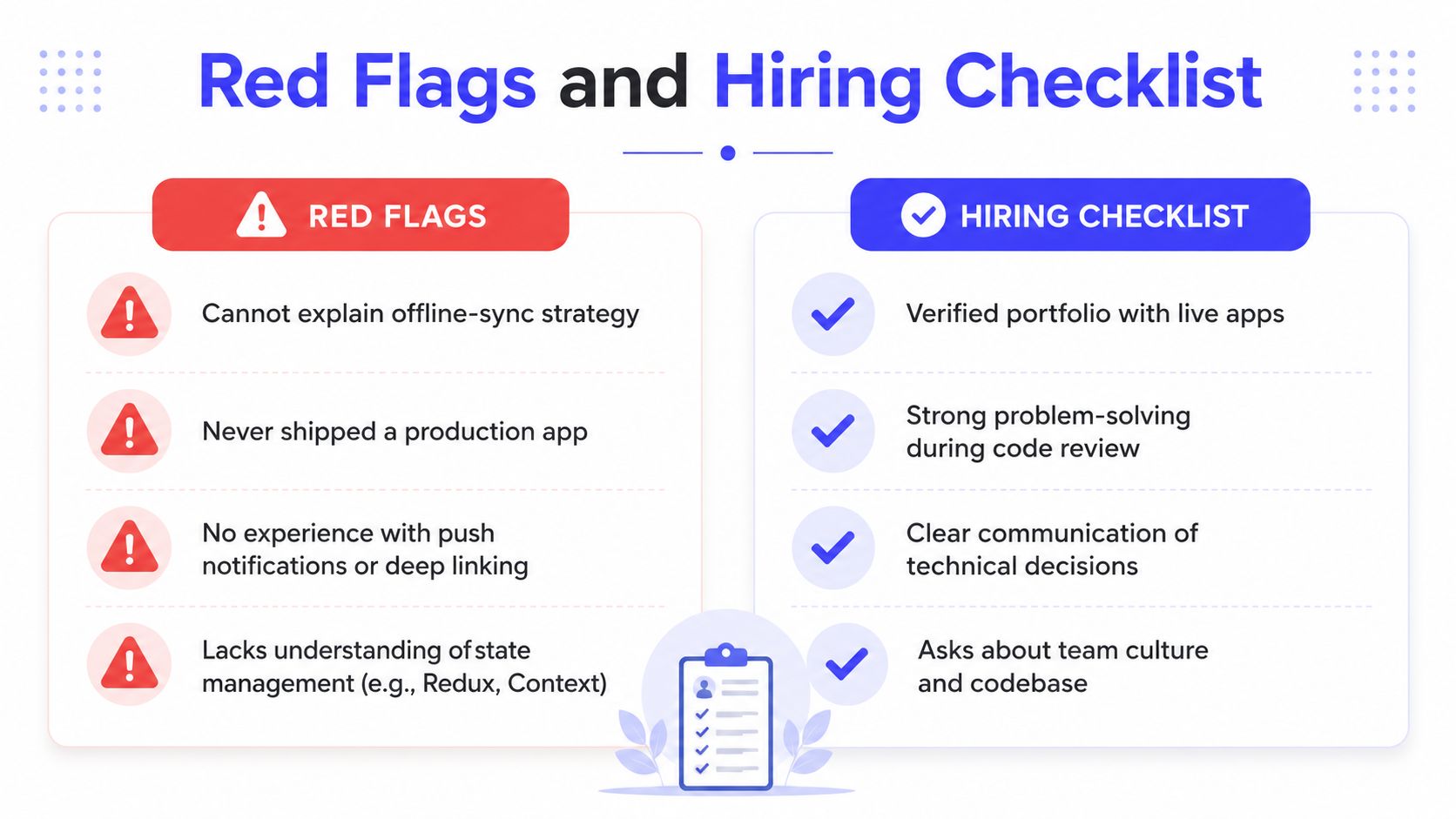
Practical rule: if a candidate cannot explain offline sync, app-store shipping, and platform-specific behavior, they are not ready for ownership.
If you want a tighter question bank for the technical interview, use a set like the React interview questions and answers page, then apply it to mobile scenarios instead of stopping at React theory.
Add a de-risking trial
A paid trial is the cleanest way to de-risk a senior or fractional hire. Industry guidance often recommends a short trial with measurable checks such as code coverage, bug density, sprint velocity, and adherence to performance benchmarks before a long-term commitment (CISIN). Use that approach when the stack is changing fast or when the team still needs proof of fit.
Do not use the trial as a cheap substitute for judgment. Use it to see whether the engineer can own a slice of the mobile stack, communicate clearly, and work inside your release process without supervision. A candidate who can pass a technical screen and still falter in a live codebase is telling you exactly what you need to know.
Onboarding and Ramp Plan for the First 90 Days
Hiring ends too late in too many teams. The true failure begins when the new engineer has access but no path to shipping. You want a ramp plan that gets them into production work fast without putting releases at risk.
Week one should be about context, not heroics
Give them repo access, environment setup, and a guided code tour. Have them learn the release flow, app-store dependencies, and the current bug backlog. Their first wins should be boring and low risk.
Week two should include a reversible change
Ask for one scoped change that can merge to main without drama. That might be a UI fix, a small state refactor, or a safe API integration. The point is not speed for its own sake. The point is to prove they can work inside your process.
By week three, they should own something real
Give them an owned slice of the roadmap with a clear definition of done. They should also start participating in release responsibilities in a limited way, so by day 60 they're accountable for more than local code changes. If they can't own a visible slice by then, something is wrong with either the role or the onboarding.
Tie onboarding to the same KPIs you used in the trial, like code coverage, bug density, and velocity. That keeps the evaluation grounded in delivery, not vibes. A clear 30-60-90 plan also helps the engineering manager and the new hire agree on what good looks like before friction starts.
Red Flags, Common Pitfalls, and Your Hiring Checklist
Some hires fail for obvious reasons, and most hiring pages still skip them. If you want fewer regrets, watch for candidates who can't explain their offline-sync strategy, have never shipped to both stores, or treat React Native like a hobbyist React project.
The mistakes that waste months
Hiring a senior engineer to do junior work is expensive and demoralizing. Skipping the paid trial on a senior hire is another easy way to miss fit. Ignoring time-zone overlap for on-call or release support turns remote flexibility into an operational headache.
Use this checklist before you post
- Role definition: Decide the architecture, workflow, and ownership boundary.
- Engagement model: Choose full-time, contract, or fractional based on roadmap, not habit.
- Comp band: Set a range that matches the level you need.
- Interview kit: Use scenario-based technical questions and a live task.
- Paid trial: Use one for senior or high-risk roles when the scope is uncertain.
- Onboarding plan: Define week one, week two, and week three outcomes in writing.
The best filter is still specificity. Good candidates respond to a clear problem, not a vague title.
If you want help turning that checklist into a real search, ThirstySprout can help you scope the role, run a pilot, and compare full-time, contract, or fractional options without committing to a long contract upfront.
Start with a 20-minute scope call, define the app's architecture and release burden, then run a 2 to 4 week pilot before you lock into a six-month relationship. If you're ready to hire react native developers with less guesswork, book the pilot, review a few sample profiles, and make the decision against real work instead of résumé noise.
Hire from the Top 1% Talent Network
Ready to accelerate your hiring or scale your company with our top-tier technical talent? Let's chat.