

You're probably here because one of two things is happening. Your Rails app is growing faster than your team can support, or your existing codebase has started to fight back with slow releases, brittle tests, and upgrades nobody wants to touch.
That's when a generic “full-stack Rails dev” search usually goes wrong.
When companies try to hire a Rails developer, they often start with sourcing. That's too late. The key advantage is upstream. Define the exact role, write a job description that strong candidates respect, run a vetting loop that tests production judgment, and onboard with enough structure that your new hire ships in the first few weeks.
A good Rails hire can own delivery. A bad one can leave you with more code, less clarity, and a team that stops trusting the application.
Practical rule: Hire for the actual job in front of you, not the title that sounds familiar.
Defining Your Ideal Rails Developer
The first decision isn't seniority. It's mission.
A Rails engineer who shines in a greenfield build may struggle in a legacy modernization role. A careful maintainer who can unwind technical debt may not be the fastest person to shape a new product from scratch. That distinction gets overlooked far too often, even though it changes the interview plan, the scorecard, and the compensation conversation. A hiring guide from Celential makes this point directly: many teams need a maintenance or modernization Rails engineer rather than a generic product builder, and role definition should reflect that reality in its hiring guidance.
Choose between builder and renovator
I usually separate Rails roles into two buckets.
Greenfield builder
- Best for: New SaaS products, internal tools, MVPs, fresh APIs
- Look for: Fast iteration, clean modeling, pragmatic product sense, comfort making trade-offs with limited information
- Listen for: How they choose defaults, when they avoid premature abstraction, how they sequence features
Modernization specialist
- Best for: Rails upgrades, dependency cleanup, performance bottlenecks, flaky test suites, fragile monoliths
- Look for: Debugging discipline, change management, incremental refactoring, operational caution
- Listen for: How they de-risk upgrades, isolate regressions, and improve maintainability without freezing delivery
The wrong hire usually happens when the company says “we need a senior Rails dev” but the actual need is narrower. If your app is on an older Rails version, has Sidekiq jobs that misbehave, and takes too long to deploy, you're not hiring for feature velocity alone. You're hiring for stewardship.
Use a role definition worksheet
Before you post anything, answer these five prompts internally:
- What must this person own in the first quarter
- Is the main risk delivery speed, system stability, or architectural debt
- Will they inherit an existing codebase or set conventions from scratch
- Do they need DevOps and AWS fluency, or can platform engineers support that
- Will success be measured by shipping features, reducing incidents, or making the codebase easier to change
Here's a simple scorecard to align the team:
| Hiring need | Ideal profile | Interview focus |
|---|---|---|
| New product launch | Greenfield Rails builder | Product trade-offs, schema design, conventions |
| Legacy app cleanup | Modernization Rails engineer | Refactoring, upgrade strategy, debugging |
| Scale and reliability | Senior systems-oriented Rails engineer | Background jobs, observability, performance |
| Hybrid role | Staff-level Rails generalist | Architecture ownership, mentoring, delivery |
A quick gut check
If your hiring panel can't explain the difference between the role you're opening and “a good Rails developer,” pause the search.
That confusion will show up in the job description, the interview loop, and the offer process.
Writing a Job Description That Attracts Top Talent
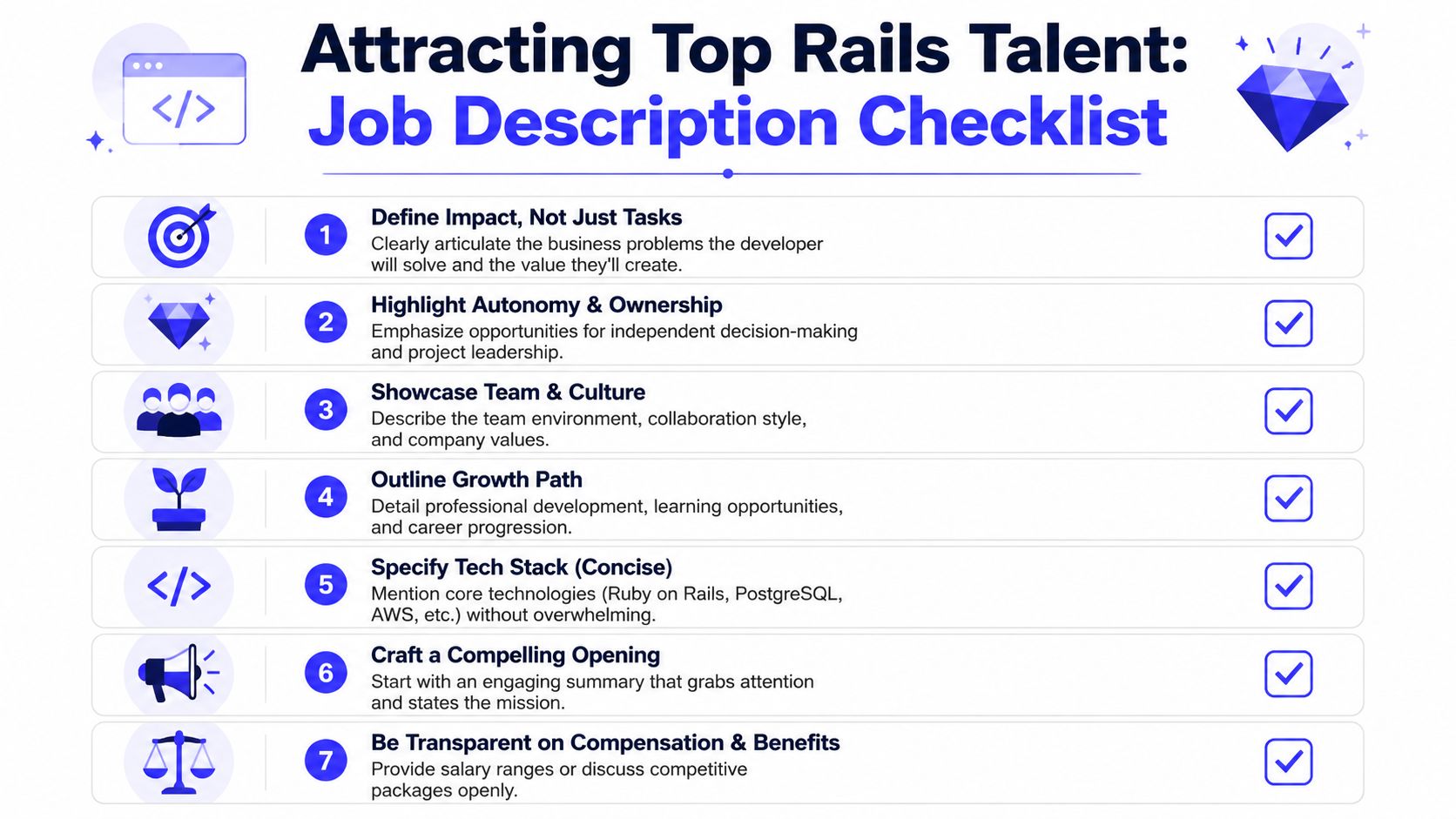
Strong Rails candidates don't respond to shopping lists. They respond to scope, ownership, and clarity.
Most weak job descriptions read like internal notes pasted into a public posting. They list every framework, every tool, and every nice-to-have gem, then bury the only part that matters: what the person will change.
Write for outcomes, not tasks
Bad responsibility bullets sound like this:
- Weak: Maintain Rails application and build new features
- Weak: Write APIs, fix bugs, and support deployment
- Weak: Collaborate with cross-functional stakeholders
Better ones sound like this:
- Better: Own checkout and subscription workflows in a Rails app used by paying customers
- Better: Improve release safety by tightening test coverage around billing, background jobs, and admin actions
- Better: Lead the next Rails upgrade with a staged rollout plan and clear rollback paths
The second set does two things. It tells the candidate what matters, and it signals that your team understands engineering work beyond CRUD tickets.
A job description template that works
Use this structure.
Opening summary
Start with mission, not company boilerplate.
“Join a small product and engineering team building a Rails application that powers customer onboarding, billing, and internal operations. You'll own backend delivery in production, improve code quality, and help shape how we scale the system.”
What this person will own
Use a short list tied to business outcomes.
- Core product surface: Which parts of the app they'll touch
- System responsibility: Performance, background jobs, APIs, observability, upgrades
- Team role: IC, tech lead, mentor, or player-coach
First 90 days
Here, senior candidates decide if the role is real.
- Month one: Get the app running locally, understand the domain, ship one low-risk improvement
- Month two: Own a meaningful feature or modernization track
- Month three: Propose and begin executing a systems or architecture improvement
Must-haves and nice-to-haves
Keep this tight. Core stack, core responsibilities, no tool dumping.
For format ideas, a good parallel is this AI engineer job description example, which gets the basics right by framing the role around outcomes and ownership.
A senior engineer can tell in a minute whether a job description was written by someone who knows the work.
What to leave out
Don't ask for everything.
Avoid long requirement blocks like “expert in Rails, React, Node, Python, Kubernetes, Terraform, Kafka, GraphQL, Elasticsearch, and mobile.” That reads like internal indecision. Good candidates self-select out because they assume the team doesn't know what it needs.
If you want to hire a Rails developer who can handle production work, respect their time. Be explicit about the problem, the environment, and what success looks like.
Sourcing Rails Talent Beyond Standard Job Boards
Job boards are fine for volume. They're weak for precision.
The best Rails hires often come from places where engineers show their work, not where they click “Easy Apply.” If you rely only on inbound applicants, you'll spend more time filtering than evaluating.
Four sourcing channels worth using
Specialized talent networks
This route is useful when you need pre-screened engineers and don't want to build the entire top-of-funnel yourself. Networks vary a lot. Some are recruiter-heavy. Some are assessment-heavy. Some focus on contractors, others on long-term hires.
If you're also benchmarking alternatives for backend hiring, curated collections of fully remote backend engineering roles can help you see how strong companies frame remote backend openings and compensation transparency.
One option in this category is ThirstySprout, which helps companies source and vet remote technical talent. That can fit if your internal recruiting team is small and you need a tighter shortlist rather than more resumes.
GitHub and public code
GitHub sourcing takes more effort, but the signal is better.
You're not looking for stars or flashy side projects. Look for:
- Consistent contribution patterns: Signs they finish work over time
- Readable Rails code: Naming, testing habits, migrations, service boundaries
- Judgment in issues and PRs: How they discuss trade-offs and review feedback
A small but useful tactic is searching contributors to gems, internal tools, or Rails-adjacent libraries your team already uses.
Rails communities
Rails Slack groups, Discord servers, and local meetups are useful for passive candidates. You won't always get an immediate hire, but you'll learn who is respected by other practitioners.
The downside is speed. Community sourcing works best when you already know your target profile and can write a direct, technically credible message.
Employee and investor networks
This channel gets underrated. Good founders, CTOs, and early engineers usually know one or two Rails people they trust.
The quality is often high because the referral includes context. The risk is homogeneity. If you only hire through warm networks, you can narrow your candidate pool too much.
Outreach that starts a conversation
Use short outreach. Skip generic praise.
Try this:
Hi [Name], I'm hiring for a Rails role focused on [greenfield build / legacy modernization / scaling background jobs]. Your experience with [specific repo, migration work, API architecture, Rails upgrade] caught my attention.
The role owns [specific scope], and the team cares a lot about maintainability and production quality. If that's relevant, I'm happy to share the details and compare notes.
This works because it shows you know what you're hiring for. It also leaves room for a no without forcing a resume request in the first message.
A Vetting Workflow That Signals Production Readiness
A polished resume can hide weak engineering habits. A production-ready Rails developer can explain trade-offs, read an ugly code path without panic, and ship changes safely.
That's why I prefer a four-stage loop. Each stage should remove a specific kind of risk.
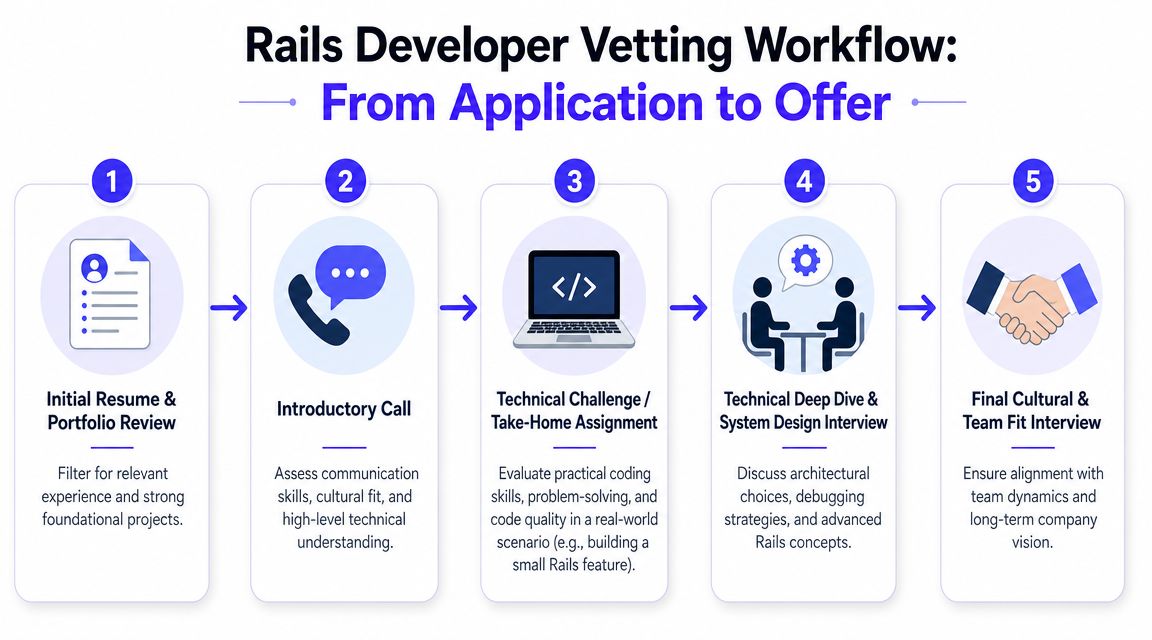
A practical hiring methodology from SoftAims breaks this into three layers: framework fundamentals, code-quality signals, and systems skills, with emphasis on avoiding candidates who can build CRUD features but struggle with deployment or production schema design in its Rails hiring guidance. That's the right lens.
Stage one with a focused screen
The first call should be short and specific.
Don't ask them to tell their life story. Ask for one recent project and drive into details.
Use prompts like:
- Architecture: “What part of the Rails app did you own end to end?”
- Decision-making: “What did you deliberately keep simple?”
- Production judgment: “What failed in production, and how did you handle it?”
- Team habits: “How did code review work on that team?”
You're testing whether the candidate speaks in specifics. Vague answers are usually a bad sign.
Stage two with a technical deep dive
This interview should map to the actual job.
For a builder, ask:
- Design a Rails app for multi-tenant account management
- Model subscriptions, users, and permissions
- Explain what belongs in controllers, models, jobs, and service objects
For a modernization hire, ask:
- You inherit an older monolith with flaky tests and slow deploys. Where do you start?
- How do you plan a Rails upgrade with limited engineering capacity?
- How do you identify dangerous dependencies and migration risks?
Production-readiness checklist
Use this scorecard:
| Area | What to check |
|---|---|
| Rails fundamentals | MVC, REST, routing, ActiveRecord associations |
| Data judgment | Migrations, indexes, transaction awareness, schema trade-offs |
| Test strategy | Feature coverage, request specs, use of factories, maintainability |
| Background work | Sidekiq or job processing patterns, retries, idempotency |
| Systems skills | AWS familiarity, deployment flow, logs, incident debugging |
A structured service can help standardize this step. Teams that need consistency across panels sometimes use tools like a candidate vetting engine to centralize screening criteria and reduce interviewer drift.
Stage three with code review or a paid trial
I prefer a small, production-like exercise over a toy algorithm.
Good options:
- Add a feature to an existing Rails repo
- Review a pull request with intentional problems
- Fix a bug tied to data consistency or background jobs
Look at more than correctness.
Check:
- Commit quality: Small, logical steps beat one giant dump
- Test judgment: Do they test behavior that matters
- Code empathy: Would another engineer want to maintain this
- Explanations: Can they explain trade-offs in security, performance, and maintainability
Toptal says its process has a 98% trial-to-hire rate on its Ruby on Rails talent page, which is a strong signal that short paid trials can validate real delivery better than interviews alone.
Hiring note: A paid trial should look like real work in a safe sandbox, not free consulting.
Stage four with behavioral validation
Teams often waste time on culture fluff. Don't.
Ask about collaboration under pressure:
- “Tell me about a disagreement over a technical direction.”
- “When did you push back on shipping something?”
- “How do you work with product when requirements are still moving?”
You're not looking for polished stories. You're looking for evidence that the person can operate inside a real team, not just inside a code editor.
Benchmarking Compensation and Engagement Models
Compensation for Rails talent isn't one market. It's several markets layered together by geography, seniority, and hiring model.
One 2026 analysis estimates average global Rails hiring costs at $30 to $100 per hour, with junior talent at $18 to $60 per hour, mid-level at $40 to $100 per hour, and senior talent at $100 to $150+ per hour. The same analysis places annual compensation in a broad global range of $86,000 to $395,000, with a global median of $143,000 per year. Its regional benchmarks put the US at $120,000 to $200,000+, Europe at $50,000 to $120,000, Asia at $10,000 to $50,000, and Latin America at $40,000 to $80,000 in this 2026 Rails compensation analysis.
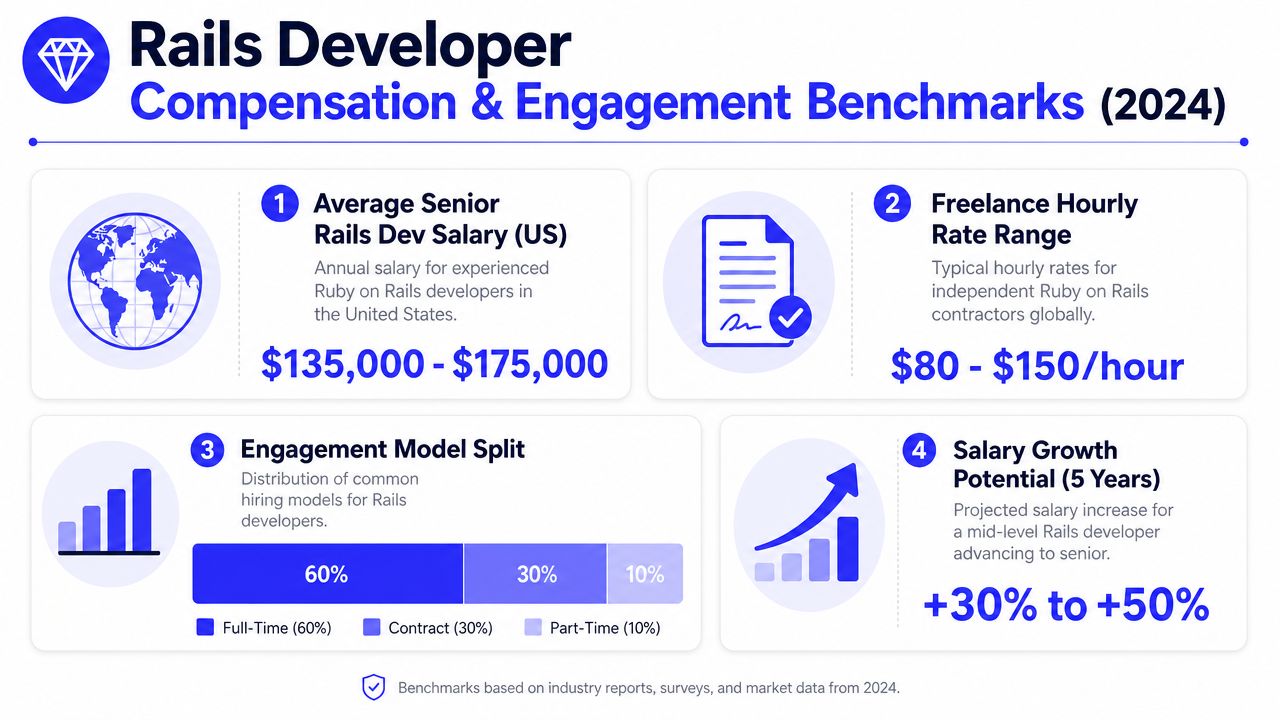
Use compensation as a scope signal
Those ranges are wide for a reason.
If you need someone to own architecture, performance, deployment, and mentoring, you're not shopping in the same market as a developer who can deliver isolated tickets with clear specs. Teams get into trouble when they define a staff-level problem and budget for a mid-level execution role.
A useful cross-check is to scan adjacent hiring markets too. If you also hire frontend talent, these guides to land remote React developer jobs can help compare how remote engineering demand is framed across stacks.
Contract versus full-time
This decision should follow the shape of the work.
| Factor | Contractor | Full-Time Employee |
|---|---|---|
| Speed to start | Usually faster | Usually slower |
| Best use case | Defined projects, upgrades, backlogs | Ongoing product ownership |
| Flexibility | High | Lower |
| Team continuity | Lower | Higher |
| Institutional knowledge | Can be limited | Builds over time |
| Management overhead | Can be lower for narrow scopes | Worth it for long-term ownership |
Contract vs. Full-Time Rails Developer Comparison
Choose a contractor when:
- You need to stabilize a codebase
- A Rails upgrade has a clear beginning and end
- You need specialist help before committing to a permanent role
Choose a full-time hire when:
- The app is core to the business
- Product and platform decisions keep evolving
- You want ownership to compound inside the team
Pay for the problem you need solved. Don't optimize only for hourly rate.
Onboarding Remote Hires for Fast Productivity
A signed offer doesn't create momentum. A structured first month does.
Remote Rails hires fail early for predictable reasons. Access is missing. Local setup is painful. Nobody explains the business rules behind the app. The engineer spends two weeks learning by interruption.
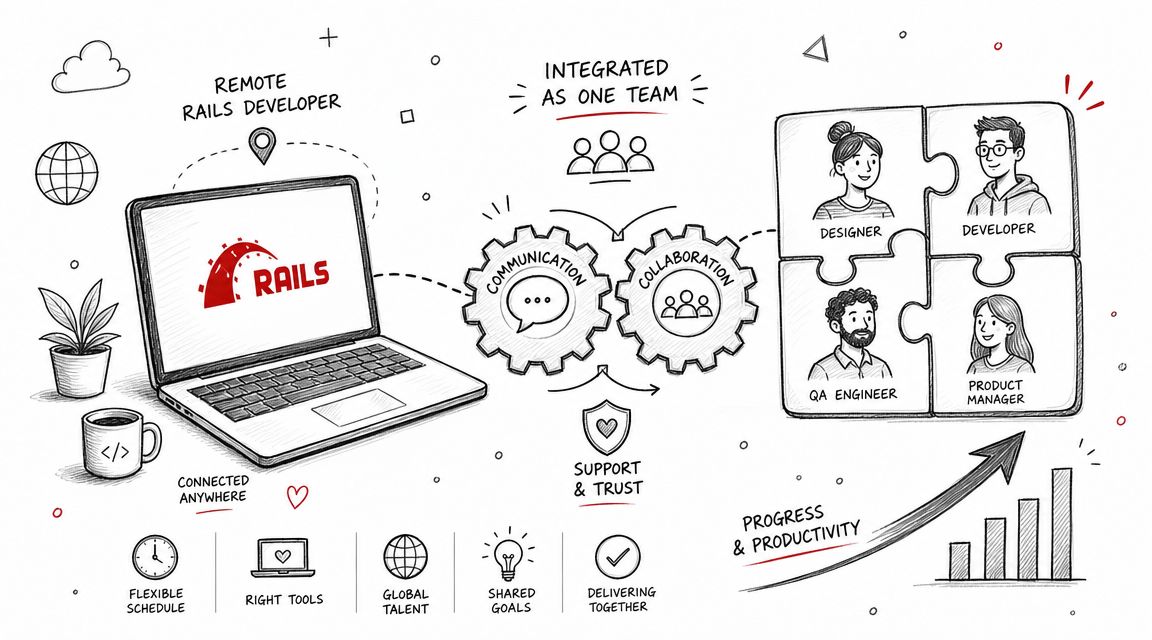
Get Day 1 right
Your new hire should have these before their first standup:
- Access: GitHub, Jira, Slack, staging, cloud dashboards, error tracking, password manager
- Local setup guide: Rails version, Ruby version manager, database steps, seed data, test commands
- Architecture map: Main app components, key domains, job system, deployment flow
- People map: Engineering manager, tech lead, product partner, on-call contact
If you run a distributed team, this practical guide to managing remote teams is a good reminder that operating rhythm matters as much as tooling.
Use a 30-60-90 plan
First 30 days
Keep the first win small and visible.
Ask the engineer to:
- Run the app locally
- Trace one key user flow from controller to database
- Fix a low-risk bug or ship a contained improvement
- Review recent pull requests to learn team standards
This phase is about reducing uncertainty. They need context before they need speed.
Days 31 to 60
Now expand scope.
Good targets:
- Own a medium-sized feature
- Improve one painful area in test coverage
- Join incident review or deployment review
- Document one part of the system they had to learn the hard way
A broader onboarding guide for SaaS businesses is useful here because the same patterns apply. Clear expectations, visible milestones, and fast feedback loops matter more than an overloaded wiki.
A short walkthrough can help the new hire see how experienced teams ramp remote engineers into production work:
Days 61 to 90
By this point, the engineer should start owning a system, not just tickets.
Examples:
- Billing subsystem
- Admin tooling
- Background job pipeline
- Authentication and authorization flows
Ask for one written proposal in this window. It can be a refactor, a reliability improvement, or a release process change. That tells you whether they've moved from implementation into judgment.
Common Hiring Pitfalls and Red Flags to Avoid
Most bad Rails hires don't fail because the person can't write Ruby. They fail because the company ignored warning signs in scope, process, or evaluation.
Here's the pre-mortem I use.
The five failure patterns
You hired for the wrong mission
A strong builder joins, but the actual job is legacy stabilization. They get frustrated. The team gets no relief. This starts with poor role definition.The candidate talks in abstractions
If someone can't explain a schema choice, a testing trade-off, or why a job failed in production, don't assume depth is hiding behind confidence.The interview loop tests trivia, not work
Rails hiring goes sideways when teams rely on puzzle questions and never inspect code quality, debugging habits, or deployment judgment.Nobody checks maintainability
A candidate may complete the exercise and still write code the team will hate maintaining. Review naming, test choices, structure, and how they communicate trade-offs.Your process looks chaotic from the outside
Delayed feedback, overlapping interviews, and unclear ownership push strong candidates away. Senior engineers read your hiring process as a preview of how engineering operates.
If a candidate can only describe what they built, but not why they built it that way, the risk is high.
One more red flag matters. Watch for engineers who describe every project as a solo act. Rails apps live for years. You want someone who can leave the codebase better and help other people work inside it.
If you need help hiring engineers who can handle real production complexity, ThirstySprout helps teams source and vet remote technical talent for long-term and contract needs. Start with a clear role definition, run a production-focused interview loop, and tighten onboarding so your next Rails hire ships useful work quickly.
Hire from the Top 1% Talent Network
Ready to accelerate your hiring or scale your company with our top-tier technical talent? Let's chat.