

You're probably in the middle of the same ugly quarter a lot of founders hit. Paid acquisition is getting pricier, activation hasn't moved, and the board still wants a clean growth story that doesn't sound like a channel report disguised as strategy.
A real growth marketing strategy doesn't start with more campaigns. It starts with a system that connects spend to revenue, retention, and expansion, then uses experiments to remove waste from the funnel. The point isn't to “do more marketing,” it's to find the exact points where your growth engine leaks and fix those first.
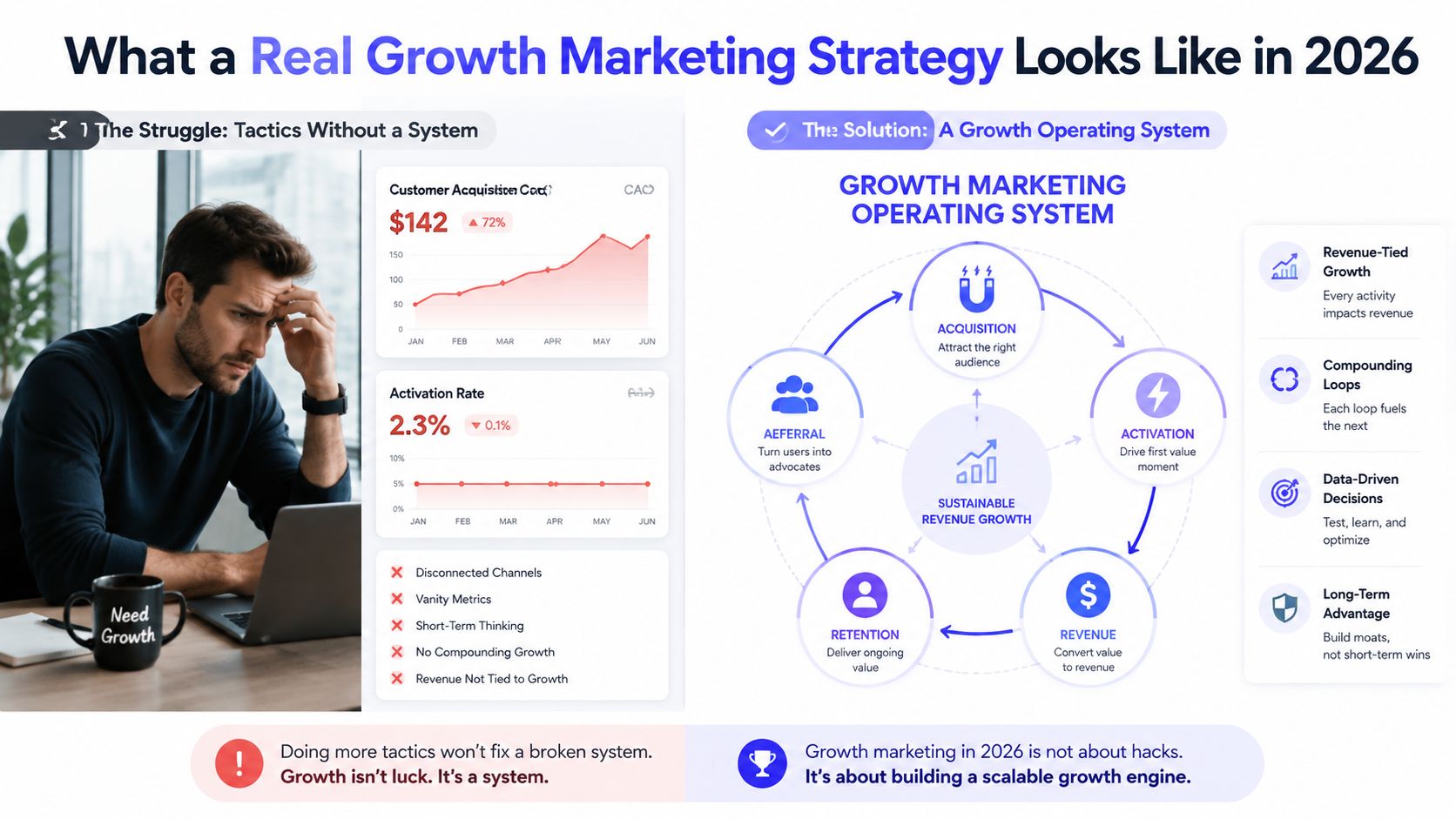
What a Real Growth Marketing Strategy Looks Like in 2026
A real growth marketing strategy starts with revenue, then works backward through the funnel to find where value is created or lost. It measures the full chain, from acquisition to activation, retention, expansion, and conversion, because a channel that drives traffic but fails to keep customers is just expensive noise. The operating model has to tie spend to CAC, LTV, monthly recurring revenue, retention, activation, and conversion rate so the team can see whether growth is compounding or stalling. One useful reference for that metric mix is Twilio growth marketing metrics.
The economics usually look different once you separate efficient demand from paid demand. In the benchmark set cited by Twilio, organic CAC is $942, paid acquisition CAC is $1,907, and retention is benchmarked at 84.5%. The same source points to 2.2% visitor-to-lead conversion, 21% upsell and cross-sell, and 20% to 35% annual recurring revenue growth year over year. Those numbers matter because they show the trade-off growth teams face. Paid volume can scale faster, but organic efficiency and post-sale expansion often decide whether the model holds up.
What separates strategy from marketing theater
A lot of teams still present growth as a stack of campaigns and channel outputs. That works until the board asks why traffic rose while revenue quality stayed flat. At that point, the gaps are usually obvious. The deck is full of reach, leads, and clicks, but thin on retention, expansion, and unit economics, which means the team is reporting activity instead of building a growth system. Companies that do this well manage the whole customer journey as one measurable loop, from first touch to repeat revenue.
Practical rule: if your strategy cannot explain how a dollar of spend turns into retained revenue, it is not a growth marketing strategy yet.
Product-market fit still sets the limit. Growth marketing can't rescue a weak product or vague value proposition, and a plan that ignores that reality burns time without changing the trajectory. The right question is more specific, where does your current system create value, where does it leak, and which gap is large enough to fix first?
Defining Goals and the KPI Stack That Actually Matters
The scoreboard comes before the experiment backlog. If you don't define a North Star Metric and the supporting KPIs around it, every test looks successful to someone and useless to someone else.
A good North Star Metric captures delivered customer value and correlates with revenue growth. Tenet's guide points to examples like weekly active users, transactions per month, and messages sent (Tenet growth marketing guide). That's the right shape of metric because it tracks real product usage, not just signups.
Build the KPI stack from the bottom up
Start with baseline numbers before you touch the funnel. If you don't know your current activation rate, retention curve, CAC by channel, and revenue expansion behavior, you'll have no way to tell whether a test helped or just shifted numbers around. The practical stack is simple:
- North Star Metric: the one output that best reflects customer value.
- Activation: the first proof that users reached meaningful value.
- Retention: whether that value repeats.
- LTV: the economic ceiling of the account.
- CAC: what you pay to acquire it.
- Expansion: how value grows after the first sale.
For an AI copilot company, the North Star Metric might be weekly active teams using the copilot in production workflows. A weak KPI setup would track free signups and page views, because those don't tell you if anyone adopted the product. For a fintech B2B startup, the better anchor could be transactions per account per month, because that's closer to durable usage and revenue than trial starts.
A founder can tolerate a messy channel mix for a while. They can't tolerate a messy KPI stack, because it makes every decision look like a debate instead of a diagnosis.
Braze gives a useful efficiency target, a CAC-to-CLV ratio of 1:3 (Braze growth marketing guide). I'd treat that as a directional target, not a magic threshold, but it's a strong reminder that acquisition only works when lifetime value has room to outrun spend. That's also why teams that obsess over signups usually end up with a prettier dashboard and worse economics.
Finding the Underserved Segments Most Guides Ignore
Most growth content stops at broad ICP definitions. That's too blunt for real work, because the strongest opportunities often sit inside smaller groups that are being ignored, overcharged, or forced into awkward workarounds.
The cleanest way to find them is to combine three inputs, behavioral data, qualitative research, and competitor gap analysis. One source frames the opportunity around underserved market angles and notes that the best openings often come from subgroups using workarounds or paying for unnecessary complexity, not from broad-market optimization (Luth Research underserved segments glossary). That's the lens worth using when the top of the market looks crowded.
How to spot the wedge before everyone else does
Start with behavioral signals. Look for accounts that use the product in unusual ways, hit limits early, or create their own workflows because the default path doesn't fit. Then layer in interviews, especially with users who adopted without being the primary target, because they often reveal why the mainstream segment isn't the whole opportunity.
Competitor gap analysis comes next. You're looking for jobs the market serves badly, not just features that are missing. If the dominant vendor sells a heavy enterprise package and mid-market teams keep building spreadsheets, scripts, or manual ops around it, that's a segment worth testing.
Mini-example from the field
An AI observability startup can spend months chasing the obvious enterprise queue and still miss the actual wedge. The better opening might be mid-market DevOps teams that need enough observability to prevent incidents, but not the overhead of a full enterprise rollout. In that case, the segment isn't defined by company size alone, it's defined by the mismatch between operational complexity and the cost of existing tools.
You can cross-check that wedge with demand signals like search trends, import and export shifts, and geographic concentration. Independent coverage has increasingly pointed growth teams toward market-intelligence-led discovery instead of pure campaign intuition (IndexBox market intelligence note). The practical payoff is simple, you stop arguing about whether the market is “big enough” and start asking whether a specific buyer cluster is badly served enough to move now.
Building the Experimentation Engine and Channel Mix
A growth engine is just a repeatable way to turn observations into tested moves. The loop is straightforward, ideation, hypothesis formation, ICE prioritization, A/B testing, statistical analysis, then rollout if the result holds up (Simon-Kucher growth marketing engine).
The mistake often made is jumping from insight to launch. That skips the part where you find out whether a problem is real, or just loud. The better habit is to collect customer information, design a simple test, run it in a controlled way, analyze engagement, and store the winning tactic so it can be reused later (Salesforce intro to growth marketing).
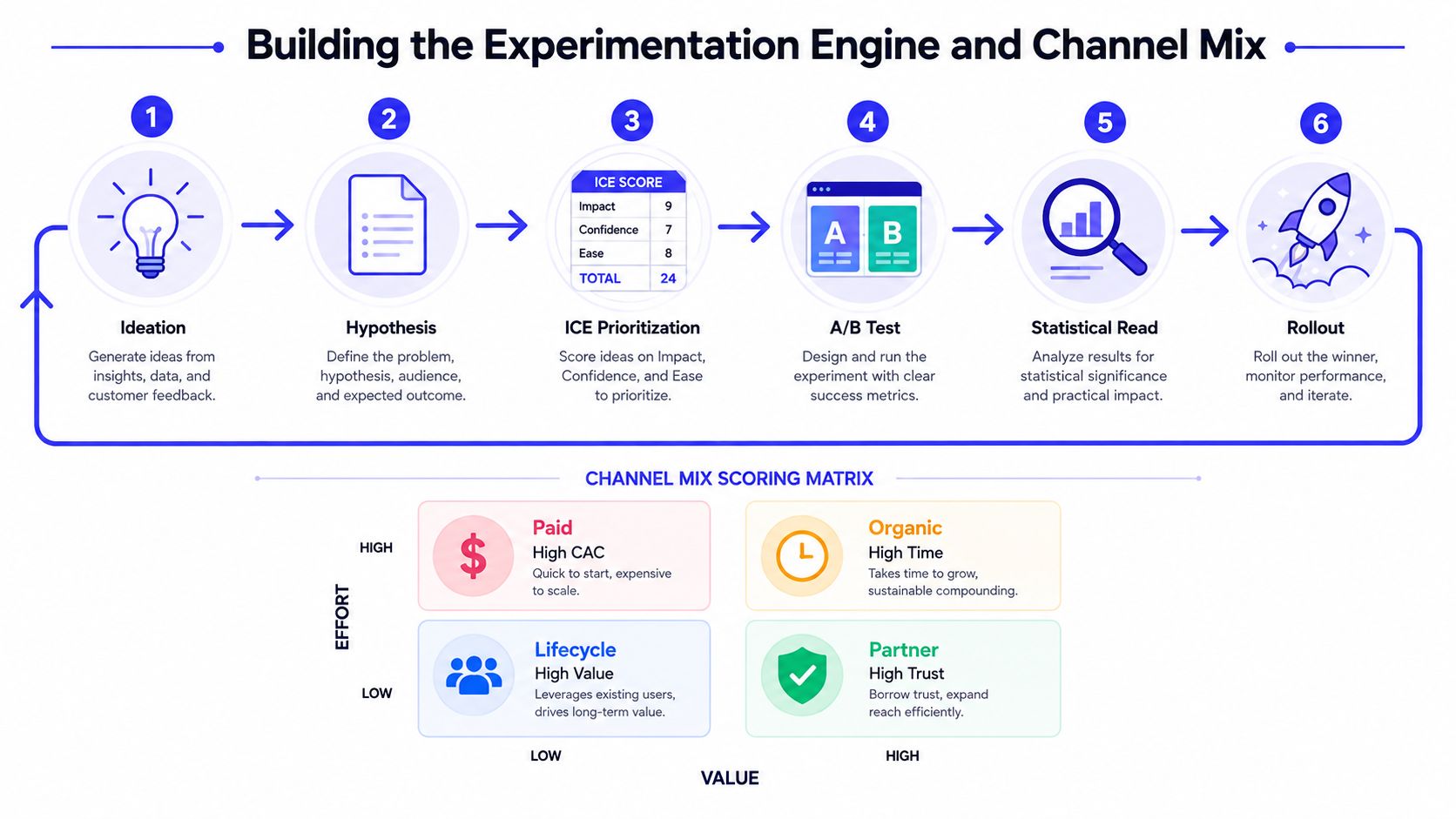
A channel mix that doesn't waste early budget
For an early-stage AI, SaaS, or fintech team, I'd usually score channels like this:
| Channel | Best use | Main trade-off |
|---|---|---|
| Paid | Fast signal and controlled testing | Higher CAC |
| Organic | Compounding demand capture | Slower time to value |
| Lifecycle | Activation, retention, expansion | Needs product data and clean events |
| Partner | Credibility and trust transfer | Slower negotiation and dependency risk |
A practical starting split often looks like 40% lifecycle, 25% paid, 20% content and SEO, 15% experiments. That mix forces you to fund retention and activation, not just demand creation. If you reverse it and shove most of the budget into paid, you'll usually buy more traffic into the same broken funnel.
How to prioritize tests
Use Impact, Confidence, and Ease to rank experiments. A high-confidence activation fix beats a flashy new channel, especially when the existing funnel is leaky. If a test doesn't have a clear baseline, a KPI target, and a stop rule, don't run it yet.
Rule of thumb: the best test is the one that can change a business decision, not just fill a dashboard.
I'd rather see one disciplined A/B test with clean attribution than five half-finished experiments that can't be read. Benchmarks suggest brands using growth marketing can grow up to 30% faster than traditional marketing, and another guide cites 5% to 15% additional growth plus 10% to 30% lower marketing costs when teams test systematically (BBK Group growth marketing strategies). The exact outcome depends on your market, but the direction is clear, disciplined testing beats opinion.
If you want a companion read on how that logic changes in B2B, the channel mechanics are similar but the sales motion is not. A useful starting point is this B2B digital marketing guide, especially if your funnel has multiple decision-makers and a longer evaluation cycle.
Lifecycle Funnels and the Mechanics of Activation and Retention
A growth strategy becomes real only after the first click. Paid traffic can open the door, but activation, habit formation, retention, and expansion decide whether an account turns into a compounding asset or another lead that never matures.
Braze's guidance on a 1:3 CAC-to-CLV ratio is useful because lifecycle improvements are what make that math hold up (Braze growth marketing guide). The same source also points to high-value actions, like inviting friends or saving a payment method, as behavioral signals that often correlate with greater long-term value. That is the kind of signal you want in your product analytics, because it shows which behaviors deserve more nudges.
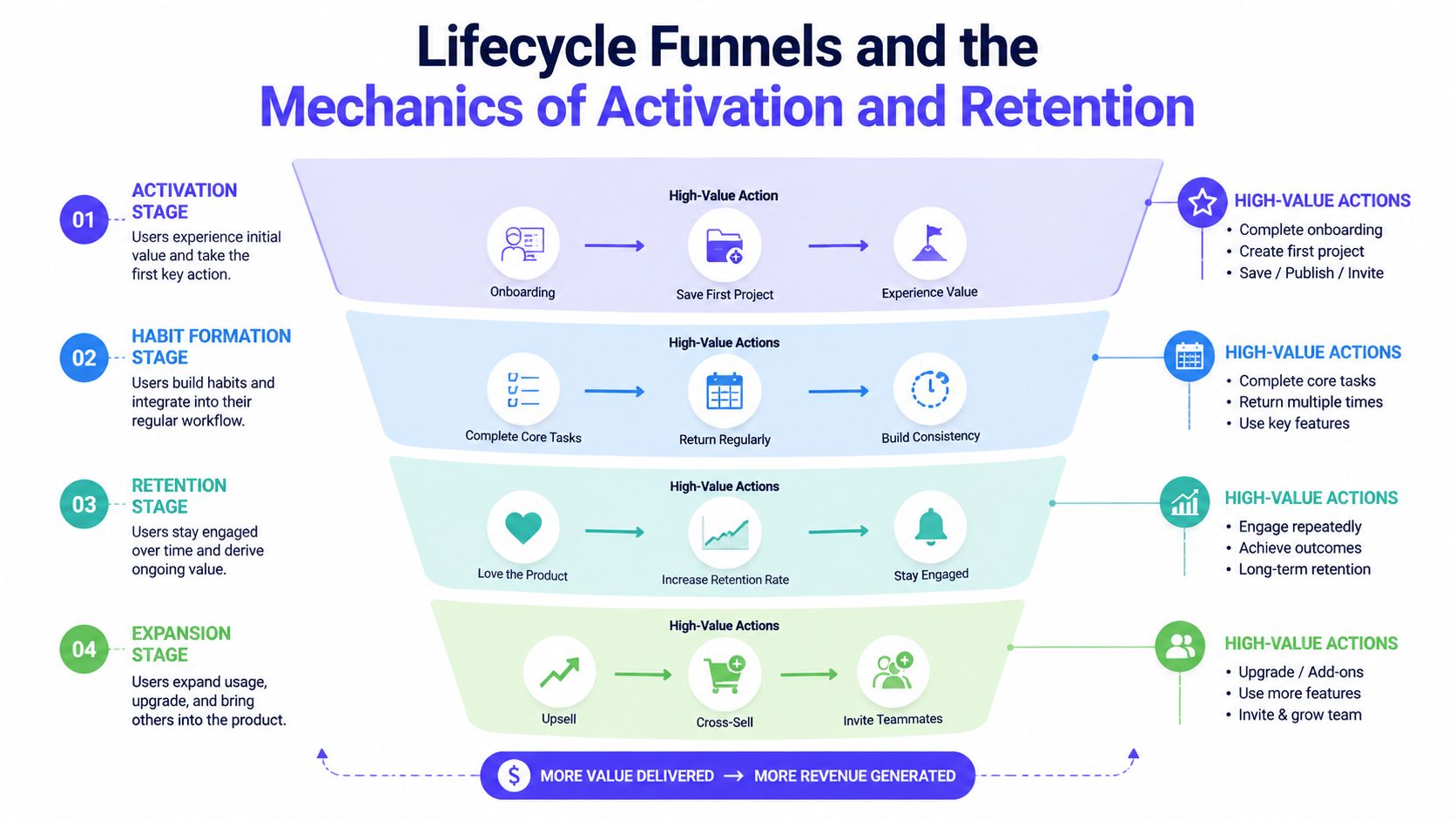
Two fixes that usually pay back quickly
A SaaS team that loses users in onboarding usually has too many setup steps, too many decisions, or too much cognitive load before first value. Removing the setup wizard can work because it gets users to the first useful action faster, and the product starts proving itself before attention fades. The point is not to make onboarding “simpler” in the abstract, it is to shorten the path to the first meaningful outcome.
A fintech team that wants more expansion revenue usually needs a better surface for the next best action. If usage-based upsell is buried, users only discover it after they have already formed a mental model of the plan. When the upgrade appears at the moment of clear value, expansion feels like a continuation of usage, not an interruption.
Read retention curves like an operator
Braze also recommends checking whether retention curves flatten out, or even better, smile, while a continual decline points to a leaky bucket that needs correction (Braze growth marketing guide). That is a much more useful read than staring at aggregate retention and hoping it looks healthy. If the curve falls and never stabilizes, the account is churning on delay rather than being retained.
The biggest trap is treating lifecycle as email volume. Good lifecycle work is behavioral and triggered by product usage, while bad lifecycle work reads like a broadcast calendar with prettier subject lines. Good teams watch for the moments that predict repeat value, then build the prompt, reminder, or offer around that action. Bad teams keep sending campaigns because the calendar says it is time to send something.
Analytics, Attribution, and the Privacy-Era Reality
If growth marketing is the engine, analytics is the dashboard and the fuel gauge. You don't need perfect measurement to move fast, but you do need enough signal to know whether a change helped or hurt.
The first instrumented events should map to the KPI stack you already chose, especially acquisition source, activation action, retention behavior, and expansion triggers. A practical event taxonomy for an AI product might look like this:
account_createdfor acquisition.workspace_activatedfor the first meaningful value.feature_usedfor repeat engagement.teammate_invitedfor referral and expansion intent.upgrade_initiatedfor revenue movement.
That's not glamorous, but it's what makes cohort analysis readable. For deeper analysis discipline, this data analysis techniques guide is the right complement if your team still argues about whether the dashboard is showing trend or noise.
Attribution in a world with weaker cookies
Cookies are less reliable than they used to be, so your model has to lean more on UTM hygiene, server-side tagging, and first-party data. Platform-reported attribution is still useful, but it's not enough on its own because each ad network has incentives to make itself look better. Marketing-mix modeling can help with broader directional reads, but it's slower and less tactical than a clean product and lifecycle event map.
The trade-off is straightforward. Platform attribution is easier to act on, while marketing-mix modeling is better for channel-level sanity checks. If you use both, you get a better answer than either one can provide alone.
Don't argue about attribution before the event names are right. Most dashboard fights are really schema problems in disguise.
A simple rule works well in practice, one source of truth for product events, one agreed set of campaign tags, and one definition of activation. Once those three are stable, the team can stop debating numbers and start diagnosing behavior.
Hiring the Growth Team and the 90/180/365-Day Roadmap
If you hire the wrong growth role first, you'll get activity before clarity. For most early teams, the better sequence is growth PM, lifecycle marketer, growth analyst, then demand-generation lead once the system can absorb traffic.
That order matters because early growth failures usually live inside the product and lifecycle, not at the top of the funnel. If nobody owns the event schema, the activation path, or the read on experiment results, a demand-gen hire just pours gas on a fire you haven't measured yet. The practical sequence is instrumentation first, experimentation second, scale third.
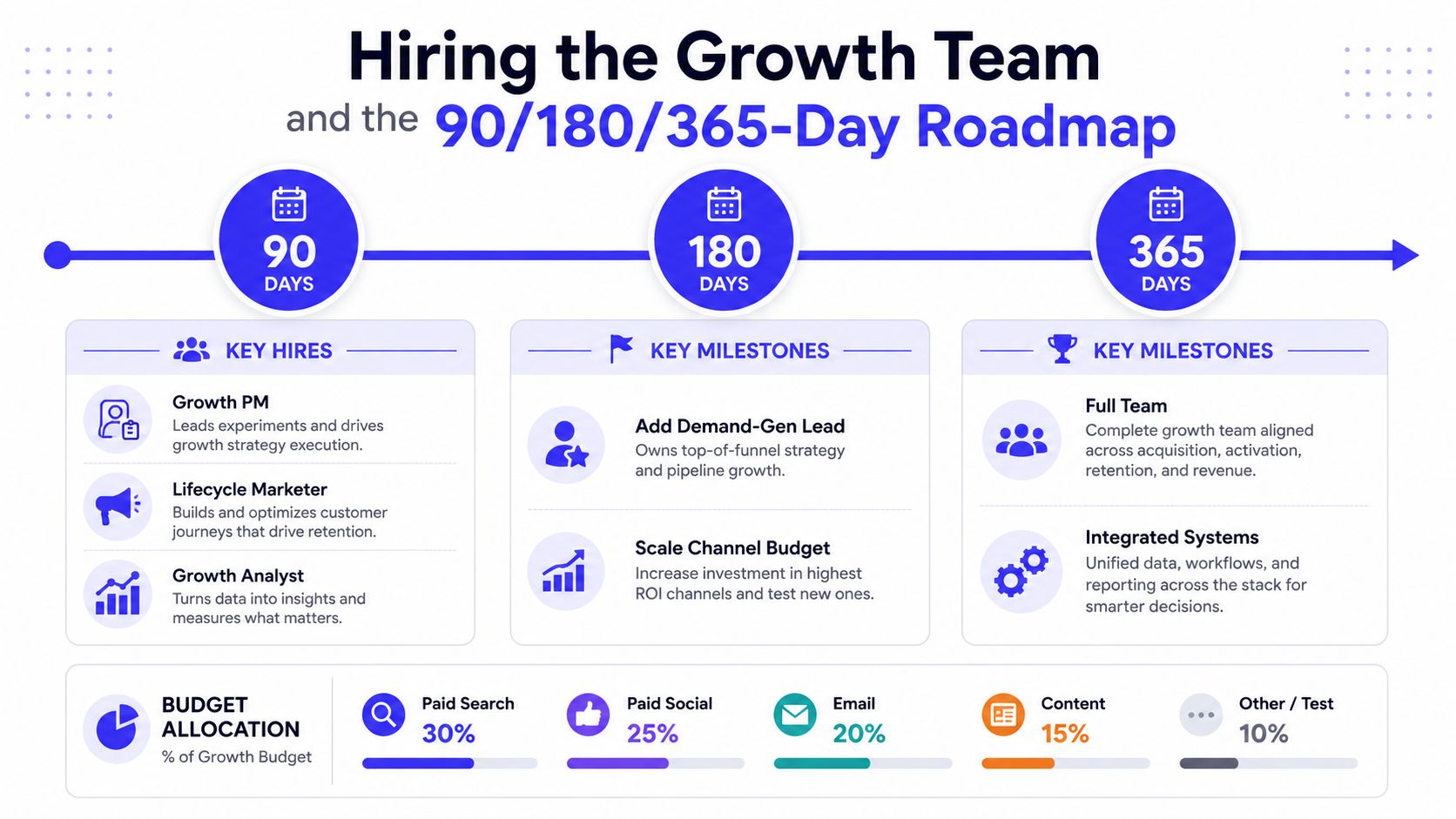
A roadmap you can lift into your planning doc
First 90 days
- Growth PM: own the KPI stack, activation map, and test backlog.
- Lifecycle marketer: build onboarding, nudges, and first retention flows.
- Growth analyst: clean up event tracking, cohorts, and attribution basics.
- Ship: one high-impact experiment tied to activation or retention.
By 180 days
- Add demand-gen lead: only after the lifecycle engine is functioning.
- Expand one new channel: use the first channel as proof, not assumption.
- Refine budget allocation: shift spend based on actual retention and CAC by channel.
By 365 days
- Full team cadence: regular experimentation, channel planning, and review cycles.
- Integrated systems: product analytics, CRM, lifecycle automation, and reporting should all speak the same language.
- Scale what works: don't add more ideas, add more repeatable throughput.
A useful internal reference for the team side of this is this cross-functional team building guide, because growth dies quickly when product, marketing, and data aren't aligned on the same operating rhythm.
The outside-help question is simple. Bring in help when you know the outcome you want, but don't yet have the specialist muscle to ship it quickly. That's usually the right time to avoid a long hiring detour and keep the quarter moving.
If your growth plan is still built around generic campaigns, it's time to reset the system. ThirstySprout helps founders and operators build the AI, data, and product teams that make growth work in practice, not just in slides. Visit ThirstySprout to start a pilot and map the team, metrics, and experiments that fit your next 90 days.
Hire from the Top 1% Talent Network
Ready to accelerate your hiring or scale your company with our top-tier technical talent? Let's chat.