

TL;DR: Quick Answers
- How to get hired: Specialize in a high-growth niche (like AI/ML or FinTech), build a portfolio that showcases remote-readiness (clear READMEs, CI/CD), and master asynchronous communication during interviews.
- What to expect: Salaries range from $115k for mid-level roles to over $200k for senior specialists. The interview process prioritizes take-home projects and system design questions to test autonomy.
- Best places to look: Focus on niche remote job boards like We Work Remotely and specialized talent networks like ThirstySprout that vet opportunities.
- Key action: Stop applying as a "generalist." Rebrand yourself as a specialist who solves a specific business problem (e.g., "Full-Stack Engineer for AI-powered SaaS platforms").
Who This Guide is For
- CTOs & Hiring Managers: Looking for a framework to find, vet, and hire effective remote full-stack developers who can deliver without constant supervision.
- Senior Full-Stack Engineers: Seeking to move beyond generic roles and land high-paying, high-impact remote jobs by showcasing specialized skills.
- Founders & Product Leads: Scoping the technical talent needed to build and scale features, especially in high-demand areas like AI integration or FinTech.
A 3-Step Framework for Landing a Top-Tier Remote Role
Landing a great full stack remote job in 2025 isn't just about what you know—it's about proving you can deliver business value from anywhere. The market has shifted. Companies are no longer looking for generalists; they need specialists who operate independently, communicate with clarity, and solve problems without needing constant oversight.
This framework cuts through the noise and focuses on what actually works.
- Specialize to Differentiate: Move beyond the generic "full stack" label. Specializing in high-demand areas like AI, FinTech, or HealthTech is how you command a higher salary and get noticed. It's about connecting your skills to a clear business outcome.
- Build a Remote-First Portfolio: Structure your projects to prove you can document your work, communicate your process, and deliver high-quality results autonomously. Your GitHub is your remote interview.
- Master the Remote Interview: From asynchronous chats to challenging take-home projects, the remote hiring process is unique. We’ll break down how to excel at each stage by demonstrating both technical skill and communication discipline.
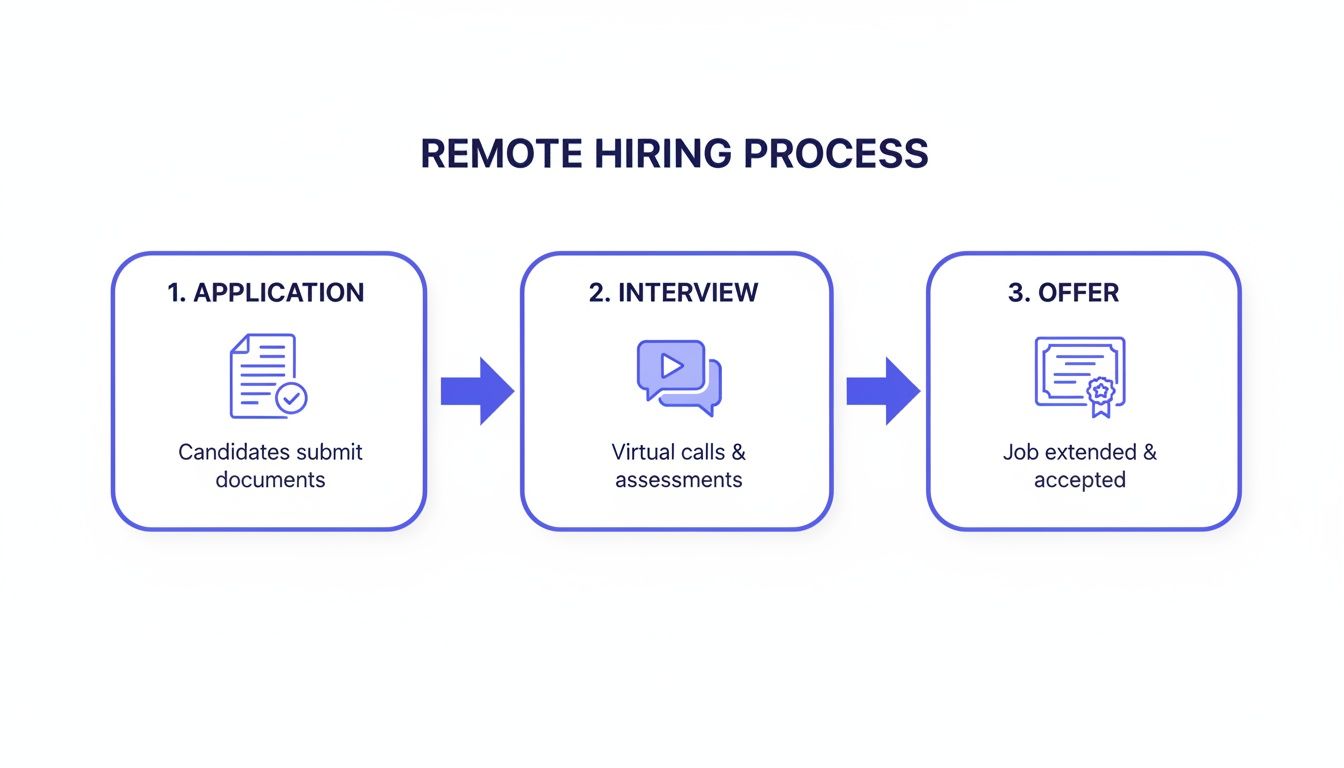
Think of this as a funnel. At each stage, you must demonstrate your value not just as a developer, but as a remote professional. The goal is to move through it efficiently by focusing on what recruiters and hiring managers truly care about.
The Remote Full Stack Hiring Funnel at a Glance
Practical Examples: Good vs. Bad Remote Candidate Signals
Your application and portfolio must actively signal that you're prepared for an autonomous, remote environment. Here are two real-world examples showing the difference.
Example 1: The Portfolio README
A hiring manager's first impression often comes from your project's README.md. It's a direct proxy for your documentation and communication skills.
Bad Example (Vague & Incomplete):
My Awesome Project
A cool full-stack app built with React and Node.
npm install && npm start
This signals low effort and creates work for the reviewer. They have no context on the project's purpose, architecture, or how to properly test it.
Good Example (Clear & Actionable):
Project: AI-Powered Customer Support Chatbot
This project is a full-stack application that uses a RAG (Retrieval-Augmented Generation) pipeline to answer user questions based on a knowledge base of documents.
Tech Stack:
- Frontend: React, TailwindCSS
- Backend: Node.js, Express
- AI: LangChain.js, Pinecone (Vector DB), OpenAI API
Getting Started
- Clone the repo:
git clone ...- Set up environment variables by copying
.env.exampleto.envand adding your API keys.- Install dependencies:
cd server && npm install, thencd client && npm install.- Run the app:
npm run devfrom the root directory.Architectural Decisions:
- We chose a RAG architecture over fine-tuning a model to reduce costs and allow for easy knowledge base updates without retraining.
- The backend uses a message queue for processing document uploads asynchronously to avoid blocking the API.
This version immediately proves you can document your work, explain technical trade-offs, and respect a colleague's time—all critical skills for full stack remote jobs.
Example 2: The Take-Home Project Submission
Your take-home assignment submission is a simulation of your work product. A working solution is table stakes; a professional submission wins the job.
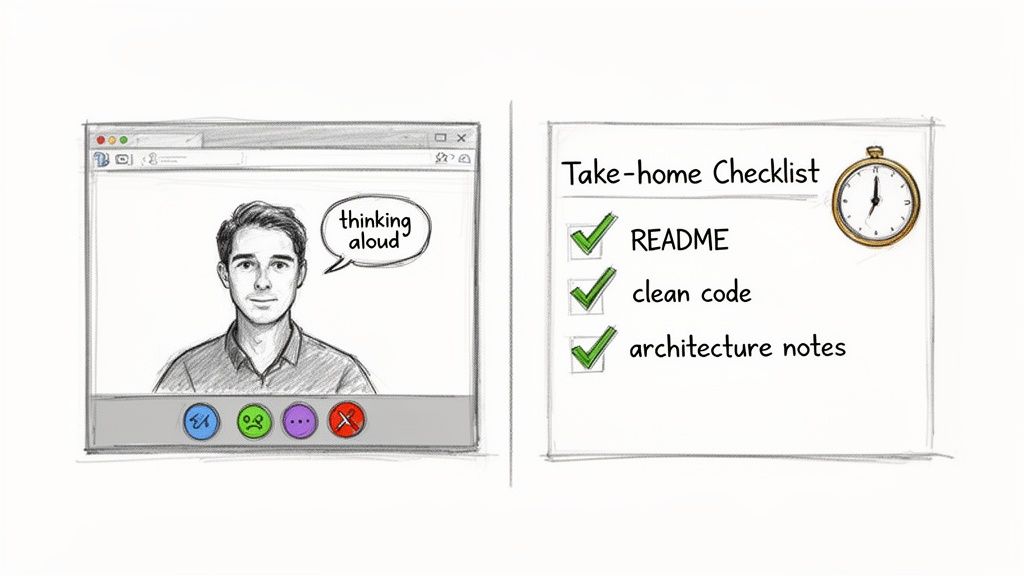
Bad Example (Code Dump):
A link to a GitHub repository with only the source code. It might work, but the reviewer has to guess how to run it, what assumptions were made, and why certain decisions were made.
Good Example (Mini-Product):
In addition to a clean, well-commented codebase, you provide:
- A Detailed
README.md: As shown above, explaining setup and architecture. - Unit and Integration Tests: Demonstrates a commitment to quality.
- A Short Loom Video (Optional but powerful): A 2-minute screen-share walking through the running application and briefly explaining a key architectural choice. This showcases your communication skills directly.
- Clear Git History: Commits are descriptive (e.g.,
feat: implement user authentication endpoint,fix: correct validation logic on form).
This approach shows you have a sense of ownership and can deliver a complete, easy-to-review package without hand-holding.
Deep Dive: Trade-offs, Pitfalls, and How to Stand Out
The market for remote talent is competitive. Understanding the common pitfalls and strategic trade-offs can give you a significant advantage.
The Generalist vs. Specialist Trade-Off
Choosing to specialize is a strategic decision. As a generalist, you might find a wider pool of jobs, but you'll also face a sea of competition and pressure on your salary expectations. A specialist sees fewer perfect-fit job postings but can command a significant premium within their chosen niche.
- The Generalist Path: Broad knowledge of different languages and frameworks (e.g., Python, Java, JavaScript). This makes you flexible but can signal to hiring managers that you haven't gone deep in any one area.
- The Specialist Path: Deep expertise in a specific tech ecosystem (like MERN with serverless deployments) or a high-growth industry (AI/ML, HealthTech). This focus turns you into a high-value asset for companies in that space.
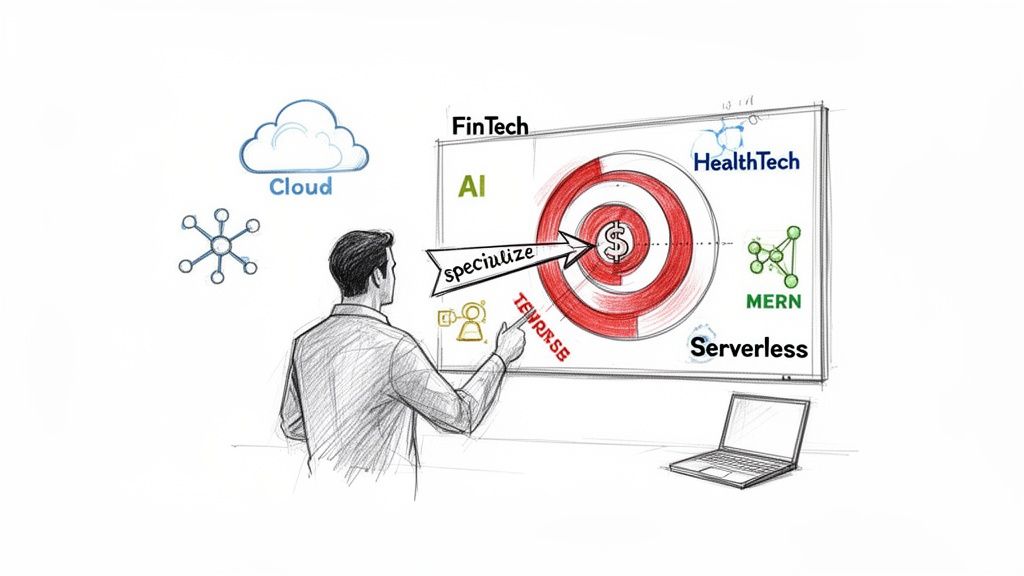
Identify High-Growth Niches
To boost your earning potential, align your skills with industries that are well-funded and facing urgent technical challenges.
When you specialize, you stop being a commodity. You’re no longer just "building features"—you're solving specific, high-value business problems. That's what the best remote companies pay top dollar for.
Prove You Build for Production with CI/CD
Want to really stand out? Show that you think about the entire development lifecycle. Integrating a Continuous Integration/Continuous Deployment (CI/CD) pipeline into your personal projects is a powerful signal. It proves you value automation, testing, and predictable releases—hallmarks of a senior developer.
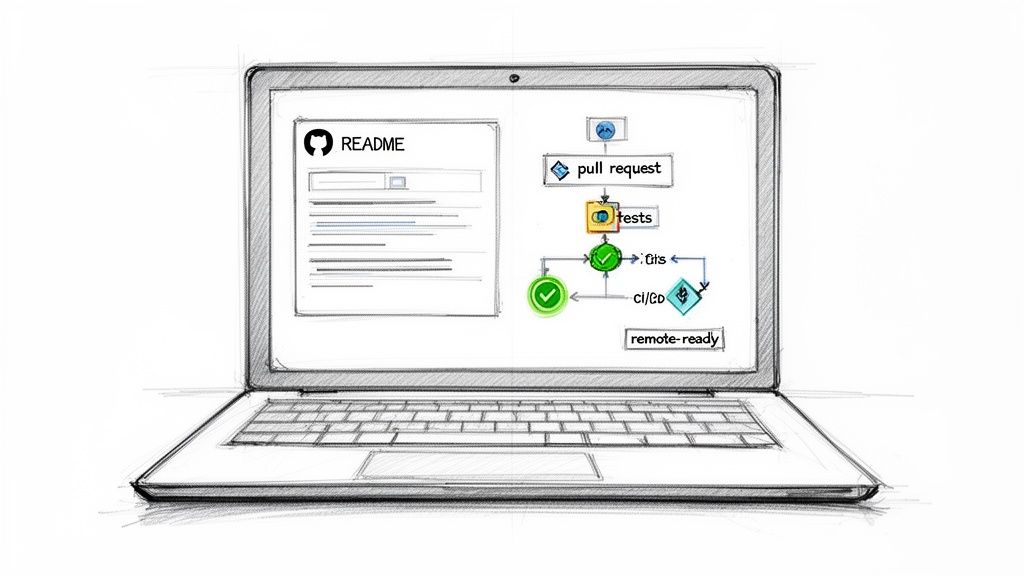
A simple GitHub Actions workflow that runs tests on every push is a massive green flag for recruiters. It's a skill many developers only learn on the job, giving you an incredible edge, especially when applying for remote software engineering internships or mid-level roles.
Checklist: Are You Ready for a Remote Full-Stack Role?
Use this checklist to self-audit your profile and preparation. If you can't check all these boxes, you have clear next steps to work on.
Profile & Portfolio
- Your LinkedIn/resume title is specialized (e.g., "Full-Stack Engineer - FinTech & Payments").
- Your portfolio includes at least one project with a detailed
README.mdfile. - Your GitHub projects have clean, descriptive commit messages.
- At least one project includes a CI/CD pipeline (e.g., GitHub Actions).
- Your portfolio is linked prominently on your resume and LinkedIn. Your resume is tailored for technical roles, as outlined in How to Write a Technical Resume That Lands Interviews.
Interview Preparation
- You have prepared a 2-minute verbal summary of your most complex project.
- You have practiced "thinking out loud" for a live coding problem.
- You can explain the trade-offs of a key architectural decision you made.
- You have a list of thoughtful questions to ask the interviewer about their team's workflow and challenges.
- You've reviewed common technical interview questions for engineers.
Job Search Strategy
- You are focusing your search on niche remote boards (We Work Remotely, RemoteOK) and talent networks (ThirstySprout, Arc.dev).
- You are researching company culture on remote work before applying.
- You have researched salary benchmarks for your niche and experience level using live data.
What to Do Next: Your 3-Step Action Plan
- Rebrand Your Profile: Spend one hour this week updating your LinkedIn and resume title from "Full-Stack Developer" to your chosen specialty. Rewrite your summary to focus on the business problems you solve.
- Upgrade Your Best Project: Pick your strongest portfolio project and spend two hours improving its
README.md. Add sections for architecture, setup, and trade-offs. Add a simple CI workflow file. - Start a Targeted Search: Instead of mass-applying, identify 3-5 companies from niche remote boards that align with your specialty. Tailor your application to each one, referencing their product and challenges. When a company needs to hire a remote developer, a targeted approach stands out.
Ready to find your next senior AI or full-stack role without the noise of traditional job boards? ThirstySprout connects you with pre-vetted remote opportunities at high-growth startups and enterprises.
Start a Pilot with top AI talent or See Sample Profiles.
References & Further Reading
- Salary Data: Check the latest full-stack engineer salary data and browse live roles on full-stack remote jobs boards.
- Interview Prep: Review these 10 actionable job interview preparation tips.
- Talent Communities: Explore professional networks like the Toptal community.
- ThirstySprout Resources: Learn more about our process at https://thirstysprout.com.
Hire from the Top 1% Talent Network
Ready to accelerate your hiring or scale your company with our top-tier technical talent? Let's chat.