

TL;DR
- Go global or fall behind: The local talent pool for AI engineers is critically shallow. A remote hiring strategy is a necessity to access niche experts and scale quickly.
- Source where developers live: Ditch generic job boards. Focus on high-signal channels like curated talent networks (e.g., ThirstySprout), niche communities (Kaggle, Hugging Face), and open-source contributions on GitHub.
- Vet for remote-specific skills: Technical ability isn't enough. Your interview process must test for asynchronous communication, problem-solving initiative, and autonomy, using a practical take-home assignment (3-4 hours max).
- Structure onboarding for Day 1 impact: A 90-day plan is non-negotiable. Focus on integration and a small first win in the first 30 days to build momentum and reduce time-to-value.
- De-risk with a pilot project: Start with a paid, two-week pilot to validate skills, communication, and team fit before committing to a long-term contract.
Who this is for
This guide is for technical leaders who need to act now:
- CTO / Head of Engineering: You need to hire senior AI/ML talent or build a new remote team without slowing down your roadmap.
- Founder / Product Lead: You're scoping new AI features and need to understand the talent, budget, and timeline required to deliver them.
- Talent Ops / Hiring Managers: You are tasked with building a scalable, efficient pipeline for sourcing and vetting world-class remote engineers.
A 5-Step Framework to Hire Remote Developers
Hiring remote developers successfully isn't luck; it's a system. This framework breaks down the process into five actionable steps, moving from sourcing to onboarding, designed to minimize risk and maximize quality.
- Build a Multi-Channel Sourcing Pipeline: Identify 2-3 high-signal channels where elite developers congregate. Track metrics like signal-to-noise ratio and time-to-hire for each channel to optimize your efforts.
- Implement a Remote-First Vetting Process: Screen for autonomy and communication as rigorously as you do for technical skills. Use a short, practical take-home assignment as your primary filter.
- Craft Competitive Global Offers: Benchmark compensation based on regional market rates, not just your local standards. Use an Employer of Record (EOR) for long-term hires to handle compliance and benefits.
- Execute a Structured 90-Day Onboarding Plan: Guide new hires from integration to full productivity with a clear 30-60-90 day plan. The goal of the first month is a small, confidence-building win.
- Launch a Two-Week Pilot Project: Before a full-time engagement, run a paid pilot. This is the ultimate test of a candidate's real-world skills and team collaboration, delivering business value from day one.
Practical Examples of Remote Hiring in Action
Example 1: Sourcing a Senior MLOps Engineer
A Series B fintech company needed two senior MLOps engineers to automate their model deployment pipeline. A generic LinkedIn post yielded hundreds of unqualified applications.
Their revised, actionable strategy:
- Targeted GitHub Search: They identified key contributors to open-source MLOps tools like MLflow and DVC, focusing on thoughtful issue comments and documentation improvements, not just code commits.
- Community Engagement: The engineering manager began actively participating in the MLOps.community Slack channel, answering questions and building credibility before ever posting a job.
- The Business Impact: They hired one top contributor to an MLflow plugin and another expert from the Slack community. Time-to-hire dropped from an estimated 3 months to just 6 weeks, directly accelerating their product roadmap.
Example 2: The High-Signal Take-Home Assignment
A health-tech startup needed a Senior AI Engineer to build out their API services. Their take-home assignment was designed to mimic a real first-week task.
- Objective: Build a simple REST API using FastAPI that takes an image URL and returns a classification using a pre-trained model from Hugging Face.
- Package the application using Docker.
- Include a
README.mdwith clear setup instructions. - Write basic unit tests for the API endpoint.
- The Business Impact: This 3-hour task provided massive signal. It immediately filtered for candidates who understood production-ready practices (containerization, testing) and could communicate their work asynchronously (clear documentation). This reduced the time spent on unqualified interviews by over 50%.
- Curated Talent Networks: Platforms like ThirstySprout pre-vet engineers for technical and soft skills, providing the fastest path to hiring a senior role.
- Niche Communities: For AI/ML engineers, this means platforms like Kaggle, Hugging Face, or specific subreddits and Discord servers.
- Open-Source Contributions: GitHub is a living portfolio. Searching for active contributors to libraries critical to your stack is a powerful way to find proven experts. For a broader look at the process, this guide on How to Hire Remote Developers is a great resource.
- Asynchronous Clarity: Can they explain complex technical ideas clearly in writing?
- Problem-Solving Initiative: Do they wait for instructions, or do they proactively explore solutions when blocked?
- Autonomy and Ownership: Do they have a history of taking a project from idea to shipped feature with minimal hand-holding?
- System Design Interview: A live, collaborative whiteboarding session (Miro/FigJam) to assess thought processes and trade-off decisions.
- Behavioral Interview: Go deep on remote-specific competencies. "Tell me about a time you resolved a production outage with a team in different time zones."
- Cross-Functional Meet & Greet: A chat with a product manager or designer to test communication with non-technical stakeholders.
- Direct Contractor: Faster and lower overhead. You sign an agreement directly with the developer. Best for short-term projects but carries higher compliance risk.
- Employer of Record (EOR): Services like Deel or Remote act as the legal employer in the developer's country, handling payroll, taxes, and benefits. This is the gold standard for building a long-term, distributed team and significantly reduces your risk.
- Days 1-30: Integration and the First Win. The focus is on removing friction. Assign an onboarding buddy and a well-defined, low-risk starter project. The goal is a small, tangible win to build confidence.
- Days 31-60: Expanding Ownership. The developer should now be a regular participant in code reviews and tackling medium-sized features with less supervision.
- Days 61-90: Full Integration. The new hire should be a fully productive team member, proactively identifying improvements and taking ownership of features. A 90-day review formalizes progress and sets goals for the next quarter.
- Define the single business problem the role will solve in the first 90 days.
- Identify 2-3 primary sourcing channels (e.g., GitHub, niche communities, talent networks).
- Create a scorecard to track channel effectiveness (Signal-to-Noise, Time-to-Hire).
- Implement a 30-minute initial technical screen to verify baseline skills.
- Design a 3-4 hour practical take-home assignment that mirrors a real-world task.
- Create an objective scorecard for grading the take-home assignment.
- Structure the interview loop with distinct stages: System Design, Behavioral, and Cross-Functional.
- Prepare remote-specific behavioral questions focused on autonomy and communication.
- Benchmark salary against regional top-of-market rates.
- Decide between a Direct Contractor or EOR model based on risk and long-term plans.
- Use an ironclad contract with clear clauses for IP, Confidentiality, and Termination.
- Prepare a 30-60-90 day onboarding plan with a designated onboarding buddy.
- Propose a two-week paid pilot project to de-risk the hire.
- Define your first remote role. Zero in on the single most important business problem this person will solve in their first 90 days.
- Build your vetting toolkit. Create a concise take-home assignment (3-4 hours max) that mirrors a real-world task, like containerizing a small model with Docker.
- Launch a two-week pilot project. This is the best way to de-risk a hire. It gives both you and the developer a chance to confirm the fit while working on code that delivers actual value.
- Start a Pilot
- See Sample Profiles
- Time Zones: Embrace asynchronous communication. A 2 to 4-hour overlap is the sweet spot for critical meetings. The rest should be documented clearly in tools like Notion or Confluence, with tasks tracked in Jira.
- Data Security: Use company-issued hardware with endpoint management, enforce least-privilege access, and have ironclad contracts with NDA and IP assignment clauses.
- Team Culture: Be intentional. Create non-work Slack channels for casual connection, schedule virtual social time, and give public praise for great work.
- Contractor vs. EOR: A direct contractor is fast and flexible for short-term projects. An Employer of Record (EOR) like Deel or Remote is the safer, more sustainable path for building a long-term, scalable team.
The Deep Dive: Trade-Offs, Pitfalls, and Best Practices
Building Your Global Sourcing Pipeline
If you post a job on LinkedIn and wait, you've already lost. To land a great remote developer, you must proactively build a multi-channel sourcing pipeline that seeks out experts where they actually work online.
The core challenge every tech leader is grappling with is clear: we have a growing demand for specialized skills, a shrinking pool of senior talent, and a massive talent gap that can only be solved by thinking globally.
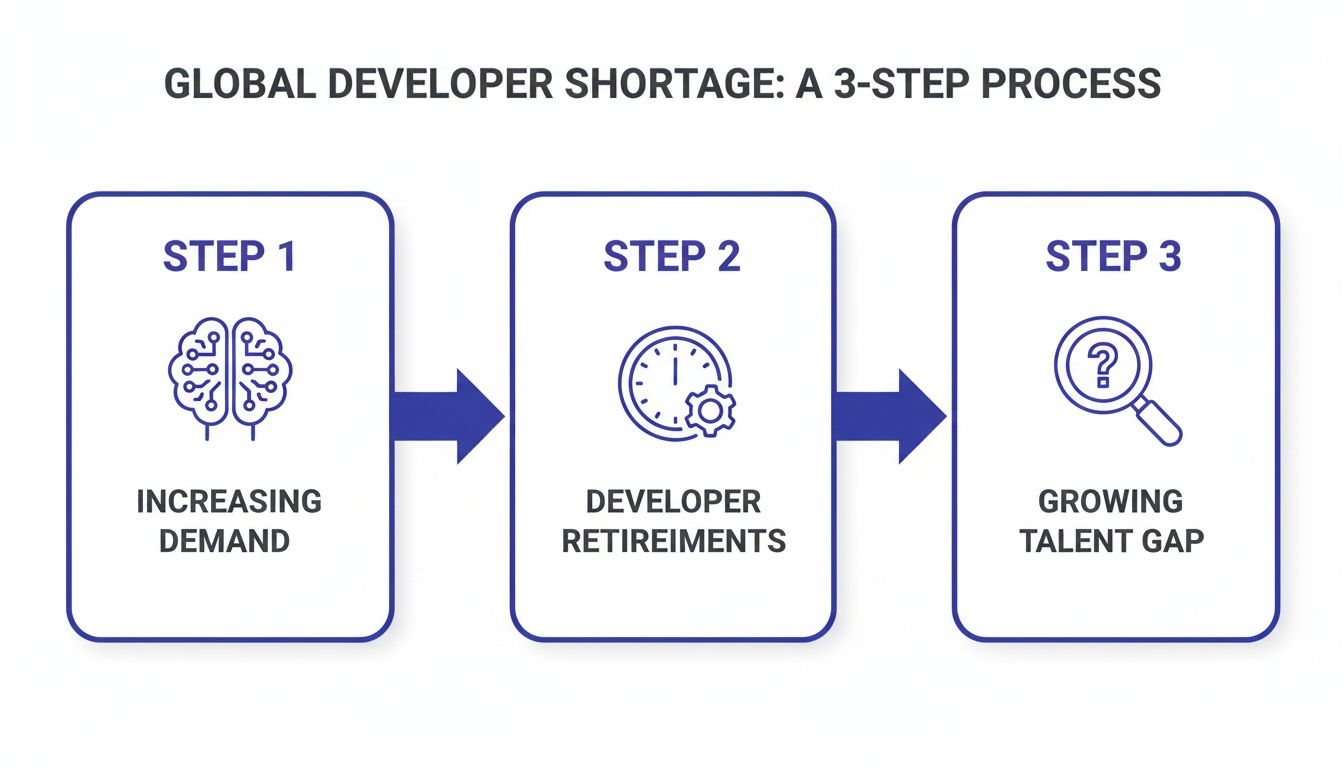
alt text: A 3-step process diagram explaining the global developer shortage, showing increasing demand, developer retirements, and a growing talent gap.
Relying on old-school, local hiring methods isn't a viable option for any company with serious ambition. This isn't about finding cheaper talent; it's about finding the best talent. Research from Fullscale.io predicts companies who delay a remote hiring strategy could see salary costs jump by 42%.
High-Signal Sourcing Channels:
Our guide on AI-powered recruiting and sourcing lays out a more comprehensive framework.
How to Vet and Interview Remote Candidates
When you hire someone remotely, you’re trusting them to be a self-sufficient problem-solver. Your vetting process must rigorously test for asynchronous communication, personal initiative, and autonomy. A bad hire kills team momentum and wastes budget. A well-structured process signals to the best talent that you run a professional engineering culture.
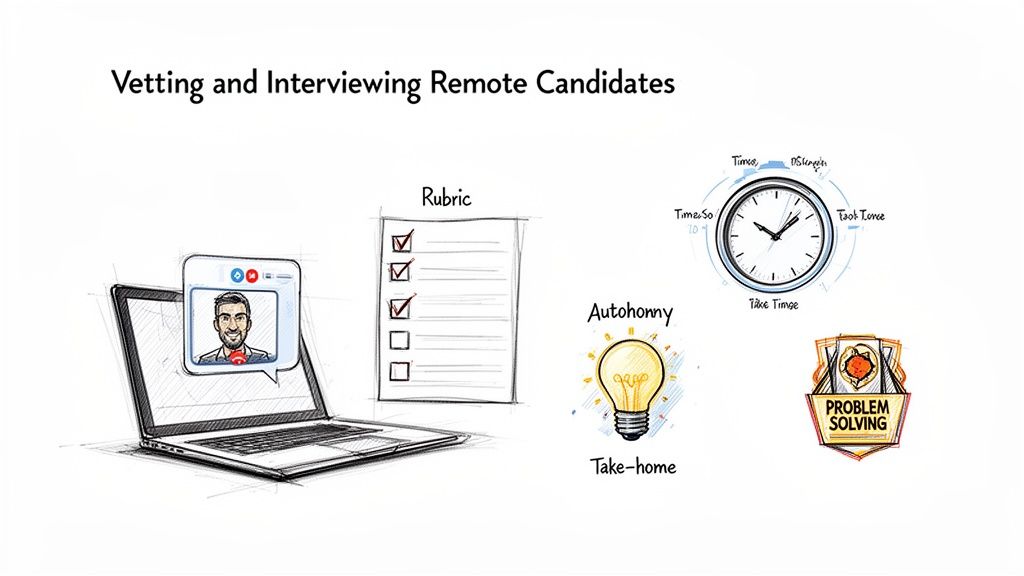
alt text: An illustration detailing the vetting and interviewing process for remote candidates with various evaluation methods.
Go Beyond Standard Technical Screens
Your goal is to identify skills that are make-or-break for remote success:
These are not nice-to-haves; they are non-negotiable. Our guide on behavioral interview questions for software engineers has prompts for uncovering these traits.
Structuring the Interview Loop
Crafting Competitive Global Offers and Contracts
Making a global offer requires a data-driven strategy that balances regional cost of living with the market rate for elite skills. The goal isn’t to find the cheapest developer; it's to find the best value by paying a top-of-market salary for their region.
According to global salary trends on arc.dev, hiring a vetted senior AI engineer from Latin America could mean saving 25-30% compared to a US-based hire, without sacrificing quality.
Direct Contractor vs. Employer of Record (EOR) - The Trade-Offs
The First 90 Days: A Remote Onboarding Plan That Works
A fumbled onboarding is the fastest way to lose a brilliant new hire. A structured 90-day plan shrinks a developer's time-to-value from months to weeks. Data from remote work trends from Robert Half shows companies that build a world-class remote onboarding machine have a significant competitive advantage.
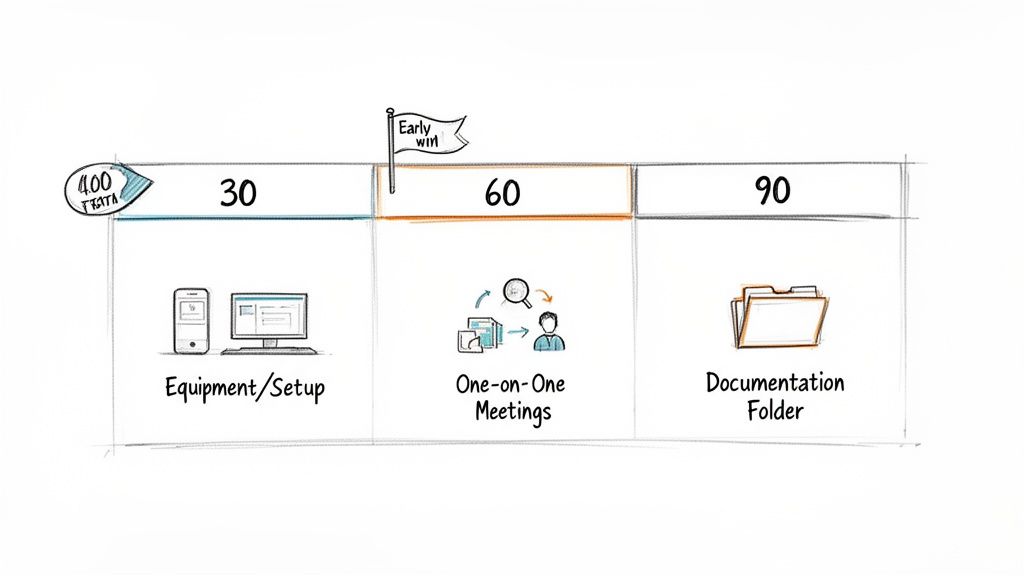
alt text: Timeline outlining 30, 60, and 90-day onboarding process with equipment, meetings, and documentation.
Checklist: Your Remote Hiring Toolkit
Use this checklist to ensure your process is repeatable, fair, and effective.
Phase 1: Sourcing & Screening
Phase 2: Vetting & Interviews
Phase 3: Offer & Onboarding
What to do next
You have the playbook. Now it's time for execution.
Ready to find your next senior AI engineer?
References & Further Reading
Ready to apply this playbook and hire elite, vetted remote AI developers? ThirstySprout can connect you with senior talent ready to start a pilot project in as little as two weeks.
Hire from the Top 1% Talent Network
Ready to accelerate your hiring or scale your company with our top-tier technical talent? Let's chat.