

You've built a promising product, hired engineers, and still find yourself making every architecture decision. The team ships features, but technical debt grows faster than confidence. An artificial intelligence startup adds model providers, vector search, evaluation pipelines, and sensitive data to a stack that already needs stronger security. A funding round or technical due diligence is approaching, and a full-time chief technology officer feels premature.
That's the problem a fractional CTO for startups can solve, but only when you hire the role for operational ownership rather than occasional advice. The right leader gives you senior technical judgment, delivery discipline, hiring support, and a credible path to security and scale without forcing an expensive executive commitment before the business needs one.
Defining the Fractional CTO Role
A fractional chief technology officer is a senior technical executive who works part-time but owns defined technology outcomes. The role commonly combines technical strategy, architecture review, engineering hiring, vendor selection, security foundations, and translation between product goals and engineering work. The engagement is typically part-time, often 5 to 15 hours per week across 2 to 4 companies, according to this practical overview of fractional CTO responsibilities.
That definition matters because “part-time” describes availability, not accountability. A fractional CTO should set the technical direction, make trade-offs, review important designs, establish an engineering cadence, and supervise execution. They shouldn't merely attend a monthly founder call and email recommendations afterward.
For a useful overview of how fractional hiring works across executive and specialist roles, see what fractional hiring means for growing companies.
Fractional CTO versus advisor
An advisor offers perspective. A fractional CTO participates in recurring decisions and carries context from one week to the next. An advisor might review your architecture and suggest improvements. A fractional CTO should decide which risks matter now, assign owners, set review dates, and return to confirm that the work shipped.
A full-time CTO, by contrast, provides continuous leadership. They can manage the entire engineering organization, handle urgent escalations, represent technology every day, and take responsibility for a broader operating system. You need that level of presence when technical decisions, people management, incidents, and organizational design consume the company's daily attention.
Practical rule: If the person can't influence the roadmap, hiring bar, architecture decisions, and delivery process, you're buying consulting hours, not fractional CTO leadership.
For another perspective on how ongoing leadership differs from project-based consulting, MR2 Solutions' fractional CTO guide offers useful context. The title matters less than the operating agreement. Define what the executive owns, what they advise on, and what remains with the founder.
The best fit is usually a startup that has outgrown founder-led engineering but isn't ready for a permanent executive hire. The company has enough product complexity to require experienced judgment, yet the founder still needs a focused leadership layer rather than a full-time department head.
When to Hire Fractional vs Full-Time Leadership
Hire a fractional CTO when your company has important technical decisions but not enough continuous executive work to justify a permanent CTO. That often includes a stalled minimum viable product, a fragmented architecture, a difficult engineering hire, technical due diligence, or an artificial intelligence initiative without a clear owner.
Use this diagnostic first:
- Decision backlog: Are architecture, vendor, hiring, or security decisions repeatedly postponed?
- Founder bottleneck: Does engineering wait for the founder to resolve questions the team can't answer?
- Delivery mismatch: Does the team have coding capacity but lack clear priorities, ownership, or technical guardrails?
- Enterprise pressure: Are prospective customers asking for security controls, reliability evidence, or compliance preparation?
- AI complexity: Does the product require model evaluation, retrieval architecture, data governance, or machine learning operations expertise?
If several answers are yes, fractional leadership can bridge the gap. The role is especially valuable when a startup needs senior judgment quickly while the founder builds the case for a permanent hire.
Technical leadership options compared
| Leadership Model | Best For | Cost Profile | Strategic Control |
|---|---|---|---|
| Fractional CTO | Startups needing recurring technical ownership without full-time coverage | Monthly or hourly engagement, tied to scope and availability | High, if decision rights are explicit |
| Full-time CTO | Companies needing daily executive presence, organizational leadership, and continuous accountability | Full executive compensation plus possible equity | Highest, with continuous ownership |
| Agency or dev shop | Defined implementation work with an established technical direction | Project or delivery fee | Lower, because the startup retains strategic decisions |
| Technical advisor | Periodic review, introductions, and high-level perspective | Usually limited advisory commitment | Moderate to low |
A dev shop can build what you specify. It won't necessarily decide whether your event model, data boundaries, or model-serving approach fits the business. A fractional CTO can make those calls, but your internal team or delivery partner still has to implement them.
A useful distinction appears in this comparison of contracting and consulting. Contracting tends to emphasize execution against an agreed need. Consulting emphasizes specialized advice. Fractional leadership sits closer to an embedded operating role, with recurring responsibility and business context.
Consider full-time hiring when the CTO must manage the engineering organization every day, own incident response, recruit continuously, or represent technology across a complex leadership team. Consider an agency when the architecture is already sound and the main problem is implementation capacity. Don't hire a fractional CTO to avoid making a decision about the operating model. Hire one to make the decisions that your current team can't own yet.
For startups adding artificial intelligence leadership specifically, this guide to fractional chief AI officer support can help separate model strategy from broader technology leadership.
Pricing Models and Market Rates
Fractional CTO pricing depends on hours, scope, seniority, and decision authority. Current market guides commonly place rates around $200 to $500 per hour, with monthly retainers often ranging from $5,000 to $25,000, according to this fractional CTO pricing benchmark.
The lower end can support architecture reviews, hiring interviews, and targeted advisory work. It usually won't provide enough presence to own a roadmap, supervise delivery, coordinate vendors, and prepare the company for enterprise scrutiny. If you need execution control, budget for consistent weekly involvement rather than the cheapest available rate.
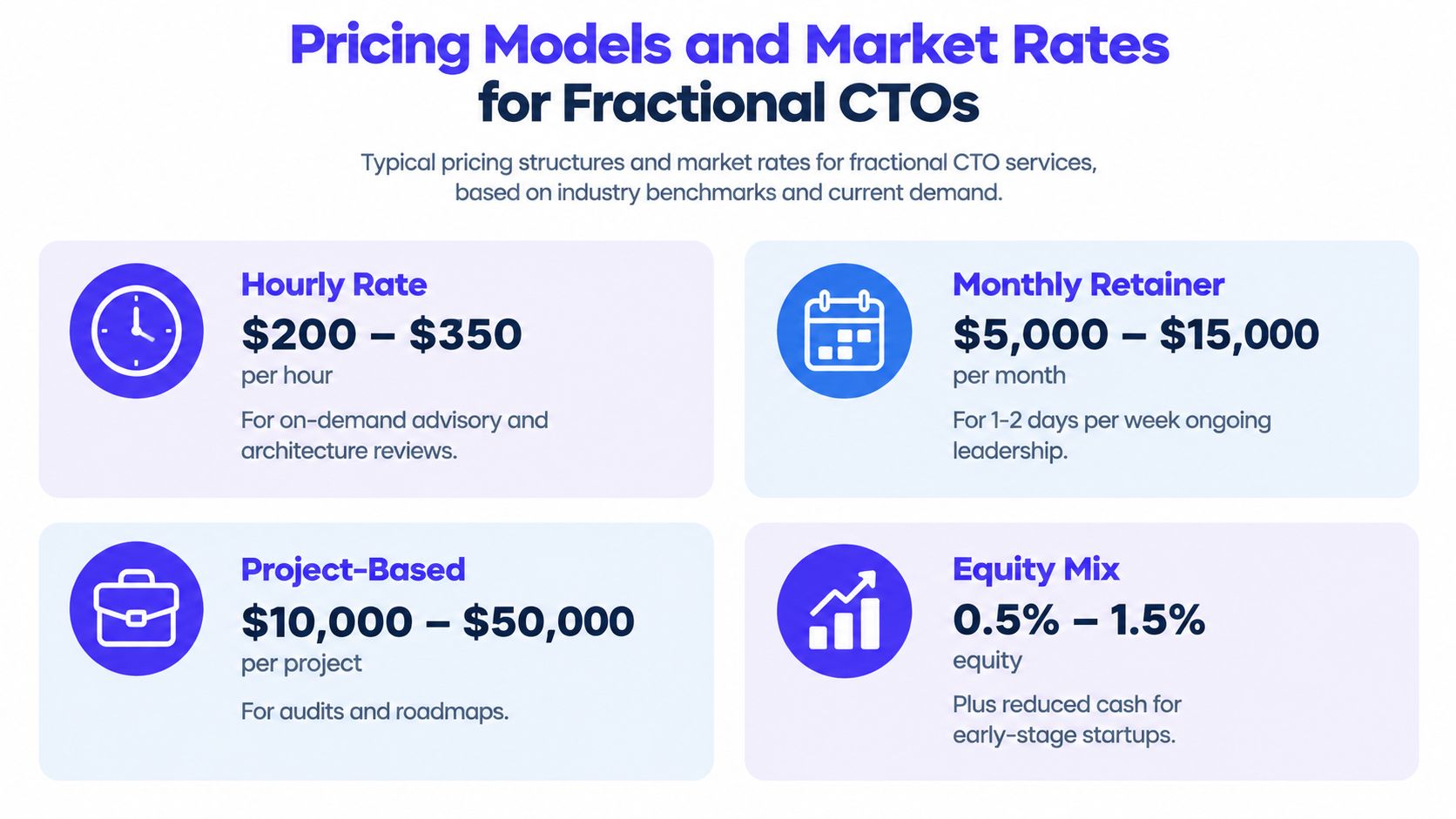
The engagement level changes materially by stage. Benchmarks commonly cluster around $10,000 to $18,000 per month at Seed and $15,000 to $25,000 per month at Series A, with a typical commitment of 15 to 25 hours per week for startups that need an embedded leadership layer. These figures and the associated scope are described in this startup fractional CTO market guide.
What each pricing model buys
- Hourly work: Best for a defined architecture review, security assessment, or hiring process. Put a cap on hours and require a written output.
- Monthly retainer: Best for recurring roadmap decisions, engineering cadence, hiring, and technical governance. Define meeting rhythm, response expectations, and deliverables.
- Project engagement: Best for a technical due diligence package, platform assessment, or roadmap. It ends when the defined artifact and recommendations are complete.
- Cash and equity mix: Use caution. Equity can align incentives, but it shouldn't replace clear milestones, availability expectations, or decision rights.
A benchmark from this startup CTO cost analysis estimates that fractional leadership may cost roughly 20% to 40% of a full-time CTO hire, while a full-time CTO may cost about $250,000 to $400,000 per year plus equity. Treat that comparison as a budgeting reference, not a promise that fractional work provides full-time coverage.
A startup should pay for the presence it needs. Don't pay a premium retainer for an executive who only provides slides, and don't expect a light advisory budget to control daily delivery. If you're also evaluating flexible engineering capacity, this guide to IT staff augmentation explains how execution support differs from executive technical ownership.
Core Responsibilities for AI and SaaS Startups
An AI SaaS startup can reach enterprise pilots with a prototype that hides serious liabilities. The fractional CTO must connect product priorities to architecture, data handling, reliability, security compliance, and the team needed to operate the system.
The work should follow a clear sequence:
Set the production boundary. Define the first supported use case, model providers, data flows, fallback behavior, and evaluation method. Agree on acceptable system behavior before the team spends time optimizing infrastructure.
Control model and data dependencies. Record prompts, retrieval sources, embedding behavior, model versions, access controls, and retention rules. A vector database is only one component. The CTO must justify its place in the architecture and define how the team will run it, monitor it, and replace it if requirements change.
Create an operations path. Establish deployment reviews, monitoring, logging, secrets management, incident response, and a repeatable process for model and prompt changes. AI systems need release controls that account for output quality as well as application errors.
Turn technical debt into decisions. Separate debt that threatens security, reliability, or delivery from work that can wait. Assign an owner, define the risk, and place the remediation beside product commitments. Unowned debt becomes an outage, a security finding, or a rushed rewrite during a sales cycle.
Build the team around the system. Decide whether the startup needs an AI engineer, machine learning operations specialist, data engineer, or platform engineer. Set an interview bar that tests production judgment, debugging, and trade-off decisions rather than familiarity with a particular tool. Talent Pronto's CTO advice on AI hiring adds practical hiring context for this work.
Security and compliance are operating work
For AI and SaaS startups, security belongs in the delivery system. The CTO should review architecture, run threat modeling, define logging and monitoring, manage secrets, prepare incident response runbooks, and organize audit readiness for Service Organization Control 2, ISO 27001, and the General Data Protection Regulation.
A published startup operating template sets milestones such as documenting and reviewing the security architecture within 4 weeks and patching 100% of critical vulnerabilities within 48 hours. Use those targets as concrete planning examples, not as a substitute for controls matched to the product's data, customers, and deployment model.
Compliance documentation alone does not protect the company. Assign accountable owners, verify that controls operate in production, and show founders which gaps could delay enterprise sales or create unacceptable exposure.
A practical review can produce a decision record:
| Decision | Owner | Evidence |
|---|---|---|
| Model provider selection | Fractional CTO, with product input | Cost, privacy, latency, and fallback assessment |
| Production access | Engineering lead | Role-based access and audit logs |
| Prompt or model release | CTO and service owner | Evaluation results and rollback plan |
| Security remediation | Assigned engineering owner | Verified patch and review record |
The table is only the mechanism. Its purpose is to make ownership visible before a customer review, investor question, or incident exposes the gap.
Risks and Common Engagement Failures
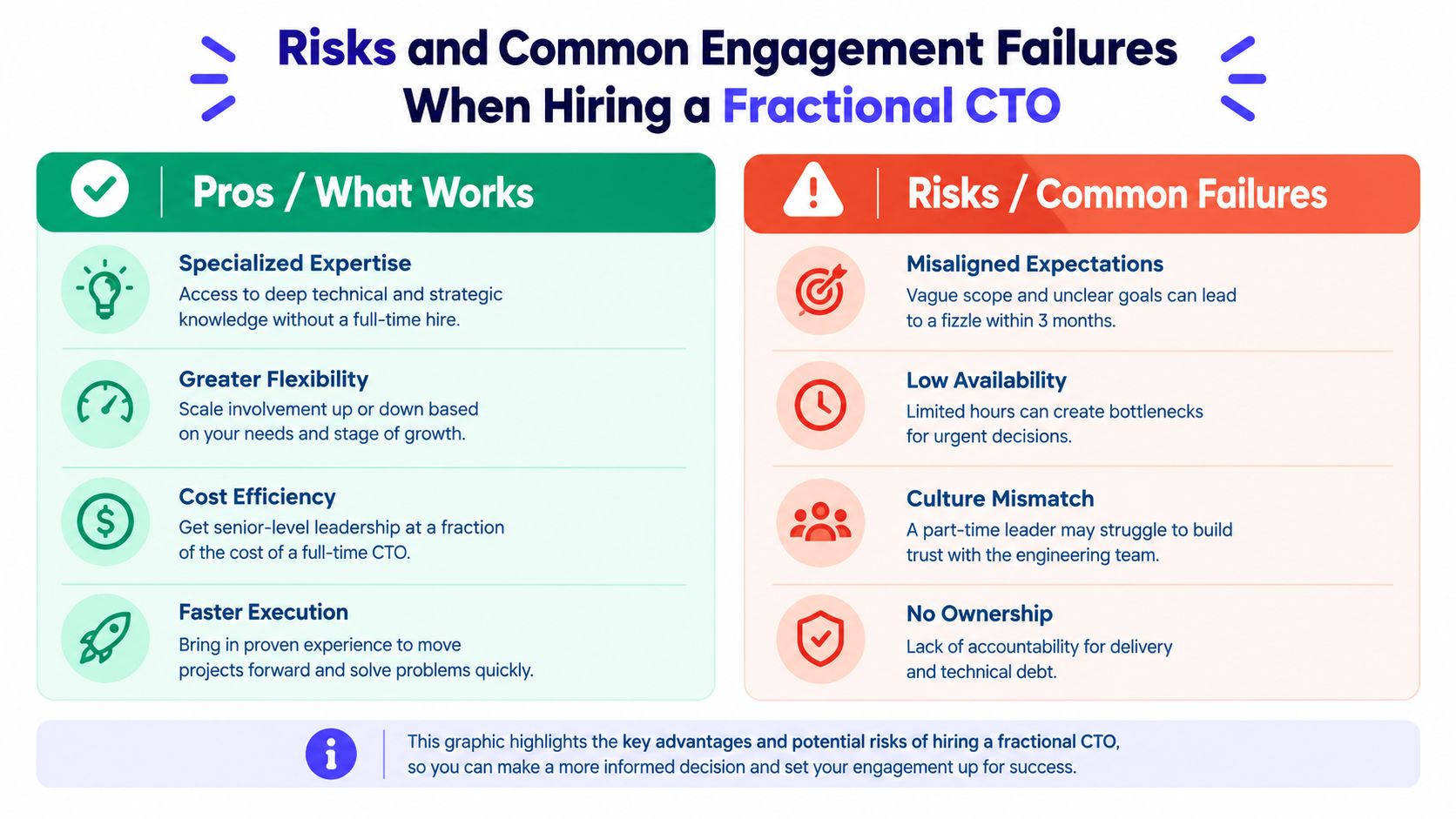
Fractional leadership fails when founders buy availability they aren't paying for or assign accountability without authority. The title won't fix unclear priorities, founder overrides, or an engineering team that doesn't know who can approve a decision.
Recent coverage identifies 60% of failures as companies expecting full-time availability at fractional rates, while 25% stem from giving the advisor responsibility without decision rights, according to this 2025 fractional CTO ecosystem guide. Those figures point to a contract problem, not a mysterious leadership problem.
The red flags founders miss
- Vague scope: “Own technology strategy” sounds senior but doesn't identify deliverables, authority, or success measures.
- Unrealistic availability: A candidate promises immediate responses while serving several companies. Ask how urgent decisions are handled and what happens outside scheduled hours.
- No production evidence: A polished executive narrative can't replace recent experience with deployments, incidents, security remediation, and difficult technical trade-offs.
- Founder veto culture: If the founder intends to overrule every important call, the CTO becomes a messenger and the team remains blocked.
- No internal counterpart: A fractional CTO needs an engineering lead or team member who can carry decisions into implementation. Without that counterpart, strategy becomes a document repository.
AI-heavy startups need an additional fit check. Survey data from 50+ fractional CTOs found that 85% specialize in only 1 to 3 verticals, while 75% shipped AI features in production during the previous 12 months. The same survey reported a median 2-day-per-week retainer of $15,000 and median engagement length of 12 months. These findings from the 2026 fractional CTO survey support a practical conclusion: choose a specialist when your risks involve AI, machine learning operations, or regulated data, rather than assuming a broad generalist fits every startup.
Don't ask whether the candidate has CTO experience. Ask which decisions they owned, what went wrong, and how the team changed afterward.
Structuring the Contract and Scope of Work
A fractional CTO agreement must settle five points before work begins: what the executive owns, how often they work, which decisions they can make, how the team escalates issues, and what evidence demonstrates progress.
Set a 90-day mandate with one primary constraint. The mandate can cover architecture, hiring, security readiness, delivery process, or AI productionization, but these workstreams should not carry equal priority. For an AI or SaaS startup, put technical debt, model reliability, data boundaries, and compliance evidence on the same planning document. Otherwise, the roadmap will favor visible features while hidden risk grows.
Write ownership into the agreement
Use an authority matrix instead of vague responsibility statements:
| Decision Area | CTO Owns | CTO Advises | Founder Approves |
|---|---|---|---|
| Technical roadmap | Technical sequencing and trade-offs | Product dependencies | Business priority and spend |
| Architecture | Standards and design approval | Major product implications | Exceptional risk acceptance |
| Hiring | Role definition and technical evaluation | Compensation input | Final offer |
| Vendors | Technical selection | Commercial negotiation | Contract commitment |
| Security | Control design and remediation priority | Legal interpretation | Risk acceptance |
State the working cadence in plain language. Include weekly availability, leadership meetings, architecture review windows, documentation requirements, and response-time service-level agreements. Separate normal questions from production incidents. Do not promise 24-hour coverage unless the contract includes it.
Use measurable security milestones
Security goals require verifiable outputs. Require documented and reviewed security architecture within 4 weeks, then set a target of 100% of critical vulnerabilities to be patched within 48 hours. Name the person who verifies completion, the system that stores evidence, and the artifact that closes each milestone. For AI products, include model access controls, sensitive-data handling, evaluation records, logging, and provider failure procedures in the scope.
Define change control before pressure arrives. If the founder adds a major hiring search, customer audit, or platform migration, the parties must reprioritize the mandate or adjust availability. Scope creep consumes capacity and weakens delivery when the contract treats added work as free.
End with an exit plan. Require architecture records, hiring materials, risk registers, vendor decisions, and a knowledge-transfer session. The engagement succeeds when the startup can operate with stronger internal capability and clearer security evidence, rather than depending indefinitely on one external executive.
Your Technical Hiring Checklist
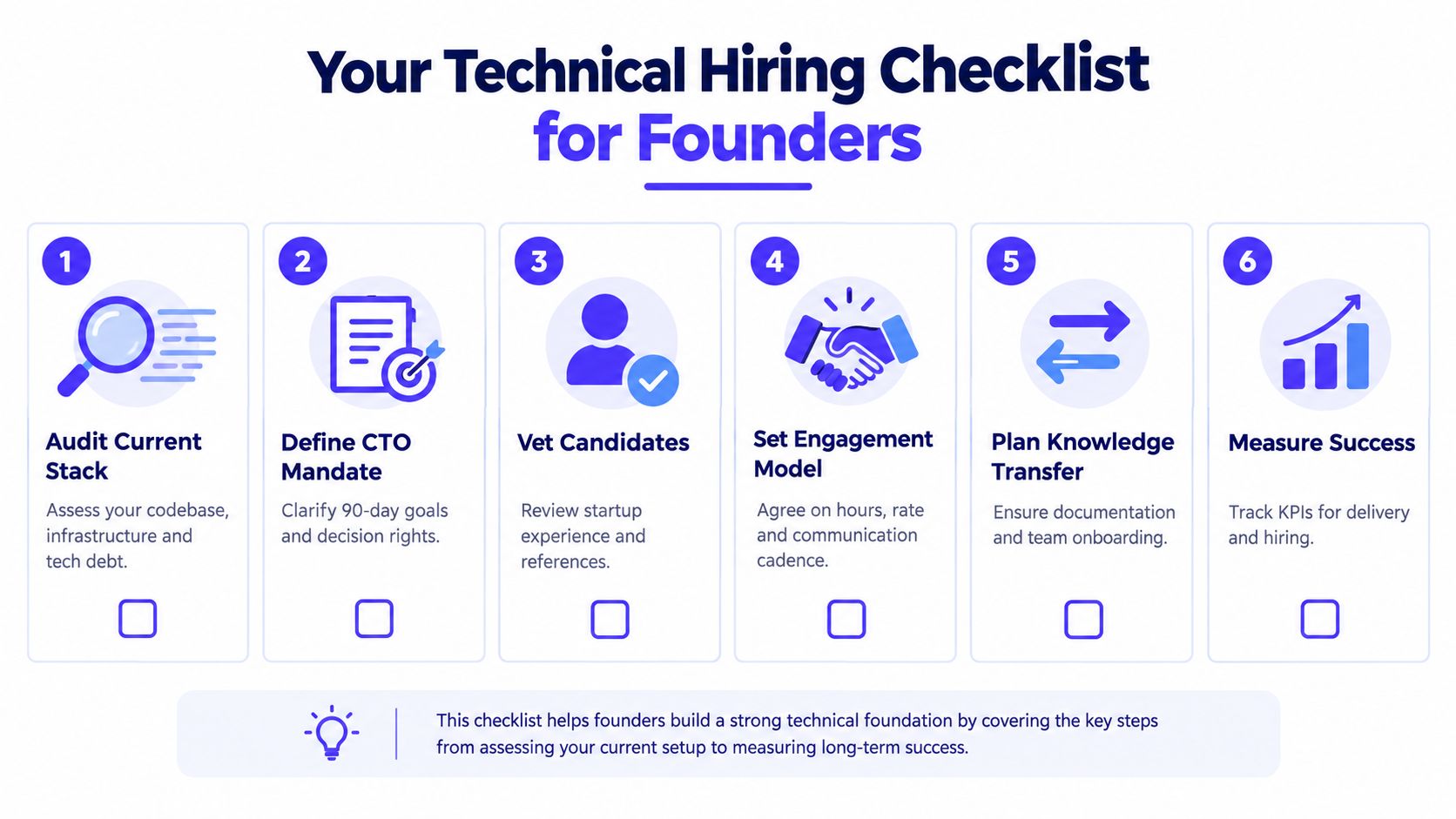
Use this checklist before you interview candidates. It forces the company to define the problem before it evaluates a personality.
Six steps to a defensible hire
- Audit the current stack. Map the application, data stores, model providers, deployment path, observability, access controls, and highest-risk technical debt. Ask the candidate to challenge your assumptions.
- Define the CTO mandate. Write the first-quarter outcomes, decision rights, weekly availability, escalation path, and expected artifacts. If you can't state the mandate in a page, the engagement isn't ready.
- Vet production judgment. Ask, “Tell me about a technical decision you reversed after new evidence appeared.” Then ask what changed in the system, team, and roadmap.
- Test AI architecture depth. Give the candidate a short scenario involving retrieval, sensitive customer data, model evaluation, and an unreliable provider. Ask them to sequence the work under a constrained budget.
- Set the engagement model. Agree on retainer or project structure, communication cadence, meeting schedule, response expectations, invoicing, and how additional work gets approved.
- Measure the first month. Track completed architecture decisions, hiring progress, security gaps converted into owners, roadmap clarity, and the team's ability to make decisions without founder intervention.
Look for a leader who can explain trade-offs to a founder and implementation details to an engineer. Review references from comparable startup stages, especially where the executive had to establish AI or SaaS foundations rather than advise a mature team.
Start with a focused pilot before committing to a long engagement. Give the candidate a real architecture review, a hiring scorecard, and a prioritized risk register. The output should help you decide whether the person can create clarity and move work forward.
ThirstySprout connects startups with senior fractional technical leaders and remote AI specialists who can define architecture, select an initial production use case, and help recruit the permanent team. Visit ThirstySprout to scope a fractional CTO pilot around your AI, SaaS, security, or engineering hiring priorities.
Hire from the Top 1% Talent Network
Ready to accelerate your hiring or scale your company with our top-tier technical talent? Let's chat.