

TL;DR
- Focus your MVP: Solve one critical user problem (e.g., peer-to-peer payments) to launch in 4–9 months for a budget of $50k–$150k. Avoid feature creep.
- Build a secure architecture: Use a microservices architecture for scalability and resilience. Isolate core functions like user management and transaction processing.
- Prioritize security and compliance: Integrate security from day one (DevSecOps). Use end-to-end encryption, MFA, and automated code scanning. Offload KYC/AML to third-party APIs to accelerate your launch.
- Choose a pragmatic tech stack: For an MVP, Python offers rapid development and a large talent pool. For high-concurrency systems, consider Go. The best stack balances security, performance, and hiring availability.
- Assemble a lean team: Start with a hybrid model—a core in-house team for vision and specialized remote talent (like a DevSecOps or AI engineer) for execution. This de-risks your roadmap and controls costs.
Who This Guide Is For
This guide is for technical leaders and founders who need to build and launch a secure fintech product within the next 3-6 months.
- CTO / Head of Engineering: You need to decide on a scalable architecture, choose a defensible tech stack, and hire a specialized team.
- Founder / Product Lead: You are responsible for defining a focused MVP, managing the budget, and navigating the trade-offs between speed to market and regulatory risk.
- Talent Ops / Procurement: You are evaluating the build vs. buy decision for your engineering team and need to understand the critical roles required for a fintech project.
Your Fintech MVP Decision Framework
Success in fintech requires making smart, deliberate trade-offs between speed, security, and cost. This framework provides a step-by-step approach to building your MVP on a solid foundation.
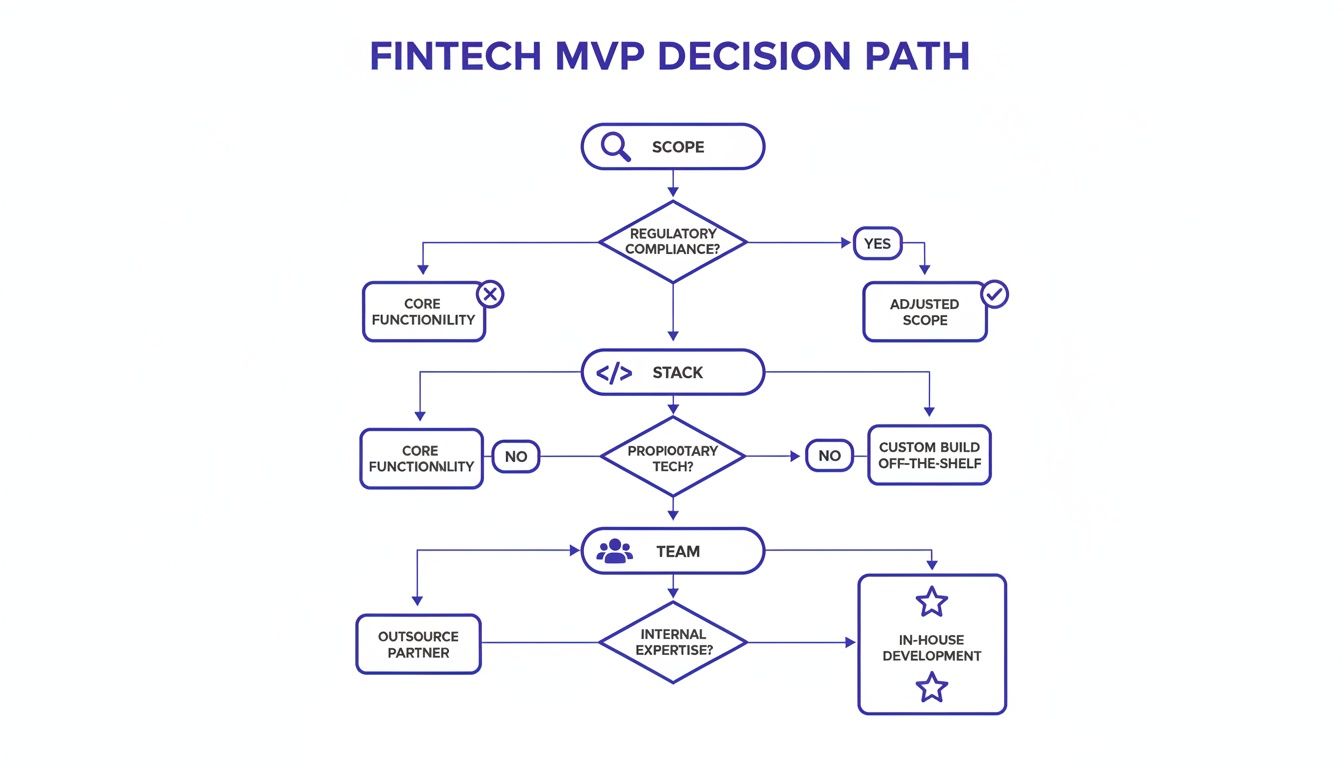
Use this decision table as your starting point for scoping a secure and scalable product.
Practical Examples of Fintech Architecture & Process
Abstract frameworks are good, but real-world examples make them actionable. Here are two common scenarios you'll face.
Example 1: P2P Payment App Microservices Architecture
For nearly every new fintech product, a microservices architecture is the default choice. It breaks a large application into smaller, independent services that communicate with each other. This improves resilience, scalability, and allows teams to deploy features faster.
Here’s a simplified architecture for a peer-to-peer (P2P) payment app, showing how these services work together.
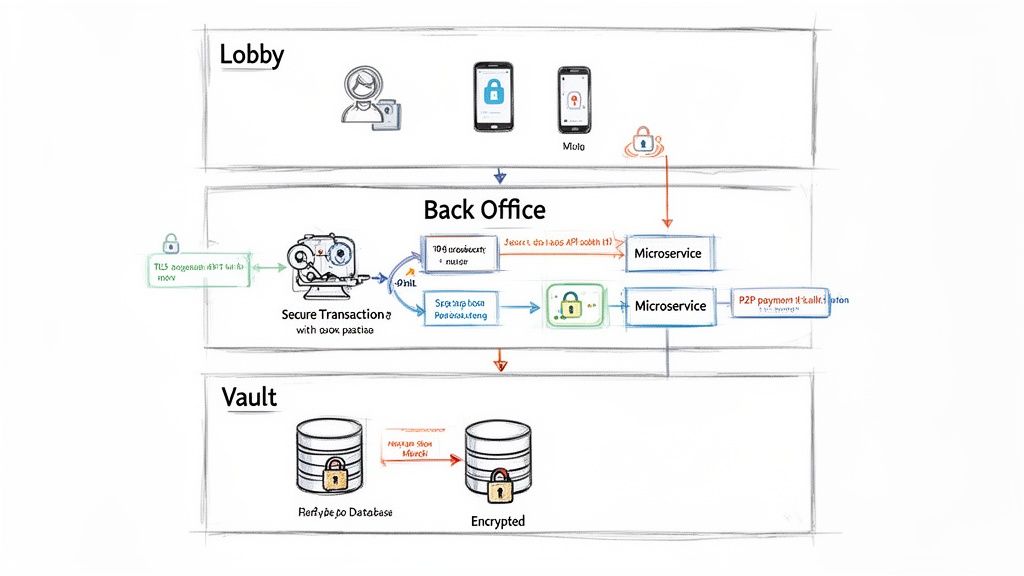
This diagram shows a clean separation of duties:
- API Gateway: The secure front door for all requests. It handles authentication and routes traffic to the correct microservice, acting as a single point of control.
- User Management Service: Handles user registration, login, and profile details. It is isolated to protect sensitive personal data.
- Transaction Engine: The heart of the app. It processes payments, checks balances, and maintains an immutable transaction log. It can be scaled independently during peak demand.
- Notification Service: Sends push notifications, emails, or SMS alerts for confirmed payments or security triggers. Its failure won't impact core transaction processing.
The business impact is clear: speed and resilience. You can ship better features faster, with less risk, which is how you win in a competitive market.
Example 2: Automating KYC for a Neobank MVP
A seed-stage neobank needed to onboard users quickly while meeting strict Know Your Customer (KYC) regulations. Building their own identity verification system was an option, but it would have taken 4–6 months of engineering time.
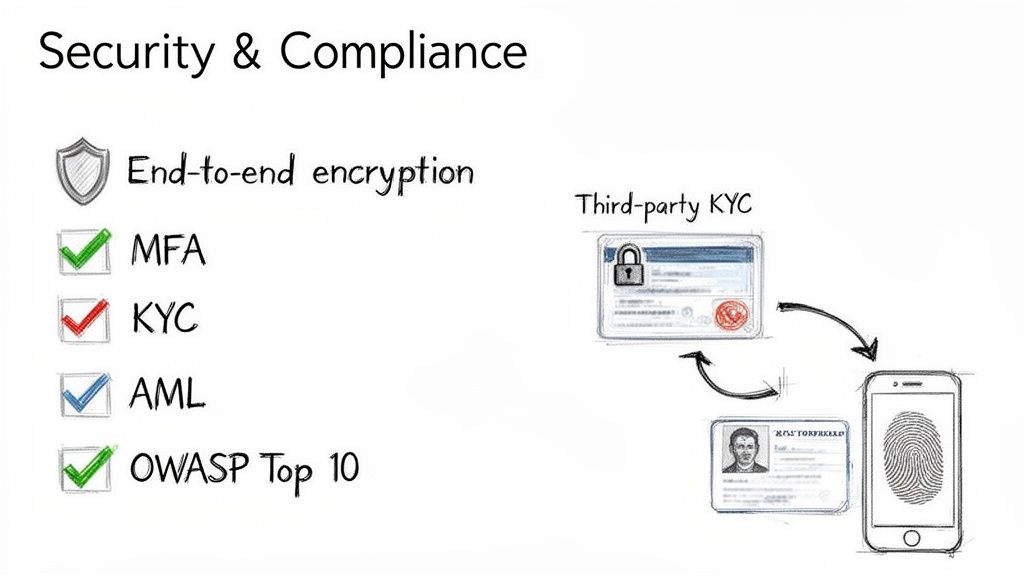
Instead, they integrated with a third-party provider like Persona or Veriff via an API.
- The Problem: High regulatory burden and long development timeline for a non-core feature.
- The Action: They offloaded the KYC process to a specialized vendor.
- The Result: The team launched a fully compliant onboarding flow in just 3 weeks. This freed their engineers to focus on the unique features of their neobank, dramatically reducing both time-to-market and legal risk from day one.
Deep Dive: Security, Compliance, and Tech Stack Trade-offs
In fintech, security and compliance are not features; they are the foundation. Attempting to add them after development is a recipe for technical debt, regulatory fines, and a complete loss of user trust.
This philosophy is called DevSecOps—weaving security into your development and operations from the very first line of code.
Integrating Security and Compliance from Day One
Your engineering team must treat these practices as non-negotiable.
- End-to-End Encryption (E2EE): Data must be encrypted at rest (in the database) and in transit (across networks).
- Multi-Factor Authentication (MFA): Passwords are not enough. Use authenticator apps, biometrics, or SMS codes to prevent account takeovers.
- Secure Coding Practices: Developers must follow established guidelines like the OWASP Top 10 to prevent common vulnerabilities.
- Immutable Audit Logs: Every critical action must be recorded in a tamper-proof log for regulatory audits and incident response.
Choosing the Right Technology Stack
Your tech stack is a business decision, not just a technical one. It impacts your hiring speed, security posture, and ability to scale. Anchor your decision on three pillars:
- Security Ecosystem: Does the technology have mature, battle-tested libraries for encryption, authentication, and threat detection?
- Performance & Scalability: Can it handle high-volume, low-latency transactions concurrently?
- Talent Pool: How difficult is it to hire experienced engineers for this stack? A deep talent pool accelerates development.
This scorecard visualizes the trade-offs for popular backend languages.
For most MVPs, Python provides the optimal balance of development speed and security. For systems where raw performance is paramount, Go (Golang) is a superior choice.
Fintech MVP Compliance Checklist
Use this checklist to translate complex compliance requirements into actionable engineering tasks for your MVP.
What to Do Next
You now have a map for navigating fintech software development. Turn this knowledge into action by focusing on these three steps.
Step 1: Define a Ruthless MVP Scope
Get painfully clear on the single problem you are solving for one target user. Is it "helping freelance designers track unpaid invoices"? Write it down. This focus prevents scope creep and accelerates your path to real user feedback.
Step 2: Draft Your Initial Architecture
Sketch out your system. Will you use microservices? Which cloud provider (AWS or Google Cloud) fits your team's skills? Make initial choices for your backend and database. This technical hypothesis forces you to weigh trade-offs before writing code.
Step 3: Perform a Team Skills Gap Analysis
Compare your architecture plan to your current team's skills. Do you have an engineer who has integrated payment gateways securely? Do you have the DevSecOps expertise to build a compliant infrastructure? Identifying these gaps now is critical.
A clear plan is your most valuable asset. ThirstySprout connects you with vetted, senior fintech and AI experts in days, not months. We help you fill critical skill gaps and accelerate your roadmap.
Ready to build a secure fintech platform? Start a Pilot
References & Further Reading
- 9 key trends in the fintech industry - (Visbanking)
- Latest Fintech App Statistics - (Vrinsofts)
- OWASP Top 10 - (OWASP Foundation)
- Software Architecture Best Practices - (ThirstySprout)
- Software Development Team Augmentation - (ThirstySprout)
- Securing Big Data Environments - (ThirstySprout)
Hire from the Top 1% Talent Network
Ready to accelerate your hiring or scale your company with our top-tier technical talent? Let's chat.