

You’re probably making this choice under pressure. The AI product roadmap is moving, the API layer can’t be an afterthought, and every architecture decision now affects hiring, onboarding, observability, and incident response later.
The first thing to clear up is simple. Express.js vs Node.js is not a true either-or decision. Node.js is the runtime. Express.js is a web framework that runs on top of Node.js. More precisely, the question is whether your team should use raw Node.js APIs or add Express.js as the application layer for the services you’re building.
For AI and SaaS teams, that distinction matters. A low-latency inference edge service has very different needs from a customer-facing REST API, admin backend, webhook processor, or internal MLOps control plane. If you treat them all the same, you usually over-engineer one side and under-protect the other.
TLDR Express vs Node A Quick Summary for Tech Leaders
If you need the fast answer, use this:
| Decision area | Raw Node.js | Express.js |
|---|---|---|
| What it is | JavaScript runtime APIs for building servers directly | Web framework built on Node.js |
| Best fit | Ultra-lean services, custom protocols, latency-sensitive endpoints | REST APIs, SaaS backends, internal tools, multi-route apps |
| Performance | Lower overhead | Slight framework overhead |
| Developer speed | Slower at first, more boilerplate | Faster for most product teams |
| Code structure | You design everything yourself | Routing and middleware are built in |
| Hiring impact | Harder to assess depth and production discipline | Easier to hire for common backend patterns |
| Recommendation | Use selectively | Default choice for most business APIs |
A few practical rules usually hold:
- Choose raw Node.js when one service has to stay extremely lean, such as an inference gateway, event ingestion edge, or a custom network service where every layer matters.
- Choose Express.js when your team is building a product API with authentication, validation, routing, middleware, error handling, and multiple stakeholders touching the codebase.
- Don’t frame this as one stack for everything. Most strong teams mix both. They keep a few performance-critical services minimal and use Express for the broad surface area of the product.
- Bias toward operational clarity over micro-optimizing too early. If the service spends most of its time serializing JSON, calling models, querying storage, or waiting on other systems, Express usually won’t be the bottleneck that decides your outcome.
- Use the hiring lens early. If your backend depends on engineers hand-rolling routing, error boundaries, request parsing, and middleware equivalents, your talent bar gets narrower fast.
Practical rule: If a service exists to expose business logic to clients, partners, or internal product teams, Express is usually the safer default. If a service exists to shave overhead from a single narrow path, raw Node.js earns its keep.
The Core Difference Runtime vs Framework
Most confusion around express js vs node js starts because people compare them as peers. They aren’t peers.
Node.js is the server-side JavaScript runtime. It executes JavaScript outside the browser and gives you the primitives for networking, file I/O, timers, streams, and the event loop.
Express.js is a framework built on top of Node.js. It gives you a simpler way to define routes, attach middleware, shape responses, and organize web application code.
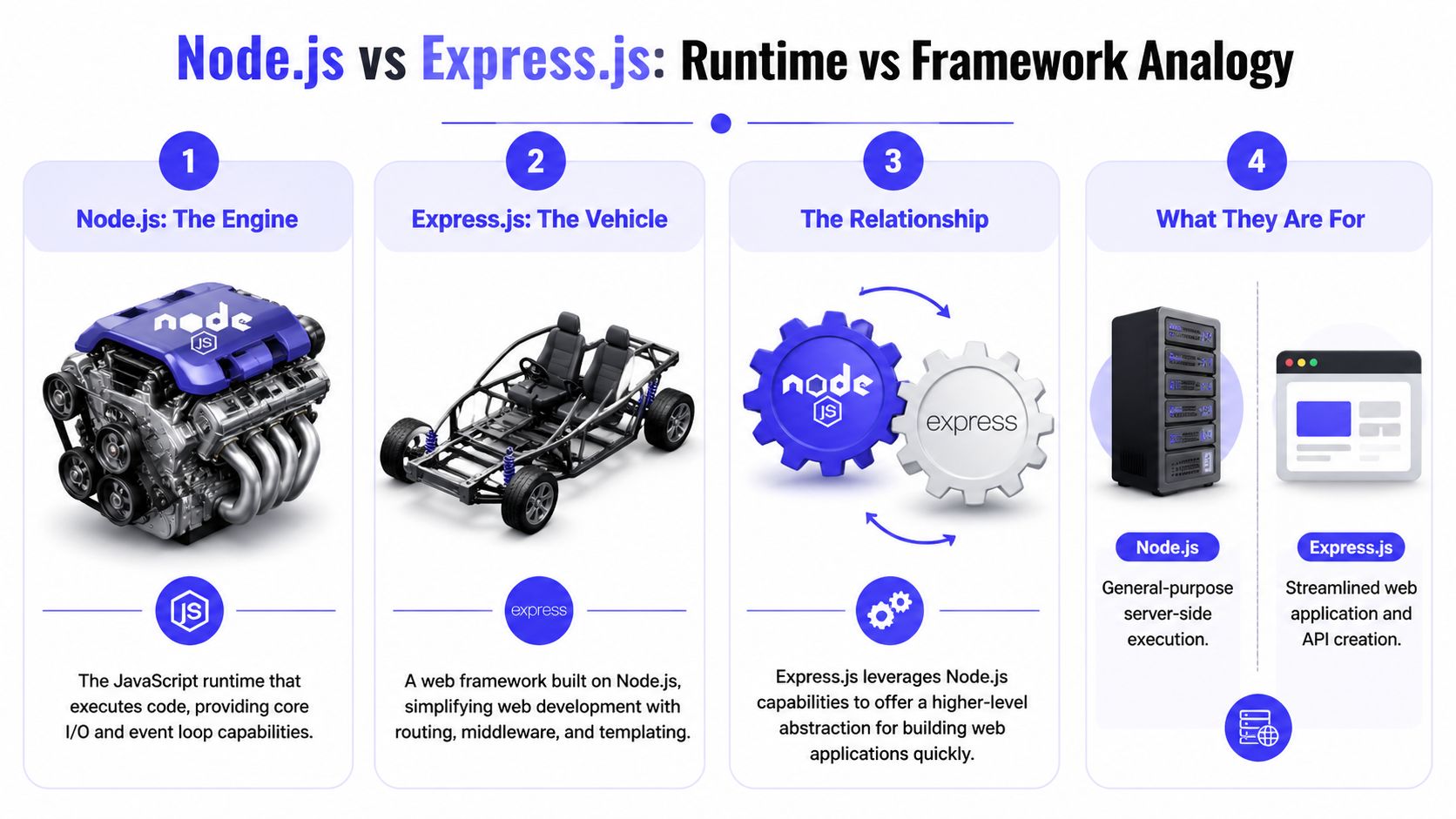
Think engine and vehicle
A useful mental model is this:
- Node.js is the engine
It provides the power, the event loop, and the low-level server capabilities. - Express.js is the vehicle
It packages common web development needs into a cleaner interface so developers don’t keep rebuilding the same parts.
With raw Node.js, you work closer to the metal. You create the HTTP server yourself, inspect the URL, parse the method, set headers, and decide how requests move through the system.
With Express, you start at a higher layer. You define app.get(), app.post(), middleware stacks, and error handlers. That removes repetitive infrastructure work and makes ordinary web backend tasks easier to read and maintain.
What the choice actually means
The choice isn’t “Node.js or Express.js.”
The choice is one of these:
- Use Node.js directly for a narrow service.
- Use Node.js with Express.js for a broader web backend.
- Mix both across your system based on service boundaries.
That last option is common in serious AI products. The orchestration API may run on Express. A tiny high-priority request forwarder or SSE streaming edge may stay on raw Node.js. A webhook receiver may use Express for clarity because operational simplicity beats shaving tiny amounts of overhead.
The wrong comparison leads to the wrong architecture. Node is the platform. Express is one way to build on it.
Why this matters to a CTO
This distinction affects more than code style.
If you choose raw Node.js everywhere, your team owns all the consistency work a framework normally standardizes. That includes request parsing, route organization, shared middleware patterns, and error surface conventions.
If you choose Express for the wrong service, you may carry extra abstraction where your service only needed a very small, controlled request path.
The right question is not “Which is better?” It’s “Where do we want abstraction, and where do we want direct control?”
Practical Examples Code and Architecture
The cleanest way to compare express js vs node js is to look at two services that show up in real AI and SaaS stacks.
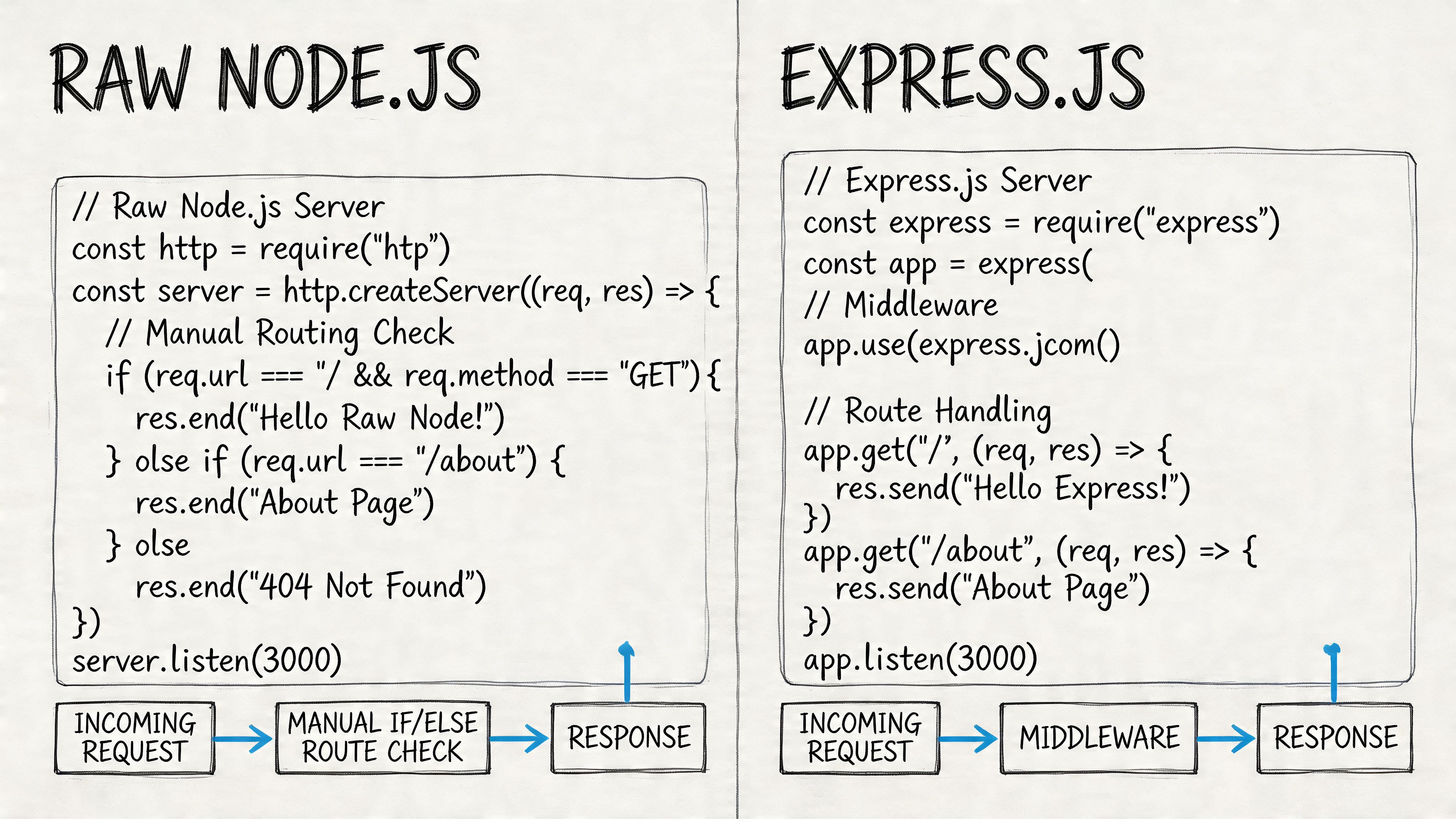
Example one raw Node.js for a narrow inference endpoint
Say you’re exposing a single /infer endpoint that forwards a request to an in-memory model wrapper or a local worker. You care about a short code path, predictable handling, and minimal abstraction.
const http = require('http');const server = http.createServer(async (req, res) => {if (req.method === 'POST' && req.url === '/infer') {let body = '';req.on('data', chunk => {body += chunk;});req.on('end', async () => {try {const input = JSON.parse(body);// Replace with real inference callconst result = {label: input.text ? 'accepted' : 'rejected'};res.writeHead(200, { 'Content-Type': 'application/json' });res.end(JSON.stringify(result));} catch (err) {res.writeHead(400, { 'Content-Type': 'application/json' });res.end(JSON.stringify({ error: 'invalid request' }));}});return;}res.writeHead(404, { 'Content-Type': 'application/json' });res.end(JSON.stringify({ error: 'not found' }));});server.listen(3000);This is lean and explicit. It also shows the trade-off quickly. You’re handling body parsing, route matching, response headers, and error behavior yourself.
A simple architecture for this service looks like this:
- Client
- Raw Node.js HTTP server
- Inference function or model adapter
- JSON response
This pattern works well when the service has a tiny API surface and a clear latency target. It does not scale elegantly when product requirements expand into auth, rate limiting, versioned routes, request validation, tracing hooks, and several teams editing the same service.
Example two Express.js for a product API
Now look at a typical SaaS backend. You need user routes, project routes, auth middleware, request validation, shared error handling, and room for additional services.
const express = require('express');const app = express();app.use(express.json());function auth(req, res, next) {const token = req.headers.authorization;if (!token) return res.status(401).json({ error: 'unauthorized' });next();}app.get('/health', (req, res) => {res.json({ status: 'ok' });});app.post('/projects', auth, (req, res) => {const { name } = req.body;if (!name) return res.status(400).json({ error: 'name is required' });res.status(201).json({id: 'proj_123',name});});app.use((err, req, res, next) => {res.status(500).json({ error: 'internal error' });});app.listen(3000);This code is closer to how product teams think. Routes are readable. Middleware is composable. Error handling has a defined place.
A common architecture here looks like:
- Web or mobile client
- Express API layer
- Auth middleware
- Controllers and services
- Database, queue, model API, or cache
If you’re building your first platform API, a walkthrough like this guide to create an API is the kind of reference that helps teams standardize structure early rather than improvising it endpoint by endpoint.
What works and what breaks
Raw Node.js works best when:
- The surface area stays tiny
- The team can enforce discipline
- The service has one job
- You want direct control over request flow
Express works best when:
- Endpoints multiply
- More than one engineer touches the service
- You need middleware chains
- You want conventional patterns that new hires recognize quickly
A lot of “we’ll keep it simple with raw Node” systems stop being simple once auth, validation, retries, logging, and request correlation arrive.
A useful mini-case for scoping
For early-stage teams, prototype choices often come from side projects. If your engineers want realistic exercises before committing to a backend style, curated web development project ideas can be surprisingly useful because they expose whether your team naturally benefits from framework structure or prefers lower-level control.
That sounds small, but it’s a real signal. Teams that struggle to keep route logic organized in a small prototype usually don’t get more organized under production pressure.
Performance Scaling and Architecture Tradeoffs
Performance questions around express js vs node js usually get framed too superficially. People ask which one is faster. The more useful question is where the overhead matters enough to justify the extra complexity.
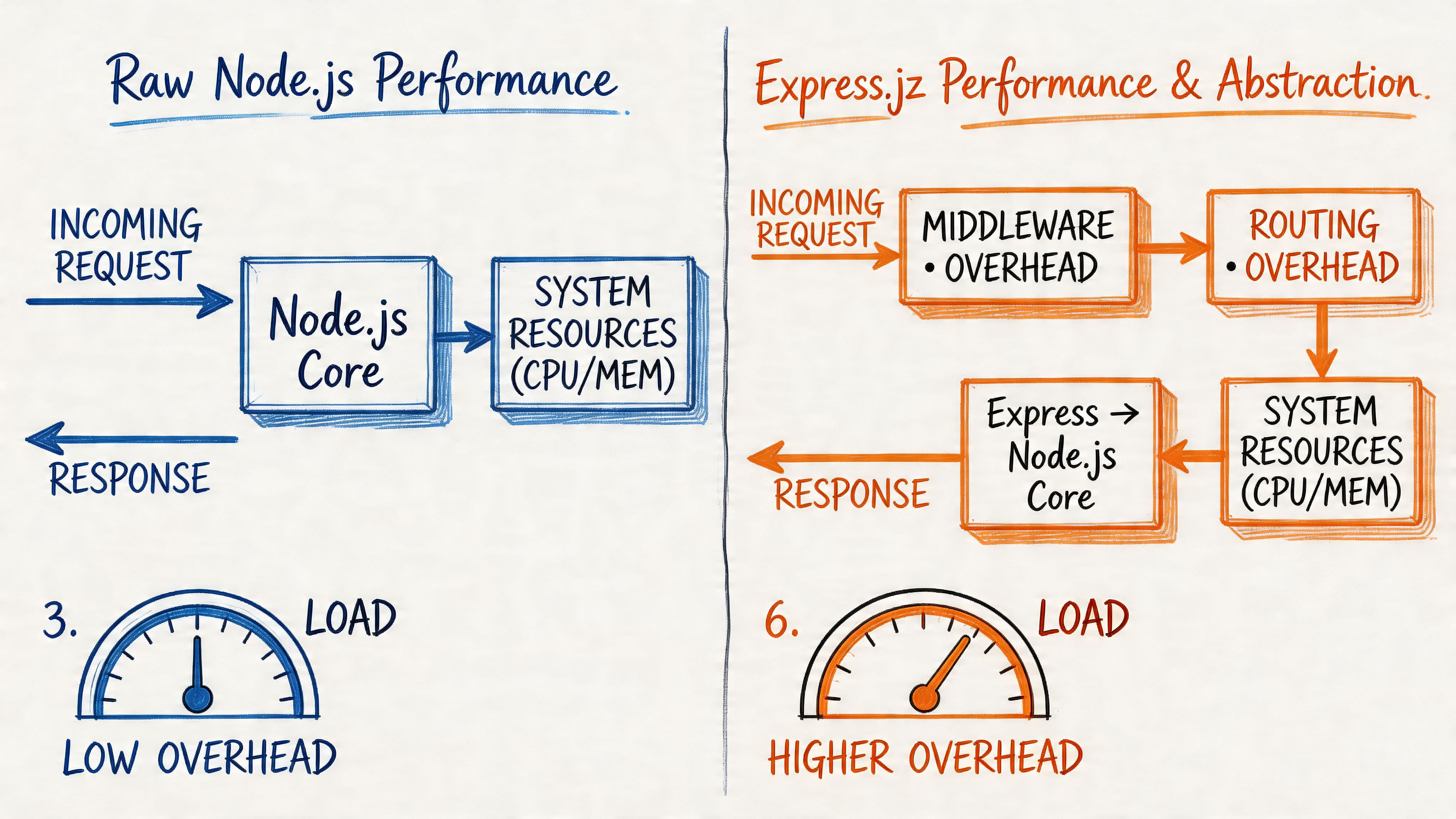
Pure Node.js HTTP servers outperform Express.js in raw benchmarks because they avoid framework middleware and routing overhead. One benchmark summary notes that the differences are typically in the range of milliseconds per request, with raw Node.js handling requests just milliseconds slower than Fiber while Express adds noticeable latency from its abstractions. That’s why raw Node.js is a fit for ultra-low-latency paths, while Express often makes sense for production APIs where that overhead fades under heavier JSON work and application logic, as discussed in this Node.js vs Express benchmark analysis.
Request path overhead
Raw Node.js keeps the request path short. The request comes in, your code inspects it, and you decide what happens next.
Express adds structure between the socket and your business logic:
- Route matching
- Middleware execution
- Request and response helpers
- Error propagation through framework conventions
That extra work costs something. The important question is whether that cost matters for the service you’re building.
If your endpoint just accepts a compact payload and returns a fast computed answer, every extra layer becomes easier to notice. If the endpoint does authentication, JSON parsing, schema validation, tracing, database work, model calls, and response shaping, the framework cost often stops being the main thing that matters.
Where Node.js wins clearly
Raw Node.js is usually the better fit for a narrow service with strict latency goals.
Good examples include:
| Service type | Why raw Node.js helps |
|---|---|
| Inference edge endpoint | Minimal request path and less framework overhead |
| Streaming bridge | Direct control over headers, chunks, and connection lifecycle |
| Custom webhook ingest | Tight control over parsing and backpressure |
| Internal protocol adapter | You may not need web framework conventions at all |
In these cases, the operational advantage is not only speed. It’s also predictability. Fewer layers make it easier to inspect exactly where time is spent.
Operator note: If one service has a hard latency budget, benchmark that service in isolation. Don’t let a generic “Express is fine” assumption drive a path that has unusual constraints.
Where Express earns its overhead
Express becomes valuable when the service complexity moves from transport cost to application complexity.
That happens fast in real products:
- Role-based access rules
- Versioned routes
- Shared validation
- Cross-cutting logging
- Consistent error responses
- Admin and partner APIs
- Middleware for auth, limits, and request context
At that point, the performance conversation shifts. The risk is no longer just framework overhead. The risk is letting every engineer invent a different pattern for concerns that should be standardized.
For AI and SaaS teams, this is common in orchestration APIs that sit in front of vector stores, queues, billing logic, tenant checks, and model providers. Those systems don’t fail because the router added overhead. They fail because conventions drift and no one can safely change shared behavior.
Scaling is not just throughput
A lot of teams talk about scaling as requests per second. CTOs should care just as much about codebase scaling and team scaling.
Raw Node.js gives maximum freedom. That freedom helps in specialized services. It hurts when there’s no enforced shape for the codebase.
Express nudges teams toward a recognizable architecture:
- routes
- middleware
- controllers
- service layer
- centralized errors
That structure is not glamorous, but it reduces operational drag. New engineers can find logic faster. Security reviews are easier. API contracts stay more coherent.
If you’re tuning read-heavy or model-heavy systems, response-time work often depends more on caching strategy, payload shape, and downstream dependencies than on the framework itself. That’s where practical guidance on caching in Node.js usually moves the needle more than swapping frameworks.
Version choice matters too
If you’re already using Express, the version matters. A benchmark review comparing Express 4 and Express 5 across Node.js versions found that Express 5 versions benchmark consistently slower in raw throughput than Express 4, especially for lightweight routes and middleware-heavy setups, while the gap narrows or disappears for larger payloads and JSON endpoints. The same review also notes significant Node.js core improvements from v18 to v20 in areas like EventTarget dispatching, UTF-8 decoding, and startup-related require() performance in this Express 4 vs Express 5 benchmark review.
That leads to a practical reading of the data:
- Express 4 is still attractive when peak throughput matters in high-request environments.
- Express 5 is attractive when your team wants newer async behavior and long-term maintenance direction.
- Node.js version upgrades can change the baseline enough that you should retest before making broad conclusions.
Here’s a useful policy for platform teams:
- Benchmark the actual endpoint mix, not toy routes.
- Separate tiny latency-critical services from broad business APIs.
- Treat framework choice and Node version choice as linked decisions.
- Optimize the few hot paths aggressively. Keep the rest boring.
What architecture usually works in AI products
The pattern that tends to hold up is split by responsibility.
Use raw Node.js for:
- latency-sensitive gateways
- streaming-heavy transport layers
- single-purpose adapters
- places where you need direct control over the HTTP lifecycle
Use Express for:
- product APIs
- internal admin services
- webhook fan-out controllers
- multi-tenant business logic layers
- MLOps control planes with many routes and policies
This video is useful if your team wants a quick visual refresher on the practical differences before building a benchmark plan.
Common mistakes that cause the wrong decision
- Picking raw Node.js for every service
Teams do this to stay “lightweight,” then gradually rebuild framework features with less consistency. - Picking Express for a tiny hot path
This is fine until that service becomes the latency bottleneck and no one wants to simplify it later. - Benchmarking synthetic routes only
Real services spend time in serialization, auth, cache lookups, network calls, and logging. - Ignoring maintenance shape
The fastest route in a benchmark may still be the wrong route for a team that needs fast onboarding and safe changes.
The right answer usually isn’t ideological. It’s architectural. Use lower-level control where it changes the outcome. Use framework structure where it lowers cost and risk.
Hiring and Operational Impact for AI and SaaS Teams
The express js vs node js comparison turns into a business decision, not merely a developer preference.
Node.js reached 40.8% of developers globally as a primary stack in 2024, more than 6.3 million websites rely on Node.js, companies implementing Node.js have achieved development cost reductions of up to 58%, and developer productivity increases of 68% have been documented. The same source also notes strong professional adoption and broad developer preference for Node.js as a web application technology in this Node.js statistics roundup.
For hiring, that means the underlying talent market is deep. But the hiring implication isn’t just “Node is popular.” It’s more nuanced.
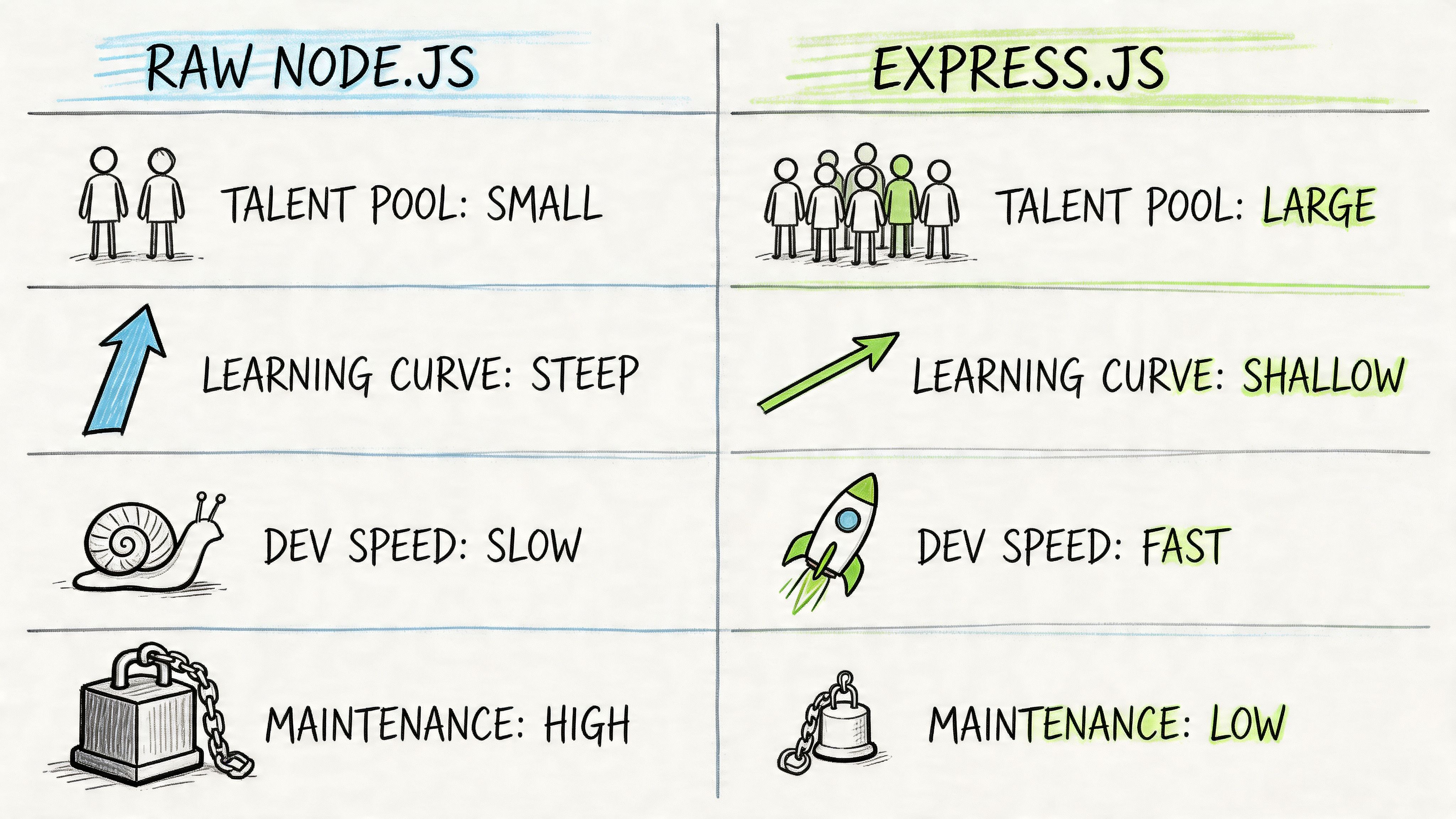
Popularity does not equal production depth
A lot of developers can work productively in Node.js. Fewer can build a production-grade backend from lower-level primitives without drifting into inconsistent routing, weak error semantics, or ad hoc middleware patterns.
That distinction matters in AI systems. Your API surface often sits between user traffic and expensive downstream systems such as model providers, vector stores, queues, and billing controls. A backend that “works” isn’t enough. It has to be predictable under growth, incidents, and team expansion.
Express helps here because its patterns are widely recognized:
- Routing conventions are familiar
- Middleware responsibilities are easier to discuss in interviews
- Onboarding is faster because structure is visible
- Code reviews can focus on business logic instead of homemade abstractions
Express usually lowers team friction
Express has massive real-world usage. BuiltWith reports 3,746,160 websites identified as Express customers globally, including 1,022,292 live websites, with 453,619 active deployments in the United States. The same report also places Express.js 1st in Node.js framework growth over both 60-day and 90-day periods, which reinforces how standard it remains for web application development in this Express adoption and growth data.
For a CTO, that matters in a very practical way. A common framework creates a more legible hiring market.
You can assess candidates on recognizable topics:
| Interview area | What good looks like in Express-heavy teams |
|---|---|
| Middleware design | Clear separation of auth, validation, and request context |
| Error handling | Centralized error shape and safe propagation |
| API organization | Routes stay thin, business logic moves to services |
| Operational maturity | Logging, health checks, and testable route behavior |
If you try to hire for “raw Node.js backend architecture” instead, interviews often become harder to standardize. You’re assessing individual engineering taste as much as transferable backend skill.
What this changes for AI hiring
AI teams often under-hire backend depth because the roadmap looks model-centric. Then the product ships, and backend concerns dominate:
- tenancy
- auth
- usage metering
- retries
- queues
- auditability
- model routing
- streaming responses
- failure handling
At that stage, Express is usually cheaper to operate because more engineers can contribute safely. Raw Node.js services can still be excellent, but they need narrower scope and stronger ownership.
A real hiring signal is to scan current market expectations. Listings like these remote Node.js fullstack engineer jobs often show what employers assume a Node backend engineer should handle in practice. In many cases, teams want broad product API experience, not just runtime knowledge.
If your roadmap requires several backend engineers to work across the same API surface, the most expensive architecture is often the one that depends on uncommon in-house conventions.
A practical hiring scorecard
Use this when deciding whether your team can sustain raw Node.js in production.
- Team seniority
If your backend team is small but very senior, a few raw Node.js services are realistic. If the team is mixed in experience, Express usually reduces variance. - Onboarding urgency
If you need new engineers productive quickly, standard framework patterns help more than custom elegance. - Ownership boundaries
Raw Node.js works better when one team owns one narrow service. It works worse when many contributors share one backend. - Compliance and review load
Framework structure makes it easier to review cross-cutting concerns consistently.
If you’re hiring distributed backend talent, this broader guide on how to hire remote developer teams is a useful lens for role definition, evaluation, and ramp-up planning.
Decision Checklist Use Raw Nodejs vs Express
Use this checklist before you lock the architecture.
Choose raw Node.js if these statements are mostly true
- The service has a very narrow purpose. It’s an inference edge, stream handler, or protocol adapter rather than a broad product API.
- Latency is a first-order requirement. You care about keeping the request path as small as possible.
- Your team understands Node internals well. Engineers are comfortable owning low-level HTTP behavior and keeping patterns consistent without framework help.
- The route surface will stay small. You’re not expecting rapid growth in endpoints, middleware, or cross-team contributors.
- You can isolate ownership clearly. One team can maintain the service without architecture drift.
Choose Express.js if these statements sound more familiar
- You’re building a customer-facing or partner-facing API.
- The service needs authentication, validation, versioned routes, and shared middleware.
- Multiple engineers will touch the code regularly.
- You want a backend that is easy to onboard into and easy to review.
- Time to market matters more than shaving a small amount of framework overhead.
- You expect the service to grow from “a few endpoints” into a real product layer.
Use a mixed approach if your platform has both profiles
A lot of strong systems do this:
- Keep the hot path lean.
- Put business APIs on Express.
- Separate services by latency sensitivity, not ideology.
Build the minimum abstraction needed for each service, not the same abstraction for every service.
A final gut check helps. If removing Express would force your team to reinvent routing, body parsing, error handling, and middleware conventions, you probably need Express. If adding Express would only wrap one small endpoint with extra machinery, you probably don’t.
What To Do Next
Three next steps usually make this decision concrete.
Audit the core requirement
Take one service, not the whole platform, and classify it accurately. Is it a latency-critical transport path, or is it a business API with growing product complexity? Use the checklist above and decide service by service.
Prototype the highest-risk component
Don’t debate framework choice in the abstract. Build the one component most likely to break your assumptions.
For many AI products, that’s one of these:
- A streaming inference endpoint
- A multi-tenant orchestration API
- A webhook ingestion service
- A usage-metering or billing-facing backend route
Test the actual shape of the work. Include auth, logging, JSON payloads, and one downstream dependency. That will tell you far more than toy benchmarks.
Define the hiring plan before implementation scales
Architecture becomes expensive when it narrows your hiring funnel. Decide early:
- who will own the low-level services
- who will maintain the broader API layer
- what conventions new hires must learn
- what interview signals prove backend production readiness
If your team needs to move from decision to delivery quickly, the best path is usually to start with a pilot, validate the service boundary, and hire against the architecture you want to run.
If you’re building an AI product and need senior engineers who can make this call pragmatically, ThirstySprout helps teams start a pilot fast with vetted AI, backend, and MLOps talent. You can bring in one expert or a full remote team to benchmark hot paths, design the API layer, and ship production systems without dragging the hiring process out for months.
Hire from the Top 1% Talent Network
Ready to accelerate your hiring or scale your company with our top-tier technical talent? Let's chat.