

TL;DR: Key Questions to Ask
- How do you balance technical excellence with shipping speed? Probes for a pragmatic framework for making trade-offs, not just a vague "it depends." Look for examples connecting technical debt to business impact.
- Describe your process for hiring, onboarding, and retaining specialized AI talent. Assesses their ability to build a team in a competitive market. A strong answer details a repeatable, metrics-driven system.
- Tell me about a time you had to deliver results with limited resources. Reveals resourcefulness and the ability to achieve leverage. Look for creative solutions like using open-source tools or APIs, not just "working harder."
- What was a major technical transition you led, and what did you learn? Tests strategic thinking and change management. The best answers focus as much on the people challenges as the technical ones.
- How do you measure the performance and impact of an engineering team? Separates managers who use vanity metrics (lines of code) from those who track business outcomes (DORA metrics, user adoption).
Who This Is For
- CTO / Head of Engineering: Needs to hire a leader who can scale a high-performing remote AI team and drive technical strategy.
- Founder / Product Lead: Needs an engineering partner who understands how to connect technical decisions to business outcomes and manage project trade-offs.
- Talent Ops / Hiring Manager: Needs a structured framework and battle-tested questions to identify top-tier engineering leadership talent.
Finding the right engineering manager for an AI-focused team requires more than just confirming technical expertise. You need a leader who can navigate complex architectural shifts, balance shipping speed with code quality, and attract, hire, and retain elite remote AI talent. Generic behavioral questions won't reveal the specific DNA required to scale a modern engineering organization building complex AI systems.
This guide provides a curated list of the most critical engineering manager interview questions tailored for hiring leads at high-growth tech companies. We move beyond the obvious to probe for the precise skills that predict success in today's demanding environment, covering:
- Execution and Delivery: Balancing product velocity with technical debt.
- Talent Management: Hiring, onboarding, and retaining top-tier AI engineers.
- Technical Leadership: Driving architectural decisions and technical strategy.
- People and Team Dynamics: Managing performance, conflict, and remote culture.
For each question, we provide a rubric outlining what separates a strong answer from a weak one and specific follow-up prompts to dig deeper. This framework will help you identify candidates who don't just manage engineers but build and scale a technical function that drives business outcomes.
1. Tell Me About a Major Technical Transition You Led
This behavioral question is one of the most effective for assessing a candidate's ability to handle high-stakes, complex change. A major transition, such as a monolith-to-microservices migration or adopting a new MLOps framework, is a crucible for leadership. It moves beyond day-to-day management to reveal their strategic thinking, communication, and resilience under pressure.
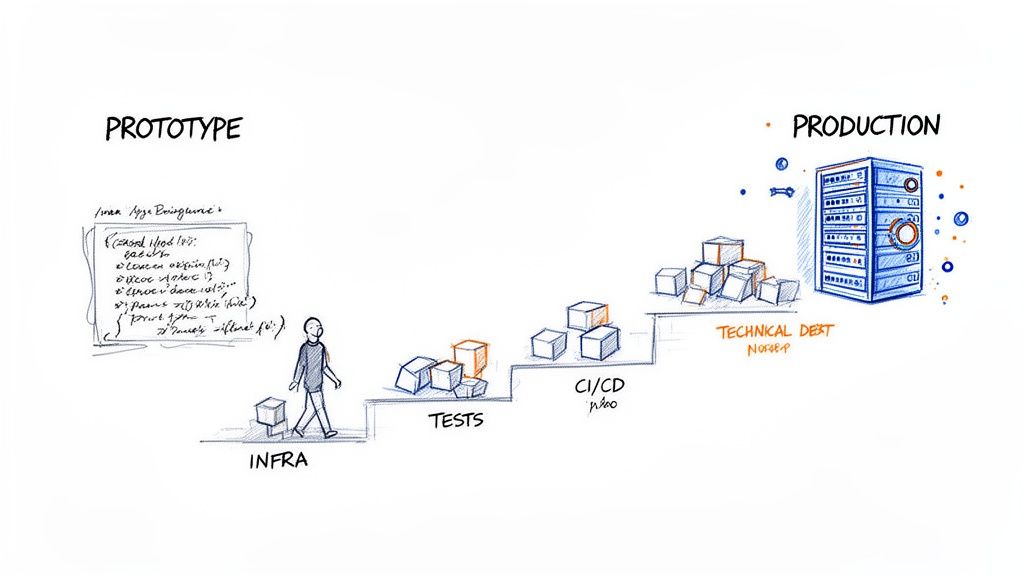
Alt Text: A diagram showing the software development lifecycle from prototype to production, highlighting the management of technical debt as a key challenge.
The intent is to see if the candidate connects technical execution to business outcomes while managing human dynamics. It’s not just about the code; it’s about navigating uncertainty, securing buy-in, and keeping the team motivated.
How to Evaluate Their Answer
A strong response will have a clear narrative: the initial problem, the proposed solution, the execution, and the final outcome with measurable results.
Look for evidence of:
- Strategic Planning: Did they articulate the "why" behind the transition? Could they explain the trade-offs (e.g., pausing feature work for long-term stability) and create a phased roadmap?
- Stakeholder Management: How did they communicate progress and risks to non-technical stakeholders? A great answer mentions a communication plan or aligning technical milestones with business goals.
- Team Leadership: How did they manage morale and prevent burnout? Listen for specific actions like celebrating small wins or protecting the team from distractions.
- Retrospection and Learning: A top-tier candidate will openly discuss what went wrong and what they would do differently. This self-awareness is a crucial signal of maturity.
Key Insight: The best answers focus as much on the people challenges as the technical ones. A manager who only talks about technology has missed the point. Ask a follow-up: "How did you manage dissent from a senior engineer on the team?"
2. How Do You Balance Technical Excellence with Shipping Speed?
This question targets an engineering manager's core function: making pragmatic, high-impact trade-off decisions. It separates technical purists from leaders who understand their role is to deliver business value through technology. The answer reveals if they can connect code quality to commercial goals.
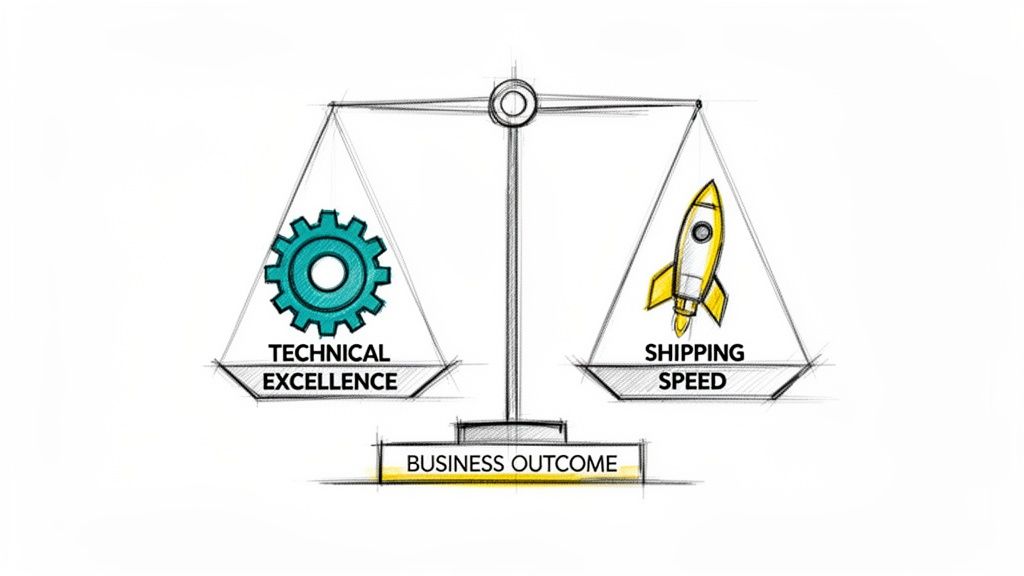
Alt Text: A balance scale shows technical excellence (gear) and shipping speed (rocket) balancing for a business outcome.
Great managers see this as a dynamic equilibrium, not a one-time choice. They should articulate a framework for when to prioritize velocity (e.g., an MVP to test a market) versus when to invest in technical excellence (e.g., refactoring a core service).
How to Evaluate Their Answer
A strong answer will go beyond "it depends" and provide a concrete framework and real-world examples.
Look for evidence of:
- Pragmatic Decision-Making: Can they provide a specific example where they consciously incurred technical debt to meet a deadline? For instance, deploying an AI model with 75% accuracy for a V1 launch, with a clear plan to iterate post-launch.
- Data-Informed Frameworks: Do they mention using metrics to guide their choices? A great answer might discuss measuring the impact of tech debt on developer velocity (e.g., using cycle time) to justify a refactoring sprint.
- Risk Mitigation: How do they ship quickly without breaking things? Listen for techniques like feature flags, robust monitoring, or investing in automated testing infrastructure.
- Business Acumen: A top candidate connects their technical strategy directly to a business outcome. They solve customer problems and drive revenue, user growth, or operational efficiency.
Key Insight: Avoid candidates who present a false dilemma. The best managers know that investing in technical excellence (like better CI/CD) is often the fastest way to increase sustainable shipping speed. Ask a follow-up: "Tell me about a time this balancing act went wrong. What did you learn?"
3. Describe Your Approach to Hiring, Onboarding, and Retaining Top AI/ML Talent
In the competitive AI landscape, a manager's ability to build and sustain a specialized team is a critical differentiator. This question assesses their understanding of the unique AI/ML talent lifecycle. The market for senior MLOps or LLM engineers is incredibly tight, so their strategy for attracting, developing, and keeping them is a direct indicator of future success.
This question tests their strategic thinking across the entire talent pipeline. It reveals if they have a repeatable, scalable system for identifying, onboarding, and retaining top talent.
How to Evaluate Their Answer
A compelling answer will detail a cohesive, end-to-end strategy, not just a list of tactics.
Look for evidence of:
- A Specialized Hiring Process: Did they build custom hiring rubrics for specific roles? Do they have a clear philosophy, such as a "Hire one, help hire two" model that involves the existing team?
- Structured Onboarding: A strong candidate will describe tailored onboarding tracks. For instance, creating separate paths for MLOps engineers focused on infrastructure versus applied scientists focused on model experimentation.
- Proactive Retention Strategies: Listen for how they create an environment for continuous learning. This could include sponsoring conference attendance or defining clear career paths that don't force a great researcher into a management role.
- Metrics-Driven Approach: Top managers track their effectiveness. Ask for specifics on their average time-to-hire or how they measure the impact of new hires. Great answers may reference improving quality of hire metrics over time.
Key Insight: The best candidates view talent management as a product, not a process. They constantly iterate on their approach. Ask about sourcing channels, managing compensation, and retaining engineers who receive frequent competitive offers.
4. Tell Me About a Time You Delivered Results with Limited Resources
This question uncovers a candidate’s resourcefulness and ability to generate leverage. In startups, achieving significant outcomes without a proportional increase in headcount is a superpower. It separates managers who execute with given resources from leaders who creatively multiply their team's impact.
Alt Text: Three cartoon figures pushing a large gear labeled 'Product Launch' with APIs, Pretrained Models, and Automation.
This is a direct probe into their ability to make tough trade-offs and ruthlessly focus on the highest-value work without causing burnout.
How to Evaluate Their Answer
A strong answer will focus on strategic leverage rather than just brute-force effort.
Look for evidence of:
- Ruthless Prioritization: Did they clearly articulate how they de-scoped the project to its essential core? Could they explain the "what we are not doing" decisions and why?
- Creative Resourcing: Did they leverage external APIs, open-source tools, or pre-trained models? A great answer might involve using a managed service or hiring a fractional specialist.
- Sustainable Practices: How did they manage team energy and prevent burnout? Look for signs of smart automation and protecting the team from distractions, rather than celebrating unsustainable efforts.
- Business Acumen: Did they connect their resource-constrained solution to a direct business impact? A top candidate will frame their success in terms of shipping an MVP that secured a design partner.
Key Insight: The best answers demonstrate multiplication, not just addition. A manager who explains how they automated a process to save 10 hours per week forever is far more impressive than one who says their team just worked extra hours.
5. How Do You Approach Technical Decision-Making and Architecture Reviews?
This question probes a manager’s technical credibility and their framework for fostering engineering excellence. It reveals if they can balance short-term delivery with long-term architectural health. The answer shows whether they operate with a consistent process or make decisions based on ad-hoc intuition.
For leaders in AI/ML, this is even more critical. Their approach to decisions around model serving infrastructure or build-vs-buy for MLOps tooling directly impacts the team's velocity and the reliability of AI products.
How to Evaluate Their Answer
A compelling answer will describe a structured process that empowers engineers while ensuring architectural coherence.
Look for evidence of:
- Structured Frameworks: Do they mention using tools like RFCs (Request for Comments) or Architecture Decision Records (ADRs)? This demonstrates a systematic approach to evaluating trade-offs.
- Collaborative Leadership: Great managers facilitate decisions rather than dictating them. Look for language about guiding discussions and building consensus.
- Business Acumen: Can they connect technical choices to outcomes like cost, performance, or time-to-market? An excellent response will frame an architectural choice within these constraints. For deeper insights, explore these software architecture best practices.
- Humility and Learning: Top candidates will readily discuss a past decision they got wrong. This shows self-awareness and a commitment to continuous improvement.
Key Insight: A manager's role in architecture is often more about asking the right questions than having all the answers. Ask a follow-up: "How do you handle strong disagreements between senior engineers during a review?"
6. Describe Your Leadership Philosophy and How You've Adapted It
This question cuts to the core of a candidate's self-awareness and ability to evolve. It forces them to connect their philosophy to concrete situations: team growth and the shift from tactical to strategic leadership.
A static leadership style is a liability in a high-growth environment. A manager who uses the same hands-on approach for a team of 20 that they used for a team of five will become a bottleneck. The intent is to find leaders who understand that their job fundamentally changes as the team scales.
How to Evaluate Their Answer
A strong response demonstrates a clear, values-driven philosophy but also shows flexibility in its application.
Look for evidence of:
- Situational Awareness: Do they recognize that different stages require different leadership styles? For example, moving from direct task management to setting context for leads in a larger group.
- Scalable Systems: How did they replace themselves? A great answer will mention creating systems like career ladders, decision-making frameworks (e.g., RACI), or structured communication channels.
- Core Principles vs. Tactics: Can they separate their non-negotiable values (like psychological safety) from their tactics (like daily stand-ups)? A mature leader knows which to hold onto and which to discard.
- Self-Reflection: A top-tier candidate will talk about a time their old approach failed and what forced them to change.
Key Insight: The best answers are specific about the "inflection points." Ask a follow-up: "What was the first sign your old communication style was breaking down?" Their ability to diagnose and adapt is what you're truly hiring for.
7. Tell Me About a Difficult Conversation You Had with an Engineer
This question cuts directly to a manager's emotional intelligence (EQ). Technical skills build a product, but interpersonal skills build a high-performing team. How a leader navigates underperformance or conflict reveals their true management philosophy.
This question tests a candidate's capacity for empathy, directness, and fairness. It’s not about finding a manager who avoids difficult conversations, but one who can conduct them with professionalism and compassion.
How to Evaluate Their Answer
A strong answer will demonstrate a structured, empathetic, and responsible approach.
Look for evidence of:
- Preparation and Fairness: Did they gather specific, fact-based examples before the conversation? A good manager prepares with data and clear intentions.
- Direct and Empathetic Communication: Could they deliver a difficult message clearly and respectfully? Listen for phrases like "My goal for this conversation is..."
- Focus on Solutions and Support: Did the conversation end with a clear action plan and a commitment of support? Effective managers are equipped with various conflict resolution strategies workplace managers need.
- Accountability and Self-Reflection: A great candidate acknowledges their own role in the situation. Perhaps they didn’t set clear expectations or provide timely feedback earlier.
Key Insight: The best answers show the manager separating the person from the problem. Ask a follow-up: "How did the relationship evolve after this conversation?" to gauge their long-term effectiveness.
8. How Do You Measure Engineering Team Performance and Impact?
This question reveals a leader's philosophy on accountability and value creation. A candidate’s answer shows whether they can connect engineering output to business outcomes or if they rely on misleading metrics like lines of code.
A great answer demonstrates a sophisticated understanding of how to blend quantitative metrics with qualitative signals to get a holistic view of team health and effectiveness.
How to Evaluate Their Answer
A strong response will frame metrics within a system of continuous improvement, connecting data to actions and team rituals.
Look for evidence of:
- A Metrics Framework: Do they mention a well-understood framework like DORA (Deployment Frequency, Lead Time for Changes, Mean Time to Recovery, Change Failure Rate)?
- Business Alignment: Can they articulate how their chosen metrics link back to customer value or company goals? For example, connecting lower bug rates to higher customer satisfaction.
- Qualitative Insight: A top-tier manager knows metrics don't tell the whole story. Listen for mentions of team health surveys, one-on-one feedback, and direct observation.
- Adaptive Measurement: The best candidates will share a story about when a metric led them astray and how they adjusted their approach.
Key Insight: The best answers show that metrics are a tool for the team, not a weapon to be used against them. Ask how they present and discuss metrics with their engineers.
9. Describe Your Experience with Building Remote Teams
In a remote-first world, this is a core competency assessment. This question probes a candidate's ability to build high-performing teams without physical co-location. It reveals their aptitude for intentional communication and fostering a cohesive culture across geographical divides.
A strong answer will demonstrate a systematic approach to overcoming the inherent challenges of remote work. This includes time zone fragmentation, communication latency, and building personal rapport. This is one of the most practical engineering manager interview questions for companies operating on a global or remote-first model.
How to Evaluate Their Answer
A compelling response moves from tools to principles. It should detail specific rituals and processes they established to make distributed work a strategic advantage.
Look for evidence of:
- Intentional Communication: Did they establish clear protocols for synchronous versus asynchronous communication? A great answer mentions creating an "async-first" documentation culture.
- Inclusive Processes: How did they ensure team members in different time zones felt included? Listen for specifics like rotating meeting times or establishing core collaboration hours.
- Culture and Cohesion: What deliberate actions did they take to build team trust remotely? Examples include virtual off-sites or a robust remote onboarding process.
- Operational Excellence: Can they describe how they maintained engineering velocity and quality? Probe for their approach to remote pair programming or effective code reviews across time zones. For more insights, review best practices to manage a remote team.
Key Insight: The best candidates see remote work as a distinct operating model. They don’t just replicate office-based practices online; they design new systems that leverage the benefits of a distributed structure.
10. Tell Me About a Time You Failed as a Manager and What You Learned
This question directly probes for humility, self-awareness, and a growth mindset. A candidate unable to articulate a real failure is a major red flag. Leadership isn't about being perfect; it's about resilience and learning from mistakes.
The question's intent is to see how a candidate processes and grows from adversity. It’s a test of authenticity. The story they choose, the ownership they take, and the lessons they derived are far more important than the failure itself.
How to Evaluate Their Answer
A strong answer moves beyond a sanitized failure (e.g., "I worked too hard") and dives into a specific situation with real consequences.
Look for evidence of:
- Radical Ownership: Does the candidate take full responsibility? They should use "I" statements ("I failed to...") rather than blaming external factors.
- Clear Impact Analysis: Can they articulate the negative consequences? This could be project delays, team burnout, or a loss of stakeholder trust.
- Actionable Learnings: What specific, tactical changes did they make to their process or management approach? A great answer connects the lesson directly to a new habit.
- Vulnerability and Humility: The candidate should be comfortable discussing their shortcomings without becoming defensive. This maturity is essential for building trust.
Key Insight: The best candidates tell a story where the lesson learned is more impressive than the failure was damaging. A weak answer is a success story in disguise ("my biggest failure was caring too much, and we still shipped on time").
Actionable Checklist for Your Hiring Process
Use this framework to build a structured and effective interview loop for your next engineering manager role.
- Define the Role-Specific Needs: Before interviewing, create a simple scorecard listing the top 3-5 skills your team needs right now (e.g., scaling a team from 5 to 15, improving release velocity, hiring specialized ML talent).
- Build a Balanced Interview Panel: Ensure your loop includes a mix of stakeholders: a direct report, a peer (e.g., a Product Manager), and a senior leader. Assign specific questions to each interviewer to avoid repetition.
- Use a Consistent Scorecard: Create a shared document where interviewers can score candidates on a 1-4 scale for key competencies like Technical Strategy, People Leadership, and Execution. This minimizes "gut feel" decisions.
- Conduct a Practical Exercise: Assign a short, relevant take-home task. Example: "You are taking over a team struggling with long release cycles. Write a 1-page document outlining the first 3 questions you would ask the team and your initial 30-day plan to diagnose the problem."
- Hold a Calibration Session: Before interviews begin, meet with the panel to align on what a "good" answer looks like for each question. This ensures everyone is evaluating candidates against the same standard.
What to Do Next
Armed with these engineering manager interview questions, you can move beyond surface-level evaluations to find a true leader.
- Build Your Interview Kit: Select the 5-7 questions from this list that are most critical for the role. Document them, along with your ideal answer criteria, in a shared document for your hiring team.
- Conduct a Calibration Session: Before the first interview, gather your panel. Walk through the questions and the scorecard together to ensure everyone is aligned.
- Refine and Iterate: After each interview loop, hold a debrief. Treat your hiring process like a product: continuously gather feedback and improve it.
Ready to skip the noise and connect directly with elite, pre-vetted AI engineering leaders? ThirstySprout specializes in matching you with top-tier talent who have already demonstrated the leadership and technical skills these questions uncover. Build your high-impact AI team in days, not months.
Hire from the Top 1% Talent Network
Ready to accelerate your hiring or scale your company with our top-tier technical talent? Let's chat.