

Most data science hiring advice still optimizes for the wrong thing. It treats the job like a contest for the strongest modeler or the fanciest credential, then acts surprised when the hire can't ship anything useful in production.
If you're hiring for a team that has to deliver real systems, the bar is different. You need people who can work across experimentation, data engineering, MLOps, product constraints, and the messy handoffs in between. That's why the strongest signal isn't Kaggle-style depth or pedigree, it's production ownership.
TL;DR
- Hire for system-building ability, not just modeling fluency.
- Define the role around the actual work, then scope seniority to match the market.
- Build a funnel with explicit conversion targets, or you'll overfill the top and starve the bottom.
- Use structured interviews and calibrated rubrics to test collaboration, deployment thinking, and decision quality.
- Treat onboarding as part of hiring, because ramp speed and retention tell you whether the process worked.
Why Most Data Science Hiring Advice Fails in Production
The common mistake is simple, hire for the smartest notebook. That works only if the job ends at a notebook. In production teams, the work usually stretches into data pipelines, feature quality, deployment, observability, and product trade-offs, which is why the market has shifted toward titles like Applied LLM Engineers, Retrieval Engineers, AI Platform Engineers, RLHF/Alignment Ops, and AI Evaluation/Safety Specialists as systems move from experimentation to production, with budgets following the same path toward versioned, observable, ROI-tracked features (Burtch Works 2025 industry report).
Credentials can add noise, not signal
Elite credentials and narrow pedigree checks often make hiring feel safer without making it better. They can raise the average resume quality in the pile, but they don't tell you whether someone can work through ambiguous requirements, collaborate with product, or keep a model alive after launch.
Practical rule: if the job includes handoffs, monitoring, or data ownership, the interview must test those behaviors directly.
That's the contrarian move in data science hiring. You stop asking, “Who has the strongest academic story?” and start asking, “Who has shipped something that survived contact with real users, real data, and real constraints?” The best candidates usually show evidence of ownership across the whole loop, not just a polished experiment.
The job has moved closer to engineering
Recent guidance on inclusive hiring pushes toward structured interviews, calibrated rubrics, and shorter loops, while warning that conventional signals like elite credentials, salary history, and narrow pedigree checks can introduce bias without improving signal (Inclusive data science hiring guidance). That lines up with what I've seen on teams that ship LLM and machine-learning products: the candidate who can explain trade-offs, document decisions, and work through production constraints tends to outperform the candidate who only knows how to maximize offline metrics.
The practical implication is blunt. If your interview loop doesn't test system ownership, your process will over-select for people who interview well about modeling and under-select for people who can deliver. That's why the rest of the playbook focuses on role design, funnel math, structured evaluation, and onboarding feedback, because those are the levers that change outcomes in real hiring.
Defining Roles and Seniority Levels That Match Market Reality
Role definition is where a lot of hiring processes break down. Teams write a vague “data scientist” job description, then realize they need a data engineer, an applied ML operator, or a senior individual contributor who can own production outcomes end to end. The fix is to define the work before you define the title.
The market is already showing that shift. Another hiring analysis found that 86% of data science roles were individual-contributor positions, 92% were permanent roles, and when location was listed, 54% were hybrid and 23% were fully remote (Interview Query market report). The same report also found that only about 15% of postings were junior or entry-level, while 45% were mid-level and 40% were senior or staff-level. That mix points to a market built for experienced builders, not for people whose only signal is classroom depth or a strong competition profile.
Use a decision tree before you write the req
Start with the business problem, then choose the role shape.
- If the team needs dashboards, reporting, and SQL-heavy analysis, the right hire may be a data analyst or analytics engineer, not a generalist data scientist.
- If the team needs feature pipelines, reliability, and platform work, a data engineer or AI platform engineer may fit better.
- If the team needs experimentation plus production shipping, hire someone who has done both, and say that plainly in the job description.
- If the team is building LLM features, look for candidates who can work across retrieval, evaluation, orchestration, and governance, not just prompt tinkering.
The strongest job descriptions describe the system, the users, the handoffs, and the failure modes. They do not just stack buzzwords. If you want senior candidates, say what they will own, what they will mentor, and where the team is still messy. Senior people self-select for hard problems, and they can spot vague scope from a mile away.
One practical way to sharpen the req is to use a structured drafting flow with your hiring manager, then pressure-test the wording against real candidates before you post it. Teams that use a clearer recruiting workflow, including tools that help organize role scope and evaluation inputs, tend to write better requisitions faster, which is exactly where an internal resource like ThirstySprout's AI recruiting tools overview can help.
Match seniority to maturity
A junior hire can work when the team has strong review habits, stable infrastructure, and a manager with time to coach. A senior hire fits when the team needs someone to create structure, make trade-offs, and reduce ambiguity. Management roles should appear only when the team needs coordination that senior IC leadership cannot cover.
| Seniority Level | Typical Experience | Core Responsibilities | When to Hire |
|---|---|---|---|
| Junior | Early-career, limited production ownership | Analysis, cleanup, support work | When the team has strong mentoring and simple scope |
| Mid-level | Some shipped work, can operate with guidance | Feature work, experiments, applied modeling, cross-functional delivery | When you need reliable contribution without full ownership of strategy |
| Senior | Repeated production ownership | End-to-end delivery, architecture decisions, stakeholder alignment | When ambiguity is high and the work cuts across teams |
| Staff or Lead | Broad systems thinking, mentorship | Technical direction, quality standards, multi-team coordination | When the data function is becoming a platform or product layer |
If you are competing with large enterprises, do not pretend you will win on brand. Win on clarity, scope, and speed. Candidates with strong production instincts want to know whether they will own meaningful work or disappear into a vague title.
For teams that source through outbound or talent research, the EmailScout LinkedIn data scraping guide is a useful reference for building cleaner prospect lists without turning the process into a spam campaign.
Sourcing Strategies and Funnel Math That Actually Works
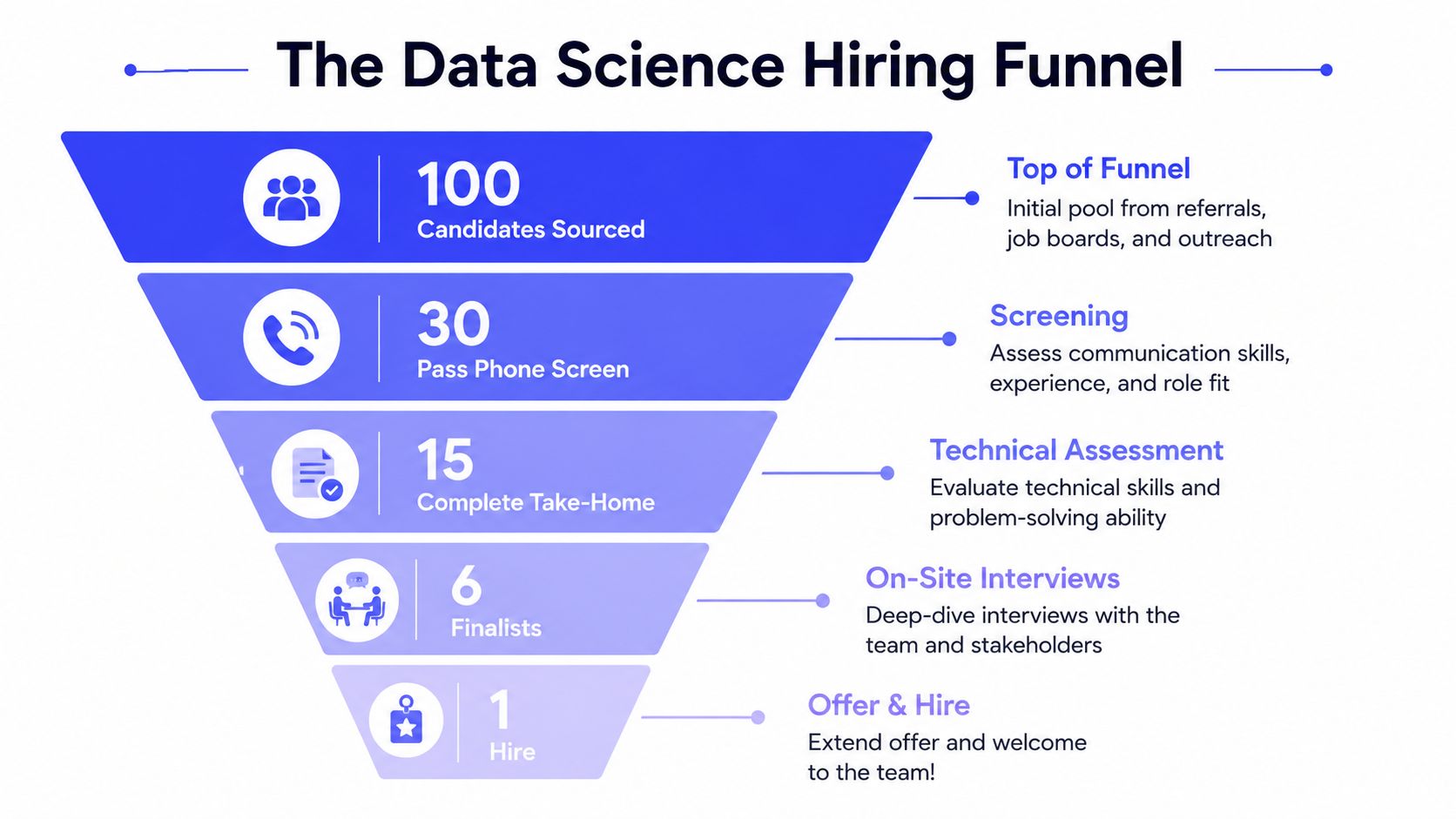
Teams waste effort at the top of the funnel. They spray job boards, collect hundreds of weak applications, then complain that the market is bad. The market is not the problem, the funnel is uncalibrated.
First Round's hiring model gives a useful operating target, 90% hire accuracy, 80% offer coverage of great candidates, 65% offer acceptance, and keeping hiring effort under 10% of team time (First Round hiring funnel guidance). Their example funnel also shows how 500 inbound applicants can collapse into 250 take-home submissions, 25 passes, 20 data-day attendees, 4 data-day passes, and 3 acceptances. That is a blunt reminder that sourcing volume is not the same thing as hiring capacity.
Build the funnel backward from the hire
If you need 1 hire, do not start by asking for 1,000 applicants. Start by asking how many qualified candidates you need at each stage, then decide which channel is likely to produce them. That usually means targeted outbound, referral paths, and niche communities matter more than broad inbound.
A practical sourcing mix looks like this:
- Inbound jobs pages and content bring in volume, but only help if your role is already well defined.
- Outbound on LinkedIn and GitHub works when you target candidates with visible production signals, not just keyword matches.
- Conference and community outreach helps when you need people already embedded in the kind of work you do.
- Specialized talent networks and agencies make sense when speed matters and your internal team cannot source at the needed depth.
If you want a tactical workflow for targeted outreach, the EmailScout LinkedIn data scraping guide is a useful reference for building lists more systematically, especially when your team is screening for production evidence instead of generic keyword fits. I would also keep an eye on AI recruiting tools for technical hiring if your recruiting team needs help triaging technical talent faster.
Do not ignore the market shape
Market shape still matters, because it changes which profiles you can realistically reach and how much persuasion you need to do. Some hiring markets skew toward individual-contributor roles, and when location is specified, hybrid and remote setups widen the pool but raise the bar for written communication and clear working agreements.
The same theme shows up in adjacent roles. A 2025 Interview Query report said Data Analyst openings increased 25% month-over-month and Data Engineer openings rose 42% month-over-month (February data science job market 2025). That is a signal to source beyond the “pure” data scientist label. The strongest candidates often sit in adjacent roles and can grow into the exact problem you have.
Interview Design and Evaluation Rubrics for Production Readiness
A good interview loop tests whether a candidate can help a team ship. A bad loop tests whether they can perform in a room. Those are not the same thing, and teams keep confusing them.
Design the take-home like real work
The best take-home exercises are small, ambiguous, and production-shaped. Give a candidate a messy dataset, a business question, and a few constraints, then ask for a short memo, a notebook, and a recommendation. Don't ask for a perfect model. Ask for decision quality, clarity, and sensible trade-offs.
Good prompts sound like this:
- “You inherit a churn dataset with missing fields and a vague stakeholder ask. What would you do in 2 hours, and what would you not do?”
- “A product team wants an LLM feature, but the retrieval layer is unstable. How do you evaluate the risk before you model?”
- “The offline metric improved, but support says the experience got worse. Walk through your debugging plan.”
Bad prompts reward memorization. They ask candidates to derive formulas from scratch or optimize toy problems that never appear in your environment. If the job includes collaboration and production ownership, your assessment has to include both.
Use a rubric that matches shipping work
The video below is a useful reference point for what production-minded evaluation can look like in practice, especially if you want a team to agree on what “good” means before interviews start.
A simple scorecard can keep the team honest:
| Category | What Good Looks Like | Red Flags |
|---|---|---|
| Code and architecture | Modular, tested, version-controlled | Hard-coded logic, no structure |
| Deployment | Containerized, CI/CD, monitoring | No path to production |
| Business impact | Clear KPI alignment, stakeholder framing | Clever work with no business link |
| Collaboration | Clear docs, onboarding plan | Can't explain decisions to non-technical partners |
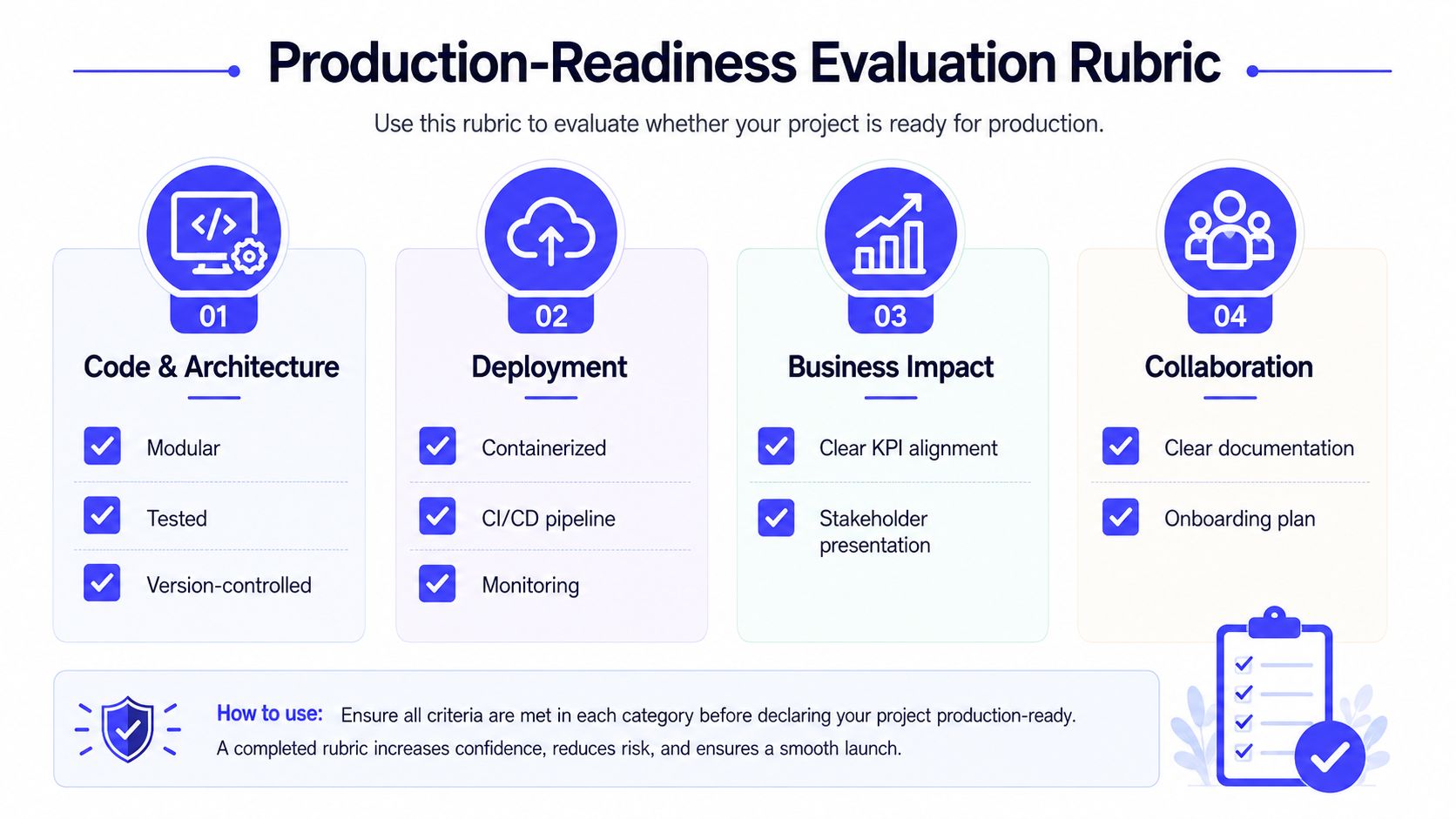
That's the kind of rubric that surfaces real signal. It also helps interviewers compare notes without turning the process into a popularity contest. For a deeper internal framework, see what is skills-based hiring.
Calibration rule: if two interviewers are scoring the same candidate very differently, the rubric isn't specific enough yet.
The other fix is shorter loops. Marathon interviewing favors endurance, not judgment. If someone can't give you a clean recommendation, explain the trade-offs, and talk through collaboration in a few focused conversations, more hours usually won't improve the signal.
Compensation Benchmarking and Remote Hiring Trade-Offs
Compensation is part math, part positioning, and part honesty about the scope of the role. If you underpay, your funnel gets weaker. If you overpay for a role that's too vague, you buy confusion at a premium.
Recent recruiting guidance recommends tracking time-to-fill, offer acceptance, and retention separately, with target ranges of 30-45 days overall and 40-60 days in tech for time-to-fill, 85-95% for offer acceptance, and 85%+ first-year retention, with 80%+ in tech (recruiting metrics guide). Those metrics are useful because they tell you whether the problem is sourcing, assessment, or compensation instead of blaming the candidate pool in general.
Choose contractor or employee based on risk
The decision isn't really about status. It's about how much integration the work needs.

A remote contractor fits work that is bounded, time-sensitive, and easier to compartmentalize. A full-time employee fits work that needs deep context, tight collaboration, and long-term ownership. If the role touches roadmap decisions, data standards, or team rituals, the employee model usually makes more sense.
For offer mechanics, it helps to review browse offer letter examples before you send a final package. The point isn't to copy language, it's to make sure the role, status, and expectations are written cleanly enough that nobody is surprised after acceptance.
Remote expands reach, but it raises coordination costs
Remote hiring gives you access to a much larger pool, which is helpful when the local market is thin. It also demands better documentation, more explicit handoffs, and stronger written communication. If a candidate needs a manager to rescue every ambiguous task, remote work will expose that quickly.
Local hiring can feel easier because the collaboration loop is shorter. But it narrows your market and often slows the search when the role needs rare production experience. The right answer depends on where the bottleneck is, recruiting reach or execution complexity.
ThirstySprout is one option for teams that need vetted remote AI and data specialists across full-time, contract, or fractional models, but the model only works when the role is scoped tightly and the team is ready to manage distributed delivery. If you're not ready for that, the safer move is to narrow the scope before you widen the geography.
Onboarding Plans and KPIs That Close the Hiring Loop
Hiring doesn't end when the offer is signed. If a new hire doesn't become useful quickly, the cost of the miss shows up later in delivery delays, rework, and manager drag.
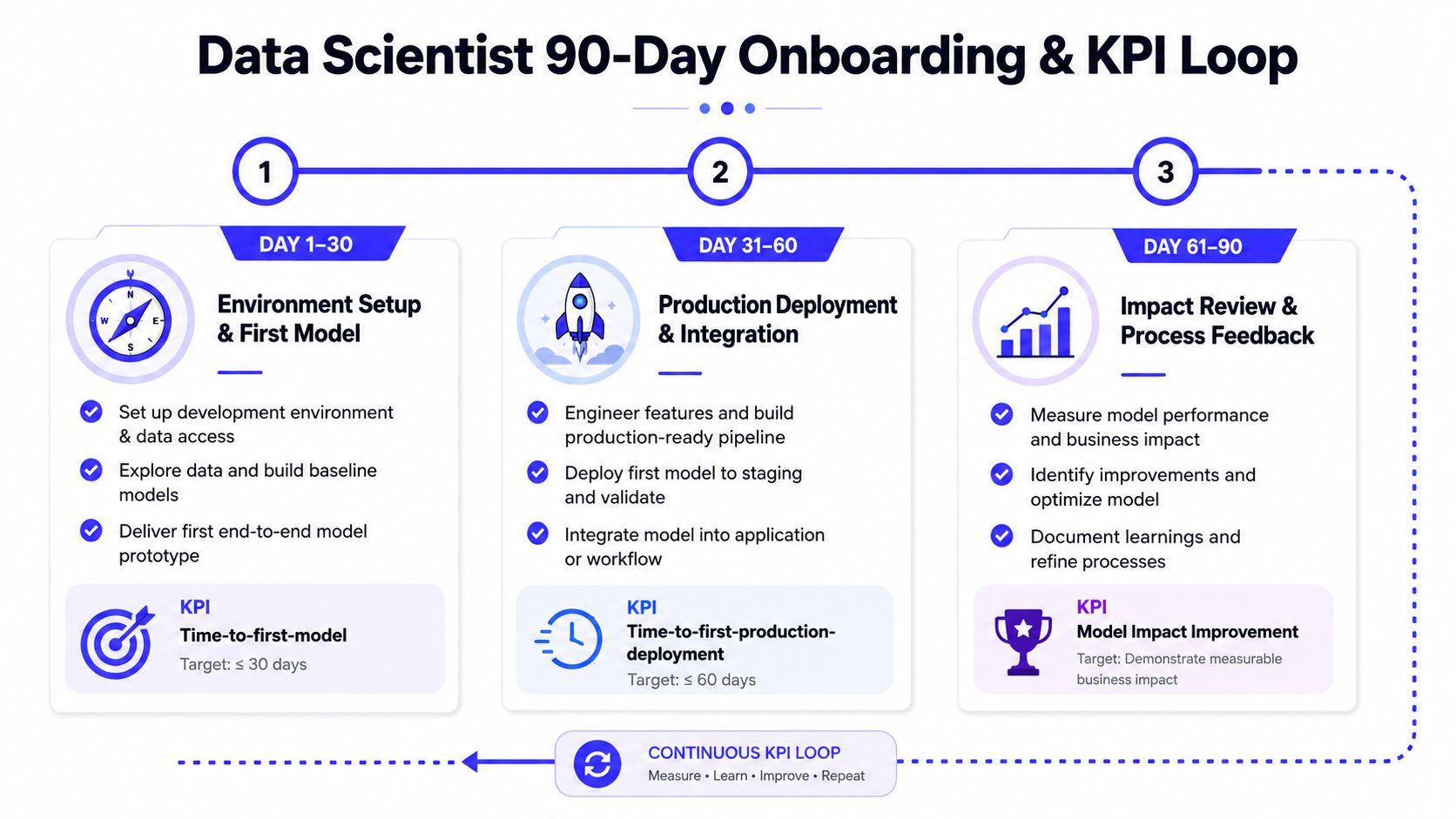
A simple onboarding playbook should map the first 30, 60, and 90 days. The candidate should learn the data environment first, then ship a contained production task, then connect that work to business outcomes and process improvement. A useful onboarding checklist for general employee ramping is available in how to onboard new employees, and the same principle applies here, with more emphasis on data access, code review, and deployment paths.
Track the right signals early
Use onboarding metrics that tell you whether the hire is compounding value.
- Time to first meaningful contribution: how quickly the person ships something the team can use.
- Quality of handoff: whether docs, tests, and communication reduce follow-up work.
- Stakeholder confidence: whether product and engineering trust the person's judgment.
- Retention and ramp: whether the hire still fits once actual work becomes visible.
For a broader framework on measuring hiring outcomes, see quality of hire metrics. The key is to close the loop. If multiple hires stall in the same place, the problem might be the job design, not the person. If new hires keep succeeding only after long rescue cycles, the assessment loop is too optimistic.
That feedback loop is where good data science hiring starts to compound. You define the role tightly, source with funnel math, test for production readiness, and then use onboarding data to refine the next round. Teams that do this well stop arguing about abstract talent quality and start improving the system that produces it.
If you need to hire data scientists who can ship in production, ThirstySprout can help you scope the role, calibrate the interview loop, and source vetted candidates who fit your stack and time zone. Visit ThirstySprout to start a pilot, or reach out if you want a tighter hiring plan for your next AI or data opening.
Hire from the Top 1% Talent Network
Ready to accelerate your hiring or scale your company with our top-tier technical talent? Let's chat.