

A promising model can pass offline evaluation and still fail on its first production request. The feature may arrive late, a source schema may change without notice, or a retrieval index may contain documents that the model shouldn't use. The algorithm gets blamed because it is visible. The data system caused the failure.
That pattern makes data engineering for AI and machine learning more than a support discipline. It is the production control plane that decides which data enters training, how that data is transformed and split, what reaches inference, and how the team detects degradation afterward.
Introduction Why Data Engineering Decides AI Success
A founder sees a support copilot answer correctly in a demo. A CTO approves the launch. Then customers begin asking about newly changed policies, while the ingestion job still delivers yesterday's content. The model hasn't changed, but its available evidence has. Users experience the result as an unreliable product.
This is why a production AI system needs more than model selection. It needs dependable collection, ingestion, storage, transformation, validation, labeling, feature or embedding management, serving, lineage, and monitoring. Each layer controls a different failure mode. If the system can't show where a training row came from, which transformation produced it, or when a retrieved document was last validated, the team can't diagnose performance with confidence.
The discipline has deep roots. The term statistics was coined in Germany in 1749, and its connection to probability theory reaches back to the 16th century. AI and machine learning applications appeared in upstream oil and gas in the early 1990s, then reached reservoir engineering and modeling by the early 2000s, as described in this historical account of statistics and AI in energy. Modern pipelines are the latest stage of that progression, not a recent add-on.
Practical rule: Treat every dataset, feature set, label set, and retrieval corpus as a production dependency with an owner, a version, and a failure policy.
This guide is for founders, chief technology officers, machine learning leads, platform engineers, and hiring teams who need an AI system to operate within weeks, not remain a successful experiment. You'll learn how to choose a minimum viable architecture, separate offline training from online inference, apply quality gates without creating bureaucracy, and decide when lightweight tools are enough. You'll finish with a checklist for building a system that protects time to value, operating cost, model quality, and business risk.
What Data Engineering for AI ML Really Means
Data engineering for AI and machine learning is the design of systems that collect, store, transform, validate, and serve data for two connected jobs: training a model and using that model in production.
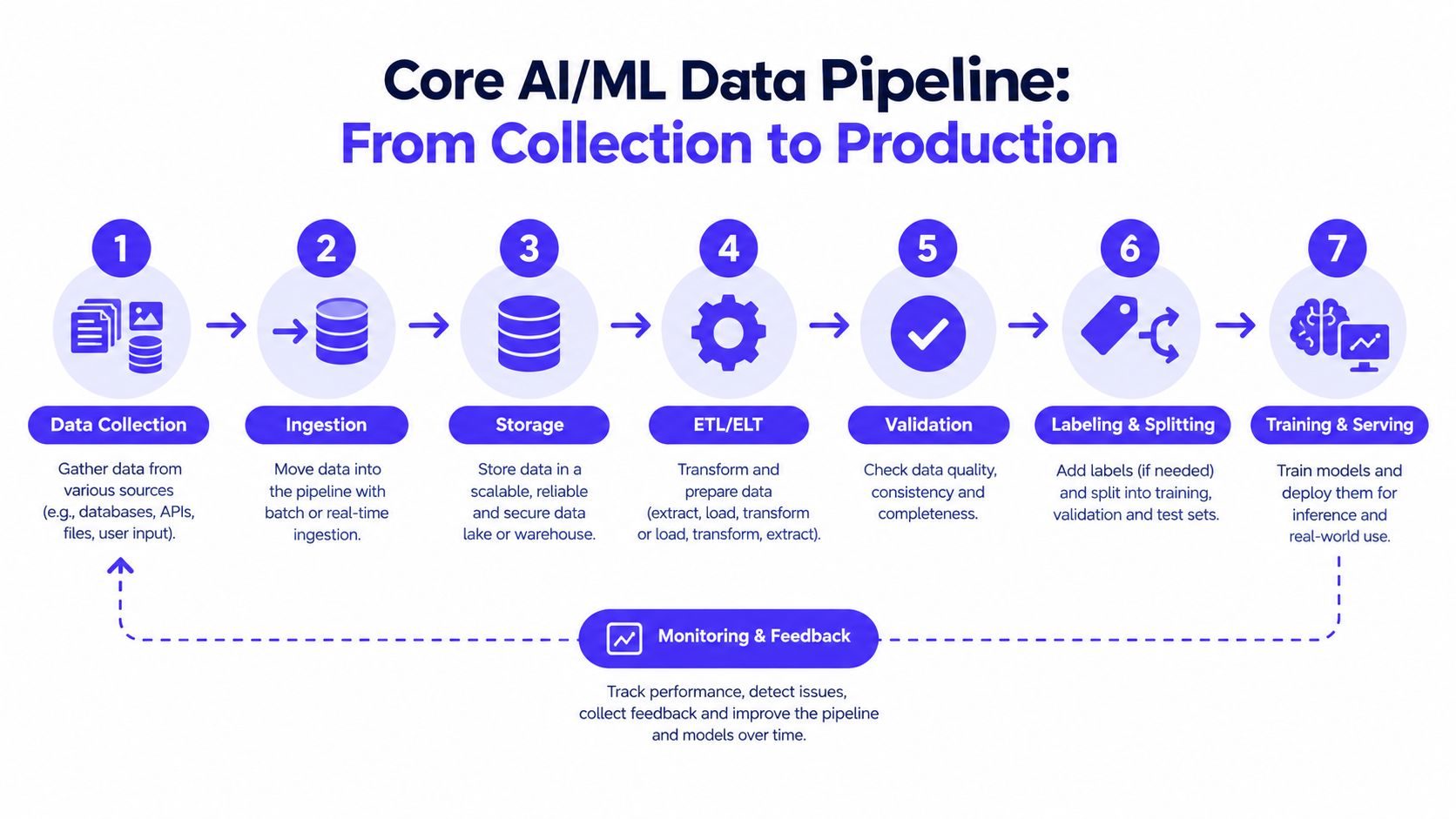
A useful analogy is a factory. Raw materials arrive from suppliers, inspectors reject damaged inputs, operators prepare consistent parts, and the finished goods move to customers. An AI pipeline works the same way:
- Collection brings in events, documents, transactions, sensor readings, or labels.
- Ingestion moves those inputs reliably into your platform.
- Storage preserves raw and curated forms with access controls.
- Transformation creates usable tables, features, chunks, or embeddings.
- Validation checks whether the data meets agreed requirements.
- Labeling and splitting prepare supervised learning assets without leakage.
- Training and serving deliver inputs to models in development and production.
The factory also needs traceability. If a product fails, the operator must identify the supplier, batch, inspection result, and process change. In AI, that traceability is lineage. Without it, a model regression becomes a debate instead of an investigation.
Where the discipline fits
Traditional analytics engineering usually optimizes trusted datasets for reporting and decision support. AI data engineering overlaps with it through modeling, testing, documentation, and warehouse practice, but adds requirements for training reproducibility, label quality, feature freshness, inference latency, evaluation data, and feedback loops.
MLOps, or machine learning operations, focuses on reliably developing, deploying, and operating models. Data engineering supplies much of the material MLOps manages. Google's Practitioner's Guide to MLOps describes the dataset and feature repository as primary development-data sources and treats curated assets at the entity-feature or full-dataset level as managed inputs.
That leads to a durable design principle:
A curated dataset or feature isn't an incidental extract. It's a versioned product that a model depends on.
For a practical introduction to corpus construction, document quality, and training inputs, Cyndra's AI dataset guide can help teams establish shared vocabulary before they choose tools.
Core Pipeline From Collection to Production Monitoring
Start with the business decision, not the platform. Ask what the model must predict, retrieve, classify, or generate, then identify the minimum data needed to support that behavior. This prevents teams from building a broad platform before they understand the product's actual freshness, latency, and governance requirements.
1. Collect and ingest with contracts
List every source, including application databases, event streams, file stores, third-party systems, and human labeling tools. For each source, record its owner, expected schema, update behavior, sensitivity, and failure response.
Ingestion should preserve the source representation before applying heavy transformations. Keep arrival timestamps and source identifiers. These fields make late data, duplicates, and replay behavior diagnosable.
2. Store raw and curated layers
A raw layer gives you an auditable landing zone. A curated layer gives models stable inputs. Don't overwrite raw records merely because a cleaned table is easier to query. You may need the original payload to reproduce a training set or understand a changed interpretation.
Storage design should reflect workload. Historical training often favors economical bulk access, while inference may require indexed or low-latency access. A small team can start with fewer layers, but it still needs clear ownership and retention rules.
3. Transform, validate, and label
Transformations should be reproducible and reviewable. Typical work includes type normalization, deduplication, entity resolution, document parsing, chunking, feature calculation, and label creation.
Put validation before training and before release. Check schema, null behavior, ranges, duplicate rates, freshness, and distribution changes. Benchmark datasets can contain label errors, annotation artifacts, privacy or copyright violations, harmful content, and representational bias, so quality gates need an issue-reporting workflow as well as automated tests, as documented in this benchmark-data study.
Split data by the behavior you need to predict. A random split can leak future information when records are time-dependent or when near-duplicate documents cross boundaries. Freeze the split definition and store its version.
4. Serve and monitor the full loop
Training consumes a versioned dataset or feature set. Inference consumes features, documents, or embeddings under different freshness and latency constraints. Monitoring must connect production inputs to model outputs and user feedback.
Track whether sources arrive, whether transformations succeed, whether retrieval returns valid context, and whether prediction inputs resemble the data used during evaluation. Data monitoring doesn't replace model evaluation. It explains why a model may be behaving differently.
Teams comparing orchestration, transformation, and validation options can use this guide to data pipeline tools as a starting point, then test candidate tools against their own failure modes.
Batch Streaming and Feature Stores for Training and Inference
Batch and streaming aren't maturity levels. They're delivery patterns. Choose based on how quickly the business decision becomes stale and how much operational complexity the decision can justify.
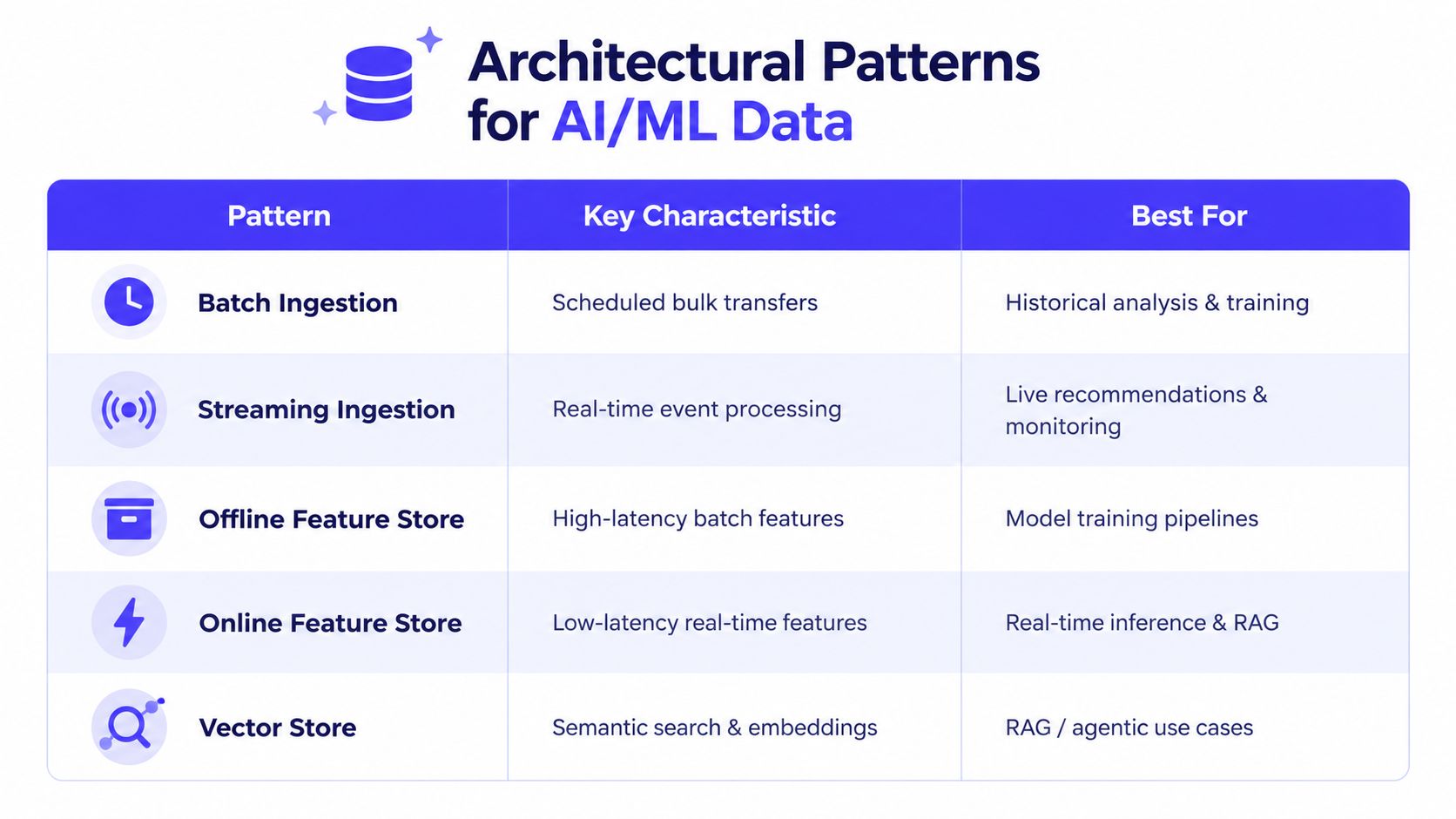
Batch ingestion suits scheduled training, reporting, periodic scoring, and document refreshes where a delayed update is acceptable. Streaming ingestion suits fraud signals, live recommendations, operational alerts, and agent workflows that read changing records. Streaming adds coordination, replay, ordering, backpressure, and incident-management concerns, so don't adopt it merely because it sounds modern.
Feature stores create another important split. The feature-store architecture reference describes an offline store that retains historical feature values with timestamps and an online store that retains the latest value for each entity for inference. The offline side supports reproducible training. The online side supports low-latency lookup.
| Workload | Recommended pattern | Latency and freshness trade-off |
|---|---|---|
| Periodic model training | Batch ingestion with an offline feature store | Lower operating complexity, historical data rather than immediate updates |
| Scheduled batch scoring | Batch ingestion and curated datasets | Efficient bulk processing, predictions can age between runs |
| Live recommendations | Streaming ingestion with an online feature store | Fresher inputs and lower serving delay, more operational overhead |
| Retrieval-augmented generation | Document pipeline with vector-compatible storage | Fast semantic lookup, quality depends on parsing, chunking, and embeddings |
| Agentic workflows over changing records | Streaming or event-triggered ingestion plus governed retrieval | Better freshness, greater need for permissions, lineage, and action controls |
A vector store isn't a replacement for a warehouse or feature store. It indexes representations for semantic retrieval. Keep source documents, metadata, permissions, and embedding versions outside the index or in linked systems so you can rebuild and audit it.
Selecting a small-team stack
For a small or mid-sized team, a lightweight combination such as DuckDB, dlt, and dbt can be sufficient when data volume, concurrency, and latency needs remain modest. It keeps the architecture understandable and reduces platform-management work. A lakehouse becomes more reasonable when you need shared governance across many producers, large-scale history, concurrent workloads, or broader organizational access.
The trade-off is not lightweight versus enterprise. It's minimum complexity versus required guarantees. A useful overview of feature stores in regulated settings is this explanation of feature-store banking use cases, especially when teams need to connect serving behavior with governance expectations.
Scaling Governance and Quality Without Overengineering
Governance should answer operational questions, not produce a library of unused documents. Who owns this field? What happens when it is late? Which data may the model access? Can the team reproduce the input behind a decision? Those answers should exist where pipelines run, not only in a policy folder.
Industry reporting in 2026 found that 72% of AI decision-makers say a poor data foundation is the root cause when enterprise AI initiatives fail, according to the cited analysis of AI and data-engineering evolution. The figure doesn't mean every organization needs a large platform. It means that data readiness is a direct production risk.
Put gates at the points of no return
Use strict checks before data enters training, before a model reaches production, and before an agent can act on sensitive or live information. Keep exploratory checks looser so engineers can learn without blocking discovery.
A practical gate set includes:
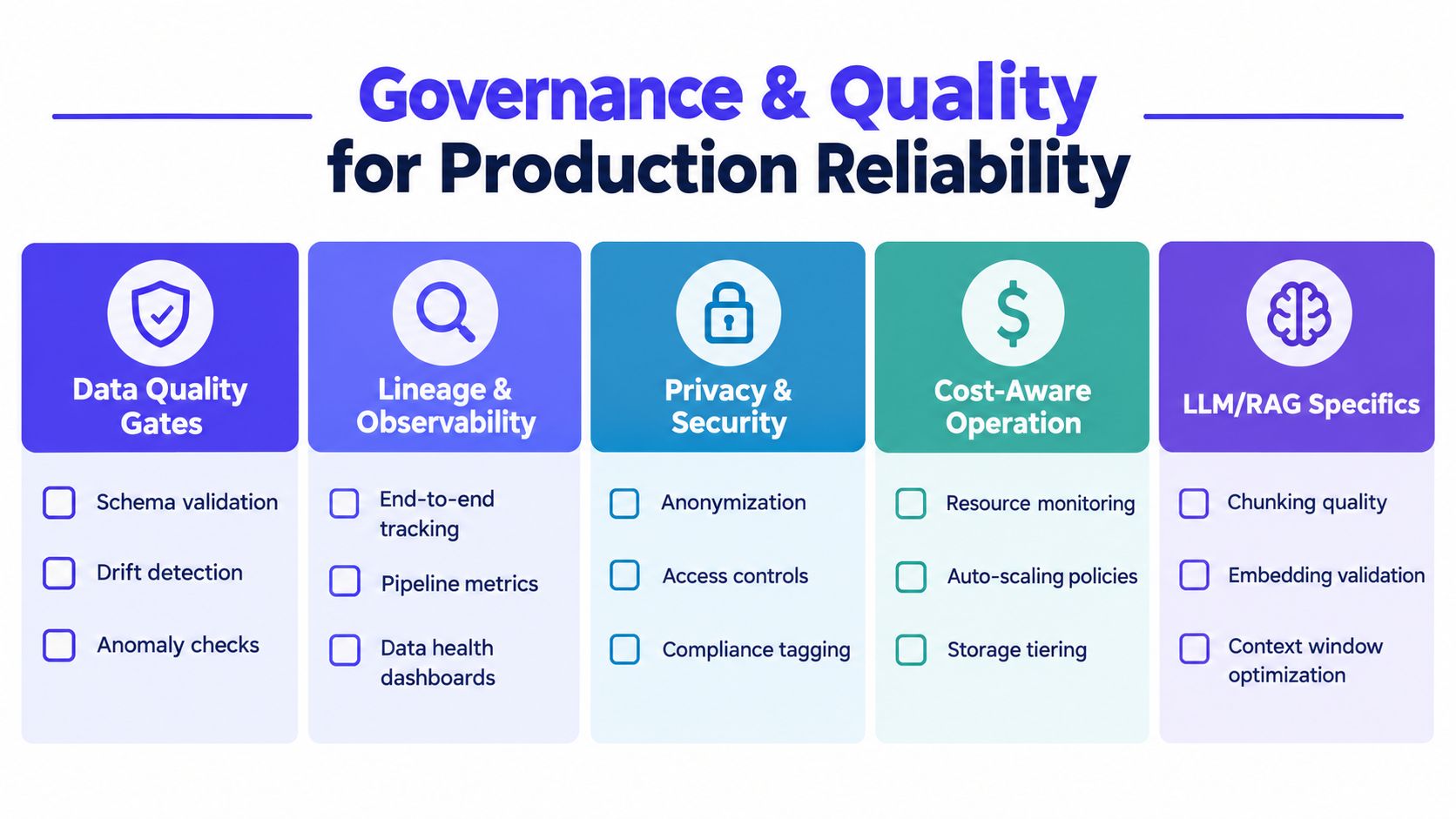
- Schema checks: Reject unexpected breaking changes and flag compatible additions.
- Freshness checks: Alert when a source or index falls behind its agreed expectation.
- Distribution checks: Investigate meaningful shifts in values, labels, or document composition.
- Leakage checks: Verify that future information or duplicate entities haven't crossed evaluation boundaries.
- Privacy checks: Apply access controls, anonymization, and compliance tags before model consumption.
- Retrieval checks: Validate metadata, permissions, chunking quality, and embedding generation.
The right threshold depends on the consequence of failure. A low-risk internal prototype may need warnings and manual review. A system that influences lending, safety, employment, or external actions needs stronger blocking rules and an auditable approval path.
Make lineage useful during incidents
Lineage should let an operator answer, “Which source change affected this prediction?” Connect source records to transformations, datasets, features, embeddings, model versions, and outputs. Add pipeline health metrics, ownership, and run history.
Data governance and master data management solve related but different problems. This comparison of data governance and master data is useful when teams are deciding whether they need policy ownership, entity consistency, or both.
Operator test: If an on-call engineer can't identify the affected source, last successful refresh, and downstream model within one incident response, your lineage is documentation, not control.
Control agentic and RAG risk
Agents combine private data access, untrusted content, and the ability to take actions. Apply least-privilege permissions, separate retrieval from write operations, log context and tool calls, and require approval for consequential actions.
Don't validate only the language model. Validate the data path that supplies it. For a broader evaluation of monitoring options, see this guide to AI observability platforms.
Cost control belongs in the same operating model. Monitor resource use, storage retention, embedding regeneration, streaming volume, and query behavior. A smaller, well-observed pipeline is safer than a sprawling stack with controls nobody maintains.
Real World Examples Lean Stack and Enterprise RAG at Scale
The architecture decision becomes clearer when you compare two operating contexts.
Example one with a lean retrieval stack
A Series A product team has a support knowledge base of under 50k documents. Its goal is a retrieval-augmented generation assistant, not a general-purpose data platform.
A sensible first design uses dlt for source extraction, object storage for raw documents, DuckDB for local or scheduled analytical work, dbt for curated transformations, and a vector store linked to document metadata. The pipeline stores source timestamps, access permissions, parser versions, chunking settings, and embedding versions.
The team can start with scheduled ingestion and add event-triggered refreshes for high-change sources. Its release gate checks document completeness, duplicate content, permission inheritance, embedding failures, and retrieval relevance against a reviewed evaluation set. The business outcome is a smaller surface area to operate and a faster path to learning whether the assistant solves a real support problem.
For implementation details, use this practical guide to build RAG systems alongside your own corpus and access-control review.
Example two with a governed retrieval platform
A scale-up with over 1M documents has a different problem. Multiple producers update content, users expect fresh answers, and the same platform supports search, assistants, and model features. A single scheduled job creates unacceptable blind spots.
Here, streaming or event-driven ingestion can route changes into a governed processing layer. The system maintains a vector index, a lineage graph, document-level permissions, embedding versions, and replayable processing states. An offline feature store can support historical training, while an online store serves current entity features to inference services.
The trade-off is clear. The larger platform can support freshness, concurrency, and centralized controls, but each new component creates another failure mode and operating responsibility. The lesson is not to copy the scale-up architecture. It is to introduce complexity only when a measurable product requirement demands it.
Your Next Steps Checklist to Build Production Ready Data Infra
Use this maturity scorecard in a working session. Mark each item missing, partially implemented, or operational.
- Source ownership: Every input has an owner and documented sensitivity.
- Replayable ingestion: The team can recover from failed or late source delivery.
- Versioned assets: Datasets, features, labels, embeddings, and splits have versions.
- Quality gates: Schema, freshness, leakage, privacy, and distribution checks run before release.
- Serving separation: Training history and low-latency inference data use appropriate stores.
- Lineage: Operators can trace a model input back to its source and transformation.
- Feedback monitoring: Production behavior, user feedback, and data drift reach the team responsible.
- Access control: Retrieval and agent actions enforce permissions at runtime.
- Cost visibility: Storage, processing, indexing, and regeneration costs are visible by workload.
Take three actions now:
- Map one AI path from source to model output, including owners and failure responses.
- Add the smallest useful gates before the next training run or retrieval release.
- Staff the missing capability. Hire a data engineer when ingestion, modeling, lineage, and feature or corpus reliability are the bottleneck. Add MLOps expertise when deployment, serving, evaluation, and operational monitoring need dedicated ownership. ThirstySprout can also help source remote data-engineering and MLOps specialists for production AI teams.
ThirstySprout helps companies hire vetted remote AI engineers, data engineers, MLOps specialists, and complete AI teams for production work. Visit ThirstySprout to start a pilot or review sample profiles for the data infrastructure your AI roadmap requires.
Hire from the Top 1% Talent Network
Ready to accelerate your hiring or scale your company with our top-tier technical talent? Let's chat.