

TL;DR
- Yes, they can. Software engineers are often more productive remotely due to fewer distractions and more deep-focus time. For roles like AI/ML engineering, it's a strategic advantage.
- It’s a talent magnet. Remote roles attract 2.5x more applicants, helping you hire niche experts (like MLOps engineers) in 2–4 weeks instead of months.
- Structure is non-negotiable. Success requires a remote-first operating model: asynchronous communication, a zero-trust security stack, and intentional culture-building.
- Measure output, not hours. Use a productivity scorecard focused on metrics like feature velocity and bug resolution time to track performance and prove business impact.
- Start with one high-impact role. Use the decision framework below to identify the best role to pilot a remote hire and build momentum.
Who this is for
This guide is for technology leaders who need to hire and manage high-performing engineering teams, specifically:
- CTOs / Heads of Engineering: Deciding on team structure, hiring strategy, and security architecture.
- Founders / Product Leads: Scoping roles and setting budgets for new features, especially in AI.
- Talent Ops / Hiring Managers: Evaluating the risks and operational needs for building a global team.
If you need to hire elite engineering talent and ship product faster, this is for you.
Quick Answer: A Framework for Deciding Which Roles Go Remote
Not every engineering role is equally suited for remote work. The decision depends on three core factors: task independence, collaboration style, and security requirements. Use this framework to make deliberate, low-risk decisions about your team structure.
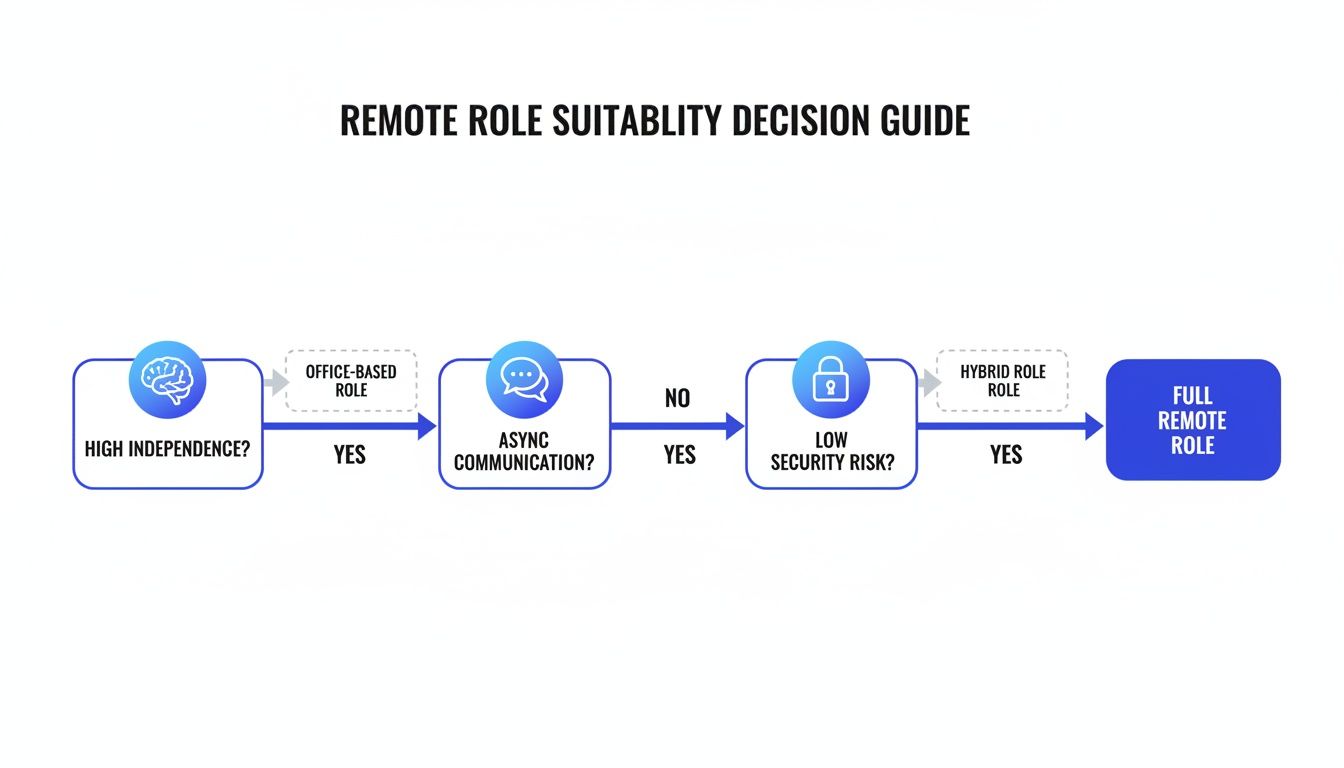
This decision tree helps you map roles to the right work model based on operational realities.
A role with high task autonomy and asynchronous collaboration needs (like a backend API developer) is a perfect remote fit. A role requiring constant physical hardware access (like an embedded systems engineer) is not.
Role Suitability Decision Matrix
Use this matrix as a scorecard to quickly assess your engineering roles.
Practical Examples of Remote Engineering in Action
Theory is good, but execution is what matters. Here are two real-world examples of how to structure remote engineering for business impact.
Example 1: Launching an AI Team in Under 30 Days
Situation: A Series A fintech startup needed to build a fraud detection model but couldn't find local machine learning (ML) talent. Their hiring process was stalled at 90+ days.
Action: They partnered with a global talent network to source and vet pre-qualified candidates. They focused on a structured, 30-day onboarding plan that included:
- A dedicated "onboarding buddy" for each new hire.
- A 90-day roadmap with clear first-month deliverables.
- Pre-configured laptops with all security software installed and VPN access ready.
Result: The startup hired three senior ML engineers across two continents in just four weeks. The new team began committing production-ready code within their first seven days, dramatically accelerating the product roadmap and time-to-value.
Example 2: Secure MLOps Remote Environment Configuration
Situation: An MLOps team handles sensitive customer data and needs remote access to production environments without compromising security.
Action: They implemented a zero-trust architecture. This ensures that even when a software engineer can work from home, the company's core assets remain protected.
Configuration:
- Mandatory VPN: All engineers must connect via a corporate Virtual Private Network (VPN) to access the Virtual Private Cloud (VPC).
- Bastion Host Access: All access to production databases, model repositories, and CI/CD pipelines is routed through a bastion host that requires multi-factor authentication (MFA).
- Strict IAM Policies: Identity and Access Management (IAM) roles are configured with least-privilege principles.
- Audit Logging: All actions within the VPC are logged for security audits and threat detection.
This setup gives engineers the access they need while providing robust security and compliance guardrails.
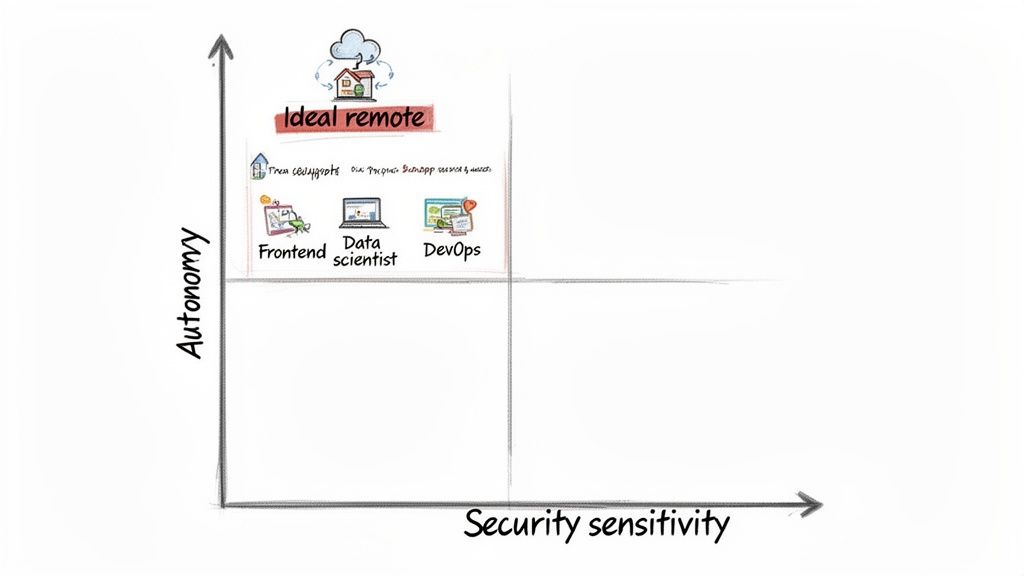
Mapping roles by autonomy and security sensitivity clarifies remote suitability.
Deep Dive: The Business Case and Trade-offs
Building a remote engineering team isn't just a perk; it's a strategic decision that impacts your burn rate, hiring speed, and ability to retain top talent.
The Business Case: Speed, Talent, and Retention
The shift to remote work has redrawn the talent map. Limiting your search to a 30-mile radius is a competitive disadvantage, especially for specialized roles in AI and MLOps.
- Hire Faster: Remote job listings attract 2.5 times more applications, widening your talent pool. Instead of spending 3–4 months searching for a senior ML engineer locally, you can tap a vetted global network and reduce time-to-hire to just 2–4 weeks. You can dig into the full 2025 remote hiring statistics for more data.
- Improve Retention: High turnover kills momentum. Data shows 62% of remote hires stay over two years, compared to just 41% of on-site staff. This stability creates a more productive and cohesive team.
- Reduce Operational Costs: The primary savings come from reduced operational overhead—less office space, fewer utilities, and lower employee turnover costs. These funds can be reinvested into product development, extending your runway. For flexible projects, strategic IT outsourcing development can further optimize costs.
The Trade-offs: Addressing Remote Work Challenges
Going remote isn't without challenges. The leaders who succeed are those who anticipate and solve for these common pitfalls.
1. Communication Silos and Culture Dilution
In an office, culture happens organically. Remotely, you must build it intentionally.
- The Problem: Without deliberate effort, teams can become isolated, knowledge sharing ceases, and camaraderie fades. This directly impacts code quality and retention.
- Engineer Social Interaction: Schedule virtual coffee chats, team lunches, and online game sessions.
- Default to Transparency: Use public Slack channels for project discussions, not direct messages.
- Establish Communication Norms: Create clear guidelines for when to use synchronous (video calls) versus asynchronous (docs, Loom) tools to protect deep focus time.
2. Stalled Growth for Junior Engineers
Junior engineers can't learn by osmosis or by tapping a senior developer on the shoulder.
- The Problem: Without a structured support system, their skill development can stall, leading to frustration and attrition.
- The Solution: Formalize mentorship. Pair every junior engineer with a senior "buddy" for their first six months. Mandate weekly 1-on-1s for coaching and require at least two hours of pair programming per week using tools like VS Code Live Share. This provides the dedicated support they need to thrive.
3. Global Compensation and Compliance Headaches
Hiring globally introduces complex legal and financial challenges.
- The Problem: Misclassifying an employee or failing to comply with local labor laws can result in significant fines and legal risk.
- The Solution: Use an Employer of Record (EOR). An EOR acts as your legal HR partner in each country, managing payroll, benefits, taxes, and compliance. This lets you hire the best talent anywhere without the administrative burden of setting up local legal entities.
Checklist: Is Your Company Ready for a Remote Engineer?
Use this checklist to assess your readiness. If you can't check at least 7 of these 10 boxes, address the gaps before you hire.
- Documentation Hub: We have a single source of truth (e.g., Notion, Confluence) for all key processes and technical decisions.
- Asynchronous-First Culture: Our team defaults to written communication and respects focus time.
- Clear Task Management: We use a project tool (e.g., Jira, Linear) where every task has a clear owner, requirements, and deadline.
- Secure Access Protocols: We have a mandatory VPN and clear IAM policies in place.
- Endpoint Security: All company devices are managed and have endpoint protection software installed.
- Structured Onboarding Plan: We have a documented 30-day plan for new remote hires.
- Output-Based Performance Metrics: We measure success based on deliverables (e.g., feature velocity), not hours worked.
- Formal Mentorship Program: We have a plan to support junior engineers' growth.
- Global Payroll Solution: We have a plan (e.g., using an EOR) to handle international compensation and compliance.
- Intentional Social Rituals: We have scheduled, non-work-related activities to build team connection.
What to Do Next: Your 3-Step Action Plan
Ready to move from theory to action? Follow these three steps to build your remote engineering team the right way.
1. Identify Your Highest-Impact Remote Role
Don't boil the ocean. Start with one critical role where a remote hire can deliver immediate value. Use the Role Suitability Matrix from earlier to identify a position that is both a natural fit for remote work and crucial to your product roadmap. A senior AI engineer or an MLOps specialist are often great starting points.
2. Prepare Your Internal Systems for Remote Success
A world-class engineer will fail if your internal systems aren't ready. Before you post a job description, get your house in order. Use the checklist above to audit your processes. Solidify your security protocols, document your communication norms, and finalize your onboarding plan. Our guide on how to hire remote developers provides detailed templates.
3. Engage a Vetted Talent Partner
The global talent pool is massive. Finding the right engineer is like searching for a needle in a haystack. A specialized talent partner does the heavy lifting of sourcing, vetting, and technical screening for you. This dramatically reduces your time-to-hire and ensures you only speak with high-quality candidates who fit your technical and cultural needs.
When you're ready to see what top-tier talent looks like, book a 20-minute call. We can provide profiles of world-class AI engineers ready to start in 2–4 weeks.
References
- Remote Work Trends & Statistics (Apollo Technical)
- 2025 Remote Hiring Statistics (SecondTalent)
- How to Manage Remote Teams (ThirstySprout)
- How to Hire Remote Developers (ThirstySprout)
Hire from the Top 1% Talent Network
Ready to accelerate your hiring or scale your company with our top-tier technical talent? Let's chat.