

TL;DR
- Define with Precision: Create a Role Scorecard, not a job description. Focus on the 3–5 specific business outcomes you expect in the first 90 days.
- Source Strategically: Choose a sourcing channel based on your urgency. For critical AI roles, specialized talent networks offer the best balance of speed (7–21 days) and pre-vetted quality.
- Vet for Reality: Use a practical take-home project (3–4 hours max) that mirrors real work. It's the most effective way to assess a remote developer’s true skill.
- Onboard for Impact: A structured 30-day onboarding plan is non-negotiable. The goal is integration and an early win, not maximum output.
- Next Action: Use our checklist below to build your hiring process. If you need vetted AI talent now, start a pilot with us.
Who This Is For
This guide is for:
- CTOs & Heads of Engineering who need to hire specialized remote talent (like AI/ML engineers) without derailing their product roadmap.
- Founders & Product Leads scoping roles and budget for new features and need to find the right skills, fast.
- Talent & Ops Leaders evaluating the trade-offs between in-house recruiting, agencies, and specialized talent platforms.
This playbook helps you build a repeatable system to hire remote developers in weeks, not months.
A Five-Step Framework for Hiring Remote Developers
Hiring remote developers isn't about throwing a job description into the void. It’s about building a predictable system that consistently lands high-impact engineers. A disciplined approach breaks the process into five manageable stages.
- Define with Precision: Go beyond a generic job description. Create a detailed Role Scorecard that defines the business outcomes you expect in the first 90 days.
- Source Strategically: Choose your channel based on urgency, budget, and skill niche. Decide between in-house efforts, talent platforms, or specialized agencies.
- Vet for Reality: Design a vetting process that mirrors real-world work, combining practical take-home tests with structured technical interviews.
- Offer Competitively: Craft a compelling offer that accounts for global market rates, compliance (e.g., Contractor vs. EOR), and incentives.
- Onboard for Impact: Implement a structured 30-day onboarding plan to integrate new hires into your tools, culture, and workflows for rapid value delivery.

Choosing Your Sourcing Model: A Decision Matrix
Your choice of sourcing model boils down to speed, cost, and guaranteed quality. For a deeper analysis, see our complete guide on how to hire remote developers. The decision matrix below clarifies the best path for your situation.
The business impact is clear: a faster, more accurate hiring process reduces time-to-market for new features and minimizes the high cost of a bad hire.
Practical Examples: Scorecards & Plans That Work
Generic job descriptions attract generic candidates. To hire top-tier remote developers, you must define the role with precision. A Role Scorecard and a 90-day plan force you to focus on business outcomes, not just a list of skills.
Example 1: Role Scorecard for a Senior AI Engineer (RAG System)
This scorecard translates a business need (better internal knowledge access) into a clear hiring framework. It acts as a magnet for the right talent and a filter for everyone else.
This level of detail tells applicants exactly what the job entails and what success looks like from day one.
Example 2: 90-Day Plan for a Remote Data Engineer
A 90-day plan gives candidates a clear picture of expectations and shows you’ve thought through how to make them successful. Their goal is to deliver reliable data the business can use.
Objective: Build and deploy a scalable data pipeline from our application database to our analytics warehouse.
Month 1 (Days 1-30): Foundation & Discovery
- Action: Audit existing data sources and analytics requirements with the product team.
- Deliverable: A technical design document outlining the proposed architecture (e.g., using Fivetran, dbt, and Snowflake).
- Metric: Design document approved by the Head of Engineering.
Month 2 (Days 31-60): Build & Test
- Action: Develop the core ETL/ELT scripts and data models.
- Deliverable: A functional, end-to-end pipeline in a staging environment.
- Metric: 95% of data tests pass, and data is validated against source systems.
Month 3 (Days 61-90): Deploy & Document
- Action: Deploy the pipeline to production, set up monitoring, and create documentation.
- Deliverable: Production pipeline running with observability dashboards and clear runbooks.
- Metric: The business intelligence team successfully builds their first dashboard using the new data.
Deep Dive: Sourcing, Vetting, and Compliance
With a clear role defined, the next steps are sourcing, vetting, and handling the legal complexities of global hiring.
Sourcing & Vetting: The ThirstySprout Method
A solid vetting process is the best way to avoid a bad hire. It must test for practical skills, not trivia. Our ThirstySprout candidate vetting engine is built on a multi-stage funnel that assesses real-world problem-solving.
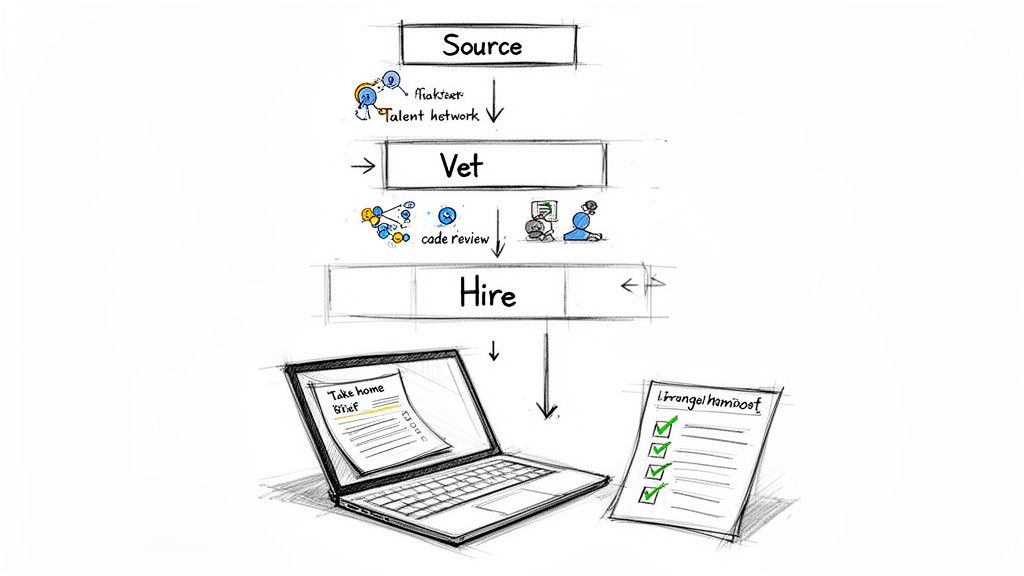
- Practical Take-Home Project: This is the most effective tool. We give candidates a small, self-contained task (3–4 hours) that mirrors the work they’d actually do. The goal is to see how they think, code, and document.
- Structured Technical Interview: This is a collaborative session to review their take-home project. We discuss system design, debugging scenarios, and the trade-offs they made. This reveals more than any algorithm quiz.
- Behavioral & Culture Alignment: We assess for key remote work traits like autonomy and asynchronous communication.
With a developer shortage keeping senior roles open 90+ days, this efficient process is a competitive advantage. See this in-depth analysis of 2025 hiring trends for more context.
Global Compliance: Contractor vs. Employer of Record (EOR)
Hiring across borders introduces legal complexity. The most critical decision is your engagement model. For insights on global team structures, see our guide on nearshore vs offshore outsourcing.
For your first few international hires, contractors may seem simpler. However, for core, long-term team members, an EOR is the only scalable and legally sound approach. It handles payroll, taxes, and benefits, letting you focus on your product. You'll also want to understand international work permit and visa requirements.
Onboarding for Impact: The First 30 Days
A structured onboarding process is your key to retaining top remote talent and accelerating their time-to-value. The goal for the first month is successful integration, not maximum output.
Here is a blueprint you can adapt:
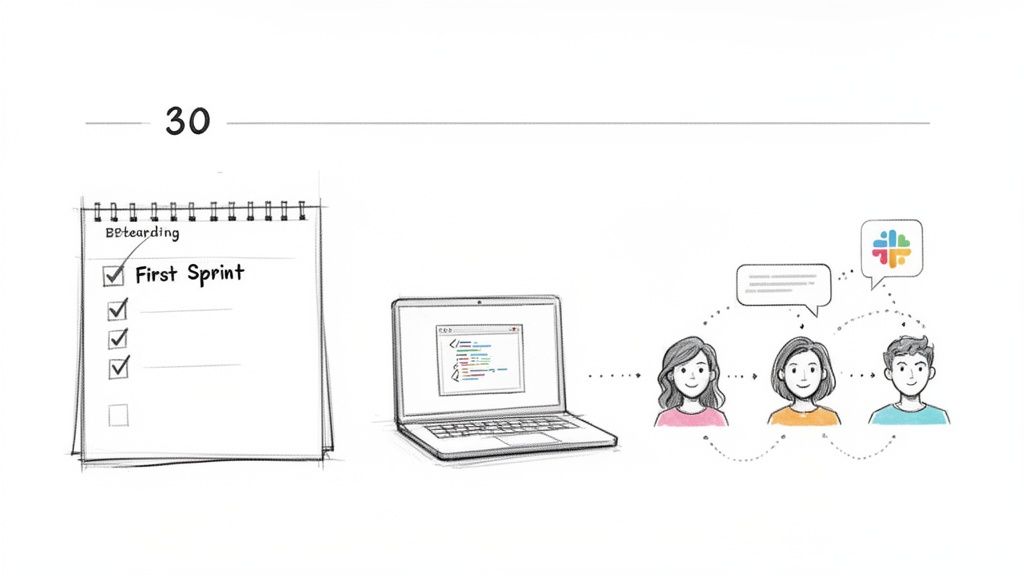
- Week 1: Access & Connection: Provision all system access before day one. Assign a peer "onboarding buddy." Schedule informal 1:1s with the team. Their first task should be a small, low-risk win, like a documentation update, to learn the deployment process.
- Weeks 2-3: Code & Cadence: Immerse them in the codebase and team rituals (stand-ups, sprint planning). Assign their first small, well-defined feature or bug fix.
- Week 4: Feedback & Future: Conduct a 30-day check-in to gather feedback on the onboarding process. Set clear objectives for the next 60 days to shift the focus from setup to impact.
A great onboarding experience is critical for productivity and retention. For more strategies, read our guide on how to manage remote teams. The data supports this: remote hires have a higher retention rate, and a great process helps you capitalize on the larger talent pool. You can discover more insights about remote work hiring statistics to see the full picture.
Actionable Checklist for Hiring Remote Developers
Use this checklist to turn theory into action. A disciplined hiring process cuts time-to-market, reduces operational costs, and helps you avoid the disastrous impact of a bad hire.
Pre-Hire Phase: Groundwork
- Write a single-sentence mission for the role.
- List 3–5 measurable 90-day outcomes.
- Detail the required technical and soft skills.
- Create a take-home project brief (3–4 hours max).
- Write open-ended technical and behavioral interview questions.
- Build a simple grading rubric for objective evaluations.
Sourcing & Vetting Phase: Execution
- Select Sourcing Channel: Choose based on budget and timeline (in-house, talent network, or agency).
- Screen initial applications against your role scorecard.
- Send the take-home project to shortlisted candidates.
- Conduct live technical and behavioral interviews.
Offer & Onboarding Phase: Closing
- Decide on the engagement model (Contractor vs. EOR).
- Draft a contract with clear IP ownership and confidentiality clauses.
- Map out a 30-day onboarding plan with an achievable first-sprint goal.
- Assign an onboarding buddy.
- Ensure all system access is ready before Day 1.
What to Do Next
- Use the Checklist: Adapt the checklist above to create your internal hiring process document.
- Define Your Next Role: Build a Role Scorecard for your most critical upcoming hire.
- Start a Pilot: If you need to hire vetted AI or engineering talent now, book a call to start a risk-free pilot with ThirstySprout. We match you with pre-vetted experts in 7–14 days.
References
- Complete Guide on How to Hire Remote Developers
- 2025 Hiring Trends Analysis
- ThirstySprout Candidate Vetting Engine
- Nearshore vs. Offshore Outsourcing
- How to Manage Remote Teams
- Remote Work Hiring Statistics
- Primary Tech Sources: LangChain, LlamaIndex, Pinecone, Weaviate, Fivetran, dbt, Snowflake.
- Collaboration Tools: Slack, Loom, Notion, Confluence, Miro, Figma.
Ready to build your remote AI team with confidence? ThirstySprout connects you with pre-vetted AI experts who have already cleared our rigorous technical assessments. Find your next hire with ThirstySprout.
Hire from the Top 1% Talent Network
Ready to accelerate your hiring or scale your company with our top-tier technical talent? Let's chat.