

You're probably making this decision under pressure. The product team wants an AI feature live soon. Your first engineers are asking whether to standardize on Python, Go, Node.js, or something faster. Recruiters are already warning you that hiring for niche stacks gets slow. This isn't a language debate. It's an operating model decision.
Pick the wrong back end programming language and you won't just pay in latency. You'll pay in hiring drag, awkward MLOps, slower debugging, and more rework once the product starts getting real users.
Choosing Your Backend Language
TL;DR
- Start with Python if you're building an AI-first MVP, internal AI tooling, or a product that depends on model orchestration, data pipelines, and fast iteration.
- Choose Go or Rust when throughput, low-latency APIs, or infrastructure-heavy services matter more than library breadth.
- Use Node.js when your workload is mostly I/O-heavy and your team benefits from one language across front end and back end. Be honest about CPU-bound limits.
- Don't choose based on benchmarks alone. Choose based on hiring speed, ecosystem maturity, and how painful your production operations will be six months from now.
- If your team is split between Go and Java concerns, this Go vs Java engineering trade-off guide is a useful lens for stack maturity and team fit.
This is for founders, CTOs, and engineering leaders building AI products with real deadlines. You're deciding the stack before the architecture hardens, before the first hiring plan is final, and before your infrastructure debt becomes expensive.
A backend programming language is the language that runs the server side of your product. It handles API requests, business logic, authentication, database access, queues, model calls, and the plumbing between your user interface and the systems that do the work.
My advice is simple. Optimize for speed to reliable production, not for ideological purity. The best language is the one that helps your team ship the first version, hire the next few engineers, and keep the system understandable when the AI layer gets messy.
A 4-Step Framework for Your Decision
The right choice comes from constraints, not taste.
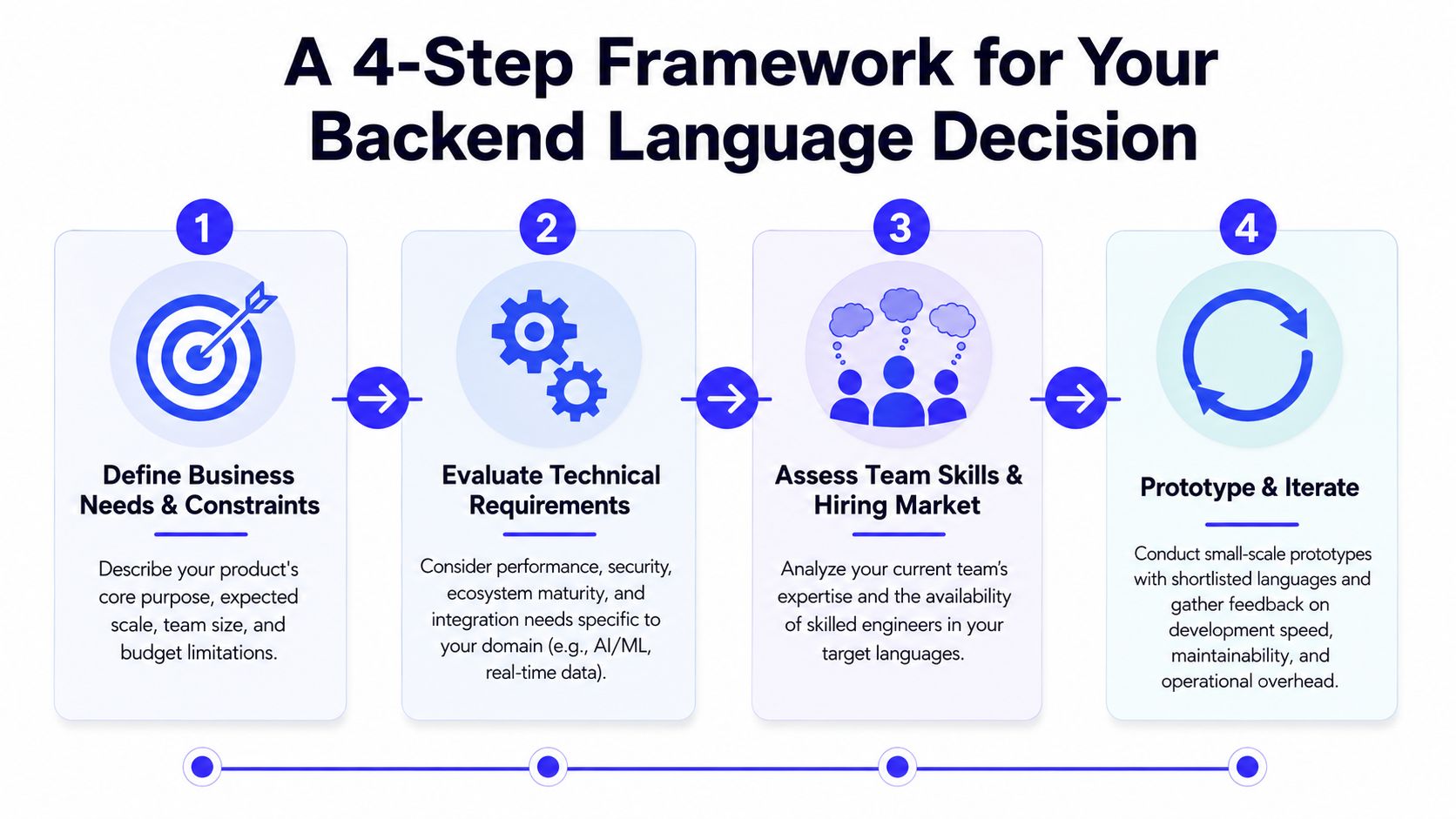
Start with workload, not language
Before you compare Python against Go or Rust, write down what the service does.
Map the core workload
Is this mostly request routing, external API calls, database queries, and model orchestration? That's an I/O-heavy shape. Is it doing heavy transformation, streaming, or compute-intensive scoring? That's a different shape entirely.Separate the AI layer from the serving layer
Many founders mash these together. Don't. Your retrieval pipeline, feature extraction, or model-serving logic may want one stack, while your public API may want another.List the hard constraints
Authentication complexity, vendor SDK support, data compliance, and cloud environment usually matter earlier than micro-optimizations.
Practical rule: If you can't describe your dominant workload in one sentence, you're not ready to pick a language.
Follow your team's gravity
Most startups don't fail because they picked the wrong syntax. They fail because they picked a stack they couldn't staff and operate.
Ask three blunt questions:
- What does your current team already know well
- What can you hire for quickly in your target market
- Which stack makes on-call and debugging less painful
Architecture meets org design. A language with great theoretical upside can still be the wrong move if every new hire needs a long ramp or if your DevOps tooling gets custom fast. Good software design principles still beat clever stack choices, especially when systems start changing weekly. This software design principles guide is worth revisiting before you lock anything in.
Score ecosystem and operating cost
Use a short decision scorecard. Don't overcomplicate it.
| Decision area | What to check |
|---|---|
| AI ecosystem | SDKs, model tooling, data libraries, serving frameworks |
| Developer productivity | Local dev speed, testing ergonomics, framework maturity |
| Hiring reality | Candidate depth, interview difficulty, onboarding friction |
| Operations | Observability, deployment patterns, container support, background jobs |
| Long-term cost | Rewrites, service sprawl, team fragmentation |
A strong decision usually looks boring on paper. That's a good sign. Boring stacks are cheaper to run.
The 2026 Backend Language Showdown
It's week six after launch. Your AI demo worked. A pilot customer wants security review answers, uptime guarantees, and a roadmap for scaling ingestion, auth, and background jobs. This is the point where language choice stops being an engineering preference and starts affecting hiring speed, operating cost, and how fast you can ship the next three features.
You don't need the globally best language. You need the language that keeps product, ML, and platform work moving without creating a staffing problem.
One market signal matters here. JavaScript still dominates general developer usage, and Python keeps gaining ground because it sits in the overlap between backend development, AI work, and data tooling. That is why the main decision is not syntax. It is whether your backend language helps you hire faster and keep your AI stack simple.
Backend language comparison for AI systems
| Language | Best For | AI/ML Ecosystem | Performance | Hiring Velocity |
|---|---|---|---|---|
| Python | AI products, internal tools, model orchestration, data-heavy APIs | Best-in-class | Moderate | Strong |
| Go | Scalable APIs, infra services, concurrent backends | Good | Strong | Good |
| Node.js | Full-stack product teams, API layers, orchestration-heavy apps | Moderate | Strong for I/O-heavy services | Very strong |
| Rust | Performance-sensitive systems, security-critical components, low-level services | Growing | Excellent | Harder |
| Java | Enterprise platforms, complex service estates, long-lived systems | Mature | Strong | Strong |
| C# | Microsoft-centric environments, enterprise apps, internal platforms | Mature | Strong | Strong |
Python is the default for AI startups
If you are building an AI product and need one default choice, pick Python.
It keeps prototyping, evaluation, model serving, and backend logic close together. That reduces handoff friction between applied ML work and product engineering. It also widens your hiring pool because Python talent spans backend engineers, data engineers, ML engineers, and automation-heavy generalists.
The trade-off is straightforward. Python is rarely your best option for raw systems performance. It wins because it reduces MLOps complexity early, and that usually saves more time and money than a faster runtime.
Go is the best second language
Go is what I recommend when your product starts behaving like infrastructure.
Use it for APIs, workers, ingestion services, and systems that need predictable concurrency and low operational drama. Go teams usually ship boring services in the best sense. Readable code, simple deploys, fast startup times, and fewer ways to create a fragile architecture.
For AI companies, this is a common split. Python handles model-facing workflows. Go handles the services around them.
Node.js is a staffing and speed play
Node.js remains a strong choice for product teams that want one language across frontend and backend.
That can be a real business advantage. Hiring can move faster. Full-stack engineers can cover more surface area. Early product iterations often ship quicker because your app team is not splitting across two ecosystems before the product deserves that complexity.
Its limitation is still real. Node.js is strongest for I/O-heavy services, orchestration layers, and database-backed application logic. It is a weaker choice when the backend itself is doing serious CPU-bound computation. If auth is a major part of your stack decision, read Webtwizz on building app auth. Identity choices often add more complexity than the language itself.
Rust is a targeted bet, not a company default
Rust is excellent when performance, safety, and resource efficiency are core requirements.
It is a poor first choice for a startup that still needs to discover its product shape. Hiring is harder. Development speed is slower for teams without prior Rust experience. The payoff is real, but it usually belongs in one performance-critical service, not across your whole backend.
Founders often overvalue benchmark wins here. Compare runtime trade-offs if you want, but keep them in context. This comparison of the fastest computer languages is useful for raw speed, yet business speed usually comes from easier hiring and simpler operations.
Java and C# are pragmatic, especially in enterprise deals
Java and C# keep winning in regulated environments, larger organizations, and Microsoft-heavy shops because they reduce organizational risk.
You get mature frameworks, stable tooling, predictable deployment patterns, and hiring markets that are deep in many regions. Those advantages matter when security review, auditability, and integration work start dominating the roadmap. Startup founders often dismiss these languages because they are not fashionable. That is a mistake.
PHP still matters, but not as your default for AI-native products
I would not start a new AI-native backend in PHP unless the business already depends on a PHP estate, a CMS-heavy platform, or a team with deep Laravel experience.
PHP still has massive installed-base gravity on the web. That matters if you are extending an existing content platform or integrating into a legacy environment. It matters far less if you are building agent workflows, evaluation pipelines, vector-backed APIs, or model-centric services from scratch.
The practical recommendation is simple. Choose the language that keeps your talent market broad, your AI tooling close to the application, and your operations boring. That is how you avoid a rewrite driven by org pain instead of technical limits.
Recommended Stacks for 3 Startup Scenarios
Your first backend hire joins in three weeks. Your product needs to ship in six. Your model pipeline is already messy. Pick the wrong language now, and you will pay for it in slower hiring, awkward AI integration, and more operational drag than a young company can absorb.
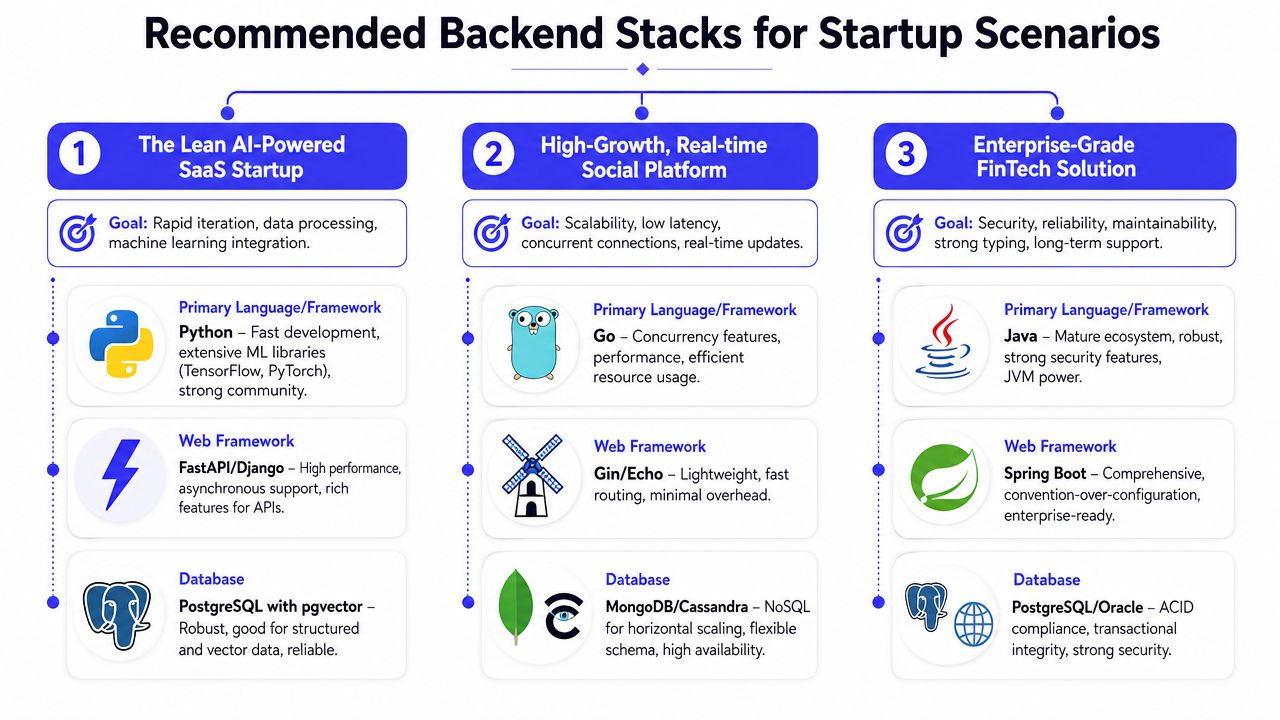
The lean AI MVP
A support copilot, internal knowledge assistant, or workflow agent needs one thing first. Shipping speed.
Recommended stack
- Back end Python with FastAPI
- Database PostgreSQL with pgvector
- Packaging Docker
- Infra Managed cloud services where possible
- Async work A queue-backed worker layer if document ingestion or batch processing grows
This stack wins because it keeps your application code, model-facing logic, and evaluation workflows close together. That shortens iteration cycles. It also widens your hiring pool, because you can recruit engineers who can work across API development, data plumbing, and ML-adjacent tasks without forcing constant cross-team handoffs.
Use Python until it hurts. For an early AI product, it usually will not. The main risk is not raw runtime speed. The main risk is building an architecture your small team cannot operate cleanly.
The high-performance fintech API
A payments, ledger, or risk system has a different failure mode. Here, operational mistakes cost money fast, and latency spikes turn into customer-facing incidents.
Recommended stack
- Back end Go or Rust
- Service communication gRPC for internal services
- Database PostgreSQL
- Messaging Kafka or RabbitMQ if event flow becomes central
- Edge layer Separate auth and gateway concerns from critical transaction paths
Choose Go unless you have a clear, workload-specific reason to choose Rust. Go gives you strong concurrency, fast builds, readable services, and a much easier hiring market. Rust can produce excellent systems, but it slows team formation and raises the bar for every new backend hire. For a startup, that second-order cost is often bigger than the performance gain.
Auth decisions matter early in this scenario because they spread through every service boundary. Read Webtwizz on building app auth before you commit to owning that complexity yourself.
This video also gives a helpful product-side view of stack selection in startup settings:
The enterprise data platform
Once you are moving data across teams, running scheduled jobs, and supporting analytics plus ML workloads, one-language purity becomes a liability.
Recommended stack
- Data and platform services Java or Scala where your data tooling and enterprise platform already live
- ML and experimentation Python
- Workflow orchestration Keep it language-agnostic where possible
- APIs Use the language your platform team can reliably operate
Founders must exercise discipline. Do not force the ML team and the platform team into the same runtime just for philosophical consistency. Use Java or Scala where long-lived platform services, integration requirements, and enterprise controls already exist. Use Python where model iteration, notebooks, and experimentation still drive the roadmap.
A polyglot stack sounds messier on paper. In practice, it often reduces MLOps friction, hiring bottlenecks, and org conflict. Different workloads deserve different tools.
Why the Language Is Only 20% of the Problem
Your first backend hire ships the API in Python in six weeks. Three months later, releases are risky, the retrieval pipeline is expensive, model-serving jobs fail unnoticed, and no one trusts the dashboards during an incident. That failure was not caused by Python. It was caused by weak architecture, weak operating discipline, and a stack choice made without thinking about who would run it.
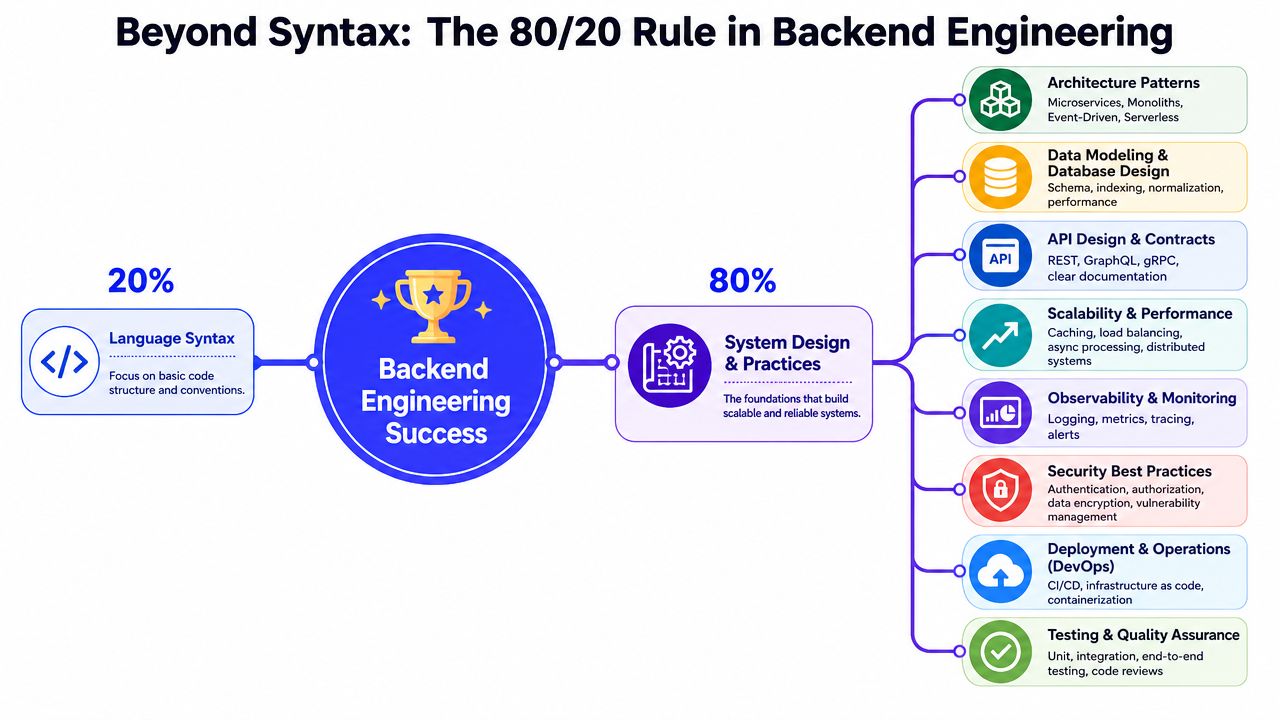
Senior back end work is mostly not about language
At senior level, the gap between average and strong engineers shows up in system judgment. SQL design. Safe database migrations. Cache design. Auth boundaries. Queueing. Failure handling. Observability. Those choices drive uptime, cloud spend, and team speed far more than syntax preferences.
The expensive backend mistakes usually look like this:
- A query path nobody profiled until latency became a customer problem
- A cache policy nobody owned until infra spend jumped
- A deployment process full of manual steps until releases started breaking production
- An auth model copied from a tutorial until permissions logic spread across services
- Monitoring that stops at app logs until model, worker, and API failures become hard to trace
Switching from Python to Go does not fix any of that. Switching from Node.js to Rust does not fix it either.
AI backends punish weak operational choices
AI products add more moving parts, and every moving part adds coordination cost. You are not only serving web requests. You are scheduling jobs, calling external model APIs, handling retries, managing vector indexes, running evaluation pipelines, and separating workloads with very different performance profiles.
That changes what “good language choice” means. The question is not which runtime wins a benchmark. The question is which stack your team can hire for, deploy cleanly, debug fast, and extend without turning MLOps into a tax on every release.
| Operational area | What matters |
|---|---|
| Containerization | Predictable builds, small images, clear dependency management |
| Orchestration | Reliable workers, job queues, service isolation |
| Infra as code | Tooling that fits your deployment workflow without custom workarounds |
| Model serving | Mature patterns for APIs, background processing, and external inference calls |
| Observability | Logs, traces, metrics, and alerts across app and model layers |
A stack that feels productive in week one can become expensive by month six if every production concern needs custom glue.
Hiring velocity beats purity
Founders regularly overvalue language purity and undervalue hiring speed. A clean all-Rust or all-Elixir story sounds disciplined. It often slows recruiting, narrows your candidate pool, and forces senior engineers to spend time teaching the stack instead of building the product.
For AI products, this effect gets stronger. Python helps with experimentation and ML tooling. Go and TypeScript help with service ownership and hiring depth in many markets. Java still wins where platform maturity, enterprise integration, and operational consistency matter more than developer fashion.
Pick the language that gives you the fastest path to a team you can build.
Security and infrastructure choices spread everywhere
Backend decisions shape key management, token handling, service-to-service auth, and encryption boundaries. If the team is shaky on these basics, fix that before debating framework nuance. This explainer on cryptographic key differences is a useful baseline for non-specialists who need to make sound infrastructure decisions.
What I'd optimize for instead
If I were advising a founder making this decision today, I'd rank priorities in this order:
- Hiring depth in your market
- AI and data ecosystem maturity
- Operational simplicity
- Fit for your dominant workload
- Language elegance
That order saves time and money.
The second-order effects are what matter. Hiring velocity. Library maturity. Deployment friction. On-call burden. MLOps complexity. Get those right and several languages can work. Get them wrong and the “best” language still turns into an expensive mistake.
Your Backend Engineer Hiring Checklist
If you've picked a stack but can't define the role clearly, you haven't finished the job.
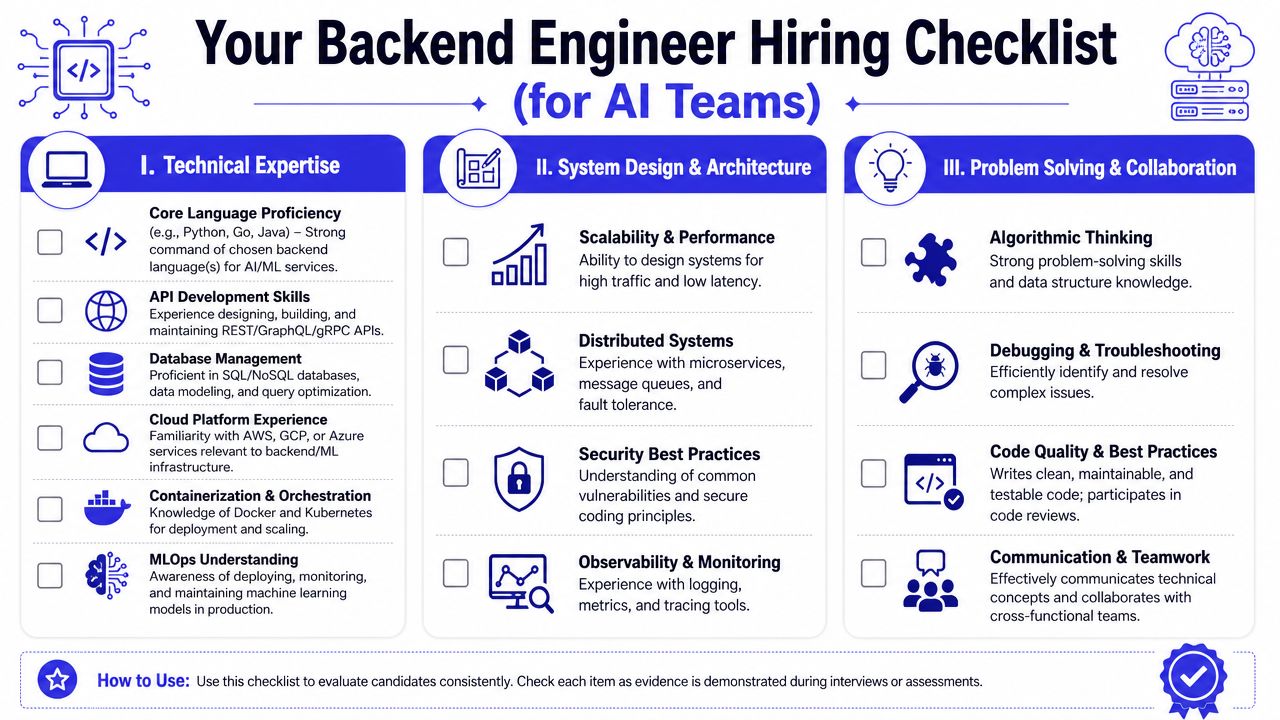
Role definition
Write the role around the workload, not the language label.
Primary mission
State whether the engineer will own APIs, model-serving infrastructure, data pipelines, internal platform services, or a mix.Critical constraints
Note your cloud environment, data stores, auth model, and deployment expectations.Seniority signal
If you need system design ownership, incident handling, and architecture judgment, hire senior. Don't hide a staff-level need inside a “backend engineer” title.
Skill matrix
Use a must-have versus nice-to-have split.
| Must-have | Nice-to-have |
|---|---|
| Strong proficiency in your chosen language | Experience with a second backend language |
| API design and service ownership | Background in event-driven systems |
| SQL and data modeling | Vector database familiarity |
| Docker and cloud deployment basics | Kubernetes depth |
| Observability and debugging | MLOps tooling exposure |
Interview kit
Don't ask trivia. Ask for judgment.
A simple screening pack:
Technical screen
“Walk through an API you designed. Where did latency, caching, and error handling become hard?”System design prompt
Design a feature-flagging service with audit history, API access, and role-based controls.Production question
“A model-backed endpoint starts timing out intermittently. What do you inspect first?”Collaboration question
“How do you work with ML engineers when model behavior changes but the API contract can't break?”
For team execution, consistency matters almost as much as candidate quality. If your managers need a better way to keep weekly hiring loops and engineering work visible, this guide on how engineering teams track progress is useful.
First-month onboarding checklist
- Week 1 Align on service boundaries, local setup, and incident history
- Week 2 Ship one safe production change
- Week 3 Review database access patterns and monitoring gaps
- Week 4 Propose one reliability or cost improvement with a concrete plan
What to Do Next
Don't leave this as a theoretical exercise. Make the decision concrete.
First, document your product's dominant workload, team strengths, and operational constraints using the four-step framework above. You should be able to defend the language choice in one page.
Second, turn that choice into a hiring brief. Define the role around ownership areas, not buzzwords. If you need a Python engineer who can also reason about queues, observability, and model-serving trade-offs, say that plainly.
Third, pressure-test your decision with a small prototype. One service is enough. Measure developer friction, deployment clarity, and how fast the team can debug a failure.
If you remember only one thing, remember this. Back end programming languages matter, but team effectiveness matters more. Pick the stack your engineers can ship and run without drama.
References
- Stack Overflow Developer Survey 2025 technology results
- Couchbase backend language overview
- W3Techs server-side programming language usage
- Developer discussion on backend fundamentals and architecture
- Backend language demand roundup and workload fit discussion
If you need senior engineers who've already shipped AI backends in Python, Go, Node.js, Java, or mixed-stack environments, ThirstySprout can help you scope the architecture, define the role, and get matched with vetted talent fast. Start a Pilot or See Sample Profiles to move from debate to execution.
Hire from the Top 1% Talent Network
Ready to accelerate your hiring or scale your company with our top-tier technical talent? Let's chat.