

The surprising part of AI talent acquisition is that the risk isn't speed, it's bad process hiding inside fast software. Teams that rush in often end up automating weak screening habits, while teams that phase the rollout build something more durable, more auditable, and easier to defend when hiring gets scrutinized.
TL;DR
- AI in recruiting is already mainstream, not experimental, with broad use across sourcing, screening, and interview workflows, as shown in the latest HR and recruiting data from SHRM and the 2025 adoption report from Elly AI.
- Start with one workflow, one role family, and human review at critical points. Phased rollouts are associated with stronger integration outcomes than big-bang launches, according to AI Alpi.
- Don't let AI narrow your pipeline. Use it for triage and prioritization, then add mandatory human checks for nontraditional candidates.
- Treat governance as a deployment requirement, not a policy afterthought. Hiring tools can fall into the EU AI Act's high-risk category when they affect employment decisions.
- Measure the business outcome, not just tool activity. Time-to-hire, cost-per-hire, candidate quality, and retention matter more than feature counts.
Why AI Talent Acquisition Is Already Mainstream
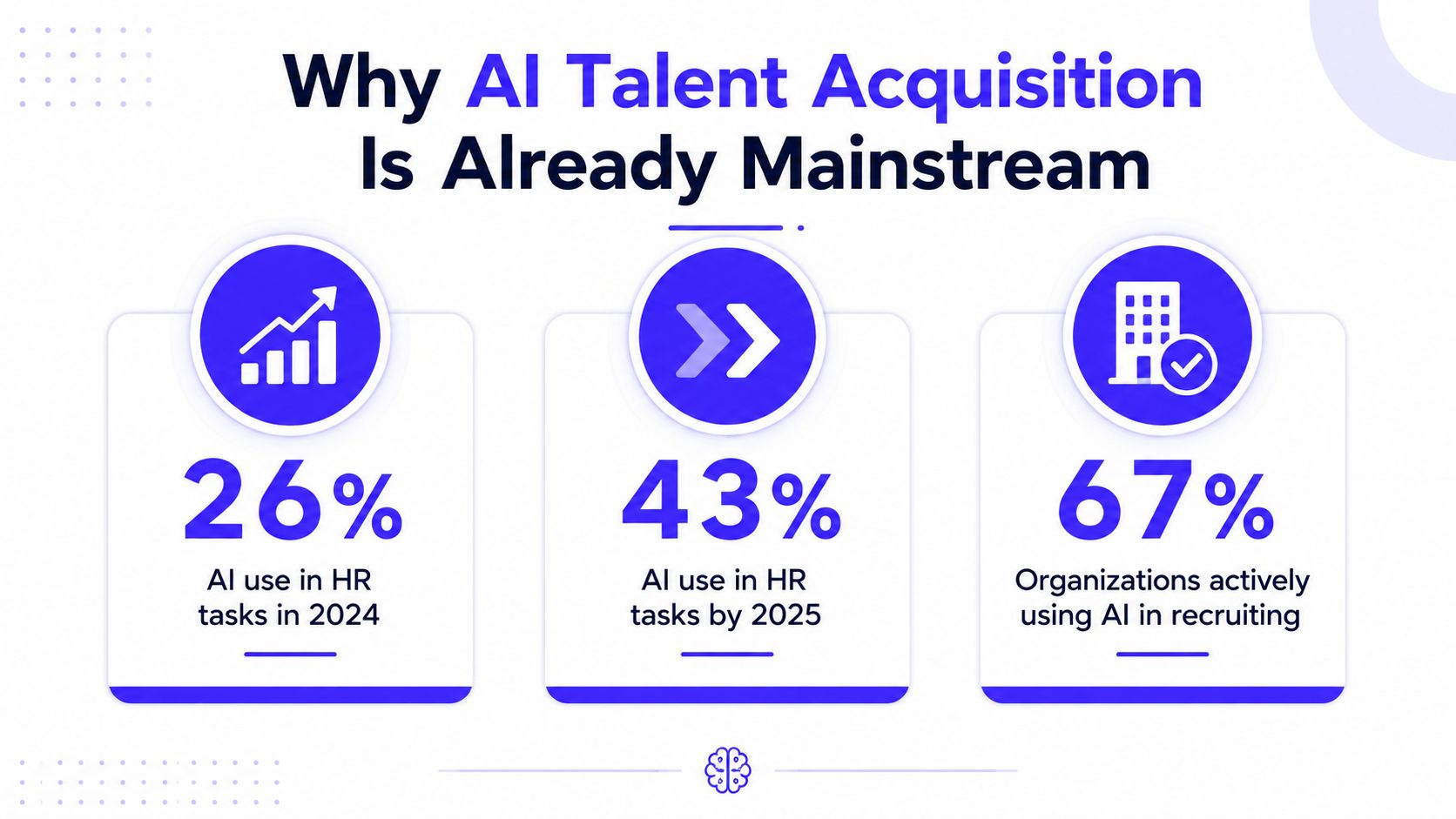
The shift caught a lot of operators off guard. AI use in HR tasks rose from 26% in 2024 to 43% in 2025, which means adoption nearly doubled in a single year, and 67% of organizations now report active AI use in recruitment processes, according to SHRM. That's the point where a tool stops being a curiosity and starts becoming part of the operating model.
A recruiting lead doesn't need a theory deck to feel that change. In the same 2025 data set, 65% of organizations use AI for sourcing and talent search, 60% for resume screening and review, and 59% for interview notes and summaries, which shows the software has moved into the busiest, most repetitive parts of the funnel. The workflow shift is even broader in the adoption report from Elly AI, where 87% of respondents said they use AI tools daily or weekly in recruiting workflows.
What that means in practice
If you're running hiring for a startup or scaling team, this isn't about whether AI can help. It's about whether your process is already competing with teams that have embedded AI into sourcing, screening, scheduling, and note-taking. A manual team can still win on judgment, but not on throughput alone.
Practical rule: If a task happens every day and follows patterns, AI should probably assist it. If a task changes careers, pay bands, or offers, a human should still own the decision.
For teams looking for a practical reference point, the Dooza AI employee platform is useful reading because it shows how staffing-oriented automation is being discussed in the market without pretending the human part has disappeared. The lesson isn't that every recruiter should buy the same stack. It's that the operating baseline has changed, and the recruiting function now needs a system, not a one-off tool.
Phased Rollout Playbook for AI Recruiting Tools
The best deployments don't begin with a platform switch. They begin with a narrow use case, a measurable target, and a clear idea of where humans still have to step in. That sequence matters because the 2025 adoption report from Elly AI found 82.5% confidence in teams with a formal AI policy, versus 58.5% without one, which tells you governance changes execution quality, not just legal posture.
A phased rollout also beats a big-bang launch on adoption. In the industry guide from AI Alpi, phased implementation was associated with a 72% AI system integration success rate and 65% higher adoption success than a full-system rollout. That lines up with how recruiting teams work. They don't change all hiring motions at once, especially when scheduling, source quality, and interview discipline already vary by manager.
A rollout sequence that holds up
Start with one workflow, such as resume screening for one role family or scheduling for one hiring pod. Define the target first, then audit the data feeding the model, then pilot under human supervision. Only expand after the pilot is stable enough to monitor for bias and process drift.
A useful way to think about it is simple. AI should prove it can improve a bounded workflow before it touches the whole funnel.
| Phase | Objective | Key Actions | Success Metric |
|---|---|---|---|
| Define targets | Pick a measurable hiring bottleneck | Set time-to-hire, quality, or fairness goals | Clear baseline and target |
| Audit data | Reduce hidden error and representation gaps | Check training data accuracy and diversity | Clean input set |
| Pilot | Test AI in one controlled workflow | Limit scope, keep human review, log outputs | Stable results in a small sample |
| Expand | Scale only after validation | Add more roles or teams gradually | Repeatable adoption |
| Govern | Keep the system safe and usable | Monitor bias, update policy, retain audit trails | Ongoing confidence and compliance |
If you're comparing tooling in parallel, the overview at best AI recruiting tools is a useful internal benchmark, but the bigger decision is still process design. Tool selection comes after you know what you're fixing.
Operator takeaway: A smaller rollout with strong checkpoints usually outperforms a broad rollout with weak ownership.
For feature-heavy products like Sales Navigator AI features, the buying question should be whether the workflow needs another layer of automation or just better discipline around the one you already have.
Sourcing and Screening Tactics That Do Not Narrow the Pipeline
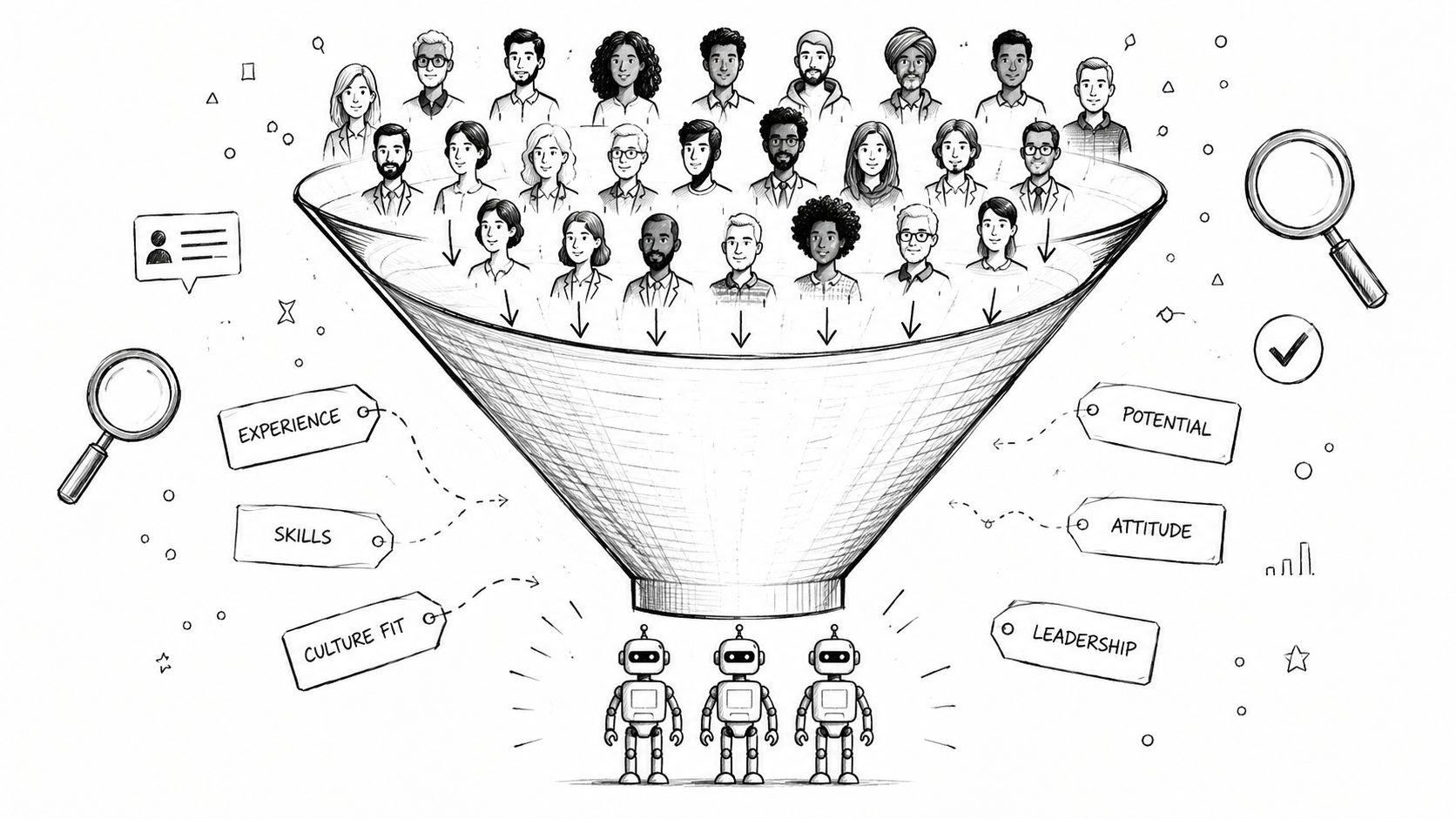
AI is very good at matching patterns. That's useful, and it's also where teams get into trouble. If you let software act as a final filter too early, it tends to favor obvious profiles and miss people whose backgrounds don't look conventional on paper.
That's the hidden-talent problem. Reporting from HR Dive says AI tools can miss career switchers, veterans, workforce-program graduates, and adult learners, which is exactly the kind of talent many teams say they want more of. The fix isn't to drop AI. It's to stop using it as a verdict engine.
Where AI helps, and where it should stop
Use AI for prioritization at the top of the funnel. That means sourcing, keyword clustering, shortlist ranking, and draft outreach. Keep final shortlisting and rejection decisions under human review when a candidate has a nonstandard path, sparse titles, adjacent skills, or a background that could be misunderstood by the model.
Research on recruiter-AI collaboration from PubMed Central frames the winning model as human-plus-machine, not machine-alone. That's the right mental model for screening. AI can sort the pile. Recruiters still decide who deserves a closer look.
A practical screening rule I've seen work is this:
- Let AI rank candidates by fit signals, not by “yes” or “no.”
- Route edge cases to humans when the profile includes a career break, a transfer from another industry, or credential patterns the model might underrate.
- Record why a shortlist was changed so the team can spot systematic mistakes later.
- Keep final rejection authority human-led for any profile that isn't a clean match.
Some of the best hires won't have the neatest resumes. If your workflow can't catch them, your hiring process is too brittle.
For a more role-based lens on search strategy, the skills-based hiring guide is a strong companion read. It fits especially well when you want the funnel to widen instead of collapse around pedigree.
EU AI Act Compliance and Governance Checkpoints
Hiring AI is not a “launch first, govern later” problem. If a system influences employment decisions, it can fall into the EU AI Act's high-risk category, which means the compliance work starts before deployment, not after a complaint. That matters for procurement, legal review, and vendor selection, especially for global teams.
The implementation standard is straightforward. Classify the tool, document how it works, keep human oversight in the loop, and maintain records that can survive review. The governance guidance from SHRM's AI and recruitment overview makes that classification point clear, and the practical management angle is reinforced by MyCulture.ai's evidence-based bias article, which focuses on bias reduction tools and the need for structured oversight.
A one-week checkpoint list
- Classify each tool by risk level. Decide whether it touches screening, scheduling, ranking, or decision support.
- Document the data inputs and decision logic. Know what the model sees and what it can't see.
- Schedule recurring bias audits. Don't wait for an annual review if the tool touches live candidates.
- Require human sign-off on shortlists and offers. Final decisions should not disappear into automation.
- Keep an audit trail. If a regulator or candidate asks why a decision changed, you need a record.
Practical rule: If you can't explain the hiring path to a candidate, you probably don't understand it well enough to automate it.
That urgency is real. General Assembly's State of Tech Talent 2025 found that 3 in 4 tech hiring managers at AI-using companies say they're hiring AI talent too quickly and not building a durable pipeline. That's a governance issue disguised as a growth issue, because rushed hiring almost always shows up later in quality, retention, or both.
The AI governance best practices guide is a useful internal reference if your team needs a policy skeleton before the next rollout.
Case Study Scaling AI Talent Acquisition at a Growth-Stage Startup
A Series B fintech team needed eight senior ML engineers in ten weeks. Their old process was the usual bottleneck mix, manual sourcing, unstructured screening, and interview scheduling that dragged across multiple calendars. They were living with a 42-day time-to-hire and a cost-per-hire exceeding 35,000 dollars.
They changed the workflow in phases. First, they added an AI sourcing layer for talent search. Then they introduced automated screening, but only with human review checkpoints for nonstandard profiles. Finally, they put an AI scheduling assistant in front of the interview loop, which removed the cancellation and rescheduling pileup that was slowing the team down.
What changed after 90 days
By the end of the rollout, time-to-hire fell to 21 days, cost-per-hire dropped to just under 17,000 dollars, and six-month retention reached 93%. The important part wasn't only the speed gain. The team also kept quarterly bias audits in place and maintained a formal hiring policy, which gave leadership confidence that the process stayed defensible while it got faster.
That's the lesson. AI helped them remove friction, but the durable improvement came from combining automation with controls. The sourcing engine found more candidates, the screening layer saved recruiter time, and the scheduling assistant removed a coordination bottleneck that usually gets ignored until it's already hurting fill rates.
A second lesson showed up in the interview feedback. Hiring managers trusted the pipeline more once the team documented where AI was allowed to rank candidates and where humans still had to review edge cases. That made the process easier to repeat for the next engineering search, which is what turns a pilot into an operating advantage.
Your AI Talent Acquisition Decision Checklist
Before you buy another recruiting tool, check the system, not the demo. Start by choosing one workflow to automate first, sourcing, screening, scheduling, or interview coordination, and tie it to a measurable target. If the vendor can't connect that feature to a concrete hiring problem, the tool is probably adding noise.
Use this checklist before rollout
- Define the first use case. Pick one role family and one workflow, then measure baseline performance before changing anything.
- Audit the data. Review training and candidate data for accuracy, completeness, and representation gaps.
- Pilot with human oversight. Keep recruiters involved at every decision point until the system proves itself.
- Verify compliance support. Ask for audit trails, explainability, and human review capabilities for high-risk hiring use cases.
- Require a formal policy. If your team doesn't have one, write it before production use.
- Monitor outcomes continuously. Track adoption, bias signals, and quality signals after launch, not just during the pilot.
A good vendor helps you govern as much as it helps you automate. A bad one gives you speed without accountability. The difference matters because AI talent acquisition is a deployment problem first and a software purchase second.
For teams that need help structuring the rollout, ThirstySprout supports hiring for AI-heavy roles and can help you scope the recruiting motion around the actual technical work, not just the job title. If you're ready to tighten the process and build a hire plan that won't break under scale, visit ThirstySprout and start from the workflow you need to fix first.
Hire from the Top 1% Talent Network
Ready to accelerate your hiring or scale your company with our top-tier technical talent? Let's chat.