

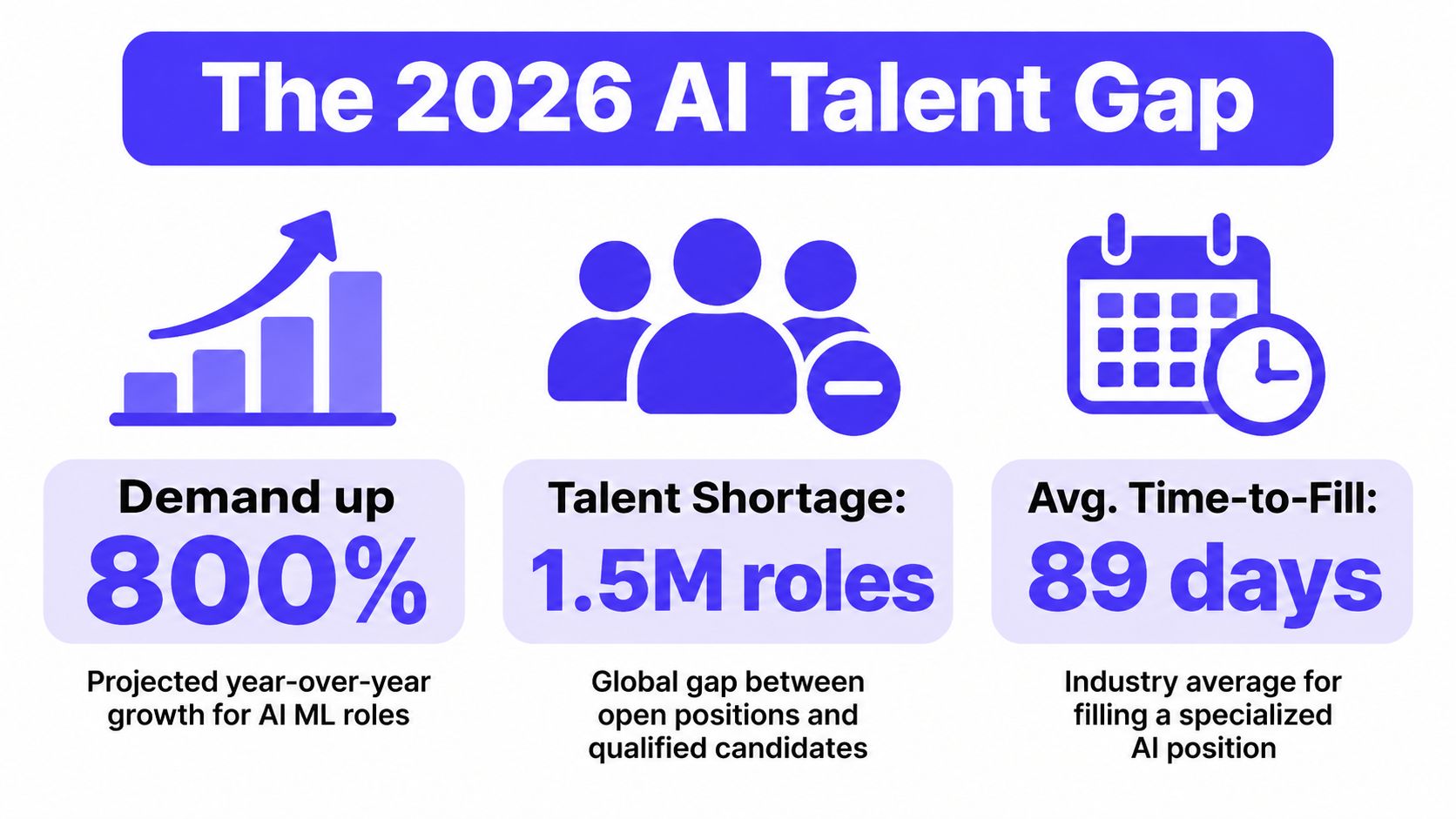
AI ML engineer hiring has moved from a specialist search to a strategic constraint. PwC's 2026 Global AI Jobs Barometer reports that job postings requiring specific AI skills, including machine learning, grew 68.9% from 2024 to 2025, compared with 8.6% total job growth. Demand for these skills expanded about eight times faster than the broader labor market, while qualified production talent remains scarce.
The practical answer is clear: define the role around shipped systems, source beyond generic job boards, and evaluate candidates with structured work samples. A fast, role-specific process beats a long interview loop built around resumes and abstract algorithm puzzles.
This playbook is for CTOs, engineering leaders, founders, talent teams, and product executives who need an AI or machine learning engineer to contribute within weeks. It focuses on the full-stack profile many hiring guides miss, someone who can connect models to APIs, products, infrastructure, monitoring, and real users.
The 2026 AI Talent Gap and What It Means for Your Search
An independent 2026 AI talent market report estimates roughly 1.6 million open AI roles against about 518,000 qualified candidates, a 3.2:1 demand-to-supply gap. It also places average time-to-fill near five months. For AI ML engineer hiring, that gap changes how leaders must plan the search, interview capacity, and delivery expectations.
A job advertisement cannot resolve a supply shortage. Engineers with production experience are often employed, comparing several approaches, or considering companies with stronger technical reputations. A post-and-wait funnel reaches active applicants, yet it rarely reaches people who have deployed, monitored, and maintained AI systems under real constraints.
Demand is rising faster than ordinary hiring
PwC's report describes AI-skilled hiring as a distinct track from general technical recruitment. Skills such as prompt engineering, machine learning, and production AI systems are increasingly rewarded, while qualified candidates remain difficult to replace or source.
ManpowerGroup's 2026 Talent Shortage Survey, covering 39,063 employers across 41 countries, found that 72% of employers still had difficulty filling roles. AI Model and Application Development was the hardest-to-find skill for 20% of employers, followed by AI Literacy at 19%. The survey places AI capabilities ahead of traditional engineering and IT skills in global sourcing difficulty.
Practical rule: Treat the search as a market-making exercise. Define the role clearly, approve the compensation position early, contact passive candidates directly, and keep decisions fast enough to respect their limited time.
Production experience is the real bottleneck
A candidate may explain model architectures, notebooks, and benchmark results fluently. That evidence does not establish whether they can protect data quality, version models, handle deployment failures, control inference cost, monitor behavior, roll back safely, and meet product requirements together.
The production-ready profile spans model development, APIs, product integration, MLOps, and user-facing behavior. Oho's machine learning talent report describes this shift toward full-stack AI engineers and identifies MLOps and data quality as differentiators. Use those areas as search and evaluation criteria, not as a long list of tools in the job description.
Plan for a search window that reflects scarcity. One 2026 hiring report estimates senior AI and ML engineer roles can take 8–12 weeks to fill, while staff roles can take 10–16 weeks. Use the time deliberately. Clarify the role before outreach, reserve interview capacity, and make the technical team accountable for prompt feedback.
AI systems still depend on strong software foundations. This analysis of software engineering demand helps place the role within the wider engineering market and keeps the search focused on deployable systems rather than isolated model expertise.
If the role includes background or identity checks, document a consistent process before outreach and review this guide to an FCRA compliant screening process before screening candidates.
Writing Role Specs That Attract Production-Ready Engineers
Senior candidates spot an unfocused AI job description quickly. Asking one person to research architectures, build data pipelines, deploy services, manage cloud infrastructure, and own product outcomes usually signals unclear priorities. Production-ready engineers want to know which decisions they will own and how success will be judged.
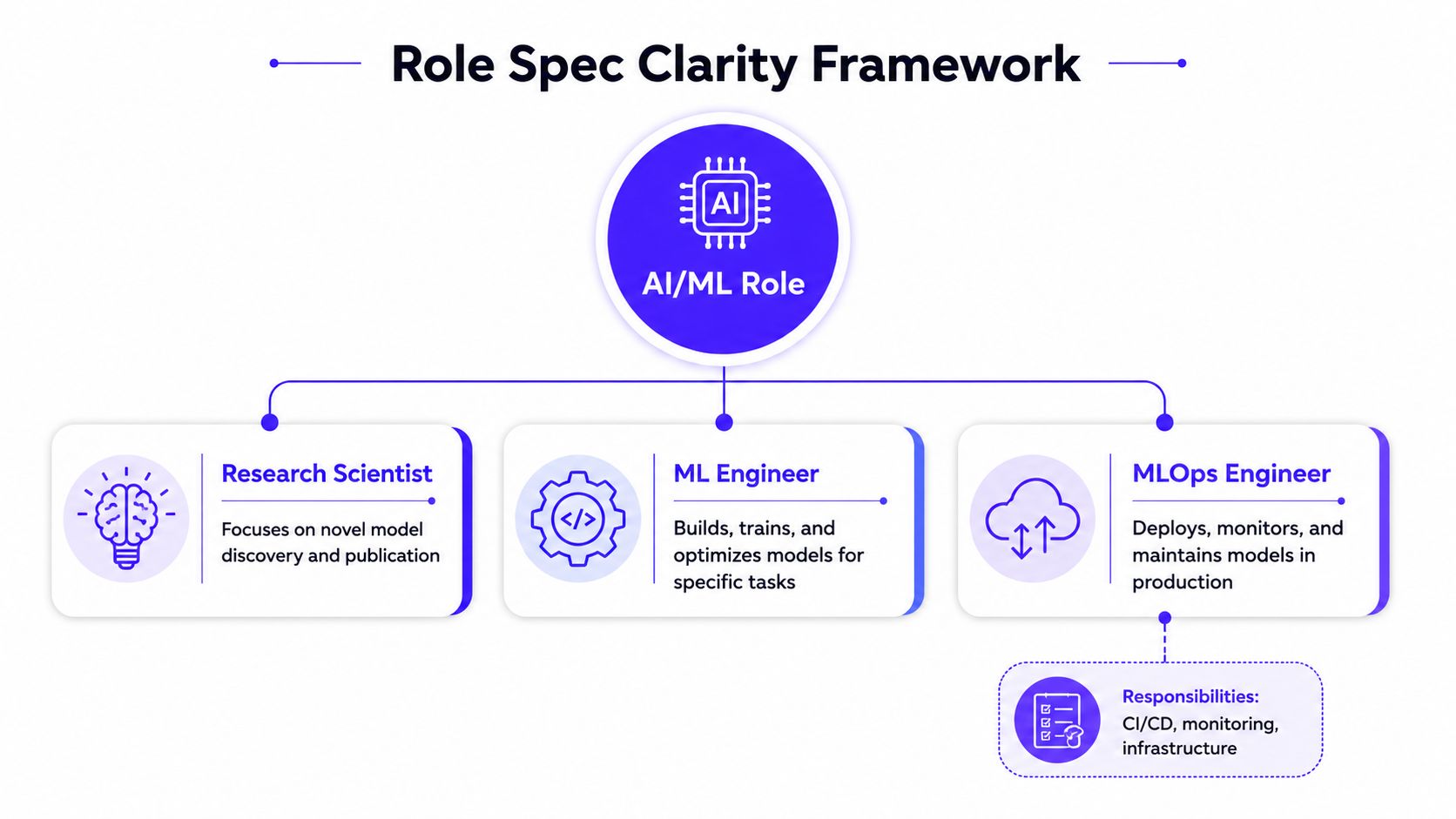
Start by naming the role's center of gravity: model building, applied product integration, or operational ownership. These profiles overlap, but each requires different evidence. A full-stack AI engineer, for example, must connect model behavior to APIs, product workflows, deployment controls, and measurable user outcomes.
Choose the role family before listing tools
Use this distinction in the opening paragraph:
| Role profile | Primary question | Evidence to request |
|---|---|---|
| Research Scientist | Can this person discover and validate new modeling approaches? | Experimental design, publications where relevant, rigorous evaluation |
| ML Engineer | Can this person build, train, and optimize models for a defined task? | Training pipelines, feature work, model evaluation, software quality |
| MLOps Engineer | Can this person deploy, monitor, and maintain models reliably? | CI/CD, infrastructure, observability, versioning, incident ownership |
| Full-stack AI Engineer | Can this person connect models to a product and operate the result? | APIs, integration decisions, evaluation, deployment, user-facing outcomes |
The AI engineer job description guide offers a fuller template. The working rule is straightforward: describe the work before describing the stack.
A responsibility statement should name the production system and its operating expectations:
Build and operate a document intelligence service that exposes model predictions through a versioned API, records evaluation results, supports rollback, and gives product teams a clear path to improve quality.
This tells candidates what they will own. It also gives interviewers concrete material for testing deployment judgment, evaluation practice, and product integration.
Production experience is the bottleneck
Write requirements as evidence rather than buzzwords:
- Model development: Explain a model choice, the baseline, the evaluation method, and the failure cases.
- Production delivery: Describe a deployed system, including dependencies, release controls, and rollback decisions.
- Monitoring: Show how data drift, quality degradation, latency problems, or service failures were detected.
- Product integration: Explain how model behavior affected an API, workflow, interface, or customer decision.
- Operational ownership: Describe what happened after launch and what changed in response.
Separate required experience from useful context. If the first release needs a reliable inference service, publication history should not become a hidden requirement. If the team is conducting novel research, production operations cannot be the only signal.
Finish with success measures candidates can understand. Examples include establishing a repeatable evaluation process, shipping a monitored service, improving data quality, or reducing manual model-release work. Tie each measure to business value and technical ownership instead of listing frameworks.
The embedded video below gives hiring managers a concise visual explanation of role boundaries.
Sourcing Channels That Actually Yield Senior AI Talent
Different sourcing channels produce different candidate behavior. A public job board can create application volume, but senior production engineers are more likely to respond to a specific technical problem, a credible referral, or a focused approach from someone who understands their work.
Use channel choice as part of role design. If you need a research-heavy scientist, look for technical publications and research communities. If you need a full-stack engineer who has operated inference services, inspect shipped repositories, technical talks, and evidence of ownership after launch.
Compare the channels before you spend the time
| Channel | Yield quality | Time investment | Best for |
|---|---|---|---|
| General job boards | Broad, uneven | Moderate screening load | Market visibility and active applicants |
| Specialized AI talent networks | Focused, pre-screened potential | Lower internal sourcing load | Production-oriented searches with urgency |
| GitHub and technical portfolios | Strong evidence when repositories are relevant | High manual review | Engineers who show software and deployment habits |
| Conference and community outreach | High context, often passive | High relationship investment | Niche specialties and technical credibility |
| Employee referrals | Often strong trust signal | Moderate coordination | Expanding through known engineering circles |
| Former colleagues and alumni | Relevant context and faster trust | Moderate | Senior hires who value team and manager quality |
A specialized network can help when your team lacks the expertise to evaluate candidates or when a niche search has stalled. ThirstySprout, for example, supports full-time, contract, and fractional AI and machine learning hiring, including production-oriented engineering and MLOps profiles.
GitHub review needs discipline. Don't reward repository volume or visual polish alone. Look for tests, readable interfaces, configuration management, documentation, error handling, evaluation logic, and evidence that the candidate understands operational boundaries.
Write outreach around the engineering problem
Passive candidates don't need another message listing every fashionable tool. They need enough detail to decide whether the work is worth a conversation.
A useful message includes:
- The system: what you're building and who uses it.
- The hard part: data quality, evaluation, latency, reliability, integration, or scale.
- The ownership: what the engineer can decide.
- The working model: time-zone overlap, async expectations, and manager access.
- The next step: a short technical conversation with a clear agenda.
Senior searches commonly stretch to 8–12 weeks, according to 2026 AI hiring market reporting, so don't wait until the end of that window to improve the funnel. Review response quality weekly. If candidates misunderstand the role, fix the message. If qualified people withdraw after the first call, inspect scope, process speed, and compensation alignment.
Building a Structured Interview Loop That Predicts Performance
A polished resume and confident interview performance can conceal weak production judgment. Structured evaluation reduces that risk by giving every candidate the same job-relevant questions, scoring anchors, and opportunity to demonstrate applied work.
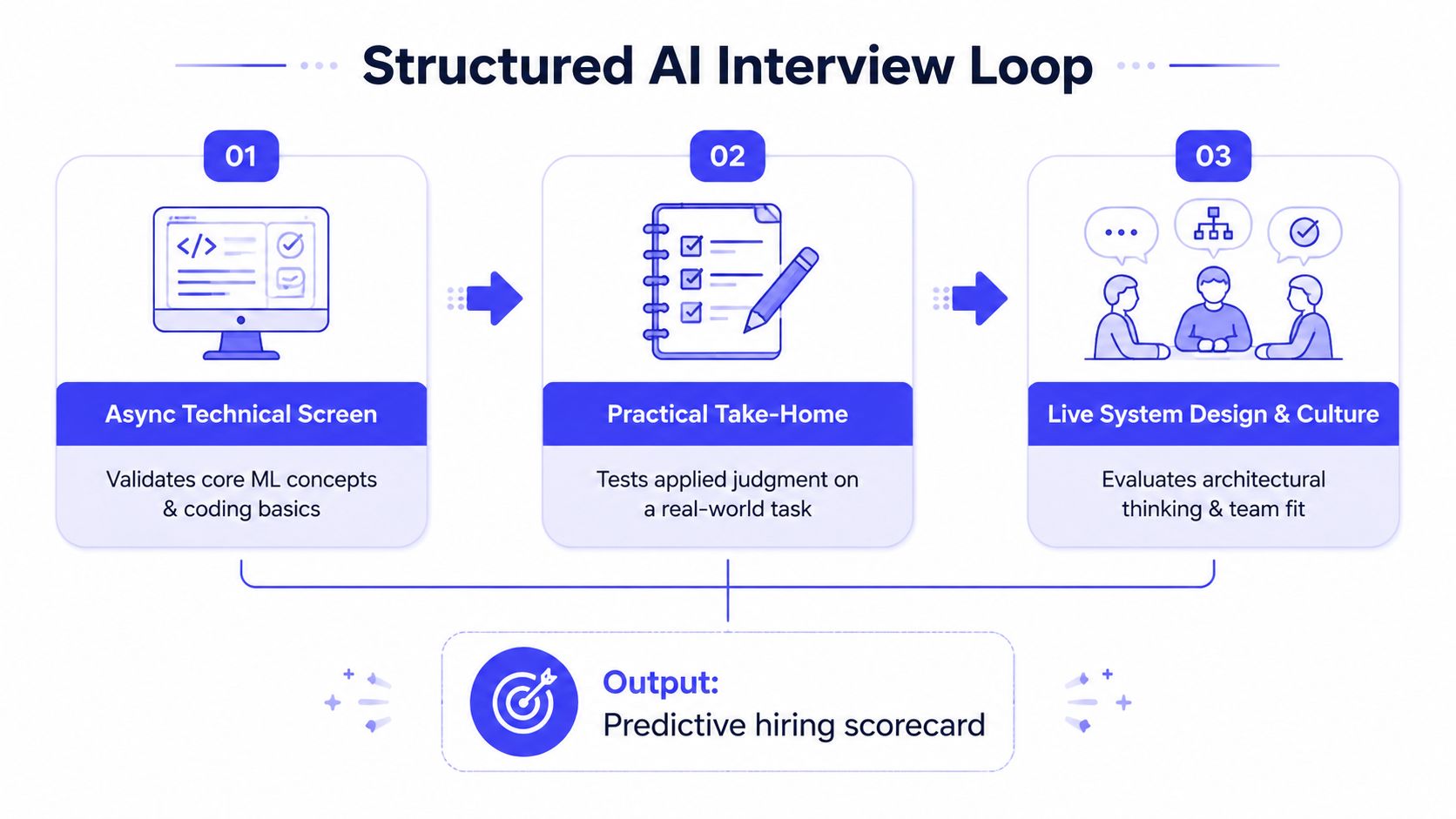
A strong loop has three connected stages. Each stage should answer a different question, and interviewers shouldn't use one stage to compensate for missing evidence in another.
Stage one tests the foundation
Use a short async technical screen to check core machine learning concepts, coding basics, and written reasoning. Ask candidates to explain a train and test split, identify a leakage risk, or review a small Python function that handles model predictions.
Keep the questions tied to the role. A production engineer should explain how a model reaches an API and how the service behaves when dependencies fail. A research-oriented candidate should spend more time on experimental validity and model assumptions.
Stage two tests applied judgment
The practical task should resemble the work the candidate would perform. Give them a realistic dataset, an evaluation objective, and enough context to make trade-offs. Don't turn it into an obstacle course of obscure library syntax.
Stage three tests systems thinking
In the live interview, ask the candidate to design the service around the model. Probe data contracts, versioning, deployment, observability, evaluation, security, and ownership boundaries. Listen for how they handle uncertainty. Strong engineers ask clarifying questions before drawing architecture diagrams.
Use a rubric rather than a gut reaction. A published remote AI interview rubric uses a 1–4 scale across technical quality and communication, with anchors ranging from weak reasoning and disorganization to strong, concise, production-aware performance. The structured AI interview question guide can help your panel create role-specific prompts.
| Dimension | 1 means | 4 means |
|---|---|---|
| Technical reasoning | Guesses, misses core constraints | Explains assumptions and trade-offs clearly |
| Code quality | Fragile or difficult to maintain | Clear structure, tests, and sensible interfaces |
| Production awareness | Stops at the notebook or diagram | Covers deployment, failure, monitoring, and rollback |
| Evaluation judgment | Uses weak or mismatched metrics | Connects evaluation to user and business risk |
| Communication | Disorganized or unclear | Concise, collaborative, and precise |
A 2026 hiring-validity analysis warns against black-box scoring, accent and dialect bias, and over-reliance on polished resumes or interview performance. Use multiple calibrated raters with the same rubric, and require written evidence for every score.
Panel discipline: Score independently before discussing the candidate. Debate the evidence, not the strongest personality in the room.
Designing Take-Home Assessments That Reveal Real Skills
A useful take-home assessment tests judgment, not the ability to produce the cleverest model. It should show whether a candidate can work with incomplete information, write maintainable code, evaluate results fairly, and explain the next production decision.
Time-box the exercise to 3–4 hours, following the practical guidance in this ML engineer take-home assessment guide. State the evaluation criteria upfront, and do not turn the exercise into unpaid product development.

Example one uses a prediction task
Provide a representative dataset and prediction objective without exposing confidential information. Request a small repository with:
- A clear train and test split.
- A baseline model and an improved approach.
- Evaluation choices with supporting reasoning.
- Error analysis or concrete failure examples.
- A concise README covering design decisions.
Review the items in that order. Split hygiene matters because leakage can make weak work appear accurate. Evaluation reveals whether the candidate connects metrics to user and business risk. Documentation shows whether decisions can survive asynchronous handoffs across a distributed team.
Example two tests production structure
Give the candidate a small inference component and ask them to package it as a service or maintainable module. Assess the following:
- Interface design: Does the component expose a predictable contract?
- Python quality: Are functions focused, dependencies clear, and tests useful?
- Failure handling: What happens with missing data, malformed input, or model errors?
- Configuration: Can the model or threshold change without rewriting the application?
- Operational thinking: Does the candidate identify logging, monitoring, versioning, and rollback needs?
This exercise can reveal more job-relevant judgment than a timed algorithm test. A candidate might choose a modest model while making sound decisions about validation, deployment, and maintainability. Another might achieve a stronger local score while overlooking leakage, reproducibility, or failure behavior.
A practical grading sheet
| Area | Strong evidence | Warning sign |
|---|---|---|
| Data handling | Reproducible splits and explicit assumptions | Leakage or unexplained preprocessing |
| Model evaluation | Metrics match the decision and error costs | One metric with no interpretation |
| Software quality | Modular structure, tests, documentation | Notebook-only submission |
| Production readiness | Monitoring and release risks identified | No plan beyond local execution |
| Communication | Clear README and concise trade-offs | Overlong explanation with no decisions |
CodeAid's hiring guide recommends combining an async technical screen, a realistic practical assessment, and a structured technical interview. Used together, these stages provide separate evidence about fundamentals, applied implementation, and systems judgment.
Compensation, Remote Logistics, and Onboarding for Long-Term Success
Scarce production skills create compensation pressure, but cash is only one part of the offer. Candidates also assess the problem's quality, the authority attached to the role, the engineering environment, and whether remote work supports focused delivery. For a full-stack AI engineer, describe the ownership clearly: model behavior, data flows, inference services, monitoring, and product integration should have named decision-makers.
Set the compensation position before outreach begins. As noted earlier, hiring plans need realistic bands and screening tied to applied AI work. If your budget cannot compete on cash, state the trade-off plainly and strengthen the role through autonomy, meaningful ownership, flexible engagement, or a credible path to impact. Avoid promising broad influence when the engineer will lack access to infrastructure, product decisions, or production data.
Remote logistics require the same specificity as technical requirements. State expected overlap, meeting norms, documentation standards, incident participation, and who makes final technical decisions. A candidate who works across time zones still needs predictable access to product context, infrastructure, reviewers, and release approvals. Record those expectations in the role specification and repeat them during the interview process.
Use a focused first sprint
A practical onboarding sequence looks like this:
- Day 1: Provision repository, cloud, observability, communication, and issue-tracking access.
- First working sessions: Review architecture, data contracts, evaluation criteria, security boundaries, and release practices.
- First sprint: Choose one bounded production task, such as adding an evaluation harness, improving an inference endpoint, or instrumenting a model service.
- Early review: Pair the engineer with a technical mentor and product owner. Inspect the shipped work, handoff quality, and decisions behind it.
- Following work: Expand ownership after the engineer understands failure modes, deployment controls, and stakeholder expectations.
Contract, fractional, and full-time arrangements solve different problems. A contract engagement fits a defined delivery need. Fractional leadership can establish engineering standards and support hiring decisions. Full-time employment suits a team that needs durable ownership of a product or platform. Choose the model according to the work, expected availability, and required continuity.
Operational test: By the end of the first sprint, you should know how the engineer works with your codebase, reviewers, data, and release process. A finished AI platform is unnecessary. Evidence of collaboration, delivery, and sound handoffs is not.
A clear scope, disciplined interview loop, fair screening, and production-oriented onboarding provide better odds than chasing an impossible unicorn profile. Start with the smallest role that can own a meaningful outcome, then build the wider team around gaps exposed by real work.
ThirstySprout helps companies hire vetted AI and machine learning engineers for full-time, contract, and fractional engagements, with attention to production systems, MLOps, product integration, and distributed collaboration. Visit ThirstySprout to define your role, review relevant talent, and start a focused pilot with a team that can work within your stack and time zone.
Hire from the Top 1% Talent Network
Ready to accelerate your hiring or scale your company with our top-tier technical talent? Let's chat.