

TL;DR
- Hire an AI Engineer to ship a user-facing AI feature fast. They integrate components like LLM APIs and vector databases into a complete application (e.g., a RAG-based chatbot). Their goal is a working product.
- Hire an ML Engineer to build or scale a core predictive model. They focus on model performance, data pipelines, and production stability (e.g., improving a fraud detection API). Their goal is an accurate, reliable model endpoint.
- The key difference is scope: AI Engineers build systems, ML Engineers build models.
- Use the decision framework below to match your immediate business goal (time-to-market vs. model accuracy) to the right hire.
- Senior ML engineers often command a higher base salary due to the specialized risk and MLOps skills required for production-grade models.
Who this guide is for
- CTOs & Heads of Engineering deciding who to hire for a new AI initiative.
- Founders & Product Leads scoping roles and budget for AI-powered features.
- Talent & Ops Leaders writing job descriptions and evaluating candidates for AI roles.
This guide is for technical leaders who need to make a hiring decision in the next few weeks and must connect that decision to a clear business outcome.
Quick Answer: The Hiring Decision Framework
Your choice depends entirely on your primary objective. Are you building a new application or optimizing an existing algorithm? Use this table to make a clear decision.
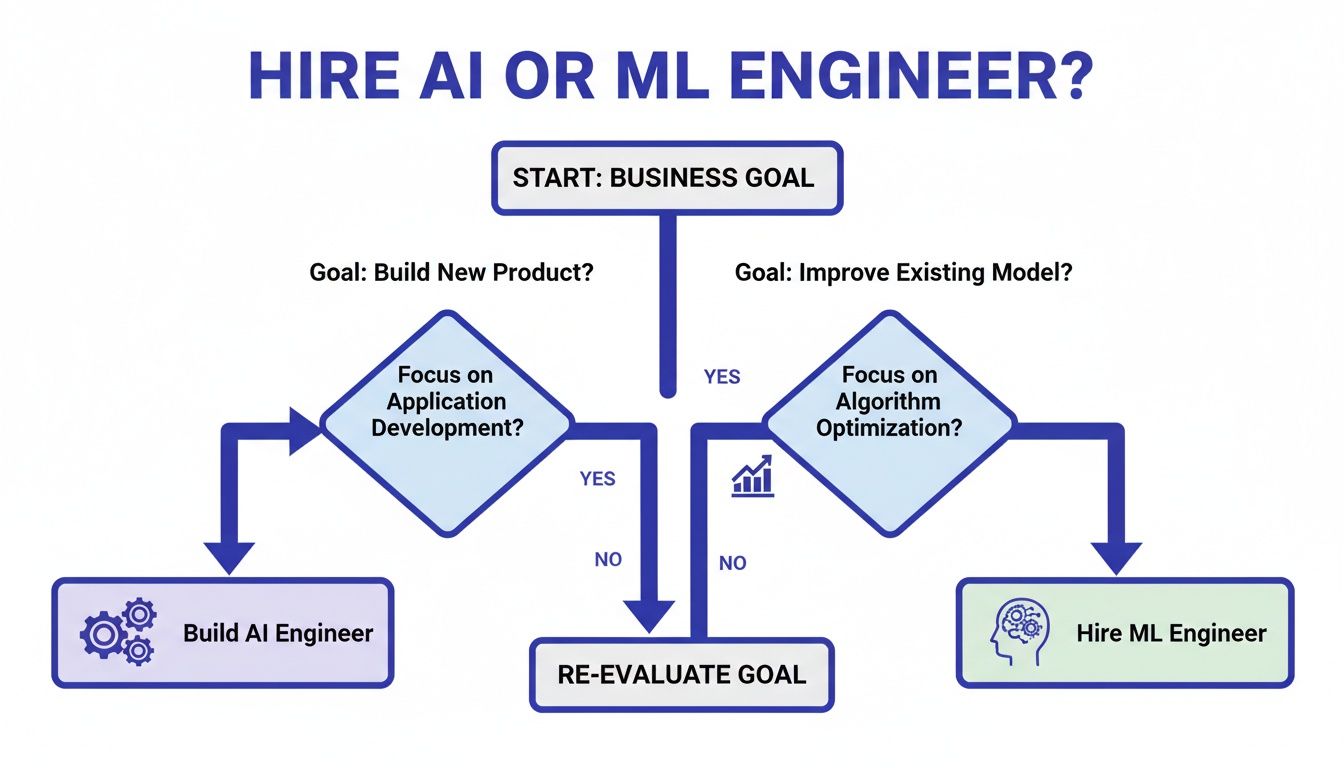
alt text: A flowchart outlining when to hire an AI engineer versus an ML engineer based on business goals.
Practical Examples: What They Actually Build
To see the difference, look at what each role delivers in a typical 90-day project. Their daily tasks and final outputs are fundamentally different.
Example 1: The AI Engineer Builds a RAG-Based Support Bot
The business need: Launch a customer support tool that answers user questions from a knowledge base of 50,000+ documents. Time-to-value is critical.
An AI Engineer owns the end-to-end system build:
- System Design: They architect the full application flow, deciding how a user query moves from the front end to the language model and back.
- Component Integration: They connect a Large Language Model (LLM) API from Anthropic, set up a Weaviate vector database, and write ingestion scripts to process and embed the documents.
- Application Logic: They build the core Retrieval-Augmented Generation (RAG) logic. This code takes a user's question, finds relevant context from the vector database, and packages it for the LLM.
- Deployment: They package the entire application using Docker and deploy it on Kubernetes or a serverless platform, exposing it via a secure API endpoint for the front-end team.
The deliverable: A complete, working chatbot application.
Business impact: Reduces support ticket volume by 40% within one quarter. Success is measured by system uptime, response latency, and user satisfaction.
Example 2: The ML Engineer Improves a Fraud Detection Model
The business need: The existing fraud detection model's accuracy is degrading, causing a 5% increase in false positives and blocking legitimate transactions.
An ML Engineer focuses entirely on the model lifecycle:
- Feature Engineering: They analyze transaction data to identify new predictive signals. They build and automate data pipelines using tools like Apache Airflow to feed these features into the model.
- Model Experimentation: They run dozens of experiments, testing new algorithms (e.g., Gradient Boosting vs. a neural network) and tuning hyperparameters to improve precision and recall.
- Production Deployment: Once a better model is validated, they create a new, optimized model endpoint. This involves following rigorous MLOps best practices for versioning, testing, and safe rollout.
- Monitoring: They set up dashboards to monitor the new model for performance degradation or concept drift, ensuring it remains stable and effective.
The deliverable: A highly optimized, scalable model endpoint.
Business impact: Reduces false positives by 15%, directly protecting revenue and improving customer trust. Success is measured by model performance metrics.
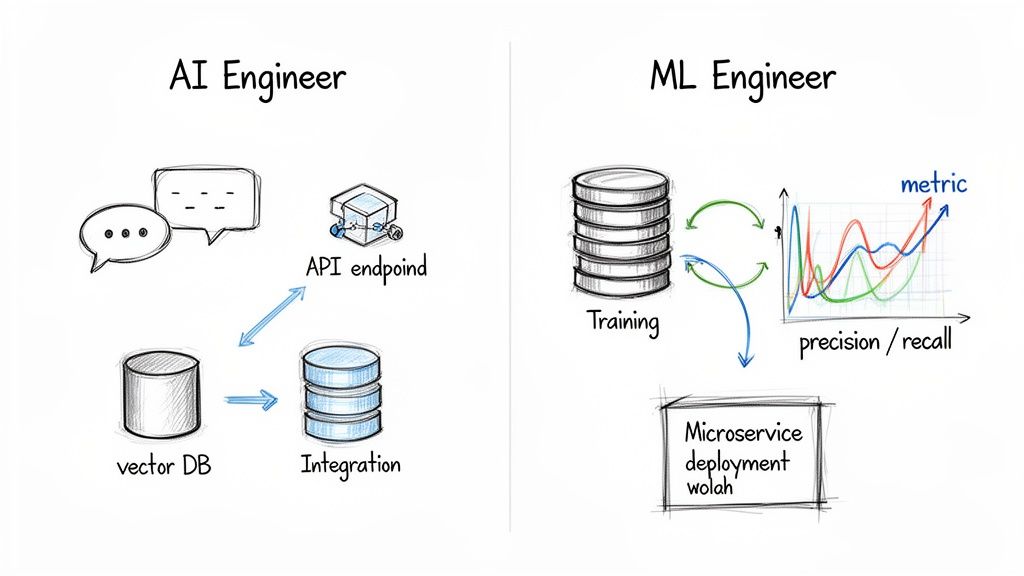
alt text: A sketch diagram comparing the distinct workflows and components for AI and ML Engineers, showing AI Engineers integrating services and ML Engineers iterating on a model.
Deep Dive: Skills, Stacks, and Trade-Offs
The technology stacks for these two roles reflect their different priorities. The AI Engineer is a strong software developer who works with AI components. The ML Engineer is a model specialist who operationalizes machine learning.
The key trade-off is breadth versus depth. An AI Engineer's software skills get the product shipped. An ML Engineer’s deep MLOps and modeling knowledge ensures the core intelligence is trustworthy and scalable.
The AI Engineer's Toolkit (System Builder)
Their toolbox focuses on building robust, scalable applications. Look for strong software engineering fundamentals.
- Software Development: Expert in Python, often with experience in Go or Java for building high-performance, concurrent systems.
- Cloud & Infrastructure: Deep knowledge of AWS, GCP, or Azure. Fluent with services like Lambda, S3, and Cloud Run, and infrastructure-as-code tools like Terraform.
- API & Service Integration: Expertise in designing and consuming RESTful APIs to connect microservices, third-party AI models (Large Language Models (LLMs)), and data sources.
- Containerization: Skills in Docker and Kubernetes are non-negotiable for reliable software deployment.
The ML Engineer's Stack (Model Specialist)
Their stack is laser-focused on the model lifecycle, bridging data science and production engineering.
- ML Frameworks: Mastery of TensorFlow or PyTorch for building and training models.
- Data Processing: Experience with distributed tools like Apache Spark for handling large-scale data, beyond just Pandas and NumPy.
- MLOps Tooling: This is the key differentiator. Proficiency with tools like MLflow for experiment tracking, Kubeflow for pipelines, and model monitoring platforms.
- Model Optimization: Knowledge of techniques like quantization and pruning, and how to use GPUs to make models faster and cheaper to run.
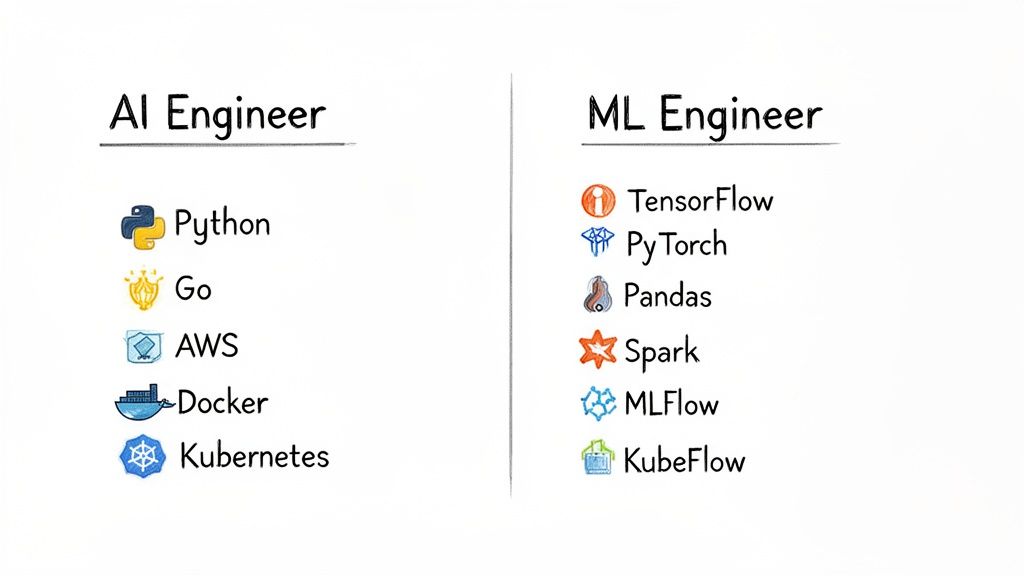
alt text: A side-by-side comparison table listing essential skills and tools for AI Engineers (Python, Go, LangChain, Kubernetes) and ML Engineers (Python, TensorFlow, PyTorch, Kubeflow).
Salary and Compensation Trade-Offs
Both roles command premium salaries, but the structure often differs based on business impact. AI Engineer compensation may be tied to product launch milestones, while ML Engineer compensation often reflects the deep, specialized skill required to manage mission-critical model risk.
According to market data, senior ML engineers often command a slightly higher base salary, reflecting the scarcity of true production MLOps expertise.
Typical U.S. Base Salary Ranges (2025 Estimates)
Sources: TechGig's 2026 report, Cogito's 2026 salary guide.
The total cost includes more than salary. Factoring in your organization's recruitment cost per hire provides a more complete picture of the investment.
Hiring Checklist & Template
Use this checklist to clarify your needs before writing a job description or starting interviews. Your answers will point directly to the right role.
1. Define Your Primary Business Goal
- Build a new user-facing product/feature. (→ AI Engineer)
- Improve an existing predictive model's accuracy or scale. (→ ML Engineer)
2. Identify the Core Technical Risk
- System integration risk: Connecting multiple APIs, services, and data sources reliably. (→ AI Engineer)
- Model performance risk: Ensuring the algorithm is accurate, stable, and monitored in production. (→ ML Engineer)
3. Determine the Key 90-Day Deliverable
- A working prototype or v1 application. (→ AI Engineer)
- A measurable improvement in a core model metric (e.g., 10% lower error rate). (→ ML Engineer)
4. Assess Your Current Team's Gaps
- We have strong ML modelers but need someone to build the product around their work. (→ AI Engineer)
- We have great software engineers but lack deep expertise in productionizing ML models. (→ ML Engineer)
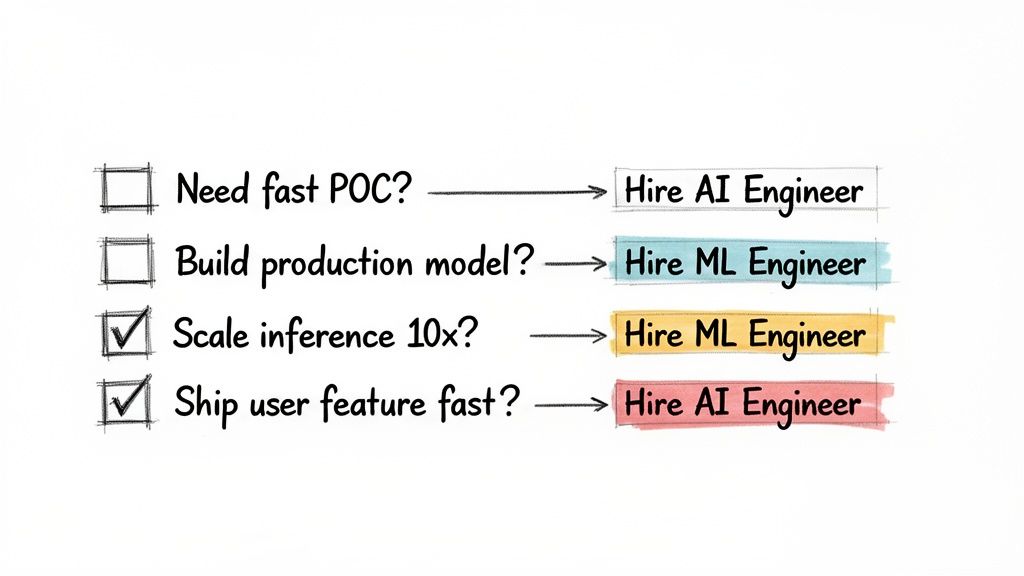
alt text: A checklist graphic contrasting the primary tasks for AI Engineers (fast POC, shipping user features) with those for ML Engineers (building production models, scaling inference).
What to Do Next
- Use the checklist above to confirm which role aligns with your immediate project goals.
- Draft a precise job description based on that role's specific skills and deliverables. Our guide on how to hire AI engineers provides a template.
- Book a free, 20-minute scope call with us. We can help you validate your hiring plan and connect you with pre-vetted, production-ready engineers who fit your exact needs.
Ready to hire the right expert for your team? ThirstySprout connects you with the world's top remote AI and ML engineers, vetted for real-world production experience.
References & Further Reading
- What is MLOps? - AWS Documentation
- What is Kubeflow? - Official Kubeflow Documentation
- MLOps Community Resources - MLOps.org
- A Deep Dive into MLOps Best Practices - ThirstySprout Blog
Hire from the Top 1% Talent Network
Ready to accelerate your hiring or scale your company with our top-tier technical talent? Let's chat.