

Agentic AI system design has moved from an interesting research problem to a production constraint. On the OSWorld benchmark for real computer-use tasks, agent accuracy rose from roughly 12% to 66.3% in 6 months, according to the 2026 AI Index summary. The same source notes that agents still fail about one in three attempts on structured benchmarks. That combination, rapid improvement and a persistent reliability ceiling, changes the engineering question. The hard part isn't choosing a larger model. It's designing the orchestration, permissions, evaluation, and fallback paths around the model.
This guide treats an agent as a software system that plans, calls tools, maintains state, receives feedback, and operates within explicit boundaries. You'll get a practical architecture, governance controls, evaluation metrics, two workflow examples, and a hiring checklist for teams that need to move from prototype to controlled pilot.
Introduction to Agentic AI and Why System Design Matters Now
A single-turn assistant produces an answer and stops. An agentic system receives a goal, chooses actions, calls external tools, examines their results, adjusts its plan, and continues until it reaches a defined state or asks a person to take over.
The difference is operational, not cosmetic. Every tool call adds another failure point: the agent may choose the wrong system, misread a response, lose context, repeat work, or perform an irreversible action without approval. Production quality therefore depends on the complete trajectory, including orchestration, permissions, data readiness, latency, and recovery behavior. A stronger model can improve one step while leaving the workflow unreliable.
OSWorld results show rapid progress in computer-use performance, from roughly 12% to 66.3% within 6 months, while structured attempts still fail about one in three times. The improvement supports investment in planning and execution loops. The remaining failures set a practical boundary: production agents need guardrails, human oversight, and fallback paths, with evaluation based on completed work rather than fluent intermediate messages.
Why operators should care now
Deployment has moved quickly, with early indexed systems appearing in early 2023 and about half of indexed deployments occurring in the second half of 2024, according to an AI agent history and deployment chronology. The chronology does not make an agent appropriate for every business. It does show why architecture and governance decisions are arriving before many organizations have established operating patterns.
Those decisions shape the business result:
- Time to value: A bounded workflow with explicit tools can reach a pilot faster than a general autonomous assistant.
- Quality: Durable state, trusted data, and structured tool outputs reduce avoidable errors.
- Risk: Permission boundaries and approval gates contain mistakes before they become external or irreversible actions.
- Latency and cost: Fewer unnecessary model calls, sensible parallel execution, and clear stopping conditions limit response time and infrastructure demand.
- Team productivity: Stable contracts let AI engineers, data engineers, and MLOps specialists work on separate system components.
Data readiness deserves equal attention. An agent cannot reliably act on records that are incomplete, stale, inaccessible, or inconsistent across systems. Treat source quality and access policy as design inputs, not cleanup work after the prototype.
Practical rule: Treat the model as one component in an action system. Do not treat the model as the system.
For CTOs, staff engineers, product leaders, and talent owners, the safer path is a bounded job with only the required tools. Measure complete trajectories, record latency and failure reasons, and expand autonomy only when the evidence supports it. Agentic design is an orchestration and governance problem first, and a model-selection problem second.
What Agentic AI Really Means Beyond the Chatbot
An agentic system is best understood as a junior analyst with tools, operating under a manager's rules. Give it a goal such as preparing a customer renewal brief. It can break the work into steps, search approved systems, save findings, check results, and request approval before sending anything externally. The analogy also exposes the limitation: a capable analyst still needs access boundaries, reliable records, and a clear definition of done.
An agentic workflow usually contains six parts:
- Goal: It receives an outcome rather than only a question.
- Plan: It converts that outcome into executable steps.
- Tools: It calls search, database, browser, ticketing, or business APIs.
- State: It retains relevant information across steps.
- Feedback: It uses tool results and environment signals to revise its approach.
- Control: It stops, escalates, or requests approval when a policy boundary applies.
A chatbot can answer, “What is the renewal date?” An agent can identify the account, retrieve the contract, check billing status, compare usage, draft a renewal brief, and route it for review. That difference comes from orchestration. A stronger language model may write better text, but it does not by itself provide permissions, durable state, evaluation, or safe action handling.
A layered architecture
A production system commonly separates responsibilities:
- Planner: Converts the goal into tasks and selects the next step.
- Tool router: Chooses an allowed tool and validates its arguments against the tool contract.
- Memory and state layer: Stores durable facts, intermediate results, and task status.
- Grounding layer: Retrieves trusted information and preserves its provenance.
- Policy and safety layer: Applies permissions, approval requirements, rate limits, and stop conditions.
- Executor: Runs the selected action and returns a structured result.
- Evaluator: Checks whether the action and final state meet the task contract.
This separation makes failures easier to locate. A wrong answer may come from stale data, an invalid tool argument, a planning error, or a policy decision. Those causes require different fixes. Treating every failure as a prompt problem sends the team in the wrong direction.
The field includes earlier work on multi-agent systems, symbolic planning, and belief-desire-intention architectures, followed by neural orchestration that made flexible tool use practical. A survey of agentic architecture history provides background on these architectural shifts.
Use agency when a task requires exploration, ambiguous goal interpretation, multi-step planning, or interaction with a changing environment. For a known, deterministic path, a conventional service or workflow engine is usually easier to test and operate. It also tends to provide more predictable latency.
A resource about creare un chatbot per il service can help stakeholders distinguish a service chatbot from a system that performs controlled actions across business software. The operational questions are direct: what decisions may the system make, and what actions may it take without a person? Also ask how quickly it must respond, how its behavior will be evaluated, and whether the underlying data is complete and accessible.
Core Architecture Patterns and Design Principles That Scale
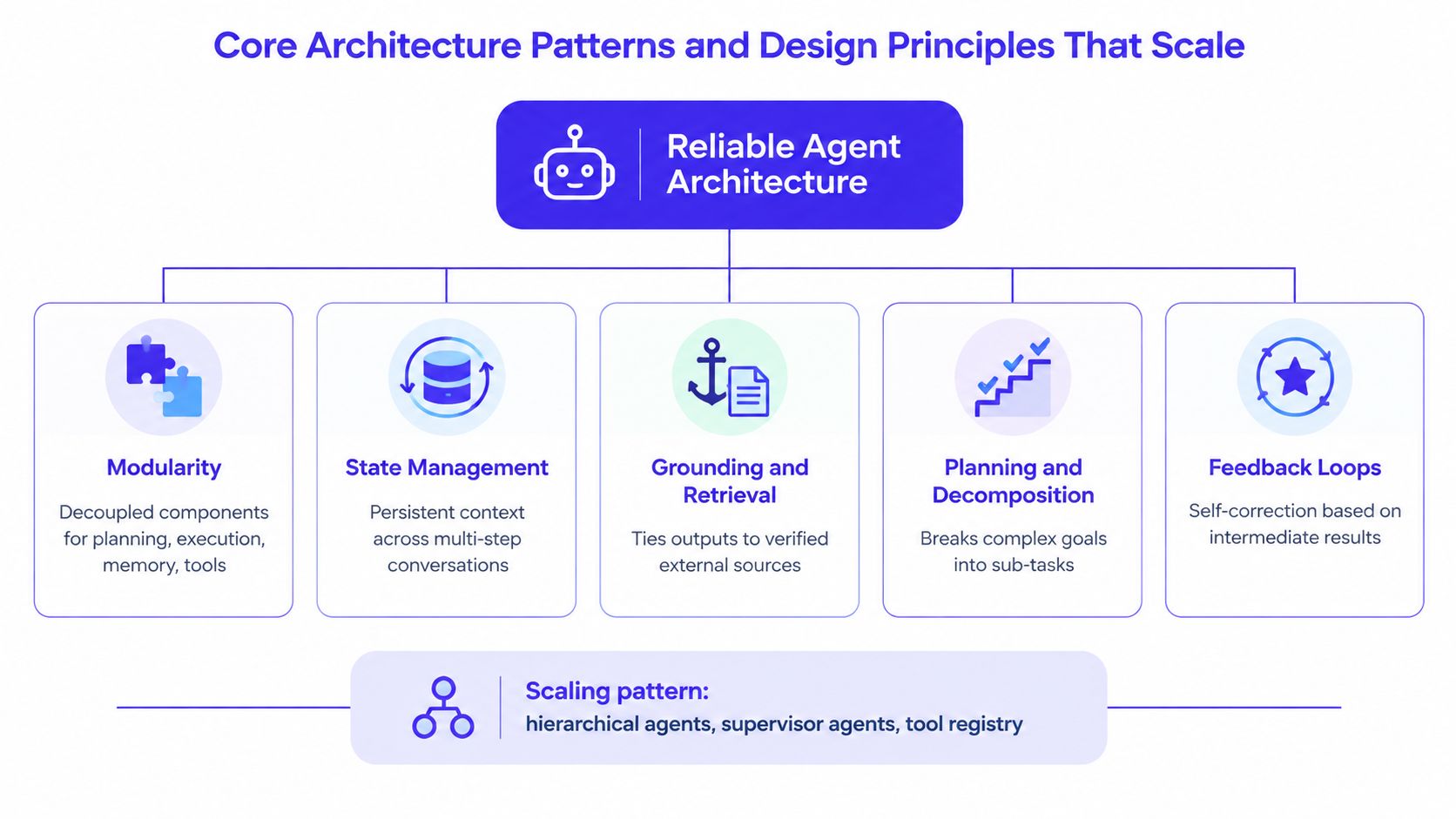
Reliable agentic AI system design starts with modular boundaries. Each component should have one clear responsibility, observable inputs and outputs, and a failure mode that the rest of the system can handle.
A single-agent loop is often the right starting point:
Goal → Plan → Tool call → Result → Replan → Final state
It keeps coordination simple and makes replay easier. A multi-agent design can separate roles, such as research, execution, and review, but it also introduces more messages, more state synchronization, and more opportunities for conflicting decisions. Add an additional agent only when the separation improves control, specialization, or throughput.
Five design principles
Modularity prevents one prompt from becoming the hidden application. Keep planning separate from execution. Let the tool layer validate arguments and permissions independently of the model. This makes it possible to replace a planner without rewriting every integration.
State management protects the task from context loss. Store the task goal, completed steps, tool outputs, pending actions, errors, and approval status as structured state. Don't rely on a long transcript as your only database. Summarize old context, retain authoritative records, and distinguish durable facts from temporary reasoning.
Grounding and retrieval connect decisions to verified information. Retrieval should return source identifiers, timestamps where available, access scope, and content that the planner can inspect. A tool that returns an unstructured blob makes it difficult to test whether the agent used the correct evidence.
Planning and decomposition should match the business process. Use small, checkable subtasks rather than an elaborate plan that becomes stale after the first tool result. A planner should know when to stop planning, when to revise, and when to ask for clarification.
Feedback loops turn execution into a controlled experiment. Every tool result should tell the agent what changed, whether the action succeeded, and what constraints now apply. A failed API call shouldn't look like an empty successful result.
Tool contracts and latency
Tool contracts deserve the same care as public APIs. Define required fields, allowed values, authorization rules, idempotency behavior, timeout handling, and the shape of success and error responses. Contract tests should run against every tool or Model Context Protocol endpoint before deployment.
Latency becomes a systems problem as soon as an agent takes multiple actions. Research on agent tool use warns that strict sequential dependence can make end-to-end latency grow linearly or even exponentially with the number of steps. The PASTE approach reported reductions of up to 48.5% in average task completion time, with p95 and p99 tail-latency reductions of up to 48.6% and 61.9%, respectively, in the cited speculative execution research.
The design implication is specific:
- Parallelize independent lookups, such as account metadata and product usage.
- Keep dependent actions sequential, such as validating a payment before issuing a refund.
- Trim tool payloads before they enter the model context.
- Cache stable reads, but never cache permission decisions without considering identity and freshness.
- Set explicit budgets for steps, tokens, tool calls, and wall-clock time.
For deeper guidance on model and tool boundaries, see LLM engineering practices.
Safety Governance and Controls for Production Agents
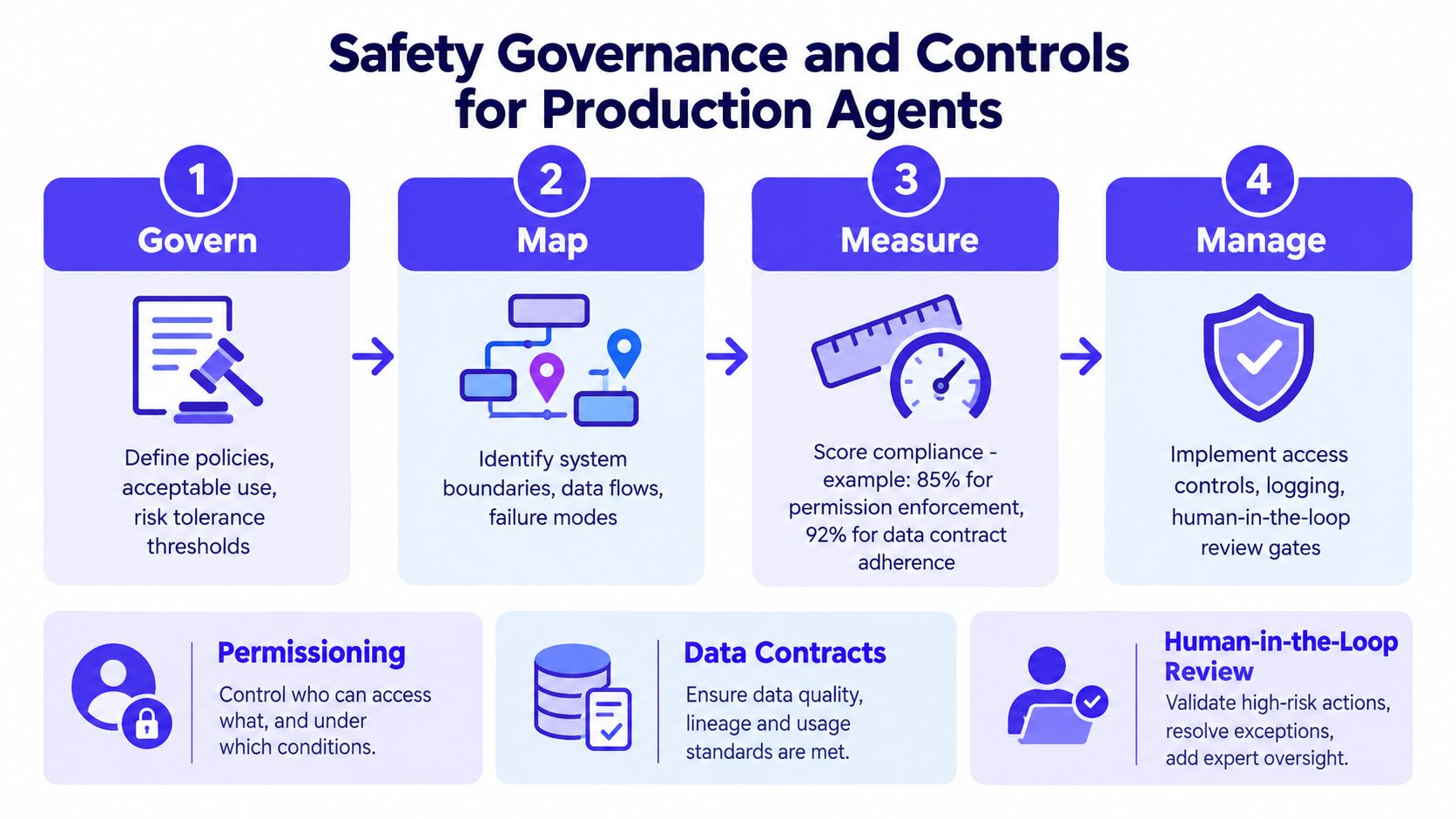
Governance works best as an engineering workflow, not a policy document stored away from the codebase. NIST's Generative AI Profile is a companion to the AI Risk Management Framework and helps organizations integrate trustworthiness into the design, development, use, and evaluation of generative AI systems. The profile is specific to generative AI, which makes it relevant when an agent combines model behavior with tool access and business decisions. NIST lists the profile as NIST AI-600-1, dated July 26, 2024, on its AI Risk Management Framework resources page.
The framework's four functions create a practical release sequence:
| Function | Engineering question | Typical control |
|---|---|---|
| Govern | Who owns the system and what risk is acceptable? | Policies, accountable owners, escalation rules |
| Map | What data, tools, users, and failure modes are in scope? | Data-flow maps, threat models, use-case boundaries |
| Measure | Does the complete trajectory meet its contracts? | Replay tests, quality scores, safety checks |
| Manage | What happens when the agent fails or conditions change? | Access controls, monitoring, rollback, approval gates |
NIST's profile was developed with input from a public working group of 2,500 participants and centers on 13 risks with more than 400 recommended actions, as described in the NIST technical reports collection. You don't need to implement every action at once. Use the risk categories to create a prioritized checklist tied to the system's intended use.
Controls that change the design
Permissioning should apply at the tool boundary, not only inside the prompt. A user who can read an account record shouldn't automatically gain authority to change its status. Pass user identity and role context to the authorization service, log the decision, and deny by default when the system can't establish permission.
Data contracts define what each source promises. Specify schemas, freshness expectations, ownership, sensitivity, and behavior when data is missing or contradictory. Enterprise surveys cited in the State of Agentic AI 2026 report identify data readiness and quality as the top blocker for 58% of respondents. The operational lesson is clear: a capable agent can't compensate for data that the organization can't safely expose or interpret.
Human review belongs before irreversible actions, not after them. Require approval for external communications, financial changes, account deletion, access changes, or any action whose impact is difficult to reverse. Low-risk read operations can remain automated when their scope and audit requirements are clear.
Observability should record the goal, plan version, model version, retrieved sources, tool arguments, authorization result, outputs, retries, latency, and final state. Protect sensitive values while preserving enough provenance to replay the decision.
Teams that need practical defenses against malicious instructions can use prompt injection prevention guidance alongside permission checks. Prompt filtering alone isn't a control boundary. The tool server must still enforce authorization.
Evaluation Metrics and MLOps for Reliable Agent Performance
A fluent answer can hide a failed process. Evaluate the trajectory, not only the final text: the model, retrieved context, tool calls, intermediate decisions, and resulting state all affect whether an agent worked.
Static question-and-answer tests still help with narrow components. They do not reveal how an agent explores, builds a working model of its environment, infers a goal, or coordinates several steps. The ARC-AGI-3 technical report describes interactive intelligence through turn-based environments that require those behaviors. Production evaluation should use similar task conditions where the agent must act, observe results, and adjust its plan.
A practical scorecard
Track four dimensions:
- Consistency: Does the agent reach an acceptable state across repeated runs with equivalent inputs?
- Resilience: Does it recover from missing data, malformed responses, permission denials, and tool timeouts?
- Predictability: Does it stay within step, latency, tool, and cost budgets?
- Safety: Does it refuse unauthorized actions, request approvals, and preserve audit evidence?
Define success at the state level. For a support agent, “answer generated” says little. “Answer cites an approved source, changes no customer data, assigns the correct queue, and records the interaction” creates a test an engineer can verify.
MLOps for action chains
Create a replayable evaluation set from production traces, synthetic edge cases, and manually authored scenarios. Version the task contract, tools, retrieval configuration, prompts, model, and policy rules together. A failed trajectory should be reproducible enough to show whether planning, retrieval, authorization, execution, or final-state validation caused the error. A practical AI agent evaluation framework can help organize these checks into a recurring operating routine.
The production agent evaluation guidance describes 12 metrics spanning consistency, predictability, and safety, and recommends reserving 10–20% of build time for ongoing evaluation and monitoring. Treat that work as part of delivery. Without it, teams discover regressions through customer incidents.
Latency needs its own dashboard. Record time to first model response, each tool duration, queue time, retries, total steps, and p95 and p99 end-to-end latency. Parallel execution can reduce waiting when dependencies are known. Speculative work can instead increase cost and load when the planner often changes direction.
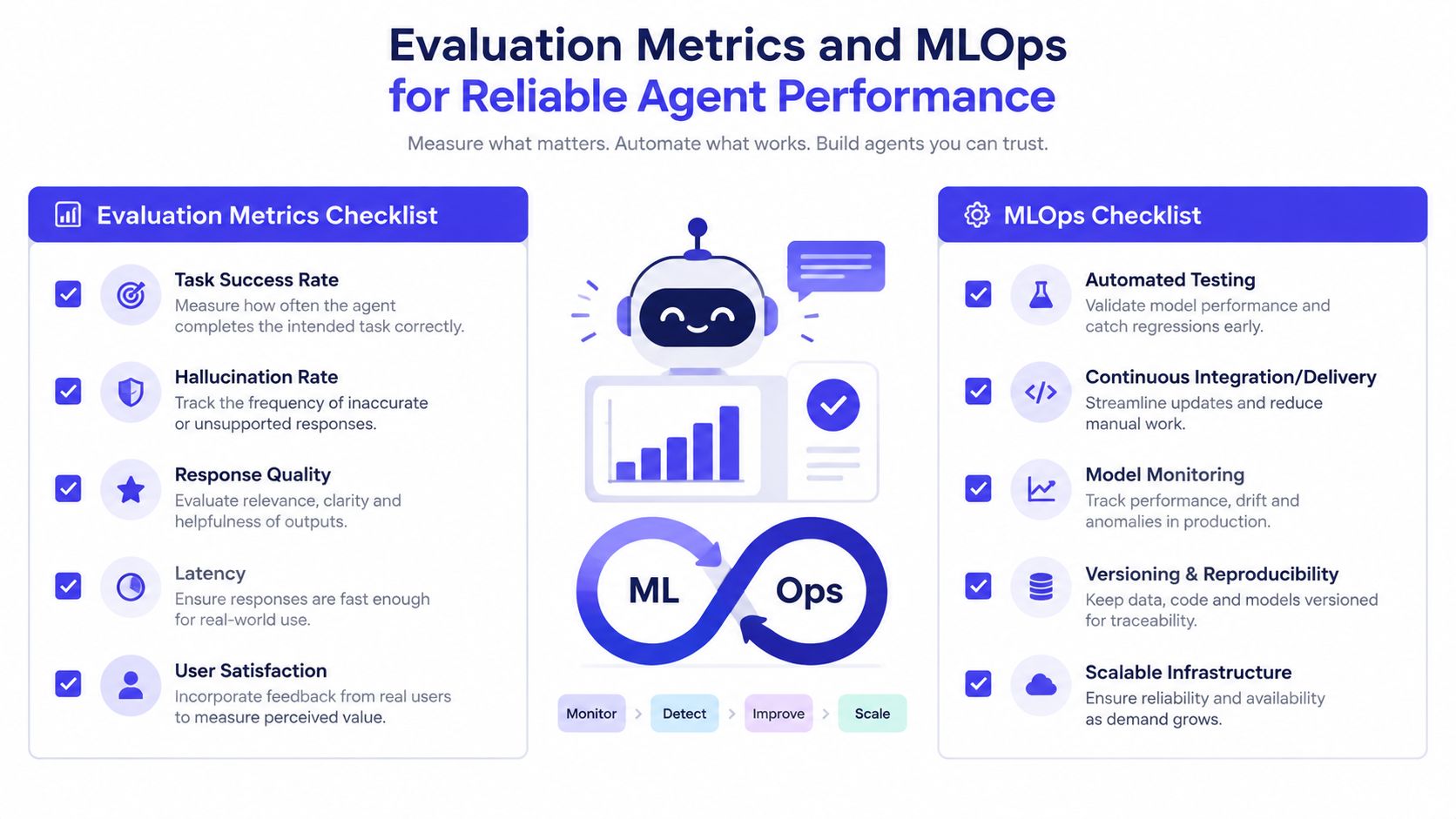
Run CI checks for tool contracts, authorization behavior, retrieval grounding, prompt-injection resistance, and regression trajectories. Deploy gradually, compare versions on the same evaluation set, and retain rollback paths for model, prompt, retrieval, and policy changes. This turns agent reliability from a model-selection question into an orchestration and governance discipline, with latency and data readiness measured alongside task quality.
Example Workflows and Trade-offs in Action
Consider two teams with different problems. The first needs an internal support copilot over a knowledge base containing 20–50k documents. The second wants a computer-use agent to complete multi-step work across SaaS tools. Both are agentic, but they shouldn't share the same architecture.
Example one, an internal support copilot
The support agent receives a question, identifies the product area, retrieves relevant documents, checks the customer's account context, drafts an answer, and routes uncertain cases to a human.
A sensible flow is:
Question → Intent classification → Parallel retrieval and account read → Grounded draft → Policy check → Human escalation or response
Use hybrid retrieval where exact product terms matter, return document identifiers and access scope, and keep account data separate from general documentation. The agent may draft freely, but it shouldn't modify a ticket or customer record without an explicit tool and permission check.
The trade-off favors controlled assistance over autonomous resolution. The business gets faster triage and more consistent drafts, while a person handles ambiguous or sensitive cases. The main failure mode is confident synthesis from stale or unauthorized context, so provenance and access filtering matter more than adding another planner.
Example two, a computer-use workflow
A computer-use agent might gather information from a browser, update records in one system, and prepare an action in another. The architecture needs a planner, browser or API tools, durable task state, screenshot or page-state interpretation, and an approval gate before changes that affect customers or money.
Keep read actions parallel when they don't depend on one another. Keep state-changing actions sequential, validate the current page or API state before each mutation, and stop when the environment differs from the expected contract.
This design accepts more latency in exchange for safety. The benchmark evidence cited earlier shows why: even strong progress leaves meaningful failure probability. A browser agent that can recover from a missing button is useful. One that selects a different customer is dangerous.
The build-versus-buy decision should follow the workflow, not the novelty of the interface. Buy commodity integrations when permissions, auditability, and support are already mature. Build the orchestration layer when your business rules, approval model, or data contracts differentiate the product.
Building Your Team and Next Steps to Ship
An agentic system needs more than an LLM engineer. The minimum team depends on risk and integration depth, but common responsibilities include:
- AI engineer: Planner behavior, tool routing, structured outputs, retrieval, and trajectory evaluation.
- MLOps engineer: Deployment, observability, versioning, rollback, latency, and reliability automation.
- Data engineer: Source quality, schemas, access scopes, freshness, and data contracts.
- AI product lead: Use-case boundaries, success criteria, approval policy, and adoption.
- Designer or service designer: Human review flows, uncertainty handling, and operator feedback.
Use a short interview exercise: give the candidate a workflow with one read tool, one write tool, incomplete data, and a required approval. Ask them to define the state machine, tool contracts, failure paths, evaluation cases, and audit events. Strong candidates will discuss what the agent must not do, not only what it can do.
A practical 2–4 week pilot can follow this sequence:
- Scope the job: Choose one workflow, one user group, and an explicit final state.
- Map the system: List data sources, tools, permissions, failure modes, and human checkpoints.
- Build the narrow loop: Start with one planner and a small tool registry.
- Create evaluation gates: Add replayable trajectories, contract tests, safety cases, and latency instrumentation.
- Run supervised operations: Review traces, label failures, and fix data or tool boundaries before expanding autonomy.
Team topology matters when several specialists share ownership. A discussion of pods and matrix organization models can help you choose between a focused delivery pod and a matrix that shares platform, data, and governance expertise.
Three actions will move the decision forward. First, write the target workflow and its prohibited actions. Second, schedule a technical design review around tools, state, data readiness, and evaluation. Third, staff the pilot with the engineering and product skills needed to operate it, not just prototype it.
ThirstySprout helps companies source senior AI engineers, MLOps specialists, data engineers, and AI product talent for production agentic workflows. Visit ThirstySprout to start a pilot discussion or review sample profiles matched to your stack, time zone, and delivery needs.
Hire from the Top 1% Talent Network
Ready to accelerate your hiring or scale your company with our top-tier technical talent? Let's chat.