

Chaos engineering intentionally injects controlled failures into production-like systems to test whether a defined steady-state hypothesis remains true. Netflix created Chaos Monkey in 2010, and by 2021, 60% of State of Chaos Engineering respondents said they had run a chaos engineering attack, showing how the practice moved beyond a niche reliability experiment. The 2021 State of Chaos Engineering report also reported that 23% of respondents had a mean time to resolution under 1 hour, while 60% reported under 12 hours.
A regional failover can look safe on an architecture diagram and still fail under real traffic. A dependency may reconnect too slowly, a retry policy may amplify load, or a supposedly redundant path may share the same connection pool. Chaos engineering gives reliability teams a controlled way to find those weaknesses before customers discover them during an incident.
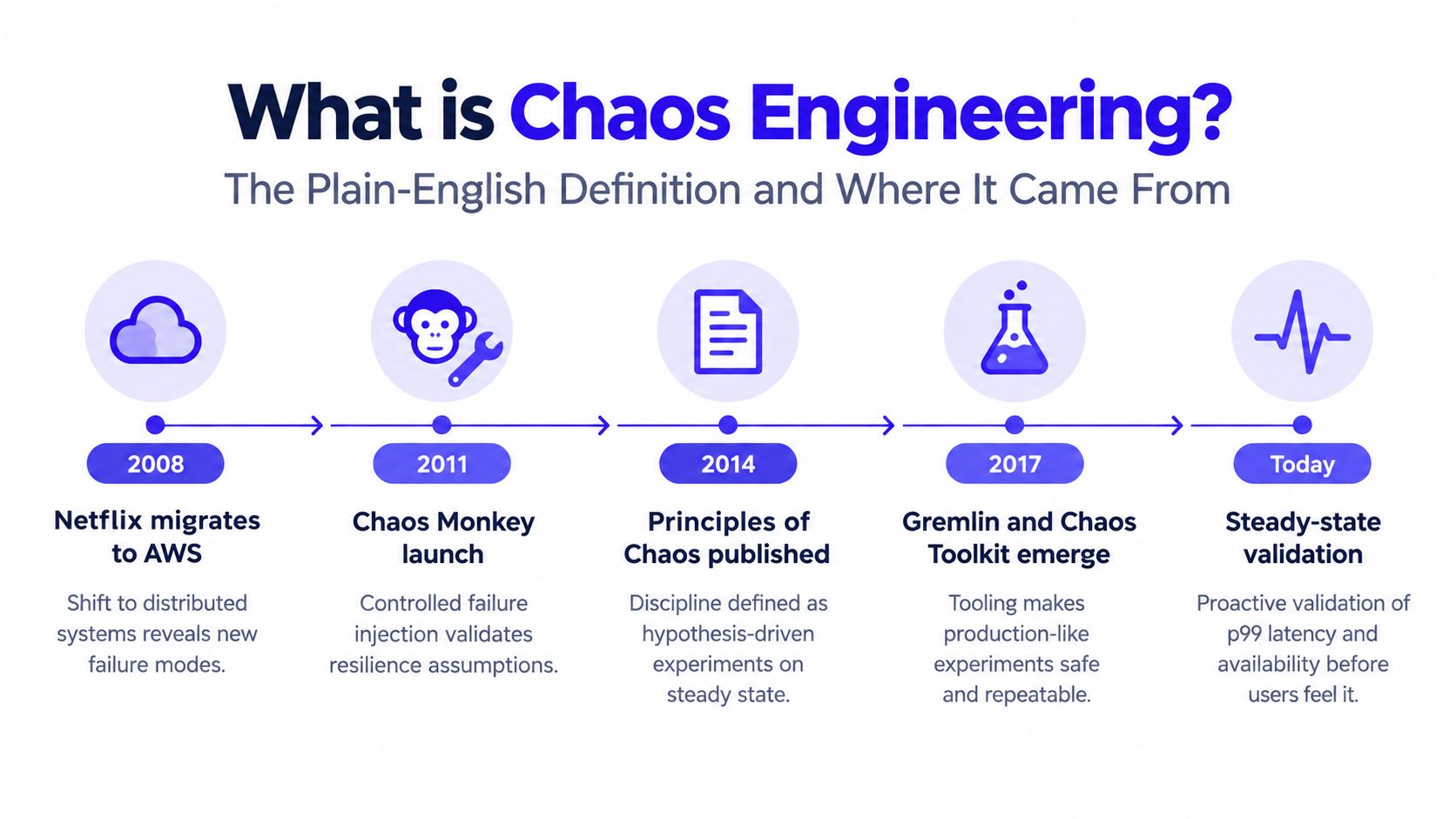
The Plain-English Definition and Where It Came From
A checkout request arrives while a regional database is failing. The secondary path accepts traffic, yet an exhausted connection pool blocks requests. Redundancy exists on the architecture diagram, but the customer journey still breaks. Chaos engineering tests this kind of gap before an incident exposes it.
Chaos engineering is resilience testing with a hypothesis. Define how the system should behave, introduce a controlled fault, and observe whether user-facing outcomes remain within acceptable limits. Teams inject faults into production or production-like systems, then measure signals such as request success rate, latency, service availability, connection saturation, queue depth, and recovery behavior. Recent research on chaos engineering describes this steady-state approach as a way to expose hidden failure modes before they become incidents.
The hypothesis must connect the fault to a customer outcome. A team might predict that a regional database failover will preserve checkout availability, then test that prediction while monitoring the complete request path. That scope matters. Checking whether the secondary database accepts traffic is insufficient if retries overload another dependency or a shared connection pool prevents requests from completing.
Chaos engineering therefore has an operational boundary. The team chooses the fault, limits its blast radius, defines stop conditions, and decides which evidence will determine success. The experiment may run in staging when production exposure is not yet justified, but a staging result cannot prove that production traffic, configuration, or dependency behavior will respond identically.
Netflix made failure injection operational
Netflix turned deliberate failure injection into an operational practice after moving from physical infrastructure to Amazon Web Services. Its work showed operators that failures could be tested repeatedly with clear ownership, controlled scope, and measurable customer-facing results. The history of Chaos Engineering and Chaos Monkey records the development of Chaos Monkey in 2010, the Simian Army in 2011, open-sourcing in 2012, and a dedicated Chaos Engineer role in 2014.
The method later gained a shared vocabulary around steady-state hypotheses, real-world conditions, controlled experiments, and measurable outcomes. The Principles of Chaos guidance also emphasizes observing what users experience, not only whether an internal component remains healthy.
Practical rule: If you can't state the expected customer-facing behavior before the experiment, you aren't ready to inject the fault.
The Core Principles That Make It a Discipline
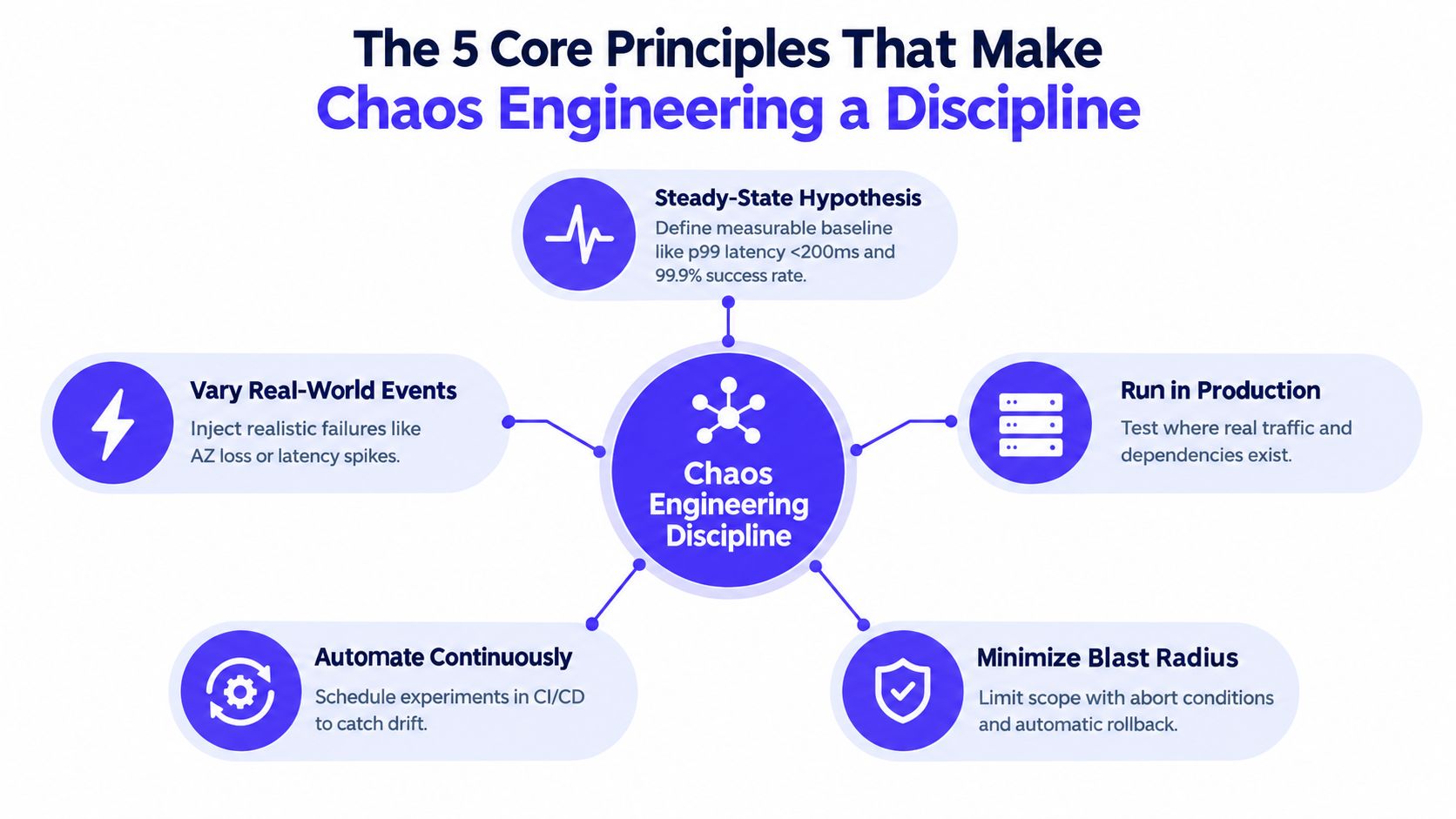
A useful chaos program rests on five connected principles. Together, they turn failure injection into a controlled way to test resilience. Without them, an experiment can become either unsafe or too shallow to guide engineering work.
Start with steady-state behavior
Define normal behavior in measurable terms before introducing a fault. Useful signals include checkout success, request latency, throughput, and service availability. The Principles of Chaos guidance recommends beginning with a steady-state hypothesis and checking it against real traffic and controlled disruption. The operator's question is direct: what must remain true for customers while this dependency is impaired?
An SRE team might write, “Checkout requests continue to meet the service objective while one dependency is unavailable.” The threshold should come from the team's existing service-level objective, rather than from a generic chaos template. A hypothesis that cannot be checked against an observable customer or system signal is not ready for execution.
Vary real-world events
Select faults that resemble incidents the service could experience. Dependency loss, latency spikes, packet loss, DNS resolution delays, certificate rotation errors, and instance termination exercise different recovery paths. Research on resilience benchmarking describes chaos experiments as a way to assess whether retries, circuit breakers, and failover preserve expected service behavior.
A team with a history of slow certificate rotation should reproduce that dependency failure first, rather than killing random compute instances. The experiment should test a known risk, expose the relevant recovery path, and produce evidence the team can act on.
Use a production-like environment
An environment must contain the dependencies that make the failure meaningful. Similar application code is not enough if staging has different traffic patterns, data distributions, queues, feature flags, or network topology.
An SRE team can mirror the production dependency graph in a controlled test environment, then validate the same fault against a narrowly scoped production canary. Google Cloud's chaos engineering guidance supports realistic scenarios, production execution where appropriate, automation, and a minimized blast radius. For AI or LLM-backed services, the test also needs representative model latency, provider behavior, token limits, and fallback paths.
Automate repeatable checks
A quarterly game day can expose weaknesses, but it will not detect architectural drift by itself. Once an experiment is safe and useful, encode its setup, monitoring, abort conditions, and cleanup so engineers can run it repeatedly.
Put those checks into delivery workflows or operational schedules. A successful experiment should function as a resilience regression test, with an owner and a review path, rather than as a dramatic event that disappears from the backlog.
Constrain the blast radius
Blast radius is the boundary around the systems, users, tenants, or regions that can experience the injected fault. Start with the smallest scope that can answer the hypothesis. For example, target 5% of pods in one availability zone and configure an automatic abort if checkout success falls below its service objective for 60 seconds.
The scope should also account for rollback time, customer concentration, and shared dependencies. A canary fleet may be safer than a whole region, while an internal user group may provide useful evidence without exposing external customers.
AWS Prescriptive Guidance recommends small initial experiments, known baselines, stop conditions, operator control, and remediation before expansion. Teams familiar with principles of software design can connect resilience findings to coupling, dependency boundaries, and failure isolation.
Production Versus Staging Where to Actually Run Experiments
The answer isn't “always production” or “never production.” Staging is safer for validating the experiment mechanics. Production is more realistic for validating customer-facing resilience. Your decision should depend on the fault, the quality of observability, the reversibility of the action, and the consequences of a bad assumption.
A staging test can confirm that the fault injector targets the intended service, the rollback works, and dashboards show the right signals. It won't necessarily reproduce production-only dependencies, traffic shape, data skew, or tenant behavior. Production experiments provide that realism, but they require stronger controls and active incident coordination.
| Dimension | Staging | Production |
|---|---|---|
| Traffic | Synthetic or representative load | Real customer traffic and behavior |
| Data | Sanitized or reduced datasets | Current distributions and dependency state |
| Risk | Easier to isolate and roll back | Potential customer, compliance, and revenue impact |
| Learning value | Good for mechanics and early hypotheses | Strongest test of end-to-end resilience |
| Controls | Environment access and teardown | Canary scope, stop conditions, on-call coverage |
| Best starting point | New fault types and unsafe assumptions | Mature experiments with proven rollback |
A practical graduation path
Start in a production-like environment. Establish the baseline, validate the hypothesis, and confirm that the team can stop and clean up the experiment. Then graduate only the experiments that have a clear business purpose and a bounded failure mode.
For production, define the target scope before execution. Use a single availability zone, an internal user group, shadow traffic, or a canary cell where possible. Require an approved runbook, an identified experiment owner, an on-call engineer, a communication plan, and automatic stop conditions tied to service-level indicators.
This matters even more for AI systems. A staging language model workflow may see clean prompts and stable retrieval results, while production contains ambiguous prompts, long conversations, stale documents, and unusual tool calls. Teams should test production-like prompt distributions and dependency paths before deciding that a model workflow is resilient.
Engineers operating production systems should also distinguish a reversible degradation test from a destructive data operation. The former may be appropriate for a tightly scoped production canary. The latter may belong only in an isolated environment with synthetic data.
Two Real-World Mini-Cases Worth Studying
The same discipline applies to infrastructure and artificial intelligence workflows. The fault changes, but the structure stays consistent: hypothesis, injection, scope, observation, remediation.
Regional dependency failure
Consider a multi-availability-zone checkout service. The hypothesis is that losing one zone won't materially affect checkout because traffic should move to healthy capacity. The team runs the experiment in staging plus a tightly scoped canary, simulating loss of the target zone while tracking checkout success, request latency, database calls, and connection-pool utilization.
The experiment reveals a synchronous DynamoDB call in the checkout path. Although the application is deployed across zones, that call blocks the failover path and turns a multi-zone design into a practical dependency bottleneck. The correct remediation isn't “add more instances.” Engineers decouple the call, add an asynchronous path where the business flow allows it, and document the dependency in the failover runbook.
The result is a clearer architecture and a more credible failover claim. The team now knows which user-facing signals define success and which internal dependency can invalidate the design.
Retrieval failure in an AI copilot
Now take a customer-support copilot that uses retrieval-augmented generation. The hypothesis is that the copilot will either use the current embedding index or fail safely when the index is unavailable.
The team routes a narrowly scoped user cohort to a stale embedding index and monitors retrieval version, citation coverage, answer acceptance signals, refusal behavior, and support escalation. The experiment exposes retrieval drift and hallucinated answers because the application accepts results without checking index freshness.
The remediation combines an index-version guard, explicit failure behavior, and monitoring for embedding drift. The model itself may not need replacement. The failure sits in the policy around retrieval freshness and the absence of a safe response when the dependency is stale.
Chaos engineering is most useful when it finds the boundary between “the component is healthy” and “the user experience is safe.”
These cases also show why vendor choice isn't the central question. Gremlin, ChaosBlade, Litmus, AWS Fault Injection Service, Steadybit, and internal tooling can all support experiments. The quality comes from the hypothesis, scope, signals, and remediation loop.
A Hypothesis-Driven Roadmap From Planning to Automation
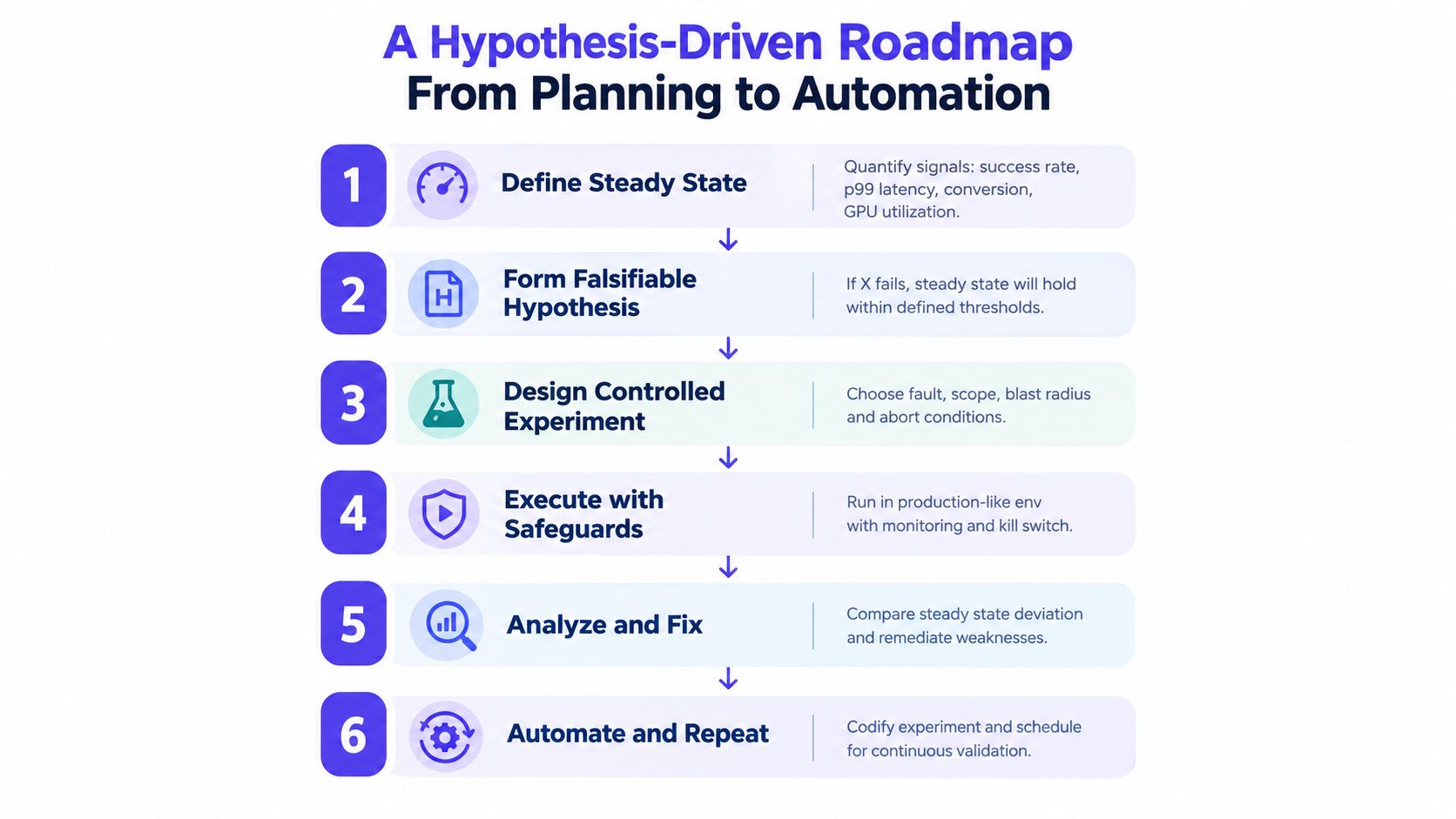
A checkout service can look healthy while a failed dependency pushes customers into retries and abandoned carts. A reliable experiment makes that failure visible without turning the game day into an outage. Use this six-step roadmap to produce evidence, fix weaknesses, and automate only after the controls work.
1. Define the steady state
Choose signals that represent both system health and user behavior. Useful examples include request success rate, p99 latency, conversion, queue depth, and GPU utilization. Prefer existing service-level indicators so the experiment uses the dashboards and alerts operators already trust during incidents.
For AI systems, include retrieval freshness, citation coverage, refusal behavior, or model-response latency when those signals affect the user journey.
2. Form a falsifiable hypothesis
Write an outcome that could be proven wrong. For example: “If one availability zone becomes unavailable, checkout success remains within the existing service objective, and the recovery path does not overload the database.”
Avoid statements such as “the system is resilient.” They offer no defined observation, threshold, or decision rule.
3. Design the controlled experiment
Select one fault and one initial scope, then fill out a one-page experiment brief: hypothesis, steady-state SLI, blast radius, abort threshold, owner, and tested kill switch. No brief, no run.
A workable scope might be one canary fleet, one tenant, or one zone. The brief should also identify the dependency path under test and the user boundary that must remain protected. AWS Prescriptive Guidance supports limiting impact and establishing exit criteria before execution.
4. Execute with safeguards
Use a suitable tool, such as Gremlin, ChaosBlade, Litmus, AWS Fault Injection Service, or Steadybit. The tool matters less than the operating controls around it. Confirm dashboards, alerts, permissions, access to the experiment, and rollback paths before injecting the fault.
Watch the user journey alongside infrastructure metrics. Healthy CPU and memory graphs do not prove that checkout, retrieval, payments, or model responses remain safe. For an LLM workflow, monitor whether stale retrieval data produces unsupported answers or unsafe fallback behavior.
5. Analyze the deviation and fix the weakness
Compare observed behavior with the hypothesis. Find the first meaningful deviation, not only the final visible error. Tracing can show whether latency began at a dependency, retry layer, queue, connection pool, or model service.
Record the remediation as an engineering item with an owner and acceptance signal. A failed hypothesis is useful. A finding that is not documented, assigned, and retested changes nothing.
6. Automate and repeat
After the experiment is safe and the remediation is complete, codify it. Schedule the scenario through GitHub Actions, Argo, or an equivalent operational workflow, then send results to the team responsible for the service.
An automation record should include the fault, scope, hypothesis, steady-state signals, abort conditions, owner, latest result, and remediation links. Repetition turns resilience from an assumption into an observable property.
A worked experiment could look like this:
- Hypothesis: Losing one zone will not push checkout outside its existing service objective.
- Fault: Remove zone capacity or block the zone-specific dependency path.
- Scope: One canary fleet with explicit user and tenant boundaries.
- Signals: Checkout success, p99 latency, database saturation, retry volume, and queue depth.
- Abort: Trigger the kill switch when customer impact or dependency saturation exceeds the approved threshold.
- Aftercare: Restore capacity, verify steady state, open remediation work, and schedule a repeat after the fix.
Dedicated chaos expertise becomes useful when experiments span several teams, involve production access controls, or target AI systems whose failure signals are harder to define. A specialist can establish the operating model, while service owners retain responsibility for hypotheses and remediation.
The following video provides an additional practical introduction to the discipline and experiment flow:
Common Misconceptions and Pitfalls to Avoid
Chaos engineering isn't random destruction. Every action should connect to a hypothesis, a measurable steady state, and an approved scope. “Break things and see what happens” creates noise and can damage trust with product, security, and operations teams.
It also isn't limited to hyperscalers. A mid-size team running Kubernetes on Amazon Elastic Kubernetes Service can benefit when service dependencies, observability gaps, and unclear service-level objectives make incidents difficult to diagnose. The experiment should match the team's maturity. Start with a narrow dependency failure, not a broad regional disaster.
What chaos engineering doesn't replace
Chaos experiments sit alongside other forms of testing:
- Unit tests check isolated code behavior.
- Integration tests check component interactions under known conditions.
- Load tests examine performance under planned demand.
- Chaos experiments examine emergent behavior when realistic dependencies fail.
Observability remains a prerequisite. Without distributed tracing, structured metrics, service-level alerts, and a trustworthy baseline, you won't know whether the fault caused the deviation or merely exposed an existing problem.
Failure patterns that waste game days
Teams get poor results when they skip blast-radius limits, run during peak traffic without a canary, or omit automatic stop conditions. A single game day also won't create a durable practice if nobody turns findings into runbooks, architectural changes, or recurring experiments.
The operational standard should be simple: run only what you can observe, stop, and explain. If the team can't identify the customer impact and restore the previous state, improve those controls before expanding the fault.
Team Roles When to Hire and a Practical Checklist
Many organizations don't need a dedicated chaos engineer on day one. SRE, platform engineering, and product engineering can share the work if they agree on ownership and maintain a visible experiment backlog.
SRE owns the steady state. SRE defines service-level signals, manages safety controls, coordinates the on-call plan, and evaluates whether the experiment answered the hypothesis.
Platform engineering provides the machinery. The platform team manages fault-injection access, environment controls, automation, observability integration, and rollback mechanisms.
Product engineering fixes the exposed weakness. The service owners understand business flows and remediate coupling, timeout behavior, retries, data consistency, and safe degradation.
A dedicated resilience lead becomes more justified when incident patterns keep recurring, game days repeatedly compete with SRE capacity, regulatory expectations require stronger evidence, or AI and machine learning workloads introduce specialized failure modes. Those workloads may need experiments for retrieval outages, model dependency latency, prompt drift, data pipeline delays, and degraded guardrails.
Use this guide to hiring a DevOps engineer when you need to distinguish general platform capability from dedicated resilience expertise. Buy a tool when access controls, experiment libraries, and integrations are the bottleneck. Build internally when your failure modes are highly specialized and your platform team can maintain the safety layer. Use external specialists when you need to establish the operating model or run a focused resilience program without committing to a permanent role.
Pre-game-day checklist
- Hypothesis documented: State the expected user-facing behavior and measurable signals.
- Baseline confirmed: Verify dashboards show normal behavior before the fault.
- Blast radius limited: Specify the service, scope, users, tenant, region, or canary boundary.
- Stop conditions tested: Confirm automatic aborts and the manual kill switch work.
- Rollback ready: Document restoration steps and assign an owner.
- Stakeholders informed: Notify on-call, service owners, security, and affected business teams.
- Findings assigned: Create remediation work and schedule a post-experiment review.
Start this sprint by choosing one recent incident, writing its steady-state hypothesis, and validating the rollback path in a production-like environment. That single exercise will tell you whether your team needs better observability, stronger platform guardrails, or dedicated chaos expertise.
ThirstySprout helps companies add senior AI, machine learning, MLOps, and data engineering specialists who can design resilience experiments for production AI systems and distributed platforms. Visit ThirstySprout to discuss a focused pilot, review sample profiles, and find the right specialist or remote team for your chaos engineering roadmap.
Hire from the Top 1% Talent Network
Ready to accelerate your hiring or scale your company with our top-tier technical talent? Let's chat.