

TL;DR
- Define the Role First: Before sourcing, define the business problem the developer will solve. Specify the technical outcomes needed in the first 90 days to avoid a costly mis-hire.
- Source from Global Hotspots: Focus on specialized talent networks and open-source communities in regions like Eastern Europe (backend, algorithms) and Latin America (frontend, mobile) for a balance of skill and cost.
- Vet for Remote Readiness: Use a practical take-home project (e.g., a mini RAG pipeline) and a system design interview to test for asynchronous communication, documentation, and autonomous problem-solving—not just coding skills.
- Onboard with a 30-60-90 Day Plan: Structure the first three months to move new hires from small, confidence-boosting wins to owning significant projects, ensuring they integrate quickly and feel productive.
- Start with a Pilot: De-risk your hire by starting with a 2–4 week paid pilot project. This validates skills and working style before a long-term commitment.
Who This Is For
This guide is for technical leaders who need to hire a software developer for a remote role and get it right the first time.
- CTO / Head of Engineering: You need to build your team with elite talent, control your budget, and move faster than competitors.
- Founder / Product Lead: You are scoping a new feature or MVP and need to find the right technical skills to execute a plan within weeks, not months.
- Talent Ops / Hiring Manager: You are tasked with finding, vetting, and onboarding remote engineers efficiently while managing risk.
If you need a practical, step-by-step framework for hiring remote developers without the usual guesswork and delays, this is for you.
The 3-Step Framework for Hiring Remote Developers
Hiring a senior software developer remotely in 2026 requires a focused process. Our framework delivers results by concentrating on three pillars: defining the role, sourcing strategically, and vetting for real-world skills.
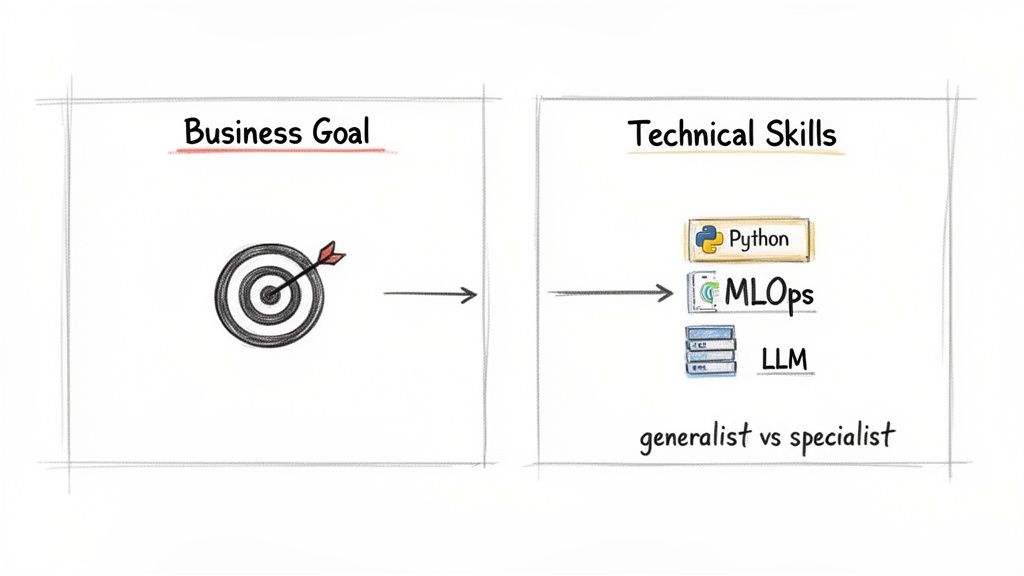
Step 1: Define the Business Problem & Role. Connect your business goal to a specific technical outcome. Instead of "hire a remote developer," it becomes "hire a Python expert to build our RAG proof-of-concept in 4 weeks."
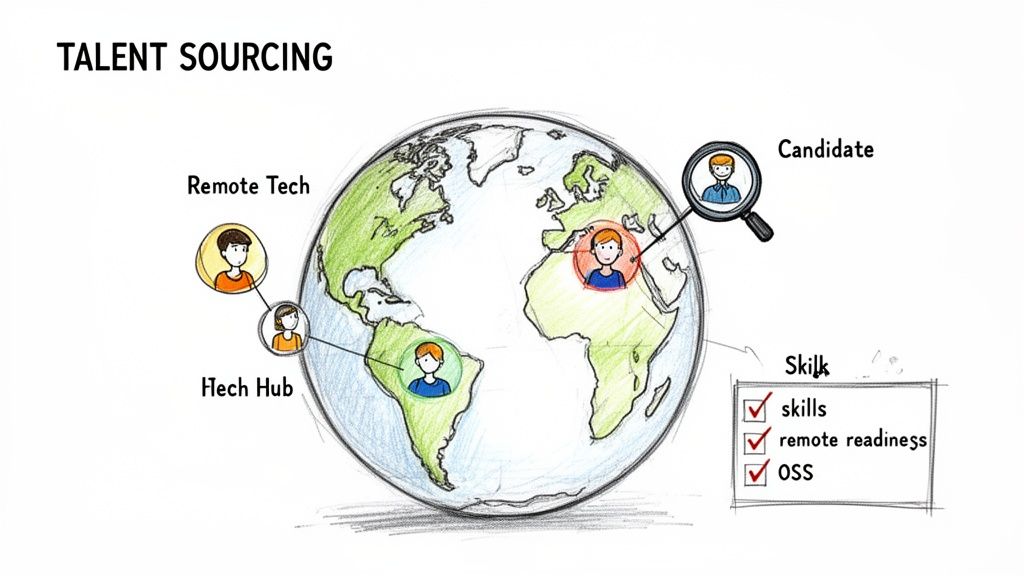
Step 2: Source from High-Value Talent Pools. Skip generic job boards. Target specialized talent networks where engineers are pre-vetted or niche open-source communities where skills are on public display.
Step 3: Vet with a Practical, Asynchronous-First Process. Use a take-home assessment that mirrors a real task, followed by a system design discussion. Evaluate candidates on communication and documentation as much as code.
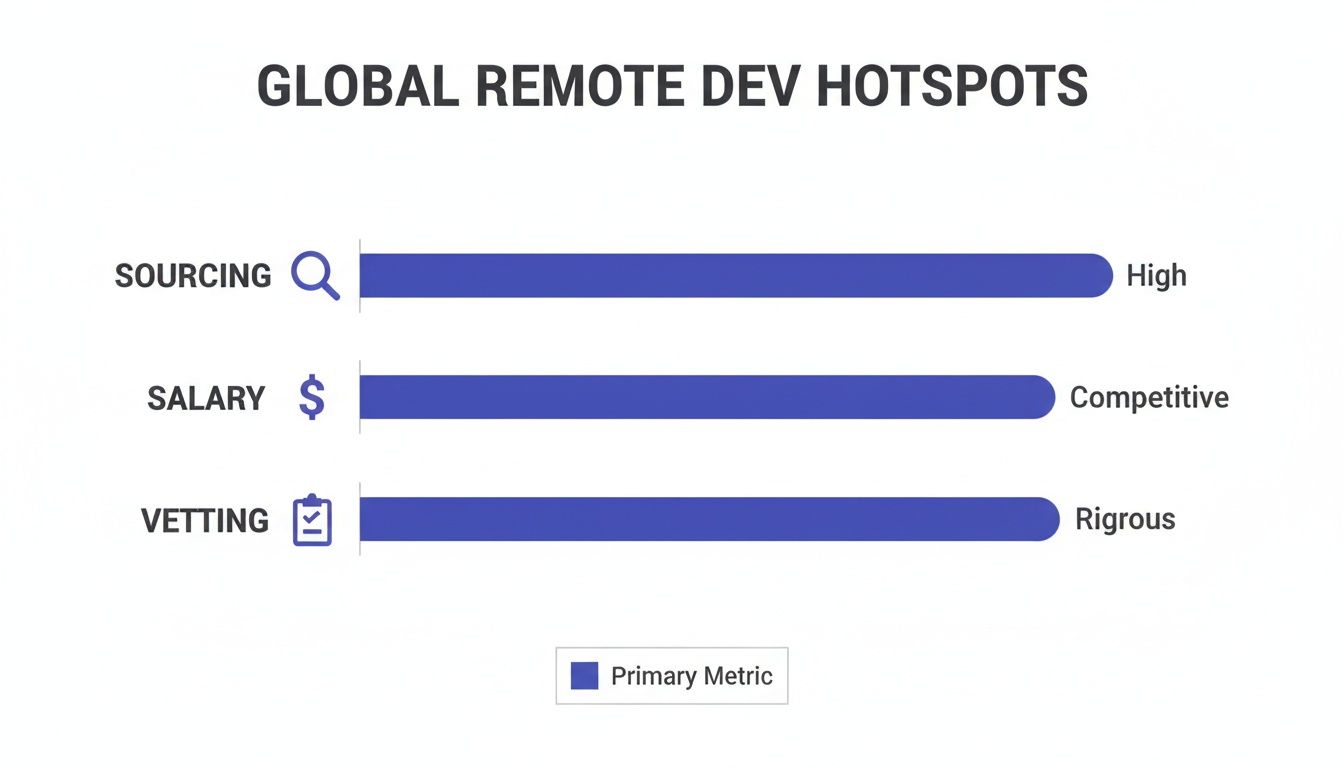
A winning strategy balances sourcing from these global talent pools, offering competitive regional salaries, and sticking to a rigorous vetting process that tests for remote readiness.
Data-Driven Salary Benchmarks
Don't guess on compensation. Overpaying wastes capital, while under-offering means you lose the best candidates. A senior AI/ML engineer in a top-tier U.S. market might command over $150,000, but you can find equivalent skills in an emerging market for 30-50% less.
Use real-time data to set competitive rates based on both skill set and location.
This data provides a solid starting point for budgeting and focusing your sourcing efforts. For a deeper breakdown of the entire process, this ultimate guide to hiring remote developers is a fantastic resource.
Practical Examples: Defining & Vetting Your Hire
Theory is one thing; practical application is another. Here are two real-world examples of our framework in action: a role-definition case study and a take-home assessment you can adapt today.
Example 1: Redefining the Role Saved a Fintech $100k+
A Series A fintech company wanted to use Large Language Models (LLMs) to automate transaction categorization. Their first instinct was to hire a full-time, senior AI engineer—a commitment of over $150,000 per year.
But by applying our framework, we mapped the immediate business problem: they didn't need a full-time builder yet. They needed a strategist to validate the approach.
The Solution: They redefined the role to a 6-week pilot project. They hired a fractional AI expert to test three technical approaches, benchmark accuracy, and deliver a data-backed roadmap.
The Business Impact: This pivot saved them from a six-figure mistake. They received a clear recommendation not to make a full-time hire until their transaction volume justified it, giving them the exact insights needed to move forward confidently.
Example 2: A Take-Home Assessment That Tests Remote Readiness
A well-designed take-home project is the single best tool for assessing practical skills and remote readiness. It simulates a genuine work assignment, revealing how a candidate structures code, documents their thought process, and communicates results.
Here’s a template we use for senior AI engineer roles:
Take-Home Assessment: Mini RAG Pipeline
- Objective: Build a simple Retrieval-Augmented Generation (RAG) system that answers questions from a small set of provided documents (e.g., 5–10 pages from a company FAQ PDF).
- Write a script to parse documents, chunk text, and create embeddings using an open-source model.
- Build a function that takes a user query, finds relevant text chunks, and feeds them into an LLM (e.g.,
gpt-3.5-turbo) to generate an answer. - Package the code in a Git repository.
- Deliverable: A
README.mdfile that explains your design choices, provides setup instructions, and shows how to run the code. - Time Allotment: 4–6 hours. We state this explicitly to respect their time.
- Specialized Talent Networks: Platforms like ThirstySprout pre-vet candidates for technical and soft skills, connecting you directly with engineers who have shipped production-level AI and ML systems.
- Niche Open-Source Communities: A developer’s GitHub profile, especially contributions to projects like
langchainordbt, is a living portfolio of their code quality and collaboration skills. - Targeted Global Hubs: Focus your search. Eastern Europe is a powerhouse for backend architecture, while Latin America has a deep talent pool for front-end and mobile experts with excellent time-zone alignment for U.S. companies.
- Screening Call (30 mins): A quick gut check to verify experience, align on salary expectations, and assess communication style.
- Technical Session (60–90 mins): A live system design discussion or a review of their take-home project. This is your window into their thought process.
- Culture Contribution Chat (45–60 mins): Understand what they add to your team dynamic. Discuss how they’ve handled remote collaboration, feedback, and ambiguity in past roles.
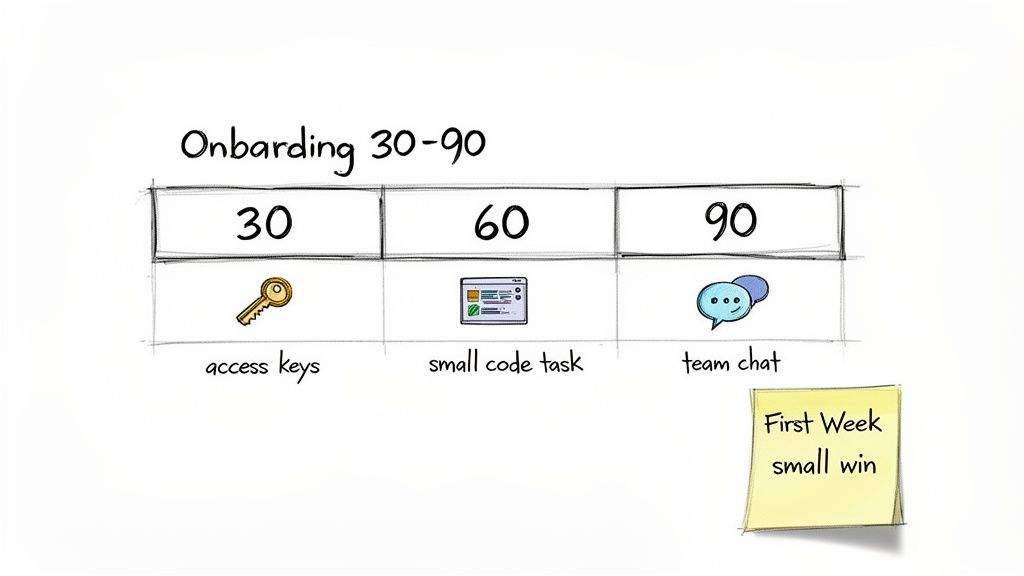
- Week 1: Setup & First Task. Get their development environment set up and assign a tiny, low-risk task (like fixing a typo or adding a log statement). This gets them familiar with your deployment process without pressure.
- Weeks 2–4: Paired Work. Pair them with an onboarding buddy. Their first real ticket should be a well-defined bug fix or minor feature, completed with support.
- Communication: Slack/Teams channels (team, engineering, social).
- Project Management: Jira, Linear, or Asana.
- Code & CI/CD: GitHub/GitLab repository and CI/CD platform access.
- Documentation: Confluence or Notion.
- Tackle a larger feature: Assign a project that requires collaboration with at least one other engineer.
- Contribute to documentation: Ask them to update docs for a process they just learned. This reinforces their knowledge and benefits the team.
- Lead a small project: Give them ownership of a feature, from scoping through deployment.
- Participate in architectural discussions: Actively encourage them to voice their ideas in system design meetings.
- Define the Role (30 Mins): Use our framework to define the one business problem this hire must solve in their first 90 days. Clarity here is your north star.
- Choose Your Sourcing Strategy: Compare the time and cost of traditional recruiting against a specialized talent network like ThirstySprout. The opportunity cost of a slow hiring process is massive.
- Launch a Pilot Project: The single best way to de-risk a remote hire is to start with a contained, well-defined pilot project. It's a real-world test drive that builds confidence for both sides.
- Start a Pilot Project to validate an engineer's skills on a real task.
- See Sample Profiles to see the caliber of our pre-vetted AI talent.
- The Ultimate Guide to Hiring Remote Developers - Lathire
- Skills Required for a Software Engineer - ThirstySprout
- Best AI Recruiting Tools - ThirstySprout
- How to Manage Remote Teams Effectively - ThirstySprout
This assessment tests Python and LLM ecosystem skills. More importantly, the quality of the README.md reveals their ability to communicate asynchronously—a critical skill for any software developer remote role.
Deep Dive: Sourcing, Vetting, and Onboarding
With a clear role definition, you can now execute the hiring plan. This means sourcing from the right places, running an effective interview process, and onboarding for long-term success.
Sourcing and Vetting Elite Remote Talent
If your hiring strategy starts with a generic job board post, you’re fishing in the wrong pond. Top-tier talent is almost always passive, which means you have to find them. The global developer population is set to hit 28.7 million by 2025, with 45% working remotely some of the time. This is a huge advantage if you know where to look.
Go beyond "post and pray":
Vet for Remote Readiness, Not Just Tech Skills
Technical ability is table stakes. Real success in a remote role depends on "remote readiness"—the ability to communicate with clarity, work autonomously, and collaborate effectively in an asynchronous environment.
The most common failure point for a new remote hire isn't their coding ability. It’s their inability to function asynchronously. To gauge this, your vetting process should mirror their day-to-day job. For a deeper dive, check out our guide on the best AI recruiting tools.
To keep the process objective, use a scorecard. It forces you to evaluate every candidate against the same criteria, making your final decision clearer and reducing bias.
Running a Remote Technical Interview That Actually Works
A remote interview should be a collaborative working session, not an interrogation. The goal is to see how the candidate thinks, communicates, and solves problems. We use a focused, three-stage process:
For senior roles, a system design discussion is more revealing than a simple coding challenge. Here’s a prompt we use:
Prompt: "Let's say we want to build an internal Q&A bot for our engineering team, pulling from 50,000 pages of internal docs. Walk me through the high-level architecture you'd propose for the first version."
This open-ended prompt reveals their architectural instincts and ability to balance complex trade-offs.
Checklist: Onboarding Your Remote Developer for High Performance
A signed offer is the starting line. A great onboarding experience is your single best tool for turning a new hire into a high-impact team member and retaining the talent you worked so hard to find.
Use this 30-60-90 day plan as a roadmap to eliminate guesswork.
[ ] Days 1–30: Integration and First Wins
The first month is about acclimation and scoring a small, confidence-boosting win.
[ ] Days 31–60: Building Contribution and Context
The focus shifts from how to why. The developer should be ready for more complex tasks.
[ ] Days 61–90: Driving Ownership and Impact
The new hire should be on their way to becoming a fully autonomous team member.
Managing remote engineers isn't about watching them work; it's about measuring outcomes. This requires a management style built on trust, clarity, and asynchronous communication. For a deeper dive, explore our guide on how to manage remote teams effectively.
What to Do Next
You now have the playbook for finding, vetting, and managing a top-tier software developer remote hire. Acting on this plan is what separates fast-moving companies from the rest.
Ready to find your next great remote developer in days, not months?
Book a quick scope call with our team. We can often introduce you to the right expert from our network within 48 hours.
References
Ready to skip the guesswork and connect with elite, pre-vetted AI and software engineers? ThirstySprout matches you with top-tier remote talent ready to make an impact in days, not months.
Hire from the Top 1% Talent Network
Ready to accelerate your hiring or scale your company with our top-tier technical talent? Let's chat.