

TL;DR:
- When to hire: Use a product management consultant for urgent, specialized projects with a clear end date (e.g., launching an AI feature in 3–6 months) where you lack in-house expertise. Avoid them for long-term core product ownership.
- Engagement models: Choose Fractional PM for part-time leadership (6–12 months), Project-Based for a specific outcome (e.g., market entry), or Strategic Advisor for high-level guidance.
- Key deliverables: Expect a validated product roadmap, a prioritized feature backlog in a tool like Jira, and a go-to-market (GTM) plan.
- Measure success: Don't track documents; track business impact. Link the roadmap to revenue growth, the backlog to reduced engineering cycle time, and the GTM plan to feature adoption rates.
- Next step: Book a 20-minute scoping call to define your needs and see pre-vetted AI PM profiles. You can start a pilot in 2–4 weeks.
Who This Is For
This guide is for you if you are a:
- CTO / Head of Engineering: You need to de-risk a complex technical initiative (like a new AI feature) and need a product leader who can translate business goals into a clear engineering backlog, fast.
- Founder / Product Lead: You're facing a critical deadline for a new product launch, a market expansion, or a pre-funding roadmap audit, and you lack the specific expertise or bandwidth on your current team.
- Talent Ops / Procurement: You are evaluating the trade-offs between a full-time hire and a specialized consultant to fill a critical, time-sensitive product gap without adding long-term headcount.
When to Hire a Product Management Consultant: A Quick Framework
One of the toughest calls for a founder or CTO is knowing when to bring in outside help. It’s rarely about a lack of internal talent; it’s about strategically applying a specialist’s skills to a problem that can make or break your quarter.
The real question isn't, "Do we need help?" It’s, "What kind of help will deliver the highest return on investment right now?"
For early-stage companies, this moment often arrives at a growth inflection point. You might be gearing up for a Series B and need a defensible roadmap to secure funding. Or perhaps you're building a complex AI feature but don't have anyone who understands MLOps. A full-time hire is a permanent solution for what is often a temporary, high-urgency problem.
Use this decision tree to map out the best path forward.
Alt text: A flowchart guiding product manager hiring decisions, covering needs, internal talent, consultants, and upskilling.
Consulting shines when you're against a tight deadline and need a specialist for a project with a clear end date. You get the expertise without adding to your long-term headcount.
Decision Table: Full-Time Hire vs. PM Consultant
Ultimately, a consultant is a targeted weapon; a full-time hire is a permanent part of your army. Choose based on the immediate business outcome you need.
2 Practical Examples of PM Consulting in Action
Theory is one thing, but seeing how product management consulting drives business results is another. Here are two real-world scenarios showing how the right expert can solve critical problems under pressure.
For more detailed examples, check out these product management case studies.
Example 1: Launching a Generative AI Feature in 90 Days
A Series A B2B SaaS company wanted to use generative AI to automate customer reporting. Their engineers were capable, but the product team had never shipped a machine learning (ML) product. With competitors closing in, they needed to move fast without making critical mistakes.
The Engagement: They hired a fractional AI Product Manager for a focused, 90-day project.
The consultant’s mission was to define the Minimum Viable Product (MVP), create the technical product requirements document (PRD), and implement measurement to validate the feature's success.
The 90-Day Action Plan:
- Days 1–15 (Audit & Scoping): The consultant audited the tech stack and data infrastructure. They worked with engineering leads to select the right Large Language Model (LLM) and vector database, balancing performance and cost. They scoped the MVP to a single, high-impact use case to ensure a quick win.
- Days 16–45 (Execution & Alignment): The PM wrote detailed PRDs and user stories in Jira, specifying prompt chaining logic and the user feedback interface. They ran weekly check-ins to keep the product, data science, and front-end teams aligned.
- Days 46–90 (Launch & Measurement): The consultant configured events in Mixpanel to track adoption, engagement, and quality scores. They managed a beta launch with key customers, incorporating feedback before the full rollout.
Business Impact: The expert-led project launched in under one quarter. Data showed users who adopted the AI feature had a 15% higher retention rate, directly improving the company's net revenue retention (NRR).
Example 2: De-Risking International Market Expansion
A fast-growing fintech startup targeted European expansion. Leadership knew this required navigating a minefield of financial regulations (like PSD2), different payment processors, and new user expectations. A misstep could cost millions and damage their brand.
The Engagement: They hired a project-based consultant with deep expertise in European fintech compliance for a six-month contract.
The consultant’s goal was to create a repeatable playbook for entering three target countries compliantly and successfully.
Key Deliverables:
- Market-Specific Competitive Analysis: The consultant identified local competitors, analyzed their products, and uncovered a key feature gap the startup could exploit for an immediate market advantage.
- Localization Roadmap: This went beyond translation to define requirements for currency formatting, local payment gateway integrations (like SEPA), and region-specific onboarding flows.
- Compliance & Regulatory Checklist: Working with legal counsel, the consultant created an exhaustive checklist covering GDPR, PSD2, and other critical regulations, ensuring the product was compliant from day one and avoiding regulatory fines.
Business Impact: The consultant’s specialized knowledge accelerated time-to-market by an estimated two quarters. This de-risked the venture and freed the core product team to focus on the existing roadmap, preventing a costly distraction.
Choosing the Right Engagement Model
Picking the right consulting model isn't a minor detail—it determines the scope, cost, and ultimate success of the partnership. Most engagements fall into one of three buckets, each tailored for a different business need.
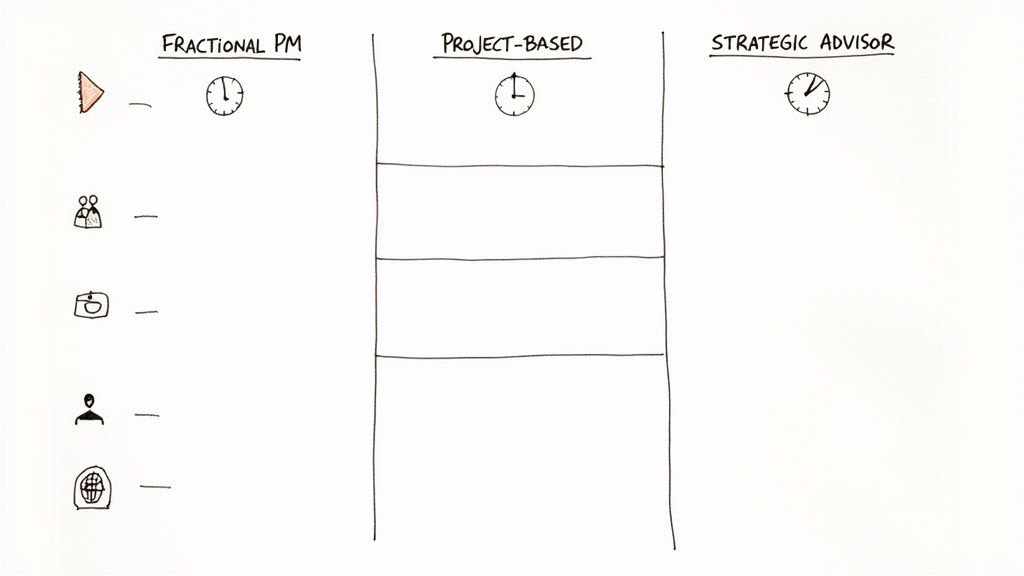
Alt text: A whiteboard diagram comparing Fractional PM, Project-Based, and Strategic Advisor roles with icons for various dimensions like duration, scope, and deliverables.
This choice dictates how an external expert integrates with your team, what they deliver, and how quickly you see a return on investment.
The Fractional PM Model
A Fractional Product Manager provides seasoned product leadership on a part-time basis. This is ideal for early-stage startups that need senior strategic oversight but cannot afford a full-time executive salary.
- Best For: Seed to Series A startups needing consistent, hands-on product leadership.
- Typical Duration: A 6–12 month retainer for 10–20 hours per week.
- Expected Deliverables: A validated product roadmap, a prioritized backlog, sprint planning leadership, and mentorship for junior PMs.
The Project-Based Model
This is your special forces unit. The Project-Based model embeds a consultant to tackle a specific, time-bound mission, such as launching a new product or entering a new market. It is a surgical strike designed for a defined outcome.
- Best For: Executing a critical initiative with a clear start and end date.
- Typical Duration: 3-6 months.
- Expected Deliverables: A fully launched feature, a market entry playbook, or a completed product discovery phase.
The Strategic Advisor Model
Sometimes you need a wise counsel, not another person in the trenches. The Strategic Advisor provides high-level guidance to your executive team to shape long-term vision and de-risk major decisions.
- Best For: Series B+ leadership teams facing a pivot, acquisition, or complex market entry.
- Typical Duration: A quarterly or monthly retainer for a few advisory hours.
- Expected Deliverables: Roadmap audits, competitive analysis, advice on team structure, and coaching for your CPO or VP of Product.
For a deeper analysis of these models, see our guide on staff augmentation vs. managed services.
Core Deliverables & Measuring Success (The Trade-offs)
When you hire a product management consultant, you are paying for outcomes, not just advice. Vague promises of "strategic alignment" are worthless. You need concrete deliverables that your team can execute on and clear metrics to prove they are working.

Alt text: A handwritten product management checklist on white paper, showing tasks like roadmap, backlog, and feature definitions.
A great consultant connects every document and decision directly to business impact. Here are the essential deliverables and how to measure their true success.
Essential Product Deliverables
Any high-impact engagement should produce a core set of actionable documents. If a potential consultant cannot commit to these, it's a major red flag.
- A Validated Product Roadmap: More than a timeline, this is a strategic guide outlining which problems you are solving for which customers and how it achieves your business goals.
- A Prioritized Feature Backlog: A living backlog in a tool like Jira with well-defined user stories and acceptance criteria so engineers can build efficiently.
- Go-to-Market (GTM) Strategy Outline: The launch playbook covering target audience, messaging, pricing, and sales enablement for any new product or major feature.
- Product Requirements Document (PRD) Template: A great consultant leaves your team stronger. A standardized PRD template ensures future development is rigorous, consistent, and tied to clear business objectives.
Tying Deliverables to Measurable Business Impact
Deliverables are useless without outcomes. The real value is the change they create. You must connect each deliverable to a Key Performance Indicator (KPI) to measure ROI.
Here’s a simple framework to connect work to results.
Don't measure a consultant by the number of documents they produce. Measure them by the positive change in your most important business metrics. This data-first approach is also key for evaluating your internal team, a topic we cover in our guide to measuring https://www.thirstysprout.com/post/quality-of-hire-metrics.
How to Select and Onboard the Right Consultant
Choosing a product management consulting partner is a make-or-break decision. A great fit slots into your team and delivers value in weeks. A bad fit burns budget, creates friction, and stalls momentum. You need a structured process for evaluation and onboarding.
1. Start with a Clear Vendor Scorecard
Before you schedule any calls, define what "good" looks like. A vendor selection scorecard removes bias and helps you compare options based on what truly matters to your business. This turns a "gut feel" decision into a data-informed one.
Consultant Selection Scorecard (Template)
This structured thinking is essential. For more on this, see this guide on hiring a B2B startup consultant to unlock growth.
2. Ask High-Impact Interview Questions
The interview is where you pressure-test claims. Ditch generic questions and use situational prompts that reveal how candidates think and act under pressure.
- "Walk me through how you would run the first two weeks of this engagement." A good answer focuses on active discovery, stakeholder interviews, and identifying quick wins, not passive observation.
- "Describe a time a project was going off the rails. What specific actions did you take to get it back on track?" This tests problem-solving and communication. Look for answers that show ownership, not blame.
- "How would you handle a disagreement with our Head of Engineering about the technical feasibility of a feature?" This assesses their ability to influence without formal authority—a critical skill for any consultant.
These questions separate true operators from theorists by revealing how they work.
3. Execute a Structured 30-Day Onboarding Plan
The first month sets the tone. A structured onboarding plan is the difference between a consultant delivering value on day five versus day fifty. The goal is to eliminate friction and provide context so they can be productive, fast. This is similar to how you would hire a dedicated development team, where rapid integration is key.
Week 1: Immersion and Access
- Provide access to all tools on day one: Jira, Figma, Slack, Confluence, and analytics platforms.
- Schedule 30-minute introductions with key stakeholders (engineering lead, design lead, head of sales).
- Share core documents: existing roadmaps, user research, and past PRDs.
Weeks 2-3: Alignment and Initial Milestones
- Collaborate to define their first critical project milestone to create immediate focus.
- Have them shadow key team ceremonies like sprint planning and retrospectives.
- Assign a small, tangible first task, like auditing the backlog or drafting a one-page GTM brief.
Week 4: First Value Delivery
- The consultant presents their initial findings or first deliverable for team feedback.
- Establish a weekly check-in cadence and a simple reporting format.
- By month's end, both you and the consultant should have zero ambiguity about what success looks like for the next 60 days.
Checklist: Getting Started with a PM Consultant
[ ] 1. Define the Problem & Business Impact: Use the decision table in this guide to confirm your need. Is it a short-term, specialized project? Quantify the business outcome you expect (e.g., "launch AI feature to increase retention by 10% in 6 months").
[ ] 2. Set a Realistic Budget: Based on the engagement model (Fractional, Project-Based), determine a budget. Project-based engagements for a feature launch can range from $30k-$80k, while fractional PMs are typically $8k-$15k per month.
[ ] 3. Create a Vendor Shortlist: Identify 2–3 potential consultants or firms with proven expertise in your specific domain (e.g., AI, fintech). Check their case studies for evidence of tangible results.
[ ] 4. Run a Structured Evaluation: Use the Consultant Selection Scorecard template to score each candidate objectively. Ask the high-impact interview questions to vet their problem-solving skills.
[ ] 5. Conduct Reference Checks: Speak with 1–2 past clients who had a similar problem to yours. Ask about the business impact, their integration with the team, and what they would have done differently.
[ ] 6. Draft a Clear Statement of Work (SOW): The SOW should explicitly state the timeline, key milestones, deliverables (roadmap, backlog), and the success metrics (KPIs) that will be used to measure performance.
[ ] 7. Execute the 30-Day Onboarding Plan: Once hired, use the week-by-week plan to ensure the consultant integrates quickly and starts delivering value within the first month.
What to Do Next
- Confirm Your Need: Use the decision framework. If you have an urgent, specialized project with a clear end date, a consultant is likely the right move.
- Evaluate Your Options: Don't get sold on a pitch. Download our Consultant Selection Scorecard to objectively rate potential partners on the criteria that actually drive business value.
- Scope Your Project: Talk to an expert. A brief, focused conversation can validate your approach or identify risks you haven't considered.
ThirstySprout connects you with pre-vetted, top-tier AI Product Managers ready to start a pilot in 2–4 weeks, helping you bypass the lengthy and expensive full-time hiring process.
- Start a Pilot
- See Sample PM Profiles
Frequently Asked Questions
Here are straight answers to the most common questions we hear from founders and product leaders about product management consulting.
What are the typical pricing models?
Pricing is tied to the value you need. The three most common models are:
- Monthly Retainer: A fixed fee each month for a set number of hours or responsibilities. Best for fractional PMs or ongoing strategic advisory, creating predictable costs.
- Project-Based Fee: A fixed price for a defined scope and outcome (e.g., a new product launch). This de-risks the engagement by aligning cost directly with a specific deliverable.
- Blended Model: A hybrid approach, often starting with a fixed-fee discovery project before moving to a monthly retainer for execution.
How do you ensure a consultant fits our company culture?
A brilliant strategist who creates friction with your team is a net negative. We focus on two areas to ensure a strong cultural fit:
- Vetting for Soft Skills: We screen for communication style, adaptability, and the ability to lead through influence. We prioritize operators who listen first and collaborate effectively.
- Structured Onboarding: Our 30-day integration plan includes one-on-ones with key stakeholders and integration into your team's daily workflows and tools like Slack and sprint meetings. A consultant should feel like a temporary extension of your team, not an outsider.
What is the difference between a product coach and a consultant?
This is a critical distinction. A consultant is a player; a coach is on the sidelines.
- A Product Management Consultant is a hands-on operator hired to do the work. They write PRDs, manage backlogs, and drive projects to completion to deliver a specific business outcome.
- A Product Coach is a mentor hired to develop your internal team. They guide your existing PMs, help them level up their skills, and provide expert feedback to make your team more effective.
Knowing which one you need ensures you get the right support for your current challenge.
Ready to accelerate your roadmap with a vetted, senior AI product manager? At ThirstySprout, we connect you with top-tier talent ready to start a pilot in just 2–4 weeks.
Hire from the Top 1% Talent Network
Ready to accelerate your hiring or scale your company with our top-tier technical talent? Let's chat.