

TL;DR
- When to outsource: Outsource to accelerate time-to-market, access specialized skills (like MLOps or AI), or manage burn rate by converting fixed hiring costs to variable project fees. Avoid outsourcing your core, differentiating technology before you have product-market fit.
- Which model to choose: Use Staff Augmentation for specific skill gaps (e.g., adding 2 senior Python engineers to clear a backlog), Managed Teams for new, parallel initiatives (like building an AI copilot), and Project-Based for fixed-scope tasks (like a simple mobile app).
- How to vet partners: Go beyond generic questions. Ask practical, problem-solving questions like, "Our RAG pipeline is failing on dense PDFs. What are the first three things you'd investigate to improve precision?" Use a scorecard to evaluate technical depth, communication, security, and business acumen.
- Key to success: A rock-solid Statement of Work (SOW) with clear IP ownership and a structured 30-day onboarding plan are non-negotiable. Track performance with outcome-based KPIs like cycle time and bug rate, not just hours worked.
Who this is for
- CTO / Head of Engineering: You need to accelerate your roadmap or access niche skills without derailing your core team.
- Founder / Product Lead: You're scoping new features (especially AI-driven ones) and need to understand the budget and timeline implications of building vs. outsourcing.
- Talent Ops / Procurement: You're tasked with evaluating vendors and mitigating the risks of engaging external development partners.
This guide is for operators who need to make a decision and see results within weeks, not quarters.
A Quick Framework for Outsourcing IT Development
For a founder or CTO, the decision to outsource isn't about "build vs. buy"—it's about strategically allocating your team's focus. The best time to outsource is when you need to plug a specific capability gap, fast. It’s an accelerator, not a compromise.
Use this decision tree to identify the right outsourcing path based on your primary business driver: speed, specialized talent, or cost control.
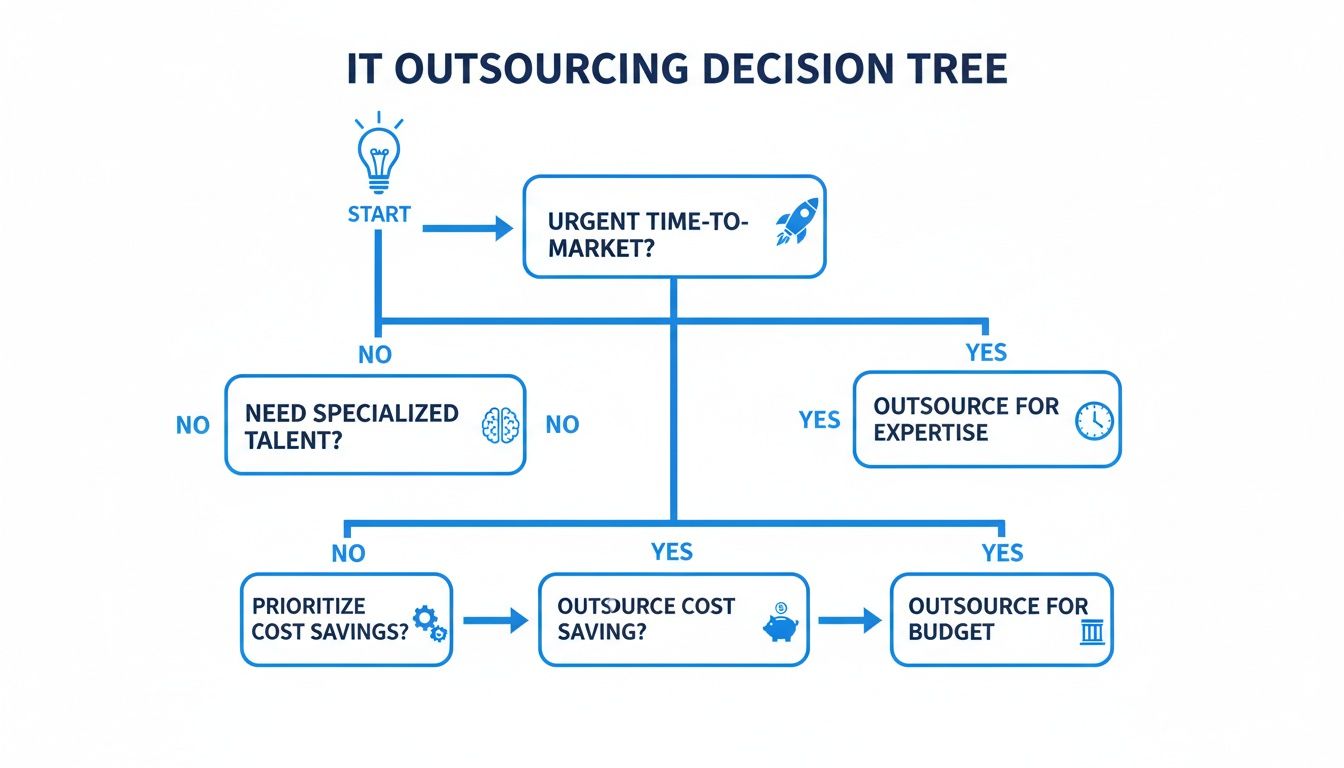
The global IT outsourcing market is projected to hit $812.71 billion by 2029, driven by clear business needs. An eye-opening 32.3% of companies cite lower expenses as a key motivator, with many reducing hiring costs by 50% or more for specialized roles.
Practical Examples: Outsourcing Models in Action
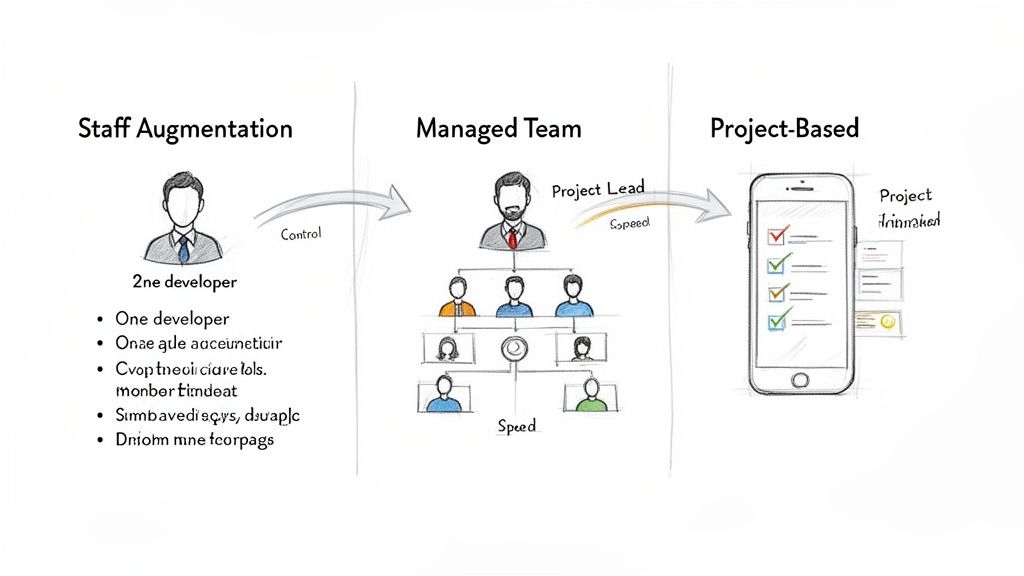
Choosing the right model shapes your costs, control, and speed. Let’s look at the three main options—Staff Augmentation, Managed Teams, and Project-Based—through real-world startup scenarios.
Example 1: Staff Augmentation (Surgical Skill Injection)
Use staff augmentation when you need to add a specific skill directly to your existing team. You retain 100% control over day-to-day management.
Scenario: A Fintech Scrambles Before a Funding Round
A Series A fintech was three months from their next funding round, but a feature backlog in their Python risk engine threatened the roadmap. They needed two senior Python engineers with financial modeling experience, immediately.
- Action: They chose staff augmentation, bypassing a months-long direct hiring process.
- Process: After a brief scoping call, they interviewed curated candidates and had two senior engineers coding in under two weeks.
- Outcome: The augmented engineers integrated with the existing squad, cleared the backlog in seven weeks, and the startup successfully closed its funding round.
Example 2: Managed Teams (Building a New Initiative)
Use a managed team when you need to build a new product or feature in parallel without disrupting your core team. The partner provides a self-sufficient squad that owns the outcome.
Scenario: Launching an AI Copilot
A B2B SaaS company needed an AI copilot to remain competitive, but their core platform team was at capacity. Pulling them off would kill momentum.
- Action: They engaged a managed team to build the copilot.
- Team Composition: 1 AI Product Manager, 2 Senior AI Engineers (for the Retrieval-Augmented Generation pipeline), 1 Full-Stack Engineer, and 1 MLOps Engineer.
- Outcome: This focused unit operated as a startup-within-a-startup, delivering the AI copilot MVP in just 12 weeks.
For a deeper comparison, see our guide on staff augmentation vs managed services.
The Deep Dive: Vetting Partners, Contracts, and Management
Finding and managing the right partner is where most outsourcing strategies succeed or fail. It requires a structured process for vetting, contracting, and performance tracking.
The Vetting Playbook: How to Find the Right Partner
A great partner doesn't just write code; they challenge assumptions and take ownership of the business outcome. Your vetting process must dig into their technical skill, communication style, and security practices.
Go Beyond Generic Technical Questions
Your goal is to simulate a real problem they would face on your project.
Let's say you're vetting an AI/ML engineer for a Retrieval-Augmented Generation (RAG) project.
Bad question: "Can you explain what RAG is?" (Tests memorization, not skill).
Better question: "We have a RAG pipeline, but users get irrelevant answers for niche queries from our dense, technical PDFs. What are the first three things you'd investigate to improve precision?"
This question forces them to diagnose a real problem, prioritize actions (chunking, embeddings, retrieval methods), and prove they have hands-on experience.
Getting Contracts and Onboarding Right
A vague Statement of Work (SOW) or chaotic onboarding will undermine even the best partnership. These aren't administrative hurdles; they are the foundation for success.
Your SOW Must-Have Clauses
Your SOW is the single source of truth. Ensure it covers these non-negotiables:
- Intellectual Property (IP) Rights: All work product—code, designs, documentation—belongs 100% to your company. This is non-negotiable.
- Data Security and Compliance: Specify required standards (e.g., SOC 2, GDPR) and mandate secure practices like VPNs and private repositories.
- Termination Clause: Outline a clear off-ramp for ending the relationship, both for cause and for convenience.
- Service Level Agreements (SLAs): Define measurable standards for bug response times, uptime guarantees, and other critical metrics.
- Change Control Process: Formalize how scope changes are requested, evaluated, and approved to prevent scope creep.
A strong contract isn't about mistrust; it's about clarity. It ensures both parties understand the rules, which is the foundation for a healthy relationship.
Managing Remote Teams For Performance and Quality
Effective management is about measuring outcomes, not tracking hours. It requires a solid communication rhythm and objective Key Performance Indicators (KPIs).
Defining and Tracking the Right KPIs
Go beyond counting closed tickets. Track metrics that reveal engineering velocity and code quality:
- Cycle Time: The duration from "in progress" to "deployed." Short, consistent cycle times indicate a healthy workflow.
- Code Churn: The percentage of recently committed code that is rewritten or deleted. High churn can signal unclear requirements.
- Bug Rate: The number of bugs found in production. A direct measure of quality.
- Code Coverage: The percentage of your codebase covered by automated tests. Aim for 80% or higher for stable applications.
For more on creating this environment, see our guide on how to effectively manage a remote team. Adopting proven 10 Vendor Management Best Practices can also provide a strong framework for oversight.
Checklist: 30-Day Onboarding Plan for a Remote Developer
A structured onboarding plan is the fastest path to productivity. The goal is to make a new developer feel like part of the team, not a disconnected contractor.
Week 1: Access and Immersion
The first week is about getting equipped, oriented, and connected.
- [ ] Day 1: Grant access to communication tools (Slack) and project management software (Jira, Asana).
- [ ] Day 1: Provide credentials for code repositories (GitHub, GitLab) with appropriate permissions.
- [ ] Day 2: Set up secure access to development and staging environments.
- [ ] Day 2: Schedule 1-on-1 introductions with the engineering lead and product manager.
- [ ] Day 3: Walk through the CI/CD pipeline and local environment setup.
- [ ] Day 4: Assign a small, non-critical "good first issue" to test the end-to-end development loop.
- [ ] Day 5: Hold a brief recap to address any blockers or questions.
Weeks 2-4: Context and Contribution
- Week 2: Pair-program with an in-house developer on a more complex ticket. Attend all team meetings (stand-ups, sprint planning).
- Week 3: Assign the first solo-owned feature or bug fix to build ownership.
- Week 4: Participate in a sprint retrospective to provide fresh insights on team processes.
By the end of the first month, your remote engineer should be a fully integrated, contributing team member. This structured approach is your fastest path to seeing a real return on your outsourcing investment.
What to Do Next
- Assess Your Needs: Use the decision tree to clarify if your primary driver is speed, specialized talent, or cost savings. This will point you to the right outsourcing model.
- Prepare Your Vetting Questions: Draft 3-5 practical, scenario-based questions specific to your project's challenges. Move beyond generic technical trivia.
- Scope a Pilot Project: Define a small, self-contained project that a new partner can tackle in 2–4 weeks. This is the lowest-risk way to test a potential partnership.
Ready to accelerate your roadmap with top-tier AI and software engineering talent? ThirstySprout provides pre-vetted, senior experts who integrate seamlessly with your team.
References
- ThirstySprout: Staff Augmentation vs Managed Services
- ThirstySprout: How to Effectively Manage a Remote Team
- ThirstySprout: Data Scientist Recruiters
- Konnect Koncepts: Insights on Outsourcing HR
- BoloSign: 10 Vendor Management Best Practices
Hire from the Top 1% Talent Network
Ready to accelerate your hiring or scale your company with our top-tier technical talent? Let's chat.