

TL;DR
- For fast, vetted senior AI/ML talent: Use ThirstySprout. You get matched with top-1% engineers in 48-72 hours for pilot projects or full-time roles. Best for urgent, high-stakes hires.
- For large-scale enterprise AI programs: Consider EPAM or SoftServe. They offer deep benches, mature MLOps practices, and strong partnerships with AWS, Google, and NVIDIA for complex, regulated projects.
- For US teams needing time-zone alignment: Globant is a top choice with a strong Latin American presence. Their "AI Pod" model focuses on delivering business outcomes, not just hours.
- Actionable Next Step: Don't sign a long-term contract. Define a small, 2-week paid pilot project to test a vendor's technical skill, communication, and project management.
Who this is for
- CTO / Head of Engineering: You need to hire senior AI, MLOps, or Data Engineers to accelerate your roadmap but face a slow, competitive local market.
- Founder / Product Lead: You're scoping the budget and team needed to build an AI feature (like a RAG-based copilot or a forecasting model) and need to de-risk the technical execution.
- Talent Ops / Procurement: You're evaluating vendors to build a reliable pipeline of technical talent and need to assess quality, cost, and compliance risk.
This guide is for technical leaders who need to make a high-stakes hiring decision fast. We focus on what matters: technical depth, project management maturity, and a proven track record in building and shipping production AI systems.
A Quick Framework for Choosing a Partner
Choosing the right offshore partner depends on your project's scale, urgency, and internal capabilities. Use this decision tree to guide your choice.
| If you need... | Then your best fit is likely... | Because... |
|---|---|---|
| A few elite engineers, fast | A specialized talent network like ThirstySprout. | They focus on vetting and speed, getting you senior talent for a pilot or full-time role in days, not months. |
| An end-to-end enterprise solution | A large-scale consultancy like EPAM or SoftServe. | They have the process, scale, and deep cloud partnerships for complex, multi-year digital transformation programs. |
| Time-zone alignment for agile work | A nearshore-focused firm like Globant or Endava. | Their Latin American delivery centers enable real-time collaboration with US-based teams. |
Practical Examples: Scoping a Pilot Project
A pilot project is the best way to vet a potential partner. It replaces sales pitches with demonstrated performance. Here are two real-world examples.
Example 1: A 2-Week RAG System Pilot
- Goal: Test a partner's ability to build a basic AI application.
- Scope: "Build a proof-of-concept Retrieval-Augmented Generation (RAG) system using Python, FastAPI, and an open-source LLM (like Llama 3). The system should answer questions based on a provided 50-page PDF of our internal documentation."
- A link to a private GitHub repository containing the complete, runnable code.
- A
README.mdfile with setup instructions. - A 15-minute recorded demo showing the system in action.
- Business Impact: This quickly validates a team's core AI skills, their ability to work with unstructured data, and their documentation practices before committing to a larger project.
- Goal: Test a partner's cloud infrastructure and automation skills.
- Scope: "Take our existing ML model (provided as a
picklefile) and create a basic CI/CD pipeline using GitHub Actions. The pipeline should containerize the model with Docker and deploy it as a serverless function on AWS Lambda." - A link to the GitHub repository with the
Dockerfileand GitHub Actions workflow files. - A short document explaining the architecture and deployment steps.
- A successful deployment to a staging AWS environment.
- Business Impact: This tests critical MLOps capabilities—Infrastructure as Code (IaC), containerization, and CI/CD—that are essential for building reliable, production-ready AI systems.
- AI-Assisted Vetting: The platform uses its own technology to filter a massive global candidate pool, identifying individuals with proven track records in areas like LLMs, data engineering, and MLOps. This is followed by expert human review to ensure only top-tier candidates are presented.
- Flexible Engagement Models: You can hire full-time employees, bring on contractors for specific projects, engage fractional experts for part-time needs, or use their Employer of Record (EoR) services for seamless international hiring. This flexibility allows you to adapt your team structure to your budget and project timeline. For a deeper look, their guide on offshore software development offers practical frameworks.
- Focus on Production Experience: The network emphasizes talent that has successfully deployed and maintained AI systems in production. This is a critical differentiator for companies looking to build reliable, scalable products.
- Fast Time-to-Hire: Receive a shortlist of qualified candidates in 48–72 hours.
- High-Quality Talent: Access to the top 1% of vetted AI, MLOps, and data engineering experts.
- Flexible Engagements: Supports full-time, contract, fractional, and EoR models.
- Strong Social Proof: Trusted by companies like Mailchimp, Intuit, and Deel.
- No Public Pricing: Requires direct contact for a quote, making initial budget estimation difficult.
- Remote-First Model: May not be suitable for roles that demand a consistent on-site presence.
- Full-Stack AI Delivery: SoftServe covers the entire AI lifecycle, including data readiness assessments, large language model (LLM) implementation, and MLOps infrastructure.
- Cross-Cloud Expertise: Their engineers hold certifications and have project experience across all major cloud providers, reducing integration friction.
- Physical AI and Simulation: A unique specialization is their work in robotics and "physical AI," using synthetic data and simulation to train models for applications like predictive maintenance and automated quality control.
- Deep bench of experienced AI/ML and data engineers with proven MLOps patterns.
- Strong partnerships with NVIDIA and major cloud providers can accelerate production timelines.
- Extensive Eastern European delivery centers provide access to a large talent pool.
- Mainly focused on enterprise-level projects; smaller startups may not receive priority.
- Their advanced robotics services are highly specialized and may not be relevant for all businesses.
- Enterprise AI Integration: EPAM specializes in building and deploying GenAI and agentic AI solutions directly into enterprise workflows.
- Proprietary AI Accelerators: Their internal AI platforms are used to analyze and refactor legacy code, optimize testing cycles, and improve developer productivity.
- Global Delivery Network: With major hubs in Eastern Europe, India, and Latin America, EPAM offers a distributed model that diversifies risk and provides flexible time-zone coverage.
- Enterprise-grade engineering discipline suitable for complex, regulated industries.
- Deep co-innovation partnerships with AWS and Google Cloud ensure access to the latest AI services.
- A broad delivery network reduces single-point-of-failure risk.
- Best suited for large, strategic programs; their extensive governance may feel heavy for startups.
- High demand for their top engineering teams can sometimes lead to longer kick-off times.
- Industry AI Studios: Globant organizes its expertise into domain-specific studios (e.g., for financial services or retail), which shortens time-to-value.
- AI-Native Delivery Pods: The "AI Pod" is a core delivery construct focused on creating agents and automating processes to achieve specific Key Performance Indicators (KPIs).
- Nearshore Latin American Teams: With a large footprint in Latin America, Globant provides access to a deep talent pool that operates within or close to US time zones.
- Nearshore time-zone alignment greatly simplifies collaboration for US clients.
- Strong track record with major US brands and documented success stories.
- Rapidly growing AI portfolio and specialized studios provide domain-specific expertise.
- Their enterprise focus may mean larger minimum engagement sizes than a small startup needs.
- The availability of talent for a specific AI Pod can vary depending on the studio and region.
- Nearshore Delivery Network: With major hubs in Central/Eastern Europe and Latin America, Endava provides access to a large talent pool with strong time-zone alignment for US and EU clients.
- Fintech and Payments Expertise: They have a proven track record in the highly regulated financial sector, offering specialized knowledge in payment systems and digital banking.
- Data & AI Strategy: Endava's formal Data & AI capability helps organizations move beyond technical pilots, providing guidance on GenAI adoption and establishing robust AI governance frameworks.
- Excellent time-zone alignment for US clients through its Latin American delivery centers.
- Strong fintech and payments pedigree with enterprise-grade delivery processes.
- Emphasis on responsible AI and changing the operating model, not just implementing tools.
- Best fit for sustained programs; very small or short-term projects may be harder to staff quickly.
- AI capability depth can vary by location when compared to smaller, AI-first specialist firms.
- AI-Native SDLC: Grid Dynamics uses AI-powered accelerators throughout the development process to boost reliability and throughput.
- Production AI Components: They provide LLMOps components and multi-agent orchestration tools, helping clients build and manage production-level AI applications.
- Domain Accelerators: The firm has pre-built solution frameworks for specific domains like commerce and customer support AI, which can shorten time-to-value.
- Strong track record in delivering AI for retail/CPG, finance, and large-scale platforms.
- Clear engineering artifacts and whitepapers enable rapid client onboarding.
- US-based management combined with a global delivery network ensures strong communication.
- Optimized for enterprise-scale programs; smaller engagements may not see the full benefit.
- Niche accelerators are most effective in their specified domains.
- Full AI Lifecycle Delivery: DataArt guides clients from initial strategy through to deployment and operational management of AI systems.
- Packaged Accelerators: They offer pre-built components, such as their Intelligent Document Processing (IDP) accelerator, which can significantly speed up development.
- Proven Industry Outcomes: DataArt has a strong track record in sectors like healthcare, SaaS, and field operations, with case studies demonstrating tangible results.
- Platform and Data Engineering: Their expertise extends to the foundational data engineering required to support reliable AI applications.
- Practical focus on GenAI applications with clear, demonstrable business value.
- Transparent case studies with quantified ROI help justify project costs.
- Flexible engagement models are suitable for a wide range of company sizes.
- As a mid-sized vendor, staffing for highly niche AI subfields may require more lead time.
- Their global delivery network is smaller than that of giant system integrators.
- Scope a 2-Week Pilot: Define a small, self-contained task that tests the skills you need most. Use one of the examples from this article: building a proof-of-concept RAG system or a basic MLOps deployment pipeline.
- Interview 2-3 Partners: Reach out to your top candidates and state you want to run a paid, two-week pilot. Ask to speak with the specific engineers who would work on the project.
- Launch the Pilot: Use a simple Statement of Work (SOW), not a full MSA. Evaluate the team's process, communication, and problem-solving skills—not just the final code. This gives you the confidence to scale the partnership or cut ties with minimal loss.
- Start a Pilot: Launch a 2-week project with vetted senior AI/ML engineers.
- See Sample Profiles: Review anonymous profiles of talent in our network.
- Book a 20-minute scope call: We can help you define your pilot and match you with the right talent from our network.
- How to Hire Remote AI Engineers (ThirstySprout)
- AI Legal Software for Contract Review
- AWS Documentation on MLOps
- Building Production-Ready RAG Applications (Google Research)
Example 2: A 2-Week MLOps Pipeline Pilot
1. ThirstySprout: Best for Vetted, On-Demand AI & MLOps Talent
ThirstySprout operates as a specialized talent network, not a traditional development agency. Its core function is to connect startups and enterprises with pre-vetted, senior-level AI, MLOps, and software engineering talent for remote roles. The platform’s main value proposition is speed and quality, promising access to the top 1% of global professionals who have real-world experience shipping production systems.
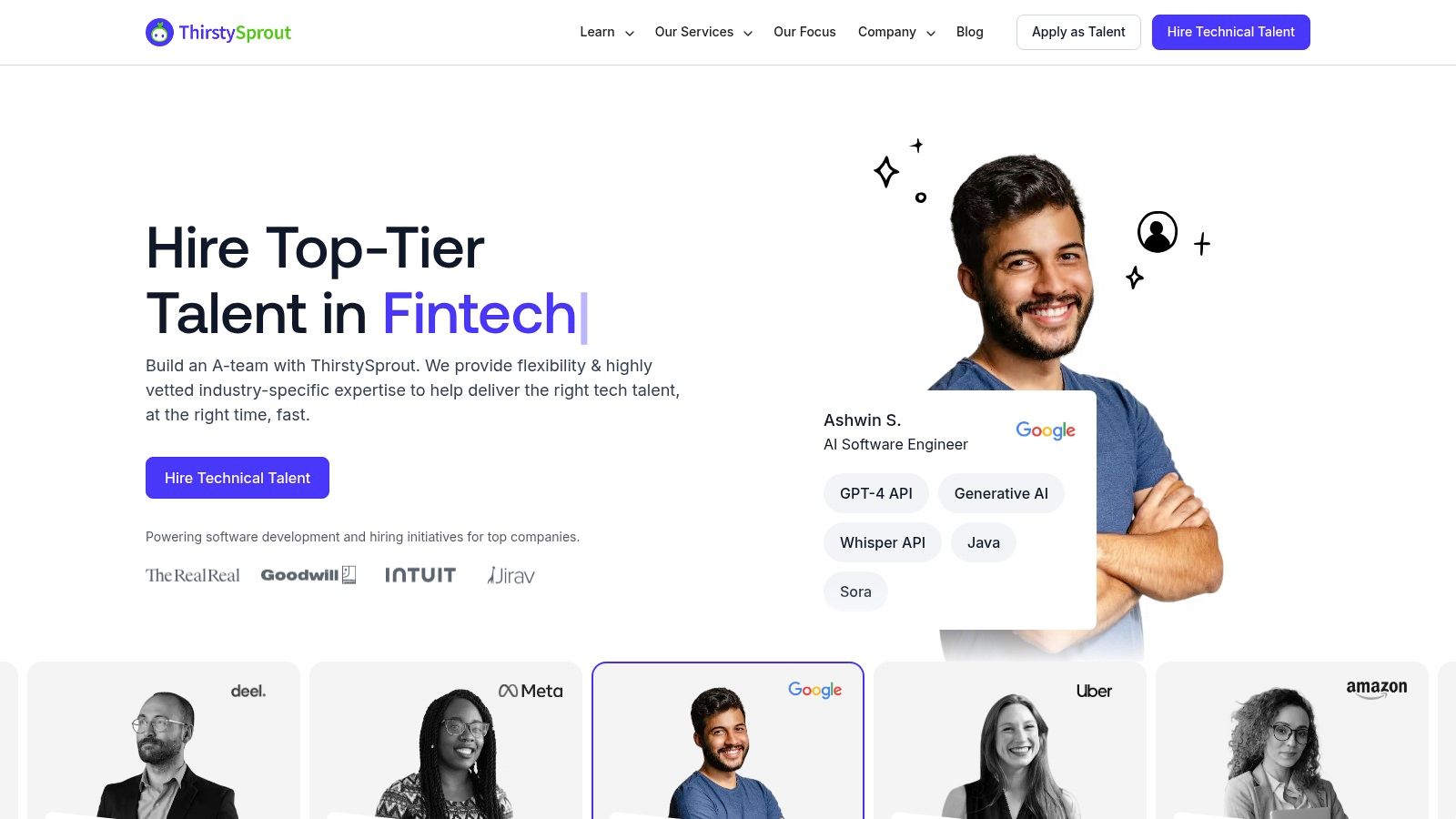
This model is particularly suited for companies that need to scale their technical teams quickly without sacrificing quality, especially in high-demand fields like machine learning. Rather than managing the entire recruitment lifecycle, you submit your requirements and can expect to start interviewing qualified candidates, often within 48–72 hours. This acceleration is achieved through a combination of an AI-powered sourcing engine and a robust, multi-stage human vetting process.
Key Features and Capabilities
ThirstySprout distinguishes itself from other offshore software development companies by focusing on individual contributors and elite teams for niche technical roles.
Pricing and Practical Considerations
Pricing is not publicly available. You need to contact their team for a quote based on the specific roles and engagement model. The platform's value proposition centers on reducing total hiring costs and accelerating team-building significantly compared to traditional recruiting.
Pros:
Cons:
Website: https://thirstysprout.com
2. SoftServe
SoftServe is a large-scale software engineering firm with strong Eastern European roots, specializing in complex, enterprise-grade AI/ML solutions. For companies needing to build or scale sophisticated AI capabilities, SoftServe acts as an end-to-end delivery partner, moving projects from initial strategy and data architecture through to production MLOps and governance. Their deep expertise across AWS, Azure, and Google Cloud makes them a practical choice for organizations with existing multi-cloud commitments.

Unlike smaller, niche agencies, SoftServe brings a mature MLOps practice to the table. They don't just build models; they build the automated pipelines required to deploy, monitor, and retrain them reliably. This operational focus is crucial for enterprise AI. Their official partnership with NVIDIA gives them early access to GenAI solution blueprints, which can shorten development cycles.
Key Offerings and Specializations
Pricing and Engagement Model
SoftServe primarily targets enterprise and well-funded scale-up clients. Their engagement models are designed for long-term, complex projects. Pricing is project-based or on a dedicated team model.
Pros:
Cons:
Website: https://www.softserveinc.com
3. EPAM Systems
EPAM Systems is a global product engineering giant known for its rigorous, enterprise-grade approach to software development. With a massive footprint in Eastern Europe, India, and Latin America, EPAM delivers complex digital transformation and AI programs at scale. They are a go-to partner for large organizations needing to modernize legacy systems or build sophisticated AI customer experiences.
What sets EPAM apart is its co-innovation partnerships with major cloud providers like AWS and Google Cloud. This provides them with direct access to platforms like AWS Bedrock and Vertex AI, enabling faster, compliant integration of GenAI features. Furthermore, EPAM uses its own proprietary AI platforms to find efficiencies in code modernization and software development life cycle (SDLC) acceleration.
Key Offerings and Specializations
Pricing and Engagement Model
EPAM's services are structured for mid-to-large-scale engagements and long-term strategic partnerships. Their pricing is typically project-based or follows a dedicated team model. While they represent a significant investment, the engineering discipline they provide is designed for mission-critical systems.
Pros:
Cons:
Website: https://www.epam.com
4. Globant
Globant is a digitally native engineering company with a significant nearshore presence in Latin America, making it a strong choice for US-based firms seeking time-zone alignment. The company has built a serious enterprise AI portfolio, structuring its delivery around industry-specific "AI Studios" and outcome-focused "AI Pods." This model shifts the focus from billing for hours to delivering measurable results.
Globant’s AI Pods are small, autonomous teams of engineers, data scientists, and product specialists who work in sprints to develop and deploy AI solutions. This structure, combined with their strong nearshore operations in countries like Argentina, Colombia, and Mexico, reduces the coordination friction often associated with offshore engagements.
Key Offerings and Specializations
Pricing and Engagement Model
Globant primarily serves enterprise clients and large, well-funded scale-ups. Their pricing reflects their outcome-oriented model, with engagements often structured around project milestones or the performance of the AI Pods.
Pros:
Cons:
Website: https://www.globant.com
5. Endava
Endava is a global engineering firm with a strong nearshore delivery model spanning Eastern Europe and Latin America. It stands out for its deep domain presence in payments, fintech, and enterprise digital solutions. For companies in these sectors, Endava provides not just technical execution but also strategic guidance on adopting Data & AI capabilities, including Generative AI and responsible AI governance.
Unlike some offshore software development companies that focus purely on staff augmentation, Endava emphasizes long-term program delivery with a strong process-oriented approach. Their extensive nearshore network offers excellent time-zone alignment for clients in North America and Western Europe.
Key Offerings and Specializations
Pricing and Engagement Model
Endava is geared toward enterprise clients and well-capitalized scale-ups looking for a strategic partner for sustained programs. Their engagement models are typically dedicated teams or project-based, designed for multi-sprint initiatives.
Pros:
Cons:
Website: https://www.endava.com
6. Grid Dynamics
Grid Dynamics is a US-headquartered engineering partner recognized for its deep experience in AI, search, and cloud-native platforms for Fortune 1000 clients. The company positions itself as an AI-native firm, building its entire software development life cycle (SDLC) around AI-driven accelerators. This approach is designed to improve delivery speed and reliability for complex enterprise systems.
A key differentiator is their focus on production-grade AI, offering LLMOps platform components and multi-agent orchestration frameworks. This makes them a strong contender for companies looking to move beyond proof-of-concept AI projects and into scalable, operational systems.
Key Offerings and Specializations
Pricing and Engagement Model
Grid Dynamics primarily serves large enterprise programs. They offer an interesting AI-powered engagement model that is output-aligned and credit-based, linking cost directly to delivered outcomes. This model is best suited for large-scale projects where the benefits of their AI-native accelerators can be fully realized.
Pros:
Cons:
Website: https://www.griddynamics.com
7. DataArt
DataArt is a global software engineering firm that combines strategic consulting with hands-on delivery, particularly in AI and machine learning. They stand out by focusing on practical, ROI-driven applications of GenAI and offering packaged accelerators to shorten time-to-value. This makes them a strong partner for companies that need to implement AI solutions with measurable business impact.
What sets DataArt apart is their transparent approach, often documented in case studies with quantified outcomes. They specialize in building AI copilots and Retrieval-Augmented Generation (RAG) chatbots that solve concrete business problems. Their broad technology literacy allows them to integrate solutions into diverse enterprise environments.
Key Offerings and Specializations
Pricing and Engagement Model
DataArt employs a flexible engagement style that accommodates both fast-growing scale-ups and large enterprises. Their pricing is typically project-based or follows a dedicated team model, tailored to the specific scope. Their focus on ROI makes them a good fit for organizations that need a clear business case for their technology investments.
Pros:
Cons:
Website: https://www.dataart.com
Checklist: Offshore Partner Selection Scorecard
Use this simple scorecard to evaluate potential partners based on what truly matters for a successful pilot project.
| Criteria | Weight | Partner A Score (1-5) | Partner B Score (1-5) | Notes |
|---|---|---|---|---|
| Technical Skill (Relevant project experience) | 40% | Do their case studies match your needs? | ||
| Communication Quality (Clarity & proactivity) | 30% | Did they ask smart questions in the intro call? | ||
| Process Maturity (Agile, CI/CD, documentation) | 20% | What is their process for code reviews and handoffs? | ||
| Cost (Value for the pilot) | 10% | Is the fixed price for the pilot reasonable? | ||
| Total Weighted Score | 100% |
This checklist is also available as a downloadable Notion Template. Copy it to your workspace to start vetting vendors today.
What To Do Next
You've reviewed the landscape. The key is that "offshore" now means accessing specialized expertise in AI/ML, MLOps, and data engineering. The right partner accelerates your roadmap. But moving from a vendor list to a productive team requires a structured, low-risk approach.
Here are your next three steps.
Ready to find the right AI experts without the risk of a long-term contract?
References
Hire from the Top 1% Talent Network
Ready to accelerate your hiring or scale your company with our top-tier technical talent? Let's chat.