

TL;DR: Your Guide to Offshore AI Development
- What is it? Offshore software development for AI is hiring specialized engineers (ML, MLOps, Data) in another country to accelerate your product roadmap and cut costs.
- Why do it? Gain access to a global talent pool, reduce engineering payroll by 40–70%, and scale your AI team in weeks, not months. The key is connecting this to business value: faster time-to-market and freeing up capital for growth.
- How do you start? Use a structured framework to choose your engagement model (e.g., dedicated team vs. fractional expert). Start with a 6–12 week pilot project to de-risk the partnership.
- What are the risks? The main pitfalls are communication gaps, time zone friction, and IP security. Mitigate these with a clear communication playbook, managed time zone overlap, and ironclad legal/technical controls.
- Recommended Action: Define a small pilot project, select an engagement model that fits, and Start a Pilot with pre-vetted senior AI engineers.
Who This Guide Is For
This guide is for technical and product leaders who need to deliver on an AI roadmap under tight budget and timeline constraints.
- CTO / Head of Engineering: You're responsible for building and scaling the AI/ML team but face intense competition for local talent and pressure to manage burn. You need a reliable way to hire senior MLOps or LLM engineers without sacrificing quality.
- Founder / Product Lead: You're scoping new AI features (like a RAG-powered chatbot or a forecasting engine) and need to understand the team structure, budget, and timeline required to get from idea to launch.
- Talent Ops / Procurement: You're tasked with evaluating vendors and building a compliant, secure process for engaging international engineering talent.
If you need to make a decision on hiring or structuring your remote AI team in the next 2–4 weeks, this framework is for you.
Quick Answer: A Framework for Choosing Your Offshore Engagement Model
Picking the right engagement model is the most critical decision you'll make. It defines your cost, control, and project outcomes. Don't just pick the cheapest option; match the model to your project's specific needs.
Use this decision flowchart to quickly determine the best fit for your AI initiative.
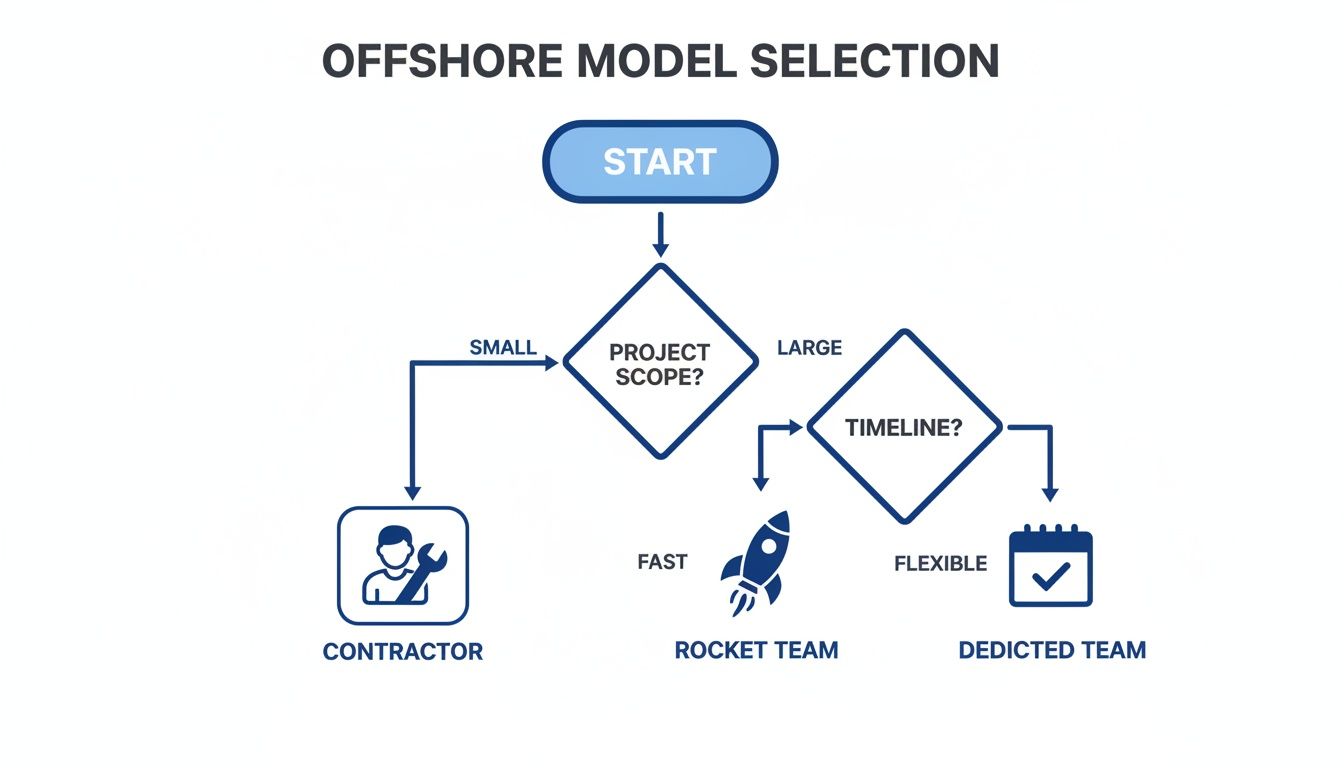
alt text: Flowchart guiding a user through offshore model selection. It starts with a project's scope (small vs. large) and timeline (short-term vs. long-term) to recommend a Contractor, Rocket Team, or Dedicated Team model.
Here's a breakdown of the primary engagement models and when to use them. For a deeper dive, check out our guide on nearshore vs offshore software development.
| Model | Best For | Control Level | Cost Structure | Scalability | AI/ML Suitability |
|---|---|---|---|---|---|
| Full-Scale Outsourcing | Well-defined, non-core functions (e.g., QA, legacy maintenance). | Low | Fixed-Price or Time & Materials | Difficult | Low |
| Dedicated Team | Core product development; long-term AI initiatives. | High | Monthly Retainer per Engineer | High | High |
| Individual Contractor | Short-term projects; filling an immediate skill gap; prototyping. | Medium | Hourly or Daily Rate | Medium | Medium |
| Fractional Talent | MLOps oversight; architectural reviews; strategic AI guidance. | High (Strategic) | Monthly Retainer (Part-Time) | Low | High |
For any serious AI work—like developing proprietary algorithms or building core product features—Dedicated Teams and Fractional Talent almost always deliver the best results. These models provide the tight collaboration and deep context that AI innovation demands.
Practical Examples of Offshore AI Teams in Action
Theory is good, but real-world examples show the true business impact. Here’s how two different companies used offshore AI talent to solve high-stakes problems.
Example 1: Fintech Fraud Detection with a Dedicated Team
A Series B fintech startup was struggling with high chargeback rates from their legacy rules-based system. They needed a real-time, AI-powered fraud detection engine built in under four months to protect revenue and improve customer trust.
The Challenge:
- High false positive rate hurting user experience.
- In-house team lacked deep ML systems experience.
- Tight 16-week deadline driven by business needs.
The Solution:
We helped them stand up a dedicated offshore "rocket team" to build the new system from scratch.
- Team: 2 Senior ML Engineers, 1 Data Engineer.
- Engagement: A dedicated team model, fully integrated into their daily stand-ups, Slack channels, and Jira boards.
- Stack: The team used AWS SageMaker for model training and deployment, building a real-time data pipeline to feed the model.
Business Impact:
Within 16 weeks, the new system was live. It reduced false positives by 30%, directly cutting chargeback costs and reducing friction for legitimate customers. The project’s success turned a cost center into a competitive advantage.
Example 2: SaaS Support Bot with a Fractional ML Engineer
A mid-sized SaaS company wanted to upgrade its support bot with Retrieval-Augmented Generation (RAG) to provide instant, accurate answers from its knowledge base. They didn't need a full-time hire but required senior expertise to design the architecture and guide their existing engineering team.
The Challenge:
- Existing engineers were new to LLM and vector database technologies.
- Needed to ensure all proprietary knowledge base data remained within their secure cloud.
- Limited budget for a full-time, senior AI hire.
The Solution:
They engaged a fractional ML engineer for 15 hours per week through ThirstySprout.
- Role: The fractional engineer acted as a hands-on architect and mentor.
- Architecture: The expert designed a secure RAG pipeline that connected their Zendesk instance to a vector database hosted inside the company's own Virtual Private Cloud (VPC), ensuring data never left their environment.
Business Impact:
The fractional expert provided the exact guidance needed to unblock the internal team. The project was completed in 6 weeks, much faster than if the team had tried to learn on their own. The company got a state-of-the-art AI feature without the cost and risk of a full-time hire.
The Deep Dive: How to Avoid Common Offshore Traps
Offshore development can accelerate your roadmap, but success depends on proactively managing three key risks: communication gaps, time zone friction, and security vulnerabilities.
1. Closing the Communication and Culture Gap
Misunderstandings are the number one reason offshore projects fail. A simple missed requirement can lead to weeks of rework. According to research, 54% of offshore projects face challenges due to cultural and communication differences.
Actionable Steps:
- Over-communicate the "Why": Don't just assign a ticket. Use a Loom video to explain the business context and user problem. This empowers your offshore team to make better autonomous decisions.
- Mandate Daily Video Stand-ups: Use the 3–4 hours of time zone overlap for face-to-face syncs. This builds trust and catches small issues before they become big ones.
- Document Visually: Use architecture diagrams, flowcharts, and clear mockups. A visual is faster to process and leaves less room for interpretation than a long document.
2. Making Time Zones Work for You
A 10-hour time difference can be a productivity killer or a strategic advantage. Without a plan, a simple question can block progress for 24 hours. With a plan, you create a "follow-the-sun" workflow where development happens around the clock.
Actionable Steps:
- Guard Your Overlap: Protect a 3–4 hour window for real-time collaboration. This is for sprint planning, complex problem-solving, and relationship building.
- Master Asynchronous Tools: Become experts at asynchronous communication. Use organized Slack channels for updates and write extremely clear requirements in your project management tool.
- Appoint a Handoff Captain: Designate one person on each team to manage the daily handoff, ensuring blockers are logged and the next team has what it needs to start work immediately.
3. Protecting Your Intellectual Property (IP) and Data
For any AI company, your code, models, and data are your most valuable assets. A recent study shows that 53% of companies see data security as a primary concern when offshoring. You must build your security strategy from day one.
Actionable Steps:
- Ironclad Legal Agreements: Ensure your contract with any third-party service provider includes a clear IP assignment clause stating you own 100% of the work. A comprehensive Non-Disclosure Agreement (NDA) is non-negotiable.
- Strict Technical Controls: Operate on a "least privilege" principle. Use VPNs, role-based access controls, and sandboxed development environments. Whenever possible, use anonymized or synthetic data to avoid exposing live customer information.
- Regular Security Audits: Don't just trust; verify. Conduct routine checks and ensure your partners are trained on your compliance standards (e.g., GDPR, HIPAA, SOC 2). Working with a pre-vetted network like ThirstySprout offloads much of this risk.
Checklist: Your Offshore AI Hiring and Onboarding Playbook
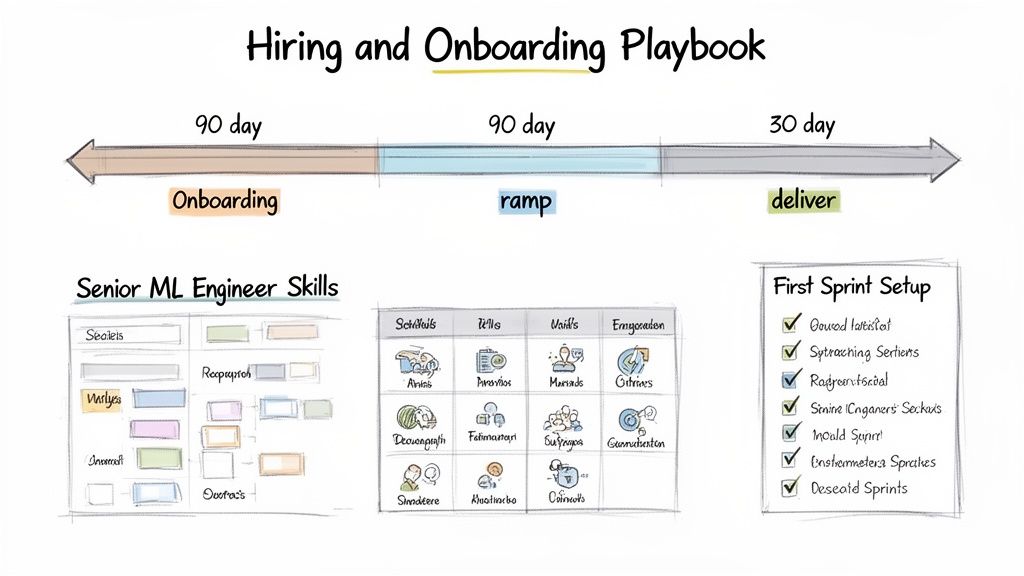
alt text: Infographic showing a 90-day onboarding playbook for a Senior ML Engineer. It covers key skills to vet, a first sprint plan, and a timeline for achieving full ownership.
Finding talent is just the start. This checklist provides a repeatable process for vetting, hiring, and onboarding offshore AI engineers to ensure they become productive members of your team, fast.
✅ Phase 1: Vetting for Production-Ready Skills
Focus on practical experience, not just academic credentials. Your goal is to find engineers who have built and scaled real-world AI systems.
- [ ] Define the Role Clearly: Create a precise job description. For help, see our guide on how to hire remote AI developers.
- "Walk me through a time a model's performance degraded in production. How did you diagnose and fix it?"
- "Describe how you would architect a CI/CD pipeline for an LLM-based application. What are the key stages?"
- Give candidates a small, self-contained problem that mirrors a real ticket. Example: "Build a simple classification API for customer reviews and containerize it with Docker."
✅ Phase 2: A 90-Day Onboarding Plan
A structured onboarding plan is the single best predictor of long-term success.
- Week 1: Provide all system access (code, cloud, PM tools) on Day 1. Assign an onboarding buddy from your core team.
- Weeks 2-4: Conduct deep-dive sessions on architecture and codebase. Assign small bug fixes or documentation tasks to get them familiar with your workflow.
- Assign their first well-defined feature or project, achievable within a single sprint.
- Set clear, measurable goals for that first sprint.
- Encourage the engineer to take ownership of a specific system component.
- They should now be contributing to sprint planning and technical discussions with minimal hand-holding.
✅ Phase 3: Legal and Financial Setup
- [ ] Finalize Contracts: Ensure IP assignment and NDAs are signed.
- [ ] Set Up Payments: Determine the best payment method. This guide on the Best Way to Pay International Contractors can help.
What to Do Next
You have the framework and playbook. Now it's time to act. Follow these three steps to build your offshore AI team with confidence.
Step 1: Define a 6–12 Week Pilot Project
Start small to de-risk the process. Choose a meaningful but contained project with a clear success metric.
Good examples:
- Build a proof-of-concept for a new AI feature.
- Automate a data cleaning pipeline.
- Tune an existing ML model to improve accuracy.
Step 2: Select the Right Engagement Model
Use the framework above to choose your model. For most AI pilots, a small dedicated team (1–2 engineers) or a fractional expert is the ideal choice. For a detailed breakdown of expenses, see our guide on offshore software development costs.
Step 3: Prepare Your Internal Team
An offshore team is an extension of your own. Appoint a clear project lead, document your communication protocols, and prepare all technical access before Day 1.
Ready to build your world-class AI team? ThirstySprout connects you with the top 1% of pre-vetted senior AI and ML engineers from global talent hubs.
See Sample Profiles
References & Further Reading
For additional data and insights, we recommend the following primary sources and related ThirstySprout guides.
- Offshore Software Development Statistics for 2025 (Devico.io)
- Offshore Software Development Trends & Statistics (DesignRush)
Hire from the Top 1% Talent Network
Ready to accelerate your hiring or scale your company with our top-tier technical talent? Let's chat.