

TL;DR
- A Lead Software Developer is a senior engineer who splits their time between coding (30–50%) and team leadership. They are player-coaches, not pure managers.
- Their core job is to multiply the team's impact by mentoring engineers, owning system architecture, and enforcing code quality. This directly reduces project risk and speeds up delivery.
- Key skills in 2026 include cloud architecture (AWS, GCP), CI/CD, MLOps, and strong mentorship abilities. They must bridge the gap between engineering, product, and business goals.
- To hire one, use a structured process focusing on system design, leadership scenarios, and a practical code review exercise. Avoid promoting your best coder without a plan.
- Next Step: Review the hiring checklist below and identify the biggest technical bottleneck on your team. Is it architecture, code quality, or mentorship? This will define the type of lead you need.
Who This Guide Is For
- CTOs and Heads of Engineering: You need to scale your team's output without your best senior engineer becoming a bottleneck. You're deciding whether to hire a Lead Developer, Tech Lead, or Engineering Manager.
- Founders and Product Leaders: You need to accelerate your roadmap and de-risk a complex build (especially one involving AI). You need a technical partner to translate business needs into a viable engineering plan.
- Hiring Managers and Talent Ops: You are tasked with finding and vetting candidates for a critical technical leadership role and need a practical framework for interviews and evaluation.
Framework: Deciding Between Lead Dev, Tech Lead, & Manager
The most common point of failure is hiring for the wrong role. Use this decision framework to clarify what your team actually needs right now.
| Dimension | Lead Software Developer | Tech Lead | Engineering Manager |
|---|---|---|---|
| Primary Focus | Technical execution and team mentorship | Project-specific technical direction | People and team performance |
| Code Contribution | High (30–50%) | Varies (often high) | Low (0–10%) |
| Scope of Impact | Team or major system/domain | Single project or feature | Entire team or multiple teams |
| Key Responsibility | System design, code reviews, mentoring | Technical decisions, task breakdown | Hiring, 1-on-1s, performance reviews |
| Hire When You Need... | To elevate the entire team's technical skill and establish best practices. | A single point of technical authority for a high-stakes project. | Someone to focus on career growth, team health, and administrative tasks. |
Ultimately, the choice depends on your team's biggest challenge. Do you need someone to guide a complex project, manage the well-being of your engineers, or elevate the technical craftsmanship of the entire team? The Lead Developer fills that third, vital role.
If you're building out your team structure, our guide on the other key roles in agile software development can also provide a wider perspective.
Practical Examples of a Lead Developer's Impact
A great Lead Software Developer does far more than just manage a JIRA board. Their real value is in how they amplify the work of the entire engineering team. Here are two real-world scenarios.
Example 1: Rescuing a Stalled Project
Situation: A fintech startup is racing to launch a new payment module. The team of junior engineers is overwhelmed, progress is slow, and code quality is inconsistent. The launch is at risk.
The Lead Developer's Actions:
- Architect a Modular Design: The lead's first act is to create a clean, modular architecture. They break the massive problem into smaller, well-defined components with clear API contracts. This unblocks parallel work.
- Implement Mentorship via Pairing: They dedicate 40% of their week to pair programming sessions, guiding junior engineers through complex topics like idempotency in financial transactions.
- Build a CI/CD Safety Net: They set up a lightweight CI/CD pipeline using GitHub Actions that automatically runs tests on every commit. This builds team confidence and catches bugs instantly.
Business Impact: The feature shipped 30% faster than projected. More importantly, the junior engineers were upskilled into confident, productive contributors, reducing the company's long-term reliance on senior-only hires.
Example 2: Productionizing an AI Model
Situation: An e-commerce company's data science team built a powerful LLM-based recommendation engine in a Jupyter notebook. They have no process to deploy it reliably. Deployments are manual, risky, and take days.
The Lead Developer's Actions:
- Implement MLOps CI/CD: They design and build a robust CI/CD pipeline specifically for the AI workflow, treating the model as a software artifact.
- Version Control Everything: Prompts, model configurations, and training data are all moved into Git. Every change is now trackable and auditable.
- Introduce Canary Releases: They replace big-bang deployments with staged rollouts. New models are exposed to 1% of users first, with real-time performance monitoring. A rollback is now a one-click action.
Business Impact: Deployment time for new recommendation models dropped from 3 days to under 2 hours. This allowed the business to iterate on AI features weekly instead of quarterly, leading to a measurable lift in user engagement and sales.
Deep Dive: Core Responsibilities and Required Skills
So, what really separates an average Lead Software Developer from a great one? It's a powerful combination of technical authority and genuine leadership. You're not just hiring a senior coder; you're hiring someone who can architect a resilient microservices platform and step in to mediate a technical debate between two passionate engineers.
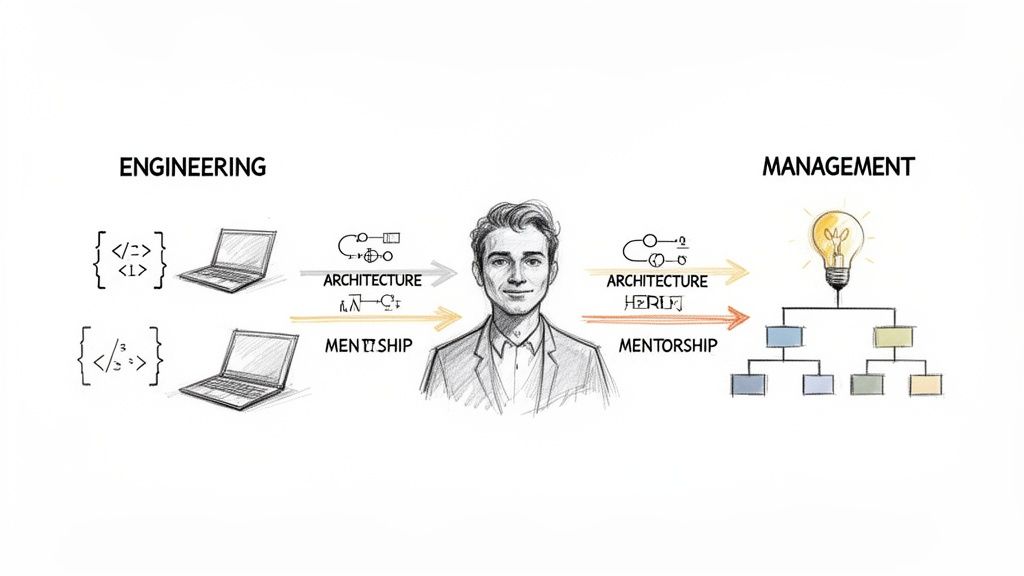
Alt text: Diagram illustrates a software developer's career path from engineering code to management ideas and organization.
Lead Software Developer Skill Matrix for 2026
This matrix outlines the essential competencies and what they look like in practice.
| Skill Category | Core Competencies | Examples in Practice |
|---|---|---|
| Technical | System Architecture | Designing a new microservice and its API contract. |
| Cloud Infrastructure (AWS/GCP) | Choosing the right AWS services to build a scalable and cost-efficient data pipeline. | |
| Code Quality & Review | Establishing clear coding standards and providing insightful, constructive PR feedback. | |
| Leadership | Mentorship & Coaching | Pair programming with a junior developer to debug a difficult problem. |
| Project Planning & Scoping | Breaking down a large feature into smaller, manageable tasks for the team. | |
| Stakeholder Communication | Explaining the technical trade-offs of a new feature to the product manager. | |
| AI/ML Specific | MLOps Fundamentals | Setting up a CI/CD pipeline in GitHub Actions to automate model deployment. |
| Data Architecture | Designing a schema for a feature store that serves models in production. |
While this role has unique demands, it builds on a strong engineering foundation. You can find a great overview of the core skills required for any software engineer in our other guide.
Pitfalls to Avoid
The biggest mistake companies make is promoting their best individual coder into a lead role without training or a clear change in expectations. The skills that make someone a great coder (deep focus, individual output) are often the opposite of what makes a great lead (communication, delegation, team enablement).
This "accidental promotion" often results in losing your best coder and getting a bad manager.
Another pitfall is letting the lead developer stop coding entirely. A good rule of thumb is for them to spend 30% to 50% of their time on hands-on coding. Below that, they lose touch with the codebase and credibility with the team. Above that, they are neglecting their primary duty: multiplying the team's output.
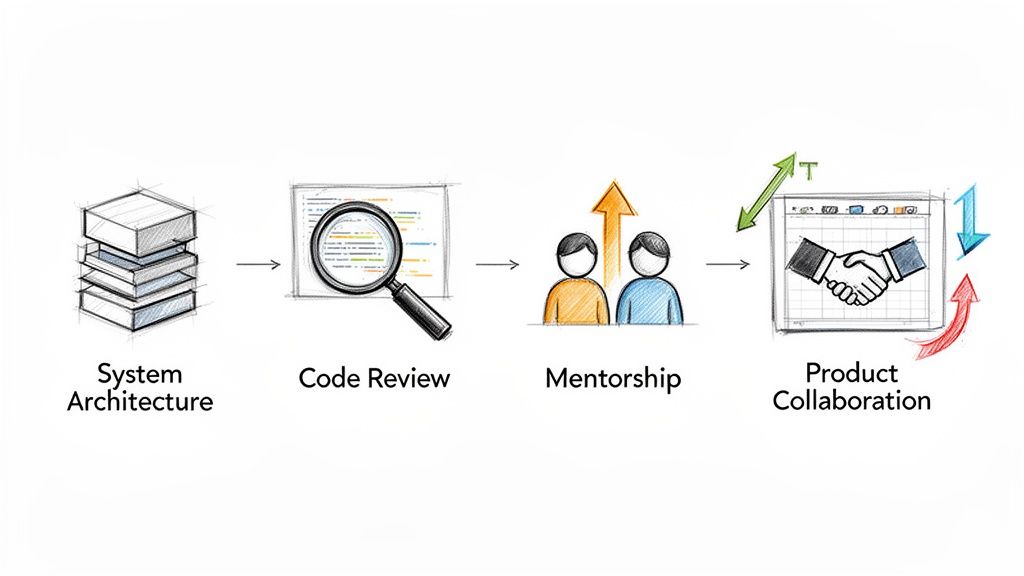
Alt text: A diagram illustrates four key steps: system architecture, code review, mentorship, and product collaboration.
Checklist: How to Hire a Great Lead Software Developer
Hiring a Lead Software Developer isn’t just filling a senior position. You’re looking for a force multiplier. A great hire can accelerate your roadmap; a bad one can bring it to a grinding halt. Use this checklist for a structured hiring process.
☐ 1. Craft a Job Description That Attracts Leaders
- Lead with the mission, not a tech list. Start with the core business problem they’ll solve. "You will own the architecture of our new AI-powered analytics platform..."
- Define the "lead" ratio. Be explicit about the split (e.g., "This is a hands-on role with a 50/50 split between coding and mentorship.").
- Showcase the team context. Mention the size and seniority of the team they will lead.
☐ 2. Run a Structured 4-Stage Interview Process
- Stage 1: Hiring Manager Screen (45 mins). Gut check for experience, communication style, and alignment with the team's biggest technical challenges.
- Stage 2: System Design Interview (60 mins). A collaborative whiteboarding session on a real, open-ended problem your team has faced. Assess trade-off discussions.
- Stage 3: Leadership & Mentorship Interview (45 mins). Use behavioral questions: "Tell me about a time you mentored a struggling junior engineer." "How did you resolve a sharp technical disagreement on your team?"
- Stage 4: Practical Code Review (60 mins). Give them a real, flawed piece of code. Ask them to review it as if for a junior developer. This tests technical depth and mentorship ability simultaneously.
☐ 3. Make a Competitive Offer (US Market 2026)
- Know the benchmarks. Data from PayScale, BuiltIn, and ZipRecruiter show an average base salary around $135k–$145k, with total compensation for top talent in AI-focused roles exceeding $209k.
- Early-Stage (Seed–Series A): Lower base salary, higher equity (0.5%–1.5%).
- Scale-Up (Series B+): Higher base salary, strong cash bonus, smaller equity grant (0.1%–0.5%).
For a complete playbook on navigating this market, see our comprehensive guide on hiring software developers.
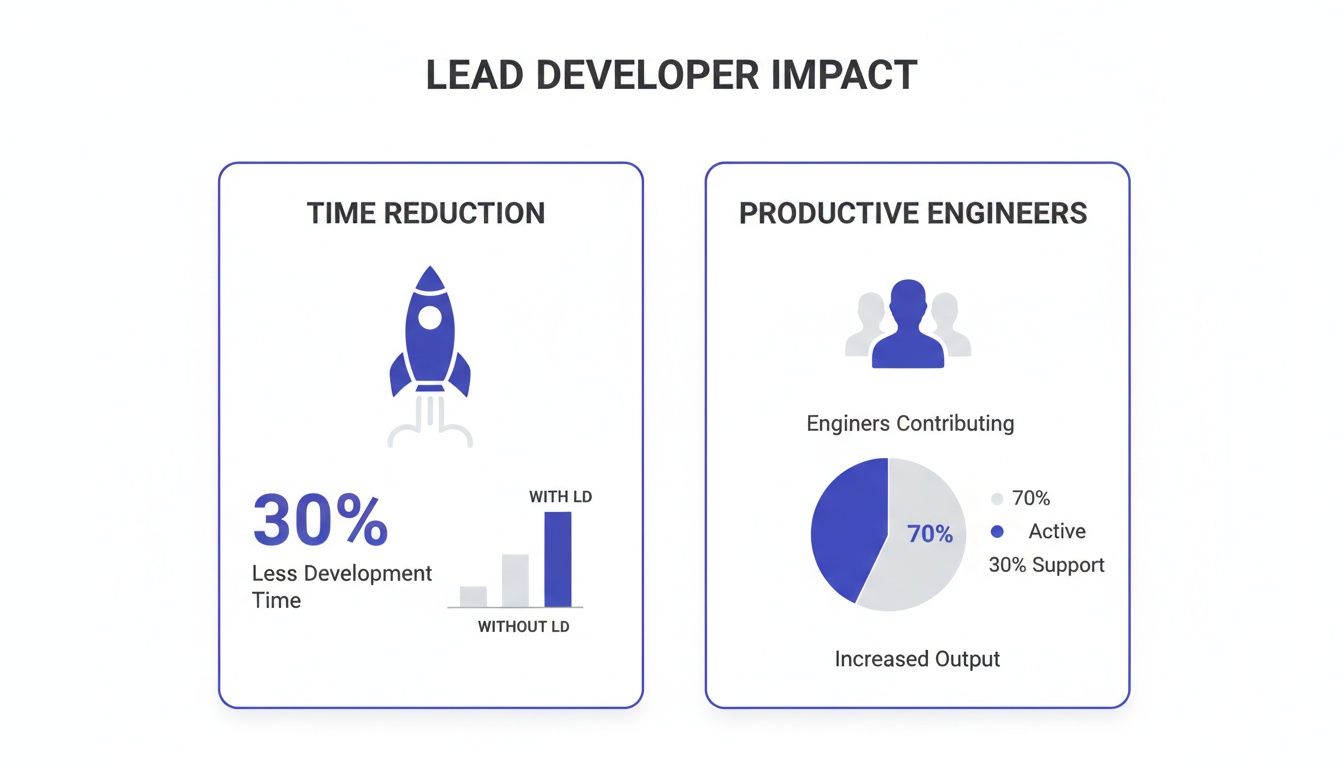
Alt text: Infographic detailing lead developer impact on project efficiency, showing time reduction and increased number of productive engineers.
What To Do Next
- Assess Your Biggest Bottleneck: Is your team slowed down by poor architecture, inconsistent code quality, or a lack of mentorship for junior members? Your answer defines the primary mission for your new lead.
- Use the Checklist to Draft a Job Description: Frame the role around the bottleneck you identified. This will attract candidates who are motivated by solving that specific problem.
- Book a Scoping Call: If you need to hire a top-tier lead for your AI or software team in the next 3–6 weeks, we can help. ThirstySprout connects you with vetted technical leaders who are ready to make an impact.
Ready to hire a lead software developer who can multiply your team's impact? ThirstySprout helps you connect with vetted, senior AI and software engineering leaders who have a proven track record of shipping production-grade systems.
Start a Pilot with a top-tier lead developer today.
References
Hire from the Top 1% Talent Network
Ready to accelerate your hiring or scale your company with our top-tier technical talent? Let's chat.