

TL;DR
- When to outsource: Use IT outsourcing services to access specialized talent (AI/ML, MLOps, Data Engineering), accelerate time-to-market, and manage your burn rate without long-term hiring commitments.
- Choosing a model: Use Staff Augmentation for skill gaps, Managed Services to offload entire functions (like MLOps), and Project-Based for well-defined builds (like an MVP).
- Key success factor: Treat your outsourcing partner like an extension of your team, not a ticket-taker. Integrate them into your workflows (Slack, Jira) and ensure a 3–4 hour daily time zone overlap for collaboration.
- How to start: Scope a small, 2–4 week pilot project with a clear goal. This is the best way to test a partner's technical skill and communication before signing a long-term contract.
Who This Is For
This guide is for technical leaders at high-growth companies who need to build and scale their teams under pressure.
- CTOs and VPs of Engineering (Series A–D): You need to hit aggressive roadmap goals for complex AI features without compromising on engineering quality.
- Founders and Product Leads: You're scoping new products but face challenges with budget constraints and finding the right AI talent.
- Heads of Talent and Procurement: You are responsible for vetting technical partners and mitigating the risks of outsourcing.
If you're struggling to hire a niche AI/ML engineer or need a smarter way to manage your runway, this framework will help you make confident decisions.
A Quick Framework for Outsourcing Decisions
Choosing the right IT outsourcing model depends on your primary driver: speed, cost, or control. A startup rushing to launch an AI feature has different needs than a larger company optimizing cloud costs.
Use this decision tree to guide your choice. Your most pressing need will point you toward the best model.
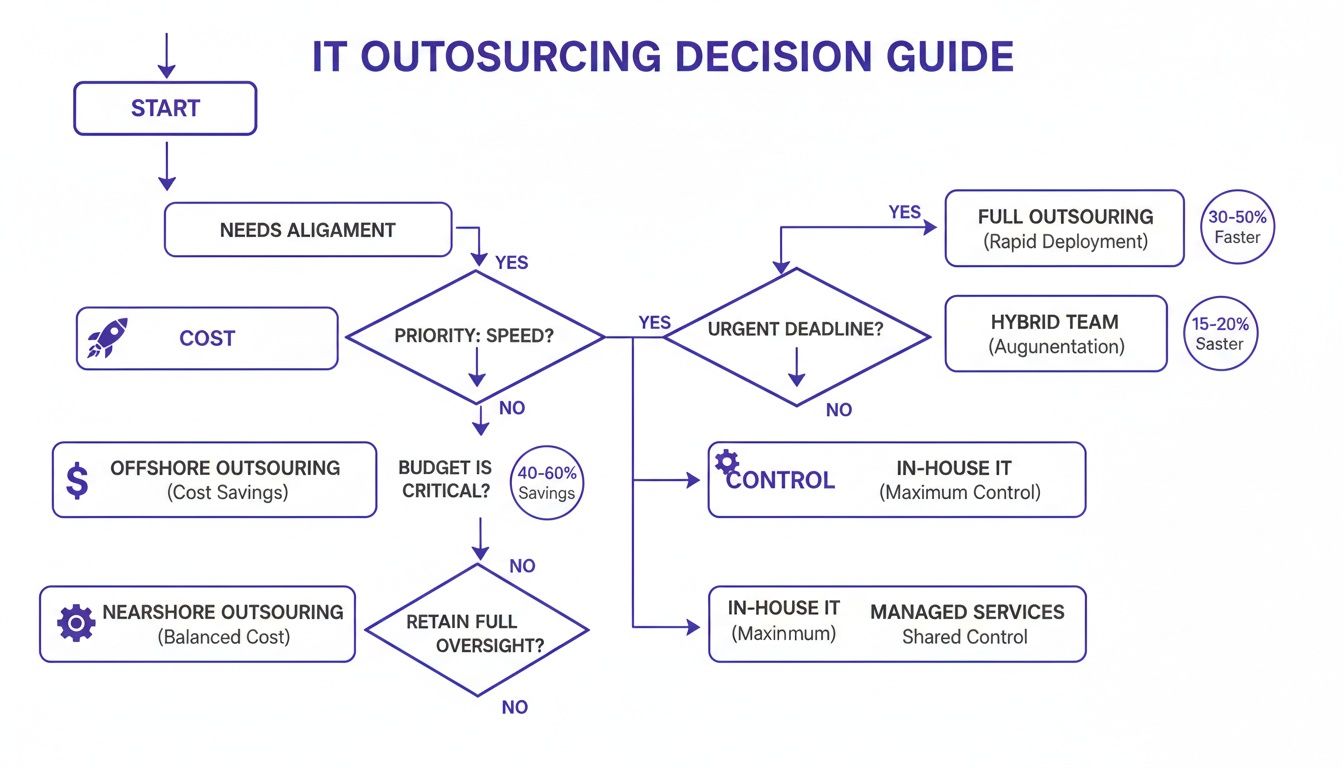
- Need speed? Use Staff Augmentation to embed specialists directly into your team.
- Need to cut costs? An offshore model offers the greatest savings for well-defined tasks.
- Need to maintain control? A nearshore or hybrid model provides better alignment and collaboration.
Getting this right prevents mismatched expectations, delays, and blown budgets.
Practical Examples of IT Outsourcing
Abstract models are one thing; real-world execution is another. Here are two mini-case studies showing how companies use IT outsourcing services to solve critical business problems.
Example 1: Fintech Startup Smashes a Data Engineering Bottleneck with Staff Augmentation
A Series B fintech company's core product depended on complex data pipelines, but they couldn't hire senior data engineers locally. Their internal team was burning out, and the product roadmap was stalled.
The Solution: They used an offshore staff augmentation partner to hire two senior data engineers in a different time zone.
- Challenge: The local hiring process for senior data engineers was taking 4+ months, blocking critical features.
- Intervention: Hired two vetted offshore data engineers who were onboarded in just three weeks.
- Integration: The engineers were fully embedded in the team, using the company's Slack, Jira, and daily stand-ups. A 4-hour daily overlap was established for real-time collaboration.
- Result: The data engineering backlog was cleared in two months, and the team shipped a key revenue-generating feature one quarter ahead of schedule. Hiring costs were reduced by an estimated 50% compared to local talent.
This was a surgical injection of specialized skills that kept the company's technical vision and culture intact while unblocking the roadmap.
Example 2: E-commerce Company Unleashes Its ML Team with Managed Services
A fast-growing e-commerce company had a brilliant Machine Learning (ML) team spending nearly half their time on infrastructure management and MLOps tasks instead of building algorithms.
The Solution: The CTO engaged a nearshore managed services provider to take over the entire cloud and MLOps function, governed by a Service Level Agreement (SLA).
- Challenge: Valuable ML engineers were bogged down with operational work, slowing down model development and experimentation.
- Intervention: A dedicated managed services team took full ownership of the CI/CD pipelines, Kubernetes clusters, and model monitoring.
- Uptime: 99.95% availability for all production ML services.
- Deployment Velocity: Increased from one model deployment per month to twice a week.
- Incident Response: 15-minute acknowledgment for any critical production alert.
Comparing the Core Models of IT Outsourcing
Picking the right model defines how you build and scale your technology. The path you choose directly impacts your control, costs, and speed. Let's compare the three main options.
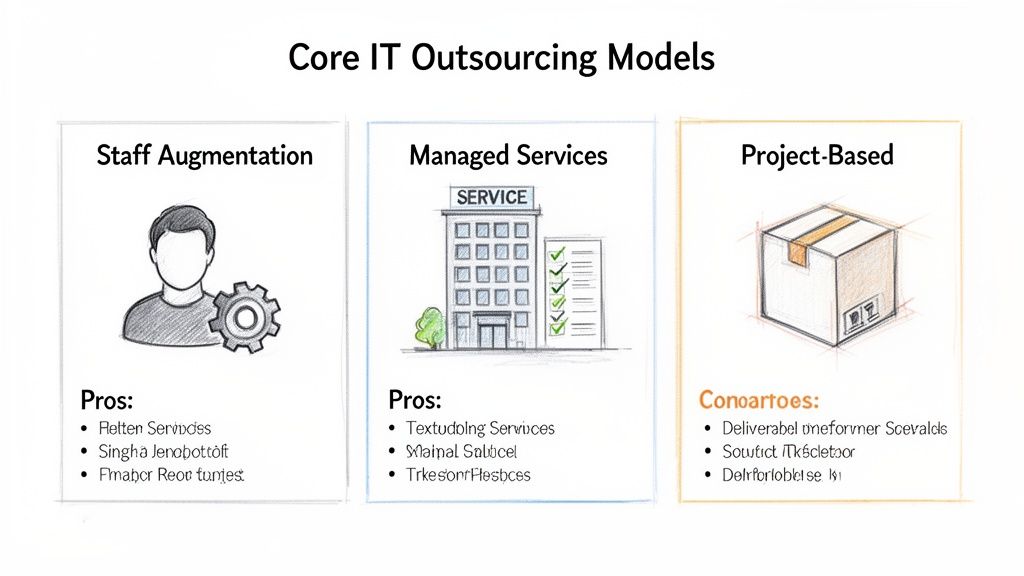
Staff Augmentation: The Scalpel Approach
You bring one or more specialists directly into your team to fill a critical skill gap. They slot into your existing workflows and report to your managers. This is ideal when your internal project management is solid but you're missing a key player, like a senior Python developer with specific AI library experience.
- Pros: Total control over the talent, fast access to niche skills, seamless cultural integration.
- Cons: Management burden remains 100% on you; less effective without strong internal leadership.
Managed Services: Offloading a Function
You hand over an entire IT function to a partner governed by a Service Level Agreement (SLA). Think managed cybersecurity, cloud infrastructure, or database administration. The provider is responsible for the people, processes, and tools to deliver a result. For a deeper dive, see our comparison of managed services vs. staff augmentation.
- Pros: Frees up your internal team for strategic work, predictable costs, vendor is accountable for results.
- Cons: Less direct control over day-to-day operations, requires a well-defined SLA.
Project-Based Outsourcing: Delivering a Defined Outcome
You have a project with a clear beginning and end, like building a new mobile app. You define the scope and timeline, and a vendor agrees to deliver it, usually for a fixed price. The vendor manages their own team to hit the target.
- Pros: Predictable costs, minimal management overhead, firm deadline for a finished product.
- Cons: Less control over daily work; scope changes can be complex and costly.
Deep Dive: How to Select and Manage Your Outsourcing Partner
Choosing a partner is a critical decision. A great one acts as an extension of your team; the wrong one burns cash and creates headaches. With 43% of tech companies planning to increase outsourcing for AI talent, a methodical selection process is essential.
Go Beyond the Resume to Assess Technical Expertise
A polished resume is just the start. You need to verify how a team solves real-world problems.
- Hold a Live Technical Review: Ask their lead engineer to walk through a past project's architecture and defend their technology choices.
- Demand Relevant Case Studies: If you're building a fintech platform, a vendor with only e-commerce experience is not a fit.
- Use a Small Pilot Task: A small, paid, one-week project is the ultimate test of their work quality, communication, and ability to handle feedback.
Evaluate Communication and Cultural Fit
Brilliant coders who can't communicate are a liability. You want a proactive collaborator who challenges assumptions, not a passive ticket-taker.
- Communication Style: Ensure their rhythm (e.g., daily stand-ups vs. async updates) matches yours.
- Problem-Solving Approach: Ask how they handled a past project that went off track. Their answer reveals their transparency and accountability.
- Time Zone Overlap: A minimum 4-hour overlap is non-negotiable for projects requiring close collaboration.
Scrutinize Security and Compliance Protocols
Security is non-negotiable. A data breach from a third-party vendor can destroy your business.
- Ask direct questions: How is data encrypted? What are your access control policies? Do you have certifications like SOC 2 or ISO 27001?
- Use a checklist: A structured vendor due diligence checklist ensures you cover all critical security and compliance points.
Vague answers are a major red flag. A partner who takes security seriously will welcome this scrutiny.
The Outsourcing Partner Selection Checklist
Use this scorecard to evaluate potential partners objectively. This simple tool helps remove bias and provides a clear, data-driven rationale for your decision.
To use: Score each vendor (1–10) for each criterion, then multiply by the weight. The partner with the highest total score is often your best bet.
What to Do Next: Your 3-Step Action Plan
- Define Your Scope: Write down the specific roles, required tech skills, and business goals. What KPIs define success (e.g., reduce time-to-hire by 50%)? Clarity here is non-negotiable.
- Vet 2-3 Partners with the Scorecard: Run your top candidates through the evaluation checklist. This forces an objective comparison based on what truly matters—technical skill, communication, and security.
- Launch a 2–4 Week Pilot Project: Never sign a long-term contract without a test drive. Scope a small, low-risk project with a clear goal. This is the ultimate real-world test of a vendor's ability to deliver.
Ready to put this plan into action?
- Start a Pilot: Let's scope a low-risk project together.
- See Sample Profiles: Review vetted AI and ML engineers ready to join your team.
References
- Gartner, Inc. Market Share Analysis: IT Services, Worldwide, 2023
- ThirstySprout. Managed Services vs. Staff Augmentation
- ThirstySprout. Offshore Software Development Costs
- Software Modernization Services. Vendor Due Diligence Checklist
Ready to build your remote AI team with vetted, senior talent? ThirstySprout helps you hire specialized engineers in LLMs, MLOps, and data engineering in days, not months.
Hire from the Top 1% Talent Network
Ready to accelerate your hiring or scale your company with our top-tier technical talent? Let's chat.