

TL;DR: Key Takeaways
- Focus on Business Impact: Ask how TypeScript choices reduce bugs, improve developer velocity, and de-risk complex AI/ML data pipelines.
- Prioritize Practical Skills: Move beyond definitions. Use scenarios involving generics for API clients, utility types for data transformation, and
async/awaitfor concurrent model calls. - Identify Architectural Thinking: Questions about interfaces vs. types, modules, and decorators reveal a candidate's ability to design scalable, maintainable systems, not just write code.
- Use the
unknownLitmus Test: A candidate’s preference forunknownoveranyis a strong signal of a disciplined, safety-first mindset crucial for production-grade software. - Actionable Next Step: Use our interview scorecard (included below) to standardize your hiring process and identify top-tier TypeScript talent for your AI team.
Who is this guide for?
This guide is for hiring managers, CTOs, and senior engineers who need to:
- Hire senior engineers for remote AI, MLOps, or data teams.
- Assess TypeScript proficiency beyond basic syntax for building robust, production-grade applications.
- Evaluate candidates' ability to connect code quality with business outcomes like reliability and time-to-market.
If you need to ensure a candidate can build and maintain a complex, type-safe application that handles intricate data flows (e.g., from LLMs or data pipelines), these questions will help you separate the experts from the novices.
A Framework for Evaluating TypeScript Proficiency
Don't just ask questions; evaluate candidates on a spectrum of proficiency. Use this simple framework during your technical screen.
| Proficiency Level | What to Look For | Red Flags |
|---|---|---|
| Novice | Can define basic concepts (e.g., "TypeScript adds types"). Struggles with practical examples or "why." | Overuses any, doesn't know unknown, can't explain the difference between interface and type. |
| Proficient | Provides correct definitions and simple code examples. Understands async/await, generics, and utility types. | Sees any as a convenient shortcut, not a code smell. Doesn't mention trade-offs or advanced use cases. |
| Expert | Explains the "why" behind choices (e.g., when to use interface over type). Connects features to business impact. | N/A. An expert discusses trade-offs, performance implications, and architectural best practices with nuance. |
1. How does TypeScript differ from JavaScript, and what business problem does it solve?
This foundational question assesses a candidate's grasp of TypeScript's core value proposition beyond just "it adds types." A strong answer connects static typing directly to business impact.
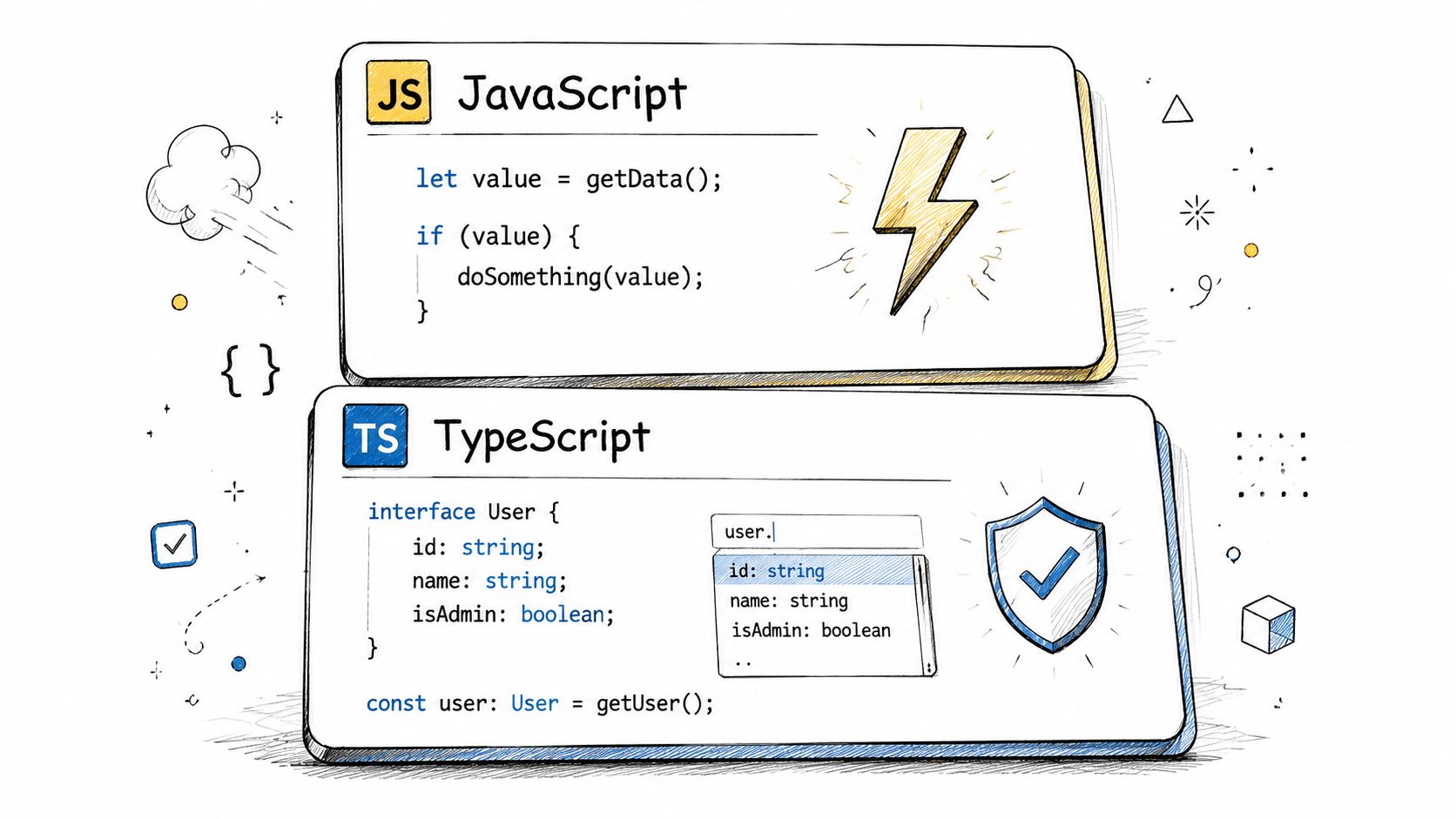
alt text: A comparison illustration between JavaScript and TypeScript coding syntax using code snippets and icons.
Expert Answer: "TypeScript is a statically typed superset of JavaScript. Its primary business value is risk reduction. By catching type-related errors during development—not at runtime—it prevents a whole class of bugs that can crash production systems. For an AI application, this means I can guarantee the shape of data moving between a data pipeline, a model, and the front end. For example, if an LLM API suddenly changes its response format, a strongly typed system will fail at compile-time, not silently in front of a user. This improves maintainability and allows teams to refactor large codebases with confidence, accelerating feature development."
For practical examples of TypeScript in action, or to delve deeper into its core concepts, consider exploring projects like feedback for Type Scripture. This topic is a cornerstone of many modern engineering interviews, which you can explore further with these technical interview questions for software engineers.
2. Show me how you'd use generics to create a reusable, type-safe API client.
This question probes a candidate's ability to write reusable, type-safe components—a core skill for building scalable systems. A good response moves from definition to a practical, real-world example.

alt text: A hand-drawn illustration showing a generic container box labeled T being used to create reusable components.
Expert Answer: "Generics let us write functions that work over a variety of types while preserving type safety. A classic use case is an API client. Instead of writing separate fetch functions for users, products, and documents, I'd create a single generic function."
Example Code Snippet:
interface ApiResponse<T> {data: T;status: number;}async function get<T>(endpoint: string): Promise<ApiResponse<T>> {const res = await fetch(`/api/${endpoint}`);if (!res.ok) {throw new Error(`API error: ${res.status}`);}const data: T = await res.json();return { data, status: res.status };}// Now we can use it with full type safetyconst userResponse = await get<User>('users/123');console.log(userResponse.data.name); // Autocompletes `name` propertyconst docResponse = await get<Document>('docs/456');console.log(docResponse.data.title); // Autocompletes `title` property"This approach keeps our code DRY (Don't Repeat Yourself) and makes it impossible to access properties that don't exist on the returned data, significantly reducing integration bugs."
3. When do you use an interface versus a type alias? Show me an example where the choice matters.
This question probes a candidate's practical knowledge of TypeScript's type system. While they often seem interchangeable, knowing the nuanced differences is a hallmark of an experienced developer.
alt text: A hand-drawn comparison diagram explaining the key differences between TypeScript interfaces and type aliases.
Expert Answer: "My rule of thumb is: use interfaces for defining the shape of objects or for API contracts; use type aliases for everything else, like primitives, unions, and complex mapped types. The key technical difference is that interfaces are 'open' and can be extended via declaration merging, while type aliases are 'closed'."
Practical Example: "Imagine we're building a plugin system for a data visualization library. The core library defines a Chart interface."
// In the core libraryinterface ChartConfig {title: string;data: number[];}"A third-party plugin can extend this interface to add its own options without modifying the original code:"
// In a third-party plugininterface ChartConfig {enable3d: boolean; // Declaration merging adds this property}"You can't do this with a type alias. This makes interfaces ideal for creating extensible public APIs. For defining a set of possible states, like an API response, a type alias with a union is more appropriate: type ApiResponse = SuccessResponse | ErrorResponse. Choosing incorrectly can make an API difficult for other developers to extend."
For more on creating robust and maintainable code, explore these principles of software design.
4. Why is unknown a better choice than any? Describe a scenario where you'd use unknown.
This question is a powerful litmus test for a candidate's discipline and commitment to type safety. An engineer who defaults to any introduces risk; one who reaches for unknown prioritizes robustness.
Expert Answer: "any is an escape hatch that turns off the type checker entirely, which defeats the purpose of using TypeScript. It's a source of potential runtime errors. unknown is a type-safe alternative. It tells the compiler 'I don't know what this type is, but we must figure it out before using it.' It forces you to perform explicit type checks."
Scenario: "When parsing a JSON response from an external, untyped API, unknown is perfect. For example, decoding a JWT (JSON Web Token) payload:"
function getPayload(token: string): unknown {// Decoding logic returns an unknown JSON payloadreturn JSON.parse(atob(token.split('.')[1]));}const payload = getPayload(myToken);// This would fail at compile time, which is good!// console.log(payload.userId); // Error: Object is of type 'unknown'.// We must perform a check firstif (typeof payload === 'object' && payload && 'userId' in payload) {// Now, TypeScript knows payload has a userId propertyconsole.log((payload as { userId: string }).userId);}"Using unknown here forces me to handle the possibility of a malformed payload gracefully, preventing a runtime crash if the userId is missing."
5. Explain type narrowing and show how you'd use a discriminated union to handle different AI model outputs.
This question gauges a candidate's skill in handling complex, variable data structures—a daily reality in AI/ML engineering.
alt text: A diagram illustrating TypeScript type narrowing, moving from unknown types through filtering mechanisms to specific classifications.
Expert Answer: "Type narrowing is how TypeScript intelligently refines a variable's type within a code block based on conditional logic. The most powerful pattern for this is a discriminated union. This is ideal when an API can return different object shapes based on a common field."
Scenario: "Let's say we have an AI service that can perform either text classification or object detection. The response structure varies."
// Define the shapes for each response typeinterface ClassificationResponse {type: 'classification'; // The "discriminant"label: string;confidence: number;}interface DetectionResponse {type: 'detection';boundingBox: { x: number; y: number; w: number; h: number };label: string;}// Create a union of the possible responsestype ApiResponse = ClassificationResponse | DetectionResponse;function processResponse(response: ApiResponse) {// TypeScript knows 'type' exists on both objectsswitch (response.type) {case 'classification':// Inside this block, TS knows `response` is a ClassificationResponseconsole.log(`Label: ${response.label}, Conf: ${response.confidence}`);break;case 'detection':// Inside this block, TS knows `response` is a DetectionResponseconsole.log(`Box found at: ${response.boundingBox.x}`);break;}}"This pattern is compile-time safe. If a new response type is added to the ApiResponse union, TypeScript will flag an error until the switch statement is updated to handle it. This prevents runtime errors when the API is updated." This concept is fundamental to writing safe, bug-resistant code, a core topic in many technical interview questions on TypeScript.
6. What are decorators in TypeScript, and what is a practical, non-framework example of their use?
This question probes a candidate's knowledge of advanced, metaprogramming features. While common in frameworks like Angular and NestJS, an expert can describe their value in a vanilla context.
Expert Answer: "Decorators are special functions that modify classes, methods, or properties at design time. They are essentially functions that wrap another function or property to add behavior. They are powerful for cross-cutting concerns."
Practical Example: "A common use case outside a framework is creating a performance logger or a cache. For instance, we can create a @LogExecutionTime decorator to automatically log how long an expensive function, like a data processing task, takes to run."
function LogExecutionTime(target: any, propertyKey: string, descriptor: PropertyDescriptor) {const originalMethod = descriptor.value;descriptor.value = function(...args: any[]) {const start = performance.now();const result = originalMethod.apply(this, args);const end = performance.now();console.log(`Execution time for ${propertyKey}: ${end - start}ms`);return result;};return descriptor;}class DataProcessor {@LogExecutionTimeprocessLargeFile() {// Simulate a time-consuming taskfor (let i = 0; i < 1e7; i++) {}}}new DataProcessor().processLargeFile(); // Console will log the execution time"This keeps our business logic clean. The processLargeFile method isn't cluttered with timing code. This separation of concerns is the key benefit and improves code maintainability."
7. Explain utility types and show how you'd use Pick and Partial to manage API payloads.
This question tests a candidate's practical TypeScript knowledge. Mastery of utility types is a clear sign of a sophisticated developer who can manipulate complex types without writing redundant code.
alt text: An illustration showing various TypeScript utility types like Pick, Omit, and Partial transforming a base type into new types.
Expert Answer: "Utility types are built-in generics for common type transformations. They are essential for keeping code DRY."
Scenario: "Let's say we have a User model. The full object contains sensitive data we don't want to expose."
interface User {id: string;name: string;email: string;createdAt: Date;passwordHash: string; // Sensitive data}"Pick is used to create a new type by selecting a few properties from an existing type. For a user profile preview, we only need the name and ID."
// The user preview DTO (Data Transfer Object)type UserPreview = Pick<User, 'id' | 'name'>;// Effectively: { id: string; name: string; }"Partial is used to make all properties of a type optional. This is perfect for an update endpoint where a client can send any subset of fields."
// The payload for our updateUser endpointtype UserUpdatePayload = Partial<Omit<User, 'id' | 'passwordHash'>>;// Effectively: { name?: string; email?: string; createdAt?: Date; }// We combine with Omit to prevent updating immutable or sensitive fields.function updateUser(id: string, payload: UserUpdatePayload) {// ... update logic}"Using utility types makes my types more intentional and maintainable. If I add a new field to User, my update payloads and DTOs remain correct without manual changes." This topic is central to many advanced interview questions on TypeScript, which you can find in resources like these senior front end developer interview questions.
8. Explain the difference between void and never and their role in exhaustiveness checking.
This question probes a candidate's deep understanding of TypeScript's type system, particularly control flow analysis. A strong answer connects these types to building more resilient and bug-free software.
Expert Answer: "void is for a function that completes but doesn't return a value (e.g., console.log). The function runs and finishes. never is for a function that never completes. This happens if it always throws an error or enters an infinite loop."
"The most powerful use of never is for exhaustiveness checking. Let's go back to our discriminated union example. We can use never to ensure we handle every possible case at compile time."
// Using the ApiResponse from before...type ApiResponse = ClassificationResponse | DetectionResponse;function processResponse(response: ApiResponse) {switch (response.type) {case 'classification':// ...return;case 'detection':// ...return;default:// If we add a new type to ApiResponse, e.g., `SummarizationResponse`,// but forget to add a case here, the code will fail at compile time.const _exhaustiveCheck: never = response;return _exhaustiveCheck;}}"If a new response type is added to the ApiResponse union, the default case will be reachable. The compiler will then throw an error because a SummarizationResponse cannot be assigned to never. This simple trick forces us to write more robust code and prevents bugs when new features are added."
9. When would you use ES modules versus TypeScript namespaces?
This question probes a candidate's understanding of modern JavaScript architecture versus legacy TypeScript patterns. The answer reveals if they are up-to-date with current best practices.
Expert Answer: "This is a bit of a trick question. You should almost always use ES Modules (import/export). Namespaces were TypeScript's solution for organizing code and avoiding global scope pollution before JavaScript had a native module system. They are now a legacy feature with very few modern use cases."
"ES Modules are the standard. They are supported by browsers, Node.js, and the entire ecosystem of build tools like Webpack and Vite. They enable critical optimizations like tree-shaking, which removes unused code from final bundles, reducing application size. In a large AI/ML monorepo, using path aliases in tsconfig.json with ES Modules is the standard for managing dependencies between packages, like a shared common-types package and various service packages."
A candidate who can't confidently advocate for ES Modules may have an outdated understanding of modern application architecture.
10. How would you robustly handle 3 parallel, asynchronous API calls to different AI models?
Asynchronous programming is fundamental to performance. This question checks a candidate's practical knowledge of concurrency, error handling, and resilient system design.
Expert Answer: "Using async/await is the baseline, but handling parallel calls robustly requires more. If one call failing shouldn't stop the others, Promise.all is the wrong tool because it fails fast. Promise.allSettled is the better choice."
Scenario: "Imagine we want to get a classification, a sentiment score, and a keyword extraction from three different models for a piece of text. We want to show the user whatever results we can get, even if one model is down."
async function analyzeText(text: string) {const promises = [classifyText(text), // Returns Promise<Classification>extractSentiment(text), // Returns Promise<Sentiment>extractKeywords(text) // Returns Promise<Keywords>];const results = await Promise.allSettled(promises);const classification = results[0].status === 'fulfilled' ? results[0].value : null;const sentiment = results[1].status === 'fulfilled' ? results[1].value : null;const keywords = results[2].status === 'fulfilled' ? results[2].value : null;if (results[1].status === 'rejected') {// Log the error from the sentiment model without crashingconsole.error("Sentiment model failed:", results[1].reason);}return { classification, sentiment, keywords };}"This approach provides resilience. It executes all calls in parallel for maximum speed but gracefully handles partial failures, which is critical when building systems that depend on multiple external services." You can find more context on server-side event handling in guides comparing Express.js vs. Node.js.
TypeScript Interview Scorecard (Template)
Use this checklist to score candidates consistently. A strong hire should score mostly 3s.
| Question / Skill | 1 (Novice) | 2 (Proficient) | 3 (Expert) | Notes |
|---|---|---|---|---|
| 1. TS Value Prop | "Adds types" | Explains bug prevention | Connects to business risk, maintainability, and team velocity | |
| 2. Generics | Defines generics | Writes a simple identity function | Builds a practical, reusable component like an API client | |
3. interface vs type | Doesn't know the difference | Knows declaration merging | Explains architectural implications (e.g., public APIs) | |
4. any vs unknown | Uses any freely | Prefers unknown but struggles with examples | Demonstrates a type-safe scenario for unknown | |
| 5. Type Narrowing | Uses if checks with typeof | Explains discriminated unions | Builds a robust, exhaustive handler for multiple data shapes | |
| 6. Decorators | Has only heard of them in frameworks | Explains what they do | Provides a practical, non-framework use case (e.g., logging) | |
| 7. Utility Types | Doesn't know them | Knows Partial or Pick | Composes them to model complex API versioning/DTOs | |
8. void vs never | Confuses them or doesn't know never | Defines them correctly | Explains never for exhaustiveness checking | |
| 9. Modules vs Namespaces | Is unsure of the difference | Knows modules are modern | Explains why (tree-shaking, ecosystem compatibility) | |
| 10. Async & Concurrency | Knows async/await | Uses Promise.all | Uses Promise.allSettled for resilient error handling |
What to Do Next
Mastering these concepts is the foundation for building robust, scalable AI applications. A candidate who can answer these questions with confidence is one who can reduce technical debt and accelerate your product roadmap.
- Adopt the Scorecard: Integrate the scorecard above into your hiring process. Standardizing your evaluation is the fastest way to ensure fair, consistent, and effective hiring.
- Run a Mock Interview: Use these questions to role-play an interview with your team. This helps calibrate everyone on what a "good" answer looks like and aligns your entire engineering organization.
- Find Your Next Challenge: Once you feel confident in your TypeScript interview skills, the next logical step is to explore available positions where you can apply them. You can find remote jobs that demand this level of expertise.
Ready to skip the noise and connect directly with pre-vetted AI and ML engineers who already master these concepts? ThirstySprout specializes in building elite remote teams with talent that can start delivering value in weeks, not months. Start a pilot project and see the difference that world-class engineering makes.
Hire from the Top 1% Talent Network
Ready to accelerate your hiring or scale your company with our top-tier technical talent? Let's chat.