

TL;DR
- When to hire offshore: When you need to scale your team with specialized skills (like AI/ML) faster than you can locally and at a 50-70% lower cost. Best for well-defined projects, not ambiguous R&D.
- How to hire: Use a curated talent network to get pre-vetted senior developers in 2-4 weeks. This avoids the high noise and low quality of freelance platforms.
- Critical success factors: A rigorous vetting process (code review, practical take-home test), a structured 30-day onboarding plan, and mastering asynchronous communication.
- What to do next: Define the role, prepare a skills scorecard, and book a scoping call to see sample profiles that match.
Who this is for
This guide is for technical leaders who need to act fast:
- CTO / Head of Engineering: You need to add 2-5 senior engineers to hit a product deadline without burning through your entire budget.
- Founder / Product Lead: You're scoping the team and budget for a new AI feature and need to understand the real costs and timelines.
- Talent Ops / Procurement: You're evaluating vendors and need to de-risk the process of hiring global talent.
Quick Framework: The Offshore Hiring Decision Tree
The decision to hire developers offshore isn't just about cost savings; it's a strategic trade-off between cost, speed, and complexity. Use this framework to decide if it's the right move for your current situation.
- Define Your Goal: Are you trying to accelerate your roadmap, access niche skills, or extend your financial runway? Be specific.
- Assess Project Clarity: Is the project well-defined with clear specs and a predictable workflow? If yes, it's a strong candidate for offshoring. If it requires constant, unstructured brainstorming with non-technical stakeholders, keep it in-house.
- Evaluate Your Internal Processes: Do you have strong documentation, asynchronous communication habits, and a solid remote onboarding plan? If not, you must build these first.
This decision tree visualizes the core trade-offs.
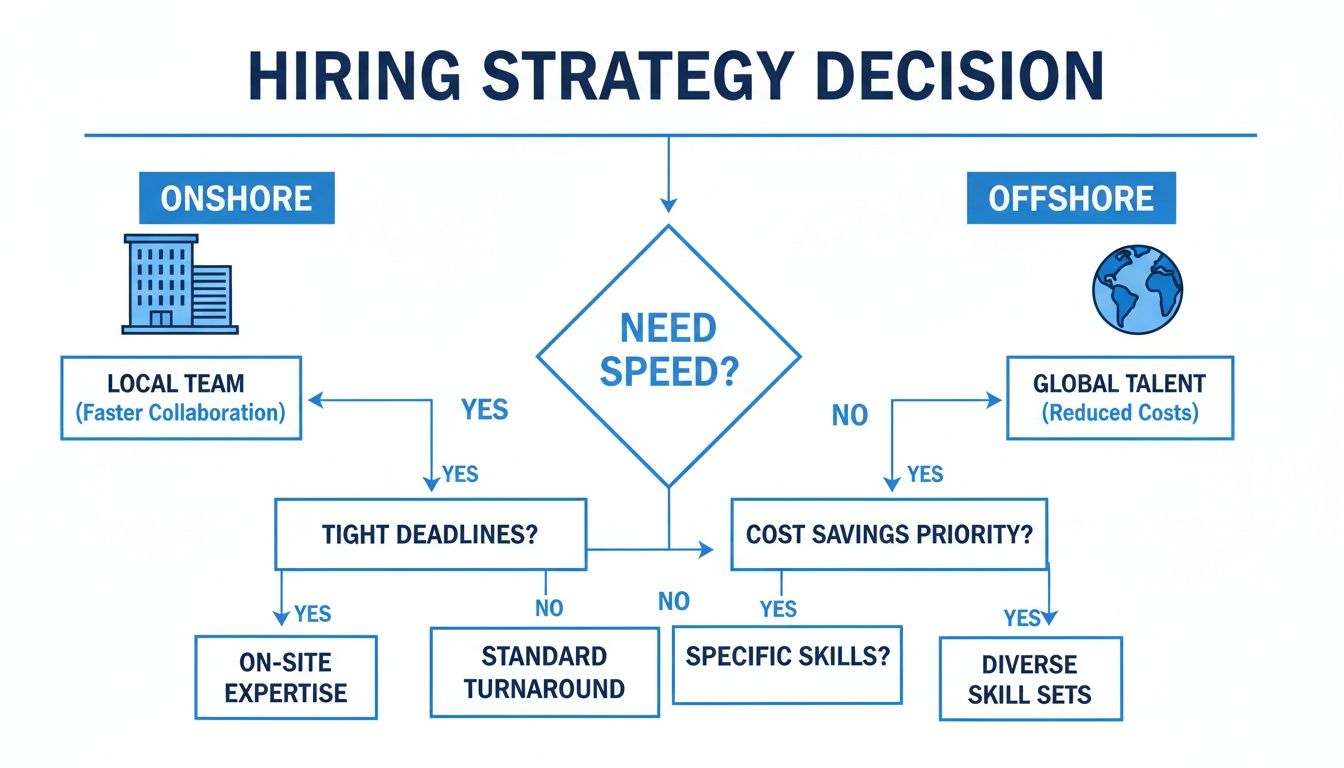
This flowchart shows that when speed and access to a wider talent pool are priorities, offshoring holds a clear advantage.
Practical Examples of Offshore Hiring in Action
Theory is one thing; execution is another. Here are two real-world scenarios where hiring offshore developers delivered a clear business impact.
Example 1: The Series A Startup's AI MVP
- Situation: A startup just closed its Series A and needs to build an AI-powered document analysis feature. Their core team is at capacity. They need 2-3 senior Python engineers with experience in Retrieval-Augmented Generation (RAG) to deliver a prototype in 90 days.
- Action: Instead of a slow and expensive local search, they engaged an offshore talent partner. They received a shortlist of vetted candidates from Eastern Europe within a week.
- Result: They hired two senior engineers who spun up a functional RAG pipeline in under 6 weeks. The cost was ~60% less than hiring in their home city, allowing them to reallocate that budget to user acquisition for the new feature. This accelerated their time-to-market and conserved crucial runway.
Example 2: Vetting a Senior Backend Engineer (The Take-Home Test)
- Situation: A fintech company needed a senior Python developer for its risk assessment engine. They needed proof of practical skill, not just a good resume.
- Action: They designed a concise, 2-day take-home test: "Build a single API endpoint using FastAPI that accepts mock transaction data, runs it through a simple ruleset, and returns a risk score. Provide a
README.mdwith setup instructions." - Result: The winning candidate from Poland delivered clean, well-tested code. More importantly, his
README.mdwas perfect, and he asked clarifying questions before starting. This demonstrated the communication and documentation discipline essential for a high-performing remote team. This test filtered out 80% of applicants who couldn't meet the bar for professional rigor.
Deep Dive: The Core Trade-Offs and Risks
Offshoring isn't a silver bullet. The cost and talent advantages come with operational trade-offs you must actively manage.
The success of an offshore team isn't determined by their location, but by your process. A well-vetted, well-integrated offshore developer is infinitely more valuable than a poorly managed local one.
Time Zones and Communication:
The biggest risk is friction from time zone gaps. You solve this by mastering asynchronous communication. Your goal isn't to force everyone onto one schedule but to make progress happen independently.
- What to do: Establish 2-4 "core collaboration hours" for high-value meetings. For everything else, rely on detailed tickets, documentation, and screen recordings (Loom).
- What to avoid: Ambiguous tasks, undocumented decisions, and expecting immediate replies outside of core hours.
Quality Control and Security:
You can't manage by walking around. Quality and security must be systemic.
- What to do: Enforce mandatory code reviews for every pull request. Have a clear, written "Definition of Done" for all tasks. Use a secrets management tool like AWS Secrets Manager or HashCorp Vault—never share credentials in Slack.
- What to avoid: Merging code without review, unclear acceptance criteria, and sharing sensitive keys via insecure channels.
Cultural Integration:
Offshore developers are part of your team, not just a resource.
- What to do: Implement a structured onboarding plan with a "buddy system." Include them in virtual team events and give them visibility into business goals.
- What to avoid: Treating them like a separate, siloed team. A lack of integration leads to low morale and high churn.
Offshore Hiring Checklist
Use this checklist to structure your hiring process and avoid common pitfalls.
Phase 1: Strategy & Sourcing (Weeks 0-1)
- Define the role's business impact and key responsibilities.
- Create a skills scorecard (must-have vs. nice-to-have skills).
- Choose your sourcing channel (curated network recommended for speed/quality).
- Define your budget, including salary and partner/EOR fees (typically +15-25%).
Phase 2: Vetting (Weeks 1-2)
- Conduct initial screening call (focus on communication and experience).
- Assign a practical, job-relevant take-home assessment (2-3 day deadline).
- Review code submission for quality, clarity, and documentation.
- Hold a live technical interview to discuss the take-home project and problem-solving approach.
- Conduct a final culture/team fit interview.
Phase 3: Onboarding (Weeks 3-4)
- Send and sign the contract with clear IP ownership clauses.
- Set up all system access (code repos, Slack, project tools) before day one.
- Assign an onboarding buddy from the engineering team.
- Prepare a well-defined "first ticket" (e.g., a small bug fix) for a quick win.
- Schedule 1:1s with the manager and key team members.
- Hold a 30-day check-in to gather feedback and course-correct.
What to Do Next
- Scope Your First Hire: Use the checklist above to define the exact role you need and the skills required to succeed.
- See Sample Profiles: Get a feel for the talent available. We can provide pre-vetted profiles of senior developers who match your criteria, often within 48 hours.
- Book a Scoping Call: A 20-minute call is the fastest way to validate your plan, understand current market rates, and start the hiring process. You can have a new developer integrated into your team in 2-4 weeks.
Ready to hire elite AI talent without the typical friction and delay? At ThirstySprout, we match you with pre-vetted senior developers who can start in as little as two weeks. Find your next hire with us.
References
- Offshore Software Development Statistics - DesignRush
- Global Developer Landscape and Rates - Mismo
- Nearshore vs. Offshore: Which is Right for You? - ThirstySprout
- Understanding Offshore Software Development Costs - ThirstySprout
- Our Candidate Vetting Engine - ThirstySprout
Hire from the Top 1% Talent Network
Ready to accelerate your hiring or scale your company with our top-tier technical talent? Let's chat.