

TL;DR
- For Ambiguity & Problem-Solving: Ask "Tell me about a time you worked on an ill-defined problem" to test how they create structure from chaos.
- For Collaboration & Influence: Use "Describe a situation where you disagreed with a technical decision" to see if they argue with data and can "disagree and commit."
- For Impact & Pragmatism: Ask "Describe a project where you significantly improved performance" to uncover a bias for delivering measurable business value.
- Actionable Framework: Use the STAR method (Situation, Task, Action, Result) to evaluate answers consistently. A strong answer always includes quantifiable outcomes.
- Next Step: Choose the 3–5 most critical questions for your open role and build a standardized scorecard to reduce interviewer bias.
Who this is for
- CTO / Head of Engineering: Needs to build a consistent, scalable interview process to hire resilient, high-impact engineers for remote AI teams.
- Hiring Manager / Tech Lead: Needs practical, field-tested questions to distinguish a good coder from a great teammate who can handle pressure and ambiguity.
- Talent Ops / Recruiter: Looking for a framework to help engineering partners standardize evaluations and reduce costly hiring mistakes.
This guide is for operators who need to make critical hiring decisions in weeks, not months.
The Quick Answer: An Actionable Framework
Technical skills are the price of entry. Behavioural interviews reveal if a software engineer can handle ambiguity, collaborate asynchronously, and solve complex problems under pressure—the skills that define top performers, especially in AI teams.
A candidate's past performance is the best predictor of future success. Use structured questions about specific situations to uncover tangible evidence of their problem-solving process, collaboration style, and resilience.
Use this simple, 3-step framework for every behavioural question:
- Ask for a Specific Story: Frame the question with "Tell me about a time when..." to avoid hypothetical answers.
- Listen for the STAR Method: A strong answer will clearly outline the Situation (context), Task (goal), Action (what they did), and Result (quantifiable outcome).
- Probe for Impact: Ask follow-up questions like "What was the business impact?" or "What did you learn from this?" to test for a growth mindset and connection to business value.
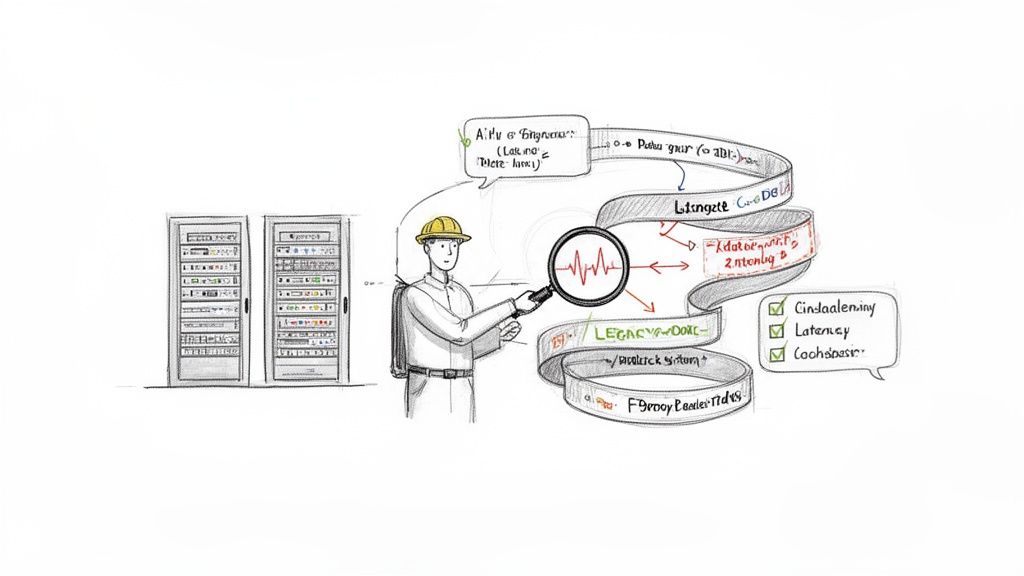
1. Tell me about a time you had to debug a complex production issue in a system you didn't build
This question tests a candidate's problem-solving methodology and composure under pressure. It gauges their ability to take ownership of an unknown system, systematically diagnose a critical failure, and drive it to resolution while communicating effectively. For AI-focused roles, this is especially potent—think debugging a model's inference latency spike or a silent failure in a distributed data pipeline.
What Interviewers Are Looking For
- Systematic Approach: Do they follow a logical process (e.g., check logs, review recent deploys, isolate variables) or panic and guess?
- Tool Proficiency: Do they mention specific observability tools like DataDog, New Relic, Grafana, or distributed tracing systems like Jaeger?
- Collaboration: Did they communicate findings in a shared Slack channel, create a war room document, or escalate effectively to another team?
- Post-Mortem Mindset: Did they just fix the issue, or did they document the root cause and implement changes to prevent recurrence?
Practical Example: Strong vs. Weak Answer
- Weak Answer: "Yeah, there was a bug once where the site was slow. I looked at the code and found a bad query and fixed it. It was faster after that."
- Strong Answer (STAR Method): "(S) The P99 latency for our model serving endpoint spiked by 400%, violating our SLA. (T) My task was to identify the root cause without rolling back a critical feature. (A) I started by analyzing our DataDog dashboards, correlated the spike with a recent config change, and collaborated with the platform team to confirm a resource contention issue. (R) The result was a 5-minute fix that restored performance, and I added a new validation step to our CI/CD pipeline to prevent this class of error, saving an estimated 2-3 hours of engineering time per month."
2. Describe a situation where you disagreed with a product or technical decision. How did you handle it?
This behavioural interview question for software engineers probes a candidate's ability to navigate conflict and influence stakeholders. It reveals maturity and communication skills. For AI roles, this is common: pushing back on a request to ship a model with fairness issues or advocating for expensive GPU observability tooling. The core test is using data to challenge a decision and committing to the outcome.
What Interviewers Are Looking For
- Data-Driven Argumentation: Did they present their case with metrics, performance benchmarks, or cost projections?
- Professionalism and Respect: Was their tone collaborative and focused on the shared goal, or adversarial?
- Stakeholder Management: Do they demonstrate an understanding of the other person's perspective (e.g., the product manager's deadline)?
- Commitment to Outcome: Can they "disagree and commit?" Did they fully support the final decision?
Practical Example: Strong vs. Weak Answer
- Weak Answer: "The product manager wanted to do something stupid, so I told my boss it was a bad idea. They eventually listened to me."
- Strong Answer (STAR Method): "(S) The product team wanted to use a new, proprietary MLOps vendor that would create lock-in. (T) My task was to evaluate this and present the technical trade-offs. (A) I built a proof-of-concept with both the vendor's tool and an open-source alternative, benchmarking performance and long-term maintenance costs. I presented my findings to the engineering lead and PM. (R) We compromised by using the vendor for a non-critical pipeline as a pilot, which de-risked the decision and improved our cross-functional team building process."
3. Tell me about a time you had to learn a new technology or framework quickly to meet a deadline
Modern software engineering is defined by rapid technological evolution. This question assesses a candidate's adaptability and learning velocity. For AI engineers, this is a daily reality, from using a new vector database for a Retrieval-Augmented Generation (RAG) system to mastering a distributed training framework. It identifies engineers who thrive in fast-paced environments.

What Interviewers Are Looking For
- Learning Process: Do they have a structured method? Do they start with official docs, build a small proof-of-concept, or seek out internal experts?
- Resourcefulness: How did they unblock themselves when stuck? Did they use documentation, community forums, or pair programming?
- Pragmatism: Did they aim for perfect mastery or just enough knowledge to deliver the feature robustly? This shows an understanding of trade-offs.
- Business Impact: Did their quick learning directly enable a project to hit a critical deadline or unblock the team?
Practical Example: Strong vs. Weak Answer
- Weak Answer: "I had to learn React for a project. I watched some tutorials and figured it out."
- Strong Answer (STAR Method): "(S) We had a one-week deadline to build a new LLM-powered microservice. (T) I was tasked with building the API layer, which required learning FastAPI. (A) I time-boxed the first day for focused learning on the official docs and building a prototype. I got feedback from a senior engineer, then implemented the core logic. (R) The service was deployed on time, now serves 100 requests per second, and unblocked the front-end team two days ahead of schedule."
4. Tell me about a time you had to work with a difficult team member or stakeholder
This question probes emotional intelligence and conflict resolution. In cross-functional AI teams, technical brilliance is not enough. This prompt reveals if you can navigate professional disagreements and manage expectations with non-technical partners. Your ability to handle these situations with empathy is a key indicator of maturity.
What Interviewers Are Looking For
- Emotional Maturity: Do they describe the situation with blame, or demonstrate empathy for the other person's perspective?
- Problem-Solving, Not Drama: Is the story focused on the conflict itself, or the process used to de-escalate it and find a productive path forward?
- Ownership: Can they admit where they might have been wrong or what they could have done better?
- Communication Skills: Did they know when to suggest a quick call to resolve ambiguity? This is one of the core skills required for a software engineer.
Actionable Tips for Answering
- Focus on Resolution: The story isn't about how "difficult" the person was; it's about how you successfully navigated the situation.
- Use the STAR Method: Structure your answer clearly. (S) "A product manager and I had a significant disagreement on the scope of an MVP for a new recommendation engine." (T) "My task was to align our expectations without delaying the launch." (A) "I scheduled a 1-on-1, listened to their user-facing concerns, then shared data on model training times that made their initial scope unfeasible. I proposed a phased approach..." (R) "We agreed on a smaller, faster MVP, and the trust we built made future planning much smoother."
- Show What You Learned: Conclude by mentioning your takeaway, like "I learned to proactively share technical constraints early in the planning process."
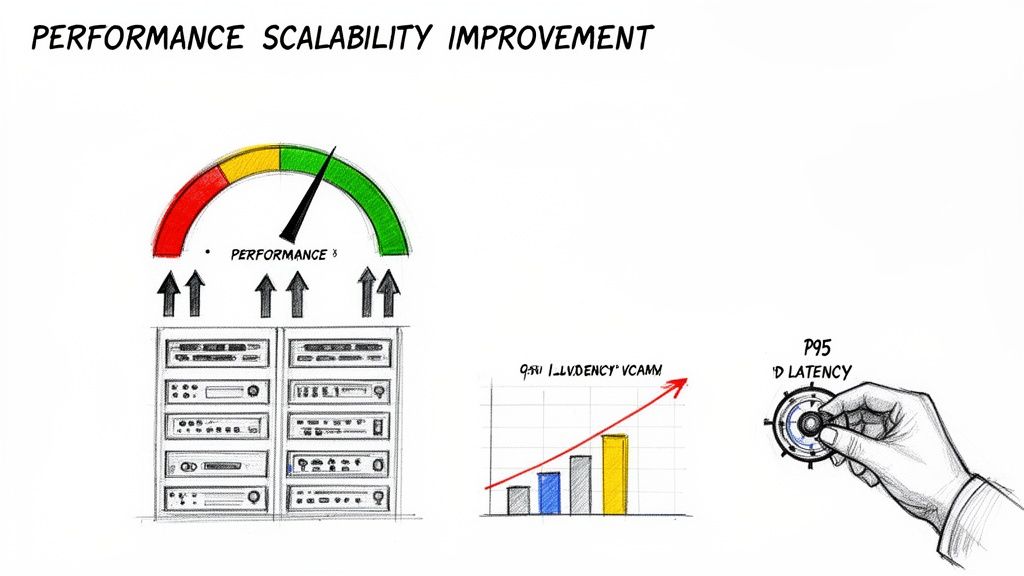
5. Describe a project where you significantly improved performance, scalability, or user experience. What was your approach?
This question probes your impact and business acumen. Companies want engineers who connect technical implementation to business value. For AI roles, performance is a core requirement that impacts feasibility and cost. A model with high inference latency feels broken, while an inefficient data pipeline can burn through a cloud budget in days.
What Interviewers Are Looking For
- Impact Orientation: Do you lead with the business outcome (e.g., "reduced p95 latency by 300ms") or get lost in jargon?
- Profiling Methodology: Can you articulate how you identified the bottleneck? Did you use tools like a profiler or observability dashboards (DataDog, Grafana)?
- Problem Decomposition: Did you break the problem down logically, form a hypothesis, and test it?
- Quantifiable Results: Can you provide specific numbers? "I reduced inference latency from 2 seconds to 450ms" is strong.
Actionable Tips for Answering
- Lead with Metrics: Start your story with the measurable "before" and "after" to grab the interviewer's attention.
- Explain Your Process: Detail your investigation and how you used profiling tools to form a hypothesis.
- Use the STAR Method: (S) Our image processing API had a p99 latency of 5 seconds, causing timeouts for 15% of users. (T) My goal was to get latency under 800ms. (A) I used a profiler, found a specific image resizing library was the bottleneck, benchmarked two alternatives, and implemented the winner. (R) This reduced p99 latency to 650ms and cut the API error rate by 90%, directly improving user retention by 2%.
- Highlight the Scale: Contextualize your impact by mentioning the number of users affected or cost savings achieved.
6. Tell me about a time you failed or made a significant mistake at work. What did you learn?
This question probes accountability, resilience, and growth. Interviewers want to see if you can own a mistake, analyze its root cause without blame, and implement changes to prevent it from happening again. This reveals professional maturity. In AI, failures are probable, so demonstrating a robust process for learning from them is non-negotiable.
What Interviewers Are Looking For
- Ownership: Do you take direct responsibility ("I made a mistake") or deflect blame?
- Impact Assessment: Can you clearly articulate the business impact of your error, such as downtime or data loss?
- Systematic Learning: What specific process changes, new tests, or documentation did you create as a direct result?
- Resilience: How did you handle the pressure and communicate the failure?
Actionable Tips for Answering
- Choose a Real Mistake: Pick a failure with tangible consequences, like deploying untested code that caused a partial outage.
- Frame it with STAR(L): Use Situation, Task, Action, Result, and add "L" for Learning. (S) Our ML model's predictions degraded silently. (T) I needed to find out why. (A) I discovered I missed a key data preprocessing step. I corrected the pipeline. (R) Performance was restored. (L) I learned the criticality of end-to-end validation, so I implemented a new automated data validation stage in our CI/CD pipeline that now runs before any model deployment.
- Emphasize Process Improvement: The best answers conclude with how you made the system better, ensuring the same mistake couldn't be easily repeated.
7. Describe a time you had to make a technical decision with incomplete information and under time pressure. How did you approach it?
This question probes judgment and risk management. It reveals your ability to balance speed with calculated risk. For AI roles, this is a daily reality. An ML engineer might have to choose a model architecture without definitive A/B test data. This question shows whether you can ship value with 80% of the information.
What Interviewers Are Looking For
- Decision-Making Framework: Did you identify knowns and unknowns? Did you define decision criteria and timebox the analysis?
- Risk Mitigation: How did you de-risk the decision? Did you build a small Proof of Concept (PoC), add feature flags, or create a rollback plan?
- Collaboration: Did you seek input from senior engineers or domain experts to fill information gaps?
- Learning: What did you learn from the outcome, and how would that inform your process next time?
Actionable Tips for Answering
- Choose a High-Stakes Example: Pick a scenario where the outcome had real consequences.
- Use the STAR Method: (S) "We needed to select a new database for our user profile service before a major feature launch, with only two days for evaluation." (T) "My task was to recommend a solution that could handle the projected load." (A) "I focused on vendor docs, ran a 1-hour load test, and consulted the principal engineer. I chose Option A because its operational model was simpler, reducing unknown risks." (R) "The database performed well at launch. I also created a lightweight evaluation template for future time-sensitive decisions."
- Quantify the Uncertainty: Clearly state what you didn't know and why you couldn't find out in time.
8. Tell me about a time you mentored, onboarded, or helped someone else grow. What was the impact?
This question probes your ability to act as a "force multiplier," elevating the entire team. For senior and staff roles, this is a non-negotiable skill. In high-growth AI startups, scaling the team's collective skill set is critical. Interviewers want evidence that you actively invest in others, which directly contributes to team velocity.
What Interviewers Are Looking For
- Leadership and Generosity: Do you proactively share your expertise?
- Empathy and Adaptability: Can you tailor your communication style to the mentee's learning preferences?
- Scaling Impact: Do you create durable resources (documentation, templates, workshops) that benefit the entire team?
- Measurable Results: What was the concrete outcome? Did the mentee get promoted or take ownership of a new service?
Actionable Tips for Answering
- Choose a Specific Story: Instead of saying "I often mentor juniors," pick one impactful instance.
- Use the STAR Method: (S) "A junior engineer on my team was struggling with our CI/CD pipeline for ML models." (T) "My goal was to help them become self-sufficient." (A) "I scheduled weekly pairing sessions, co-wrote a runbook for common deployment failures, and helped them present their first successful production release." (R) "Within two months, they were onboarding new hires to the process, and I was able to delegate all deployment responsibilities for our service to them."
- Show Humility: Mention something you learned in return. This demonstrates a growth mindset.
9. Describe a situation where you had to balance technical excellence with shipping quickly. What trade-offs did you make?
This question cuts to the core of engineering pragmatism. It assesses your judgment and ability to make deliberate trade-offs that serve the business without creating unmanageable long-term problems. For AI engineers, this is a daily reality. Do you ship a model with 95% accuracy now or spend another quarter aiming for 99%?
What Interviewers Are Looking For
- Pragmatism: Do you understand that "perfect" is often the enemy of "done"?
- Deliberate Decision-Making: Can you articulate why speed was essential and which specific trade-offs you made (e.g., less test coverage, minimal documentation)?
- Risk Management: How did you mitigate the risks? Did you add extra monitoring or create follow-up tickets for technical debt?
- Business Acumen: Do you connect technical decisions to business outcomes, like hitting a launch date or validating a hypothesis?
Actionable Tips for Answering
- Choose a Real Example: Be specific about what you sacrificed.
- Use the STAR Method: (S) We had a hard deadline to launch a new feature before a major industry conference. (T) My task was to deliver the backend service on time. (A) I proposed we ship without comprehensive end-to-end tests for certain edge cases and instead rely on robust unit tests and logging. I created high-priority tickets to add that test coverage in the following sprint. (R) We launched successfully, the feature drove 50+ enterprise leads at the conference, and we paid down the tech debt two weeks later.
- Frame it as Risk Mitigation: Show that you made an informed decision, understood the potential downsides, and had a plan to address them post-launch.
10. Tell me about a time you worked on an ambiguous or ill-defined problem. How did you approach it?
This question separates candidates who can create structure from chaos from those who get paralyzed without precise instructions. For AI engineers, this is the norm. A product manager might ask you to "make our LLM responses more helpful." Your response demonstrates whether you can translate a vague business goal into a concrete technical strategy.

What Interviewers Are Looking For
- Problem Decomposition: Can you break down a fuzzy concept into smaller, testable components?
- Proactive Clarification: Do you ask targeted questions and engage stakeholders to build a shared understanding?
- Metric-Driven Approach: How do you define and measure success? Do you propose specific metrics to make the ambiguous objective concrete?
- Iterative Mindset: Do you start with small experiments or a minimal viable product (MVP) to validate assumptions?
Actionable Tips for Answering
- Structure with STAR: (S) Leadership wanted to improve our chatbot's helpfulness. (T) My task was to define 'helpfulness' and ship an improvement. (A) I started by interviewing support agents, then proposed a rubric with metrics like 'Factual Accuracy' and 'Completeness.' I ran an A/B test with a new prompt strategy. (R) This resulted in a 15% lift in our primary helpfulness score and a clear roadmap for future iterations.
- Show, Don't Just Tell: Instead of saying "I clarified requirements," describe the exact actions you took, like creating a one-page design doc.
- Document and Align: Emphasize how you created a shared document to track assumptions, decisions, and results to show maturity and strong communication.
Deep Dive: Trade-offs and Pitfalls
Simply asking these questions is not enough. The biggest pitfall is inconsistent evaluation. Without a framework, one interviewer's "strong hire" is another's "no hire" based on gut feeling.
Key Trade-offs:
- Speed vs. Rigor: A 45-minute behavioural screen can't cover all 10 questions. Prioritize the 3-4 competencies most critical for the specific role. For a senior platform engineer, debugging and technical decision-making are key. For a product-focused engineer, ambiguity and stakeholder management are paramount.
- STAR Method vs. Conversation: While the STAR method provides structure, a rigid adherence can feel robotic. Good interviewers use it as a mental checklist while fostering a natural conversation, probing deeper with follow-up questions like "What would you do differently next time?" or "What was the hardest part about that?"
Common Pitfalls to Avoid:
- Accepting Hypothetical Answers: If a candidate says "I would probably...", gently steer them back with "Can you tell me about a time you actually did that?"
- Leading the Witness: Don't ask "Tell me about a time you were a great team player." Instead, use the situational prompt: "Tell me about a time you disagreed with a teammate."
- Ignoring Red Flags: A candidate who repeatedly blames others, shows no evidence of learning from mistakes, or cannot quantify their impact is a significant risk, regardless of their technical prowess.
Checklist: Interview Scorecard Template
Use this template to create a standardized scorecard for your hiring process. This ensures every interviewer evaluates candidates against the same objective criteria, minimizing bias.
What to Do Next
- Select 3-5 Questions: Choose the competencies most critical for your open role and build a standardized scorecard using the template above.
- Run a Calibration Session: Before interviewing, gather the hiring panel for 30 minutes. Review the scorecard and align on what a "great" answer looks like for a key question. This drastically reduces bias.
- Review and Iterate: After each hiring round, review your data. Are your new hires demonstrating the competencies you selected for? Treat your hiring process like a product: measure and improve. For more insights into how top candidates prepare, see this guide on how to prepare for a job interview.
References
- Effective Behavioral Interview Questions and Answers - AIApply
- Cross-Functional Team Building - ThirstySprout
- Skills Required for a Software Engineer - ThirstySprout
Ready to skip the sourcing and screening grind? ThirstySprout connects you with a pre-vetted network of senior AI, ML, and MLOps engineers who have already demonstrated these critical behaviors in demanding, remote environments.
[Start a Pilot] [See Sample Profiles]
Hire from the Top 1% Talent Network
Ready to accelerate your hiring or scale your company with our top-tier technical talent? Let's chat.