

An IT staff augmentation company is your fastest route to embedding specialized tech talent directly into your team, bypassing the grueling 2–4 month slog of traditional hiring. You tap into this model when you need a specific skill for a well-defined project—like an MLOps engineer for a new AI feature—without adding a permanent headcount. The primary business impacts are speed, access to a global talent pool, and significant cost control.
TL;DR: Key Insights and Actions
- For Urgent Skill Gaps: Use staff augmentation when a project requires a specialist (e.g., a data engineer for a 3-month integration) and you cannot afford to wait for a traditional hire.
- To De-Risk New Roles: Pilot a new role like an AI Product Manager for a 6-month contract to validate responsibilities and business impact before committing to a full-time hire.
- For Budget Control: Access global talent pools to manage project costs, especially for roles with high local salaries, converting a fixed capital expense into a flexible operational one.
- Key Action: Start by identifying one critical, short-term project (3-6 months) that is currently blocked by a skills gap. Use this as a pilot to test an IT staff augmentation company.
Who This Guide Is For
This guide is for CTOs, Heads of Engineering, and Talent Ops leaders who need to add technical capabilities to their teams within weeks, not months. It provides a practical framework for deciding when to use staff augmentation, how to select a partner, and how to mitigate common risks.
A Quick Framework for Deciding on Staff Augmentation
The core concept is simple: you integrate external experts into your existing team. They report to your managers and work on your projects just like any other employee, but you skip the administrative overhead of payroll, benefits, and recruitment.
This decision tree helps visualize when staff augmentation is the right strategic move.
Alt Text: Infographic decision tree showing when to choose staff augmentation for temporary project needs versus permanent roles.
Staff augmentation shines when you have temporary or project-based skill gaps where speed and flexibility are non-negotiable.
What Is an IT Staff Augmentation Company?

Alt Text: An IT professional working at a desk, illustrating the concept of integrating augmented staff into a team.
An IT staff augmentation company is a strategic partner providing on-demand access to a roster of pre-vetted tech experts. It's like having a deep bench of specialists—from senior AI engineers to cloud security gurus—ready to join your team and contribute from day one.
This isn't project outsourcing, where you hand off control. Instead, you're embedding a new team member. They report to your managers, join your daily stand-ups, and operate within your existing workflow. It's a model designed for seamless integration and direct oversight, adding specific capabilities, not just headcount.
How the Business Model Works
An IT staff augmentation company invests in building and maintaining a global talent pool. Their business revolves around finding, rigorously screening, and managing tech professionals.
When you partner with one, you plug into their recruitment engine:
- Define the Need: You outline the role, required skills (e.g., Python, PyTorch, Kubernetes), and engagement duration.
- Receive Vetted Candidates: The firm provides a shortlist of qualified professionals, often within 2-4 business days.
- Interview and Select: You conduct final interviews to ensure a technical and cultural fit.
- Onboard and Integrate: The new team member joins your crew while the augmentation company handles all backend HR, payroll, and compliance.
The Strategic Value: Flexibility and Speed
The real power of this model is its flexibility. Market projections show company spend on these services reaching $81.87 billion in 2025 and an expected $857.2 billion by 2032, signaling a major shift in how businesses build technical teams. You can learn more about IT staff augmentation market trends to see the data.
Staff augmentation provides a flexible layer to your workforce. It allows you to scale capabilities up or down with project demands, turning a fixed staffing cost into a variable operational expense.
Practical Examples of Staff Augmentation
Seeing the model in action clarifies its business impact. Here are two real-world scenarios where an IT staff augmentation company delivered measurable results.
Example 1: Fintech Accelerates AI Fraud Detection Launch
Situation: A venture-backed fintech's in-house team lacked the niche Machine Learning (ML) skills to optimize their new fraud detection model. The product launch faced a three-month delay.
Action: Instead of a lengthy search for two senior ML engineers, they partnered with an augmentation firm.
- Week 1: The fintech defined the need: Python and TensorFlow experts with experience in real-time transactional data. The partner submitted four pre-vetted candidates.
- Week 2: The CTO interviewed and selected two senior ML engineers who were onboarded into the team's agile workflow.
- Business Impact: The augmented engineers optimized the model, cutting false positives by 18%. The project got back on schedule, launching on time and beating competitors to market by a full quarter. The primary value was not filling a seat, but saving three months on a critical product roadmap.
Example 2: E-commerce Slashes Cloud Spend with a FinOps Expert
Situation: An e-commerce platform's monthly cloud bill was spiraling out of control. Their DevOps team was too stretched with daily operations to address it.
Action: They engaged a senior FinOps (Financial Operations) expert through an augmentation partner on a focused, 3-month contract to find and eliminate waste.
- Process: The expert analyzed cloud usage, identified underutilized resources, optimized instance reservations, and implemented automated shutdown scripts for non-production environments.
- Business Impact: Within 90 days, the company achieved a sustained 25% reduction in its monthly cloud bill, delivering a direct ROI that saved hundreds of thousands of dollars annually.
This surgical expertise is also why IT staff augmentation is effective for specialized projects like implementing complex API integration platforms.
How to Select the Right Staff Augmentation Partner
Alt Text: A professional conducting a vendor evaluation, representing the process of selecting an IT staff augmentation partner.
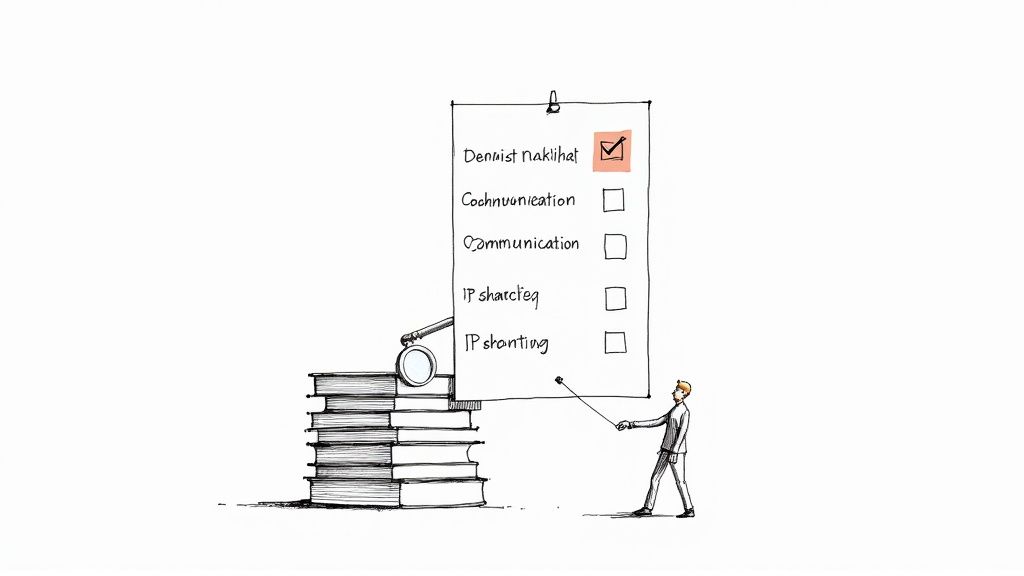
Choosing the right partner is the most critical decision. A great partner delivers high-impact talent seamlessly; a poor one creates delays and risk. This framework helps you evaluate partners on capabilities, not just their sales pitch.
A 3-Step Vendor Evaluation Checklist
Use this checklist to ensure you select a partner that can deliver quality talent reliably.
Step 1: Scrutinize Their Vetting Process
The quality of a partner's talent depends entirely on the rigor of their vetting. Dig past marketing claims like "top 3% of talent."
- Technical Depth: Do they conduct live coding and systems design interviews? Are take-home projects relevant to real-world work?
- Soft Skills Assessment: How do they evaluate communication, collaboration, and problem-solving skills under pressure?
- Verification: What is their process for conducting background and reference checks?
If a partner’s screening process isn't significantly more robust than your own, you're paying a premium for a recruiting service.
Step 2: Ask Tough Operational Questions
Assess their operational backbone. How do they handle challenges? Use these questions in your Request for Proposal (RFP).
- Look for: A clear, time-bound plan to minimize disruption.
- Look for: Proactive steps like mandatory documentation, exit interviews, and planned overlap periods.
- Look for: A structured escalation path with a dedicated account manager.
- Look for: Concrete details on NDAs, IP assignment clauses, and background checks.
- Look for: A commitment to regular check-ins and performance monitoring.
- Time and Materials (T&M): The most common model. You pay a set hourly, daily, or monthly rate. It's ideal for agile projects where requirements may change. You only pay for what you use.
- Fixed-Price: You agree on a single cost for a project with a clearly defined scope. This model offers budget predictability but is inflexible. Best for projects like a security audit or a simple website migration.
- Dedicated Team: A long-term partnership where you build a complete team that works exclusively for you. This is a great fit for complex, long-running initiatives where you need to build deep institutional knowledge. For a full comparison, see our guide on IT development outsourcing.
- Mitigation: Onboard them like permanent hires. Assign a team "buddy," grant full system access on day one, and include them in all team meetings and rituals. Full integration drives full contribution.
- Mitigation: Make knowledge transfer a core deliverable. Mandate clear documentation for all work. Use paired programming sessions to transfer skills organically. Schedule a structured 1-2 week offboarding period for a formal handoff.
- Mitigation: Over-communicate deliberately. Establish 3-4 hours of daily "golden hour" overlap for real-time collaboration. Use tools with purpose (Jira for tasks, Slack for quick chats). Master asynchronous communication by providing full context in written updates.
- Identify a Pilot Project: Select one critical, short-term project (3-6 months) currently blocked by a skills gap.
- Define the Role: Create a concise job description focusing on the 3-5 essential skills and the key business outcome you need.
- Evaluate Two Partners: Use the scorecard and questions in this guide to assess two potential IT staff augmentation companies.
- IT Staff Augmentation Best Practices, Codewave.
- IT Development Outsourcing: A Complete Guide, ThirstySprout.
- Nearshore vs. Offshore Outsourcing, ThirstySprout.
- Due Diligence Checklist Template, Fundera.
Using a robust due diligence checklist template can also help ensure you cover all critical areas.
Step 3: Use a Vendor Evaluation Scorecard
A scorecard brings objectivity to the decision, helping you weigh partners against your specific criteria. It grounds the decision in data, not just a gut feeling from a sales call.
This methodical comparison helps you focus on the operational details that predict long-term success.
Deep Dive: Trade-offs, Pricing, and Pitfalls
Staff augmentation offers incredible flexibility, but it’s crucial to understand the trade-offs and common risks before you commit.
Pricing and Engagement Models
The model you choose directly impacts your budget and project flexibility.
Common Risks and How to Mitigate Them
Knowing the common pitfalls allows you to implement simple guardrails for a successful partnership.
Risk 1: The "Us vs. Them" Culture
Treating augmented staff like outsiders kills morale and productivity. They lack the context to make good decisions.
Risk 2: Knowledge Drain on Exit
When a contract ends, valuable knowledge about your systems can walk out the door, creating a dangerous dependency.
Risk 3: Communication Gaps Across Time Zones
Different time zones and cultures can create friction and delays. This is a classic challenge discussed in our guide on nearshore vs offshore outsourcing models.
What to Do Next
Ready to scale your team with top-tier AI and engineering talent? ThirstySprout connects you with pre-vetted experts who can integrate with your team in days, not months. Start a Pilot and see the difference.
References and Further Reading
Hire from the Top 1% Talent Network
Ready to accelerate your hiring or scale your company with our top-tier technical talent? Let's chat.